Executive Class 11 Political Science
| Table of contents |

|
| What is An Executive? |
|
| Parliamentary Executive in India |
|
| Prime Minister and Council of Ministers |
|
| Permanent Executive: Bureaucracy |
|

What is An Executive?
The organ of government that primarily looks after the function of implementation and administration is called the executive.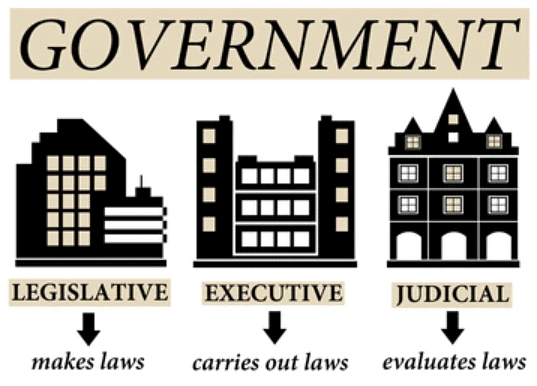
What are the principal functions of the Executive?
- An executive is the branch of government responsible for the implementation of laws and policies adopted by the legislature.
- The executive is often involved in the framing of policy. Some countries have presidents, while others have chancellors. The executive branch is not just about presidents, prime ministers and ministers. It also extends to the administrative machinery (civil servants).
Different Types of Executive
There are various types of political systems in which different executives command different political sectors:- Presidential system: The president is the Head of the state as well as the head of government. In this system, the office of the president is very powerful, both in theory and practice.
Countries: United States, Brazil and most nations in Latin America. - Semi-Presidential Executive: Under the system of Executive Presidency, people directly elect the President. It may happen that both the President and the Prime Minister belong to the same political party or to different political parties.
Countries: France, Russia, Sri Lanka - Parliamentary System: The prime minister is the head of government. Most parliamentary systems have a president or a monarch who is the nominal Head of state. The role of the president or monarch is primarily ceremonial and the prime minister along with the cabinet wields effective power.
Countries: Germany, Italy, Japan, United Kingdom as well as Portugal.
Parliamentary Executive in India
India already had some experience running the parliamentary system under the Acts of 1919 and 1935. This experience had shown that in the parliamentary system, the executive can be effectively controlled by the representatives of the people.
Why did India opt for the Parliamentary Form of government?
- Indian Constitution wanted to ensure that the government would be sensitive to public expectations and would be responsible and accountable.
- The presidential executive puts much emphasis on the president as the chief executive and as a source of all executive power.
- There is always the danger of personality cult in the presidential executive. The executive will be answerable to and controlled by the legislature or people‘s representatives.
What is the Parliamentary Form of System?
President who is the formal Head of the state of India and the Prime Minister and the Council of Ministers, which run the government at the national level. At the State level, the executive comprises the Governor and the Chief Minister and the Council of Ministers.
The President
- The highest executive authority.
- The constitution vests in him all executive powers of the Union.
- Head of the state and represents the Republic of India.
- The first Citizen of India.
Article 58: deals with the qualification of a person to be the president of India.
- Must be a citizen of India
- Completed the age of 35 years
- Must be qualified to become a member of Lok Sabha
- He should not hold any office of profit under the government.
What is the Procedure of the Election of the President?
The President of India is not directly elected by the people, but by the members of the Electoral College:
- Members of both the houses of the parliament
- Members of the legislative assembly of the state
- Elected member of the Legislative Assembly of Delhi and Puducherry.
What are the Powers and the Function of the President?
The President of India has a very important role in our democracy. The power of president can be exercised in normal time and in the period of emergency.
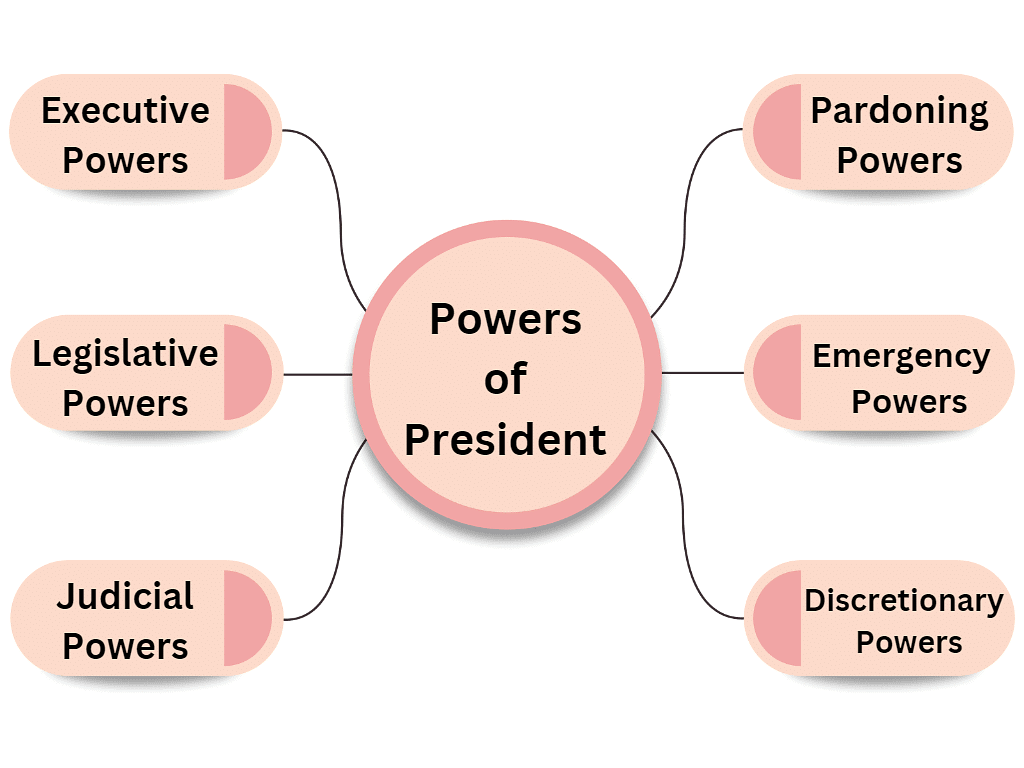
A. Executive Powers of the President
Following members are appointed by the President:
- The Prime Minister and other councils of ministers.
- Chief Justice & Judges of Supreme Court and High Court
- Chairman & members of UPSC
- CAG, Attorney General
- Chief Election Commissioner etc.
B. Legislative Powers of the President
- The president can summon propagation & dissolution of Lok Sabha.
- Summon Joint Sitting of both the houses of the Parliament
- The president can also pass ordinances during the recess of Parliament.
C. Judicial Powers of the President
- In Article 72 the judicial powers of the president preside.
- The president can grant a pardon or reduce the sentence of any convicted person under central laws.
D. Pardoning Powers of the President
They are of five types:
- Pardon
- Reprieve
- Remit
- Respite
- Commute
The president is also the Supreme Commander of the Armed Forces
E. Emergency Powers of the President
- National Emergency ( Article 352): Arising out of war, external aggression or armed rebellion within the country
- Constitutional Emergency (Article 356): In case of failure of the constitutional machinery in the states. (President’s Rule)
- Financial Emergency (Article 360): Arise in case of a threat to the financial stability or credit of India.
- Article 74 (1): There shall be a Council of Ministers with the Prime Minister at the head to aid and advise the President who shall exercise the functions, act following such advice.
- The President may require the Council of Ministers to reconsider such advice, and the president shall act by the advice tendered after such reconsideration.
F. Discretionary Powers of the President
- The President has a right to be informed of all important matters and deliberations of the Council of Ministers. The Prime Minister is obliged to furnish all the information that the President may call for. The President often writes to the Prime Minister and expresses his views on matters confronting the country.
- The Powers that the president can exercise at his own discretion:
- Reconsideration
- Veto Power
- Appointment of the Prime Minister in case of no clear majority.
- The President has the authority to request that the Council reconsider their decision. He has the veto power to withhold or refuse to give assent to bills passed by Parliament (other than money bills).
- Before becoming law, every bill passed by Parliament is sent to the President for his signature. The President has the authority to send the bill back to Parliament for reconsideration.
- This'veto power' is limited because if Parliament passes the same bill again and sends it back to the President, the President is required to give his assent to it. The President must, however, send the bill back to Congress for reconsideration within a certain time frame, which is not specified in the Constitution.
- This means that the President can keep the bill pending in his office indefinitely. This gives the President an unofficial power to wield the veto effectively. This is referred to as a "pocket veto" by some.
- When no candidate wins a clear majority in the Lok Sabha after an election, the President must choose a Prime Minister. In such a situation, the President must rely on his own judgement to determine who has the majority's support or who can actually form and run the government.
The Vice President of India
- The person holding this position is elected for a term of five years using a method similar to that used to elect the President. However, unlike the President's election, members of State legislatures are not involved in the process.
- The individual can be removed from their position by a majority resolution passed by the Rajya Sabha, which must also be agreed to by the Lok Sabha.
- As the ex-officio Chairman of the Rajya Sabha, the person assumes the duties of the President when there is a vacancy in the position due to death, resignation, removal by impeachment, or any other reason. However, they only serve as President until a new one is elected.
Prime Minister and Council of Ministers
- The Prime Minister becomes the most important functionary of the government in our country.
- Head of the Council of Ministers.
- The President exercises his powers only on the advice of the Council of Ministers.
- In the parliamentary form of executive, it is essential that the Prime Minister has the support of the majority in the Lok Sabha. This support by the majority also makes the Prime Minister very powerful.
- Decides who will be the ministers in the Council of Ministers.
- Allocates ranks and portfolios to the ministers.
- Depending upon the seniority and political importance, the ministers are given the ranks of cabinet minister, minister of State or deputy minister.
- In the same manner, Chief Ministers of the States choose ministers from their own party or coalition.
- The Prime Minister and all the ministers have to be members of the Parliament.
- If someone becomes a minister or Prime Minister without being an MP, such a person has to get elected to the Parliament within six months.
Size of the Council of Ministers
- An amendment has been made which states that the Council of Ministers must not exceed 15% of the total number of members in the House of People (or Assembly for States).
- The Council of Ministers is collectively responsible to the Lok Sabha, meaning that if they lose the confidence of the Lok Sabha, they must resign.
- The ministry is seen as an executive committee of the Parliament and governs collectively on its behalf.
Collective responsibility
- The principle of collective responsibility is based on the solidarity of the cabinet, meaning that if a single minister receives a vote of no confidence, the entire Council of Ministers must resign.
- Ministers must either accept decisions made by the cabinet or resign if they do not agree. Pursuing or agreeing to a policy for which there is collective responsibility is binding on all ministers.
- The death or resignation of the Prime Minister results in the dissolution of the Council of Ministers, while the demise, dismissal or resignation of a minister only creates a ministerial vacancy.
- The Prime Minister acts as a link between the Council of Ministers, the President, and the Parliament.
- The Prime Minister holds power from various sources, including control over the Council of Ministers, leadership of the Lok Sabha, access to the bureaucratic machine, media, and projection of personality during elections and international summits.
At the State level
- At the State level, a similar parliamentary system exists with some variations.
- The Governor of the State, appointed by the President on the advice of the central government, has more discretionary powers compared to the Chief Minister, who is the leader of the majority party in the Assembly.
- The main principles of the parliamentary system operate at the State level.
Permanent Executive: Bureaucracy
- The Executive branch of the government is composed of the Prime Minister, ministers, and the bureaucracy, which is a large administrative organization.
- In a democracy, elected representatives and ministers are responsible for governing and supervising the administration. The legislature also has the power to oversee the administration and ensure that administrative officers do not act in violation of the policies adopted by the legislature. It is the responsibility of the ministers to maintain political control over the administration. India has established a professional administrative machinery.
- The Indian bureaucracy is made up of All-India services, State services, local government employees, and technical and managerial staff who run public sector undertakings. The recruitment of civil servants for the Indian government is conducted by the Union Public Service Commission, while similar public service commissions are available for the States. Members of the Public Service Commissions are appointed for a fixed term and can only be removed or suspended after a thorough inquiry made by a judge of the Supreme Court.
- The bureaucracy is the means through which welfare policies of the government are implemented and must reach the people. However, bureaucracy is often criticized for being insensitive to the demands and expectations of the ordinary citizen.
|
44 videos|373 docs|50 tests
|
FAQs on Executive Class 11 Political Science
| 1. What is the role of the Parliamentary Executive in India? |  |
| 2. Who is the head of the Parliamentary Executive in India? | |
| 3. What is the Permanent Executive in India? | |
| 4. How is the Permanent Executive different from the Parliamentary Executive? | |
| 5. What is the significance of the Permanent Executive in India? | |




Important questions
,Exam
,Sample Paper
,Free
,study material
,Semester Notes
,Executive Class 11 Political Science
,Viva Questions
,shortcuts and tricks
,ppt
,MCQs
,practice quizzes
,Executive Class 11 Political Science
,Summary
,Executive Class 11 Political Science
,mock tests for examination
,Extra Questions
,video lectures
,Objective type Questions
,Previous Year Questions with Solutions
,past year papers
;




Chapter Notes: Executive Free PDF Download
Importance of Chapter Notes: Executive
Chapter Notes: Executive
Chapter Notes: Executive Humanities/Arts Questions
Study Chapter Notes: Executive on the App
|
© EduRev
|
Education Revolution
|


|




