Legislature Class 11 Political Science


Why do we need a Parliament?
Why do we need a Parliament?
- The legislature is not merely a law-making body. It is the center of all democratic political processes. It is packed with action; walkouts, protests, demonstrations, unanimity, concern, and cooperation. Indeed, a genuine democracy is inconceivable without a representative, efficient and effective legislature.
- The legislature also helps people in holding the representatives accountable and is the very basis of representative democracy.
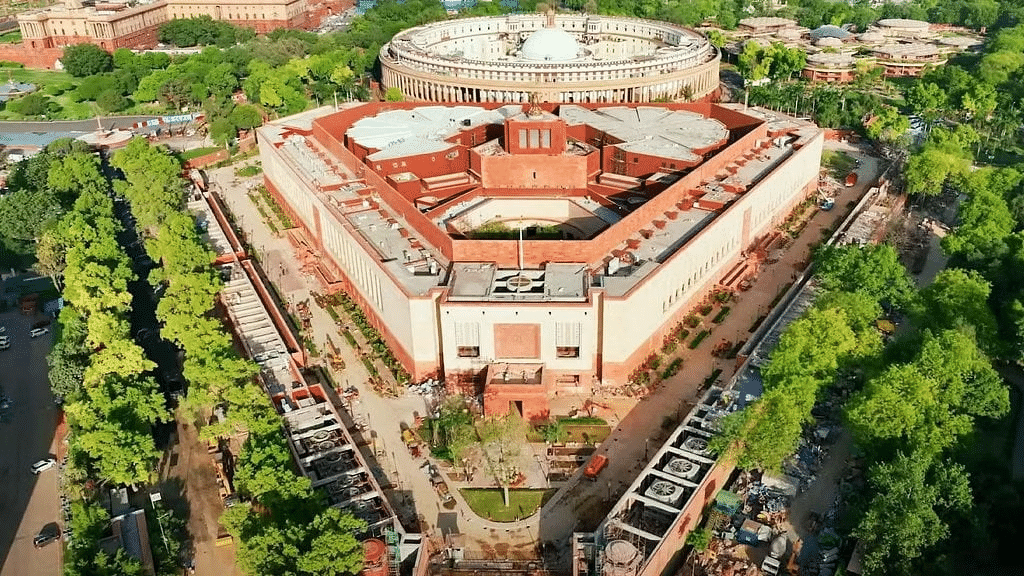 New Parliament Building of India
Why do we need two houses of Parliament?
The term Parliament refers to the national legislature. The legislature of the States is described as the State legislature. The Parliament in India has two houses. Though, it is called a bicameral legislature.The two houses of the Indian Parliament are:
- The Council of States / the Rajya Sabha
- The House of the People / the Lok Sabha
The Constitution has given the States the option of establishing either a unicameral or bicameral legislature.
States Having Bicameral legislature:
- Andhra Pradesh
- Telangana
- Bihar
- Karnataka
- Maharashtra
- Uttar Pradesh.
What are the advantages of the Bicameral Legislature?
- Countries with large size and much diversity usually prefer to have two houses of the national legislature to give representation to all sections in the society and to give representation to all geographical regions or parts of the country. A bicameral legislature makes it possible to have every decision reconsidered. Every decision taken by one house goes to the other house for its decision.
- This means that every bill and policy would be discussed twice. This ensures a double-check on every matter.
Rajya Sabha
Rajya Sabha represents the State of India, it is an indirectly elected body. Residents of the State elect members to the State Legislative Assembly. The elected members of the State Legislative Assembly in turn elect the members of Rajya Sabha.
What are the principles of representation?
Equal representation to all the parts of the country irrespective of their size or population is called symmetrical representation.Parts of the country may be given representation according to their population means that regions or parts having larger populations would have more representatives in the second chamber than regions having less population.
States with larger populations get more representatives than States with smaller populations: The following are some features associated with the Rajya Sabha.
- Members are elected for a term of six years
- Members can be re-elected.
- All members of the Rajya Sabha do not complete their terms at the same time.
- Every two years, one-third of members of the Rajya Sabha complete their term, and elections are held for those one-third seats only.
- The Rajya Sabha is never fully dissolved.
- It is called the ‘Permanent House of the Parliament.
- Rajya Sabha also has twelve nominated members.
- The members are nominated by the President.
Lok Sabha
- The Lok Sabha, or House of the People, is the Indian bicameral legislature's lower house. The people elect the Lok Sabha and the State Legislative Assemblies directly. The entire country (or state, in the case of the State Legislative Assembly) is divided into territorial constituencies of roughly equal populations for election purposes.
- One representative is elected from each constituency through universal adult suffrage, in which each individual's vote is worth the same. There are currently 543 constituencies.
What Functions does the parliament perform?
- Legislative Function: The Parliament enacts and approves legislation for the country. The main task of the parliament is to draft the bill, which is done by the bureaucracy under the supervision of the ministers.
- Substance: No major bill is introduced in Parliament without the Cabinet's approval, even the timing of the bill. Bills introduced by non-ministers have no chance of passing without the support of the government.
These debates are at the core of democratic decision-making. - Control of the Executive and ensuring its accountability: To ensure that the executive does not overstep its authority and remains responsible to the people who have elected them.
- Financial Function: In a democracy, the legislature controls taxation and government spending. Any new tax proposed by the Indian government must be approved by the Lok Sabha. Parliament's financial powers include funding the government's programs. The government must account to the legislature for funds spent and resources sought.
The legislature also checks government spending. The budget and annual financial statements do this. - Representation: Parliament represents the divergent views of members from different regional, social, economic, and religious groups of different parts of the country.
- Debating Function: The Parliament is the highest form of debate in the country it has no limitations on its powers of discussion and functions. The members are free to speak on any matter without fear or any restrictions. This makes it possible for the Parliament to analyze any or every issue that faces the nation.
- Constituent Function: The Parliament has the power to discuss and enact changes to the Constitution. The constituent powers of both houses are similar. All constitutional amendments have to be approved by a special majority of both Houses.
- Electoral functions: The Parliament also performs some electoral functions as it plays a major role in the election of the President and the Vice President of India.
- Judicial functions: The judicial functions of the Parliament include considering the proposals for the removal of:
- President
- Vice-President
- Judges of High Courts and Supreme Court.
Powers of The Lok Sabha
- The Lower House makes Lawson matters included in the Union List and Concurrent List. It can also hold the power to introduce and enact money and non-money bills.
- The Lok Sabha approves proposals for taxation, budgets, and annual financial statements and also controls the executive by asking questions, supplementary questions, resolutions, and motions through a no-confidence motion.
- One of the major powers of the House is to make constitutional amendments and approve the proclamation of emergency. It also elects the President and the Vice President and plays an important role in the removal of judges of the Supreme Court and High Court.
- The Lok Sabha establishes committees and commissions and considers their reports.
Powers of The Rajya Sabha
- Rajya Sabha Considers and approves non-money bills and suggests amendments to money bills. This House also plays an important role in the approval of the constitutional amendments. Rajya Sabha also exercises control over the executive by asking questions and introducing motions and resolutions. it also participates in the election and the removal of the President, Vice President & the judges of the Supreme Court and High Court.
- It can alone initiate the procedure for the removal of the Vice President and can give the Union parliament the power to make laws on matters included in the State list.
What are the special Powers of the Rajya Sabha?
- The Rajya Sabha is an institutional mechanism to provide representation to the States. Its purpose is to protect the powers of the States. Any matter that affects the States must be referred to it for its consent and approval.
- If the Union Parliament wishes to remove a matter from the State list (over which only the State Legislature can make law) to either the Union List or Concurrent List in the interest of the nation, the approval of the Rajya Sabha is necessary.
- This provision adds to the strength of the Rajya Sabha.
- The experience shows that the members of the Rajya Sabha represent their parties more than they represent their States.
How Does The Parliament Make Laws?
A bill is a draft of the proposed law, there can be different types of bills:
- Private Member’s Bill
- Government Bill
- When a non-minister proposes a bill, it is called a private member‘s Bill. A bill proposed by a minister is described as a Government Bill.
- The legislative procedure is identical in both the Houses of Parliament. Every bill has to pass through the same stages in each House.
- A bill is a proposal for legislation and it becomes an act or law when duly enacted.
Public Bill
- It is introduced in the Parliament by a minister.
- It reflects the policy of the government (Ruling Party). It has a greater chance to be approved by the parliament.
Private Bill
- It is introduced by any member of the parliament other than a minister.
- It reflects the stand of the opposition party on public matters.
- It has less chance of being approved by the parliament.
The bills introduced in the Parliament can also be classified into four categories:
- Ordinary bills: The Bills are concerned with any matter other than financial subjects.
- Money bills: The Bills are concerned with financial matters like taxation, public expenditure, etc.
- Financial bills: The Bills are concerned with financial matters (but are different from money bills).
- Constitution amendment bills: The bills which are concerned with the amendment of the provisions of the Constitution.
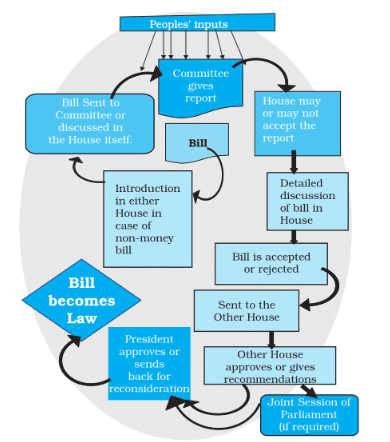
The Constitution has laid down separate procedures for the enactment of all four types of bills.
The procedures concerning ordinary bills, money bills, and financial bills are explained here.
Ordinary Bills
Stages in the First House: An ordinary bill goes through five stages: First Reading, Second Reading (general discussion), Committee Stage, Consideration Stage, and Third Reading.
Consideration in the Second House: The second House may:
- Pass the bill as is.
- Pass it with amendments, sending it back for reconsideration.
- Reject the bill.
- Keep the bill pending without action.
Deadlock Resolution: If disagreement persists for six months, it leads to a deadlock.
- Joint Session: The President can summon a joint sitting to resolve the deadlock. A majority vote passes the bill.
Money Bills
Definition (Article 110): A bill is a money bill if it addresses:- Tax-related provisions, government borrowing, fund withdrawals, or expenses from the Consolidated Fund of India.
Passage Process: If the second House approves without amendments or the first House accepts its amendments, the bill is considered passed and sent to the President.
President’s Approval
Options for the President:- Assent: The bill becomes law.
- Veto: The President may withhold assent (absolute veto), send it back for reconsideration, or use a Pocket Veto (indefinite delay).
Reconsidered Bills: If returned and passed again by both Houses, the President must assent or may use Pocket Veto.
How Does the Parliament Control the Executive?
The legislature in the parliamentary system ensures executive accountability at various stages: policy making, implementation of law or policy, and during and post-implementation stage.
Instruments of Parliamentary Control:
- Deliberation and discussion
- Approval or Refusal of laws
- Financial control
- No confidence motion
Deliberation and discussion
Legislative Oversight: Lawmakers review and critique the government's policy direction and implementation.
General Discussions: Besides bills, oversight occurs through general discussions, including Question Hour, Zero Hour, adjournment motions, etc.
- Question Hour: Ministers must answer direct questions from members on public issues, making it a key oversight tool. High attendance as members address issues like inflation, food availability, and social justice
Heated Exchanges: Discussions can be intense, with protests and walkouts, sometimes delaying legislative work.
Political Strategy: These actions serve as political tactics to press the government for concessions and accountability.
Approval and ratification of laws
- Parliamentary Ratification: For a bill to become law, it must receive parliamentary approval, reinforcing legislative control.
- Majority Support: A government with a disciplined majority often secures approval more easily, but this support isn’t always guaranteed.
- Negotiation and Bargaining: Approval frequently involves extensive negotiation within the ruling party, coalition members, and opposition parties.
- Bicameral Approval: If the government controls the Lok Sabha but lacks a majority in the Rajya Sabha, as seen with the Janata Party (1977) and NDA (2000), concessions are often necessary to pass legislation in both Houses.
- Examples of Legislative Blockages: Some significant bills, like the Lokpal Bill, failed to pass both Houses, while others, like the Prevention of Terrorism Bill (2002), were blocked by the Rajya Sabha.
Financial control
- Budget Approval: The government must present the budget to the legislature, enabling financial oversight.
- Legislative Power: Legislature can theoretically deny funds, but this is rare due to majority support.
- Scrutiny of Spending: Lok Sabha can question spending needs and examine misuse of funds based on CAG reports.
- Policy Influence: Through financial control, the legislature shapes government policy.
No Confidence Motion
- Parliament’s strongest tool for executive accountability is that it can dismiss the government if it loses majority support.
- Coalition Challenges: Since 1989, several governments have fallen due to losing coalition support in the Lok Sabha.
- Effective Oversight: For effective control, the House needs sufficient time, active participation, and a willingness to compromise.
- Decline in Engagement: Recent years have seen fewer parliamentary sessions, reduced debate time, and issues like lack of quorum and opposition boycotts, weakening parliamentary oversight.
How does the Parliament Regulate Itself?
- It is through debates that the parliament performs all its vital functions.
- Such discussions must be meaningful and orderly so that the functions of the Parliament are carried out smoothly and its dignity is intact.
- The presiding officer of the legislature is the final authority in regulating the legislature's business.
- Speaker in case of Lok Sabha and Chairman i.e. Vice-President in case of Rajya Sabha.
Anti-Defection law
- Most of the members of the legislatures are elected on the ticket of some political party. For many years after independence, this issue was unresolved.
- Finally, the parties agreed that a legislator elected on one party's ticket must be restricted from defecting to another party.
- An amendment to the Constitution was made (52nd Amendment Act) in 1985. This is known as the anti-defection amendment.
- It has also been subsequently modified by the 91st Amendment.
- The presiding officer of the House is the authority who makes final decisions on all such cases.
What is defection?
If a member remains absent in the House when asked by the party leadership to remain present votes against the instructions of the party or voluntarily leaves the membership of the party, it is deemed as defection.
|
44 videos|399 docs|50 tests
|
FAQs on Legislature Class 11 Political Science
| 1. Why is a Parliament necessary in a democratic system? |  |
| 2. What mechanisms does Parliament use to control the Executive? | |
| 3. How does Parliament regulate its own procedures? | |
| 4. What is the role of committees in Parliament? | |
| 5. How does Parliament ensure representation of diverse views? | |




Previous Year Questions with Solutions
,Exam
,Legislature Class 11 Political Science
,Sample Paper
,Extra Questions
,past year papers
,video lectures
,Semester Notes
,ppt
,MCQs
,Important questions
,practice quizzes
,Viva Questions
,Legislature Class 11 Political Science
,shortcuts and tricks
,Summary
,Objective type Questions
,mock tests for examination
,study material
,Legislature Class 11 Political Science
,Free
;



Chapter Notes: Legislature Free PDF Download
Importance of Chapter Notes: Legislature
Chapter Notes: Legislature
Chapter Notes: Legislature Humanities/Arts Questions
Study Chapter Notes: Legislature on the App
|
© EduRev
|
Education Revolution
|


|




