Constitution as a living document Class 11 Political Science
| Table of contents |

|
| Are Constitutions Static? |
|
| How to Amend the Constitution? |
|
| Why have there been so many Amendments? |
|
| Basic Structure and Evolution of the Constitution |
|
| Constitution as a Living Document |
|

The concept of the Constitution as a living document means that it is adaptable and evolving to meet the changing needs and values of society over time. In the context of the textbook, this idea acknowledges that the Constitution of India is not static but can be interpreted and amended to reflect the evolving social, political, and cultural dynamics of the nation.
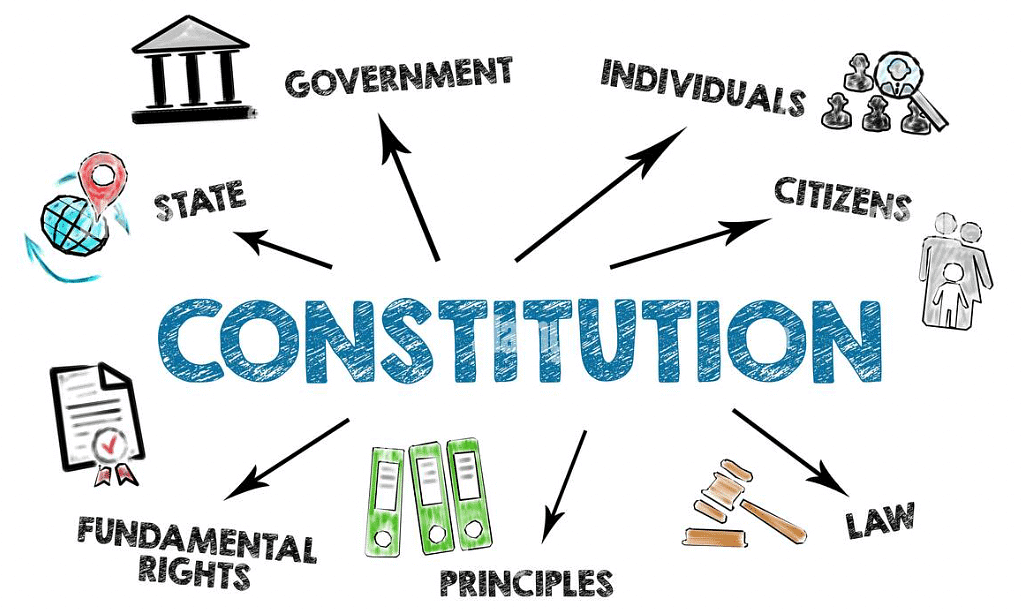
Are Constitutions Static?
- The Soviet Union, which existed for 74 years, had four constitutions. Following the collapse of the Communist Party of Soviet Union in 1991 and the subsequent disintegration of the Soviet federation, the newly formed Russian federation adopted a new constitution in 1993.
- In contrast, the Constitution of India was adopted on 26 November 1949 and implemented on 26January 1950. Despite being more than 55 years old, the same constitution continues to serve as the framework for the Indian government. This raises the question of whether the Constitution is so robust that it requires no changes, or whether its makers were far-sighted enough to anticipate future changes.
- The answer is that India has inherited a very robust Constitution, with a basic framework that is well-suited to the country. The Constitution makers were far-sighted and provided solutions for many future situations. However, it is important to note that the Constitution also accepts the necessity of modifications to accommodate the changing needs of society.
- The flexibility of interpretations in the actual working of the Constitution has allowed for both political practice and judicial rulings to demonstrate maturity and adaptability in implementing the Constitution. As a result, the Indian Constitution is considered a living document that is able to respond to new eventualities, rather than a closed and static rulebook.
Challenging Issue of Constitution and Solutions
- The provisions of a constitution should reflect attempts to address current societal problems.
- A constitution must serve as a framework for the future governance of the country.
- A constitution must be capable of responding to any future challenges that may arise.
- A constitution will always have elements that are relevant to the present and those that have long-lasting significance.
- A constitution is not a fixed and unchangeable document.
- The constitution provides a structure for democratic governance of the society.
- The Indian Constitution embodies both approaches: it is considered a sacred document but also one that may require changes as circumstances evolve. In other words, the Indian Constitution is not a static document and is subject to alteration.
- The judiciary plays a vital role in protecting and interpreting the Constitution, ensuring its ongoing relevance and effectiveness.
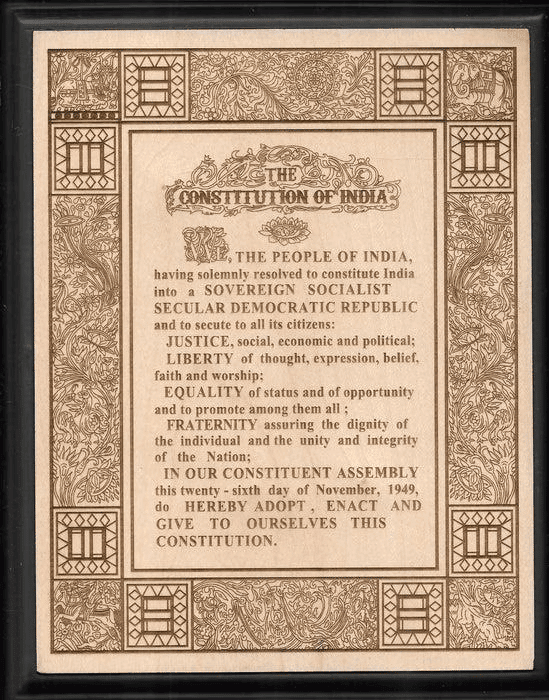 Preamble to the Constitution of India
How to Amend the Constitution?
Article 368 pertains to the amending power of the parliament, which enables it to amend, add, vary or repeal any provision of the constitution through its constituent power, as per the prescribed procedure.
Balancing Approach of the Indian Constitution
- The Constitution should be amended when necessary, but it must also be safeguarded against unnecessary or frequent changes.
- It should be both flexible and rigid.
- Flexibility means it can accommodate changes, while rigidity indicates it resists changes. A constitution that is easy to change is flexible, while one that is hard to change is rigid.
- The Indian Constitution achieves a balance between these two aspects.
- The drafters of the Constitution recognised that there might be errors or issues within it.
- Additionally, the rights and powers of the States cannot be modified without their agreement.
Amending the Indian Constitution: Process and Principles
- The Constitution was created to allow changes to fix faults or mistakes, while also stressing the need to safeguard it from unnecessary alterations.
- The drafters of the Constitution recognised there might be some faults or mistakes; they understood the Constitution could not be completely error-free.
- Some rules were included in the Constitution as temporary solutions, knowing they could be updated later after a new Parliament was elected.
- However, since the Constitution established a federal system, the rights and powers of the States cannot be altered without their agreement.
- No external body, like a constitutional commission, is needed to amend the Constitution. A special majority in both Houses of Parliament is required for any amendment to proceed.
- Once the amendment bill is approved, it is sent to the President for approval; the President cannot return it for reconsideration. This process can be quite rigid and complex.
- It is crucial to note that only the electedrepresentatives of the people have the authority to discuss and make final decisions on amendments, a principle known as parliamentary sovereignty.
- No referendum is necessary for the amendment's ratification.
Special Majority
To amend the Constitution, two types of special majorities are required:
- Firstly, the number of votes in favour of the amendment bill should be at least half of the total strength of the House.
- Secondly, the supporters of the amendment bill must also constitute two-thirds of those who participate in the voting.
- Both Houses of the Parliament must separately pass the amendment bill following this procedure (a joint session is not permitted). This special majority is required for every amendment bill.
- The fundamental principle underlying the amending process is that it should have extensive support among the political parties and parliamentarians.
- Additionally, the Constitution mandates that the legislatures of at least half the States must also pass the amendment bill for it to take effect.
Ratification by States
- In cases where amendments are related to the distribution of powers between the centralgovernment and the states or articles related to representation, a special majority is not sufficient.
- In such cases, it is mandatory to consult with the states and obtain their consent.
- To ensure this, the Constitution provides that the amendment bill must be passed by the legislatures of at least half of the states before it can come into effect.
- The protection of fundamental rights is also ensured in a similar way.
- Thus, amendments to the Indian Constitution require broad consensus and the participation of states, especially when it comes to issues related to federalism and fundamental rights.
Why have there been so many Amendments?
- Criticism is frequently directed towards the Constitution of India due to the high number of amendments it has undergone. Despite political considerations not being the sole cause for these amendments, the fact that there have been 93 amendments in just 55 years appears unusual. This steady stream of amendments has occurred every decade, regardless of the nature of politics or the party in power. The question arises whether the original Constitution was inadequate, and whether it is too flexible.
- During a period marked by political turbulence, including the anti-defection amendment (52nd amendment), several amendments were introduced. These amendments included those reducing the minimum voting age from 21 to 18, the 73rd and 74th amendments, as well as those clarifying and expanding the scope of job and admission reservations.
- Following 1992-93, a consensus emerged in the country regarding these measures, leading to amendments being passed with relative ease. These amendments, including the 77th, 81st, and 82nd amendments, were introduced to clarify and expand the scope of reservations in jobs and admissions.
Contents of Amendments Made So Far
1. Technical or Administrative Amendments
These amendments primarily involved clarifications, explanations, and minor modifications without making substantial changes to the original provisions.
Examples:
- 15th Amendment: Increased the retirement age of High Court judges from 60 to 62 years.
- 54th Amendment: Increased the salaries of judges of the High Courts and the Supreme Court.
- Reservation for SCs/STs:
- The original provision allowed reservation for 10 years.
- Periodically extended every 10 years through six amendments.
- These amendments did not alter the original provision, making them technical in nature.
- Amendment to Article 74(1):
- Clarified that the President shall act in accordance with the advice of the Council of Ministers.
- Did not change the functioning of the parliamentary system but served as a legal clarification.
2. Amendments Due to Differing Interpretations
Certain amendments resulted from differences between the Judiciary and the Parliament over constitutional interpretation.
Key Issues Leading to Amendments (1970-1975)
- Fundamental Rights vs. Directive Principles of State Policy
- Right to Private Property
- Scope of Parliament’s Power to Amend the Constitution
Judicial vs. Parliamentary Conflict
- Parliament sought to amend the Constitution to counter Supreme Court rulings.
- The 1970-75 period witnessed multiple amendments addressing these conflicts.
3. Amendments Through Political Consensus
Several amendments were passed unanimously across political parties to reflect prevailing political philosophy and societal aspirations.
Major Amendments (Post-1984):
- 52nd Amendment (Anti-Defection Law) – Prevented elected representatives from switching parties.
- 91st Amendment (Strengthening Anti-Defection Law) – Limited the size of the Council of Ministers.
- 61st Amendment – Reduced voting age from 21 to 18 years.
- 73rd and 74th Amendments – Strengthened Panchayati Raj and urban local governance.
- 77th, 81st, and 82nd Amendments – Expanded reservations in jobs and education.
- Consensus on reservations post-1992-93 led to smooth passage of related amendments.
4. Controversial Amendments (1970-1980)
Some amendments generated political and legal controversies, especially during the Emergency period (1975-77)
Highly Controversial Amendments
- 38th Amendment – Curbed judicial review on certain executive actions.
- 39th Amendment – Placed the election of the Prime Minister beyond judicial scrutiny.
- 42nd Amendment (1976):
- Most controversial amendment; considered a major rewriting of the Constitution.
- Key Changes:
- Altered the Preamble.
- Modified the Seventh Schedule.
- Amended 53 articles.
- Extended Lok Sabha tenure from 5 to 6 years.
- Restricted Judiciary’s power of review.
- Inserted Fundamental Duties.
- Passed during the Emergency, when opposition MPs were jailed.
Reversal of Controversial Amendments (Post-Emergency)
- 1977 elections saw the defeat of Congress.
- 43rd and 44th Amendments (by the new government) restored constitutional balance by nullifying most changes made by the 38th, 39th, and 42nd amendments.
Basic Structure and Evolution of the Constitution
The Basic structure doctrine has played a crucial role in shaping the Indian Constitution. Introduced by the Supreme Court in the Kesavananda Bharati case (1973), this doctrine has guided constitutional amendments and interpretations for decades. It highlights the balance between rigidity and flexibility in the amendment process, ensuring that while Parliament can make changes, it cannot alter the core principles of the Constitution.
Key Contributions of the Basic Structure Doctrine
- Limits on Parliament’s Power: Parliament cannot amend the Constitution in a way that violates its basic structure.
- Judicial Authority: The Supreme Court has the final say in determining whether an amendment violates the basic structure.
- Balance Between Rigidity and Flexibility: While some parts of the Constitution remain unchangeable, others can be amended as needed.
Judiciary’s Role in Constitutional Evolution
- Parliament believed it had the power to amend laws for the welfare of the poor and backward classes.
- The Judiciary ensured that any amendment must align with constitutional principles and legal procedures to prevent misuse of power.
- In the Kesavananda Bharati case (1973), the Supreme Court introduced the Basic Structure Doctrine, defining the core principles that cannot be altered.
- Though the term "basic structure" is not explicitly mentioned in the Constitution, the Judiciary interpreted it as the spirit of the Constitution, essential for its existence.
Review of the Constitution (2000)
- In 2000, the government appointed a commission led by Justice Venkatachaliah to review the Constitution.
- Many opposition parties and organizations boycotted the commission, fearing major changes.
- Despite political controversy, the commission upheld the basic structure doctrine and proposed no fundamental alterations.
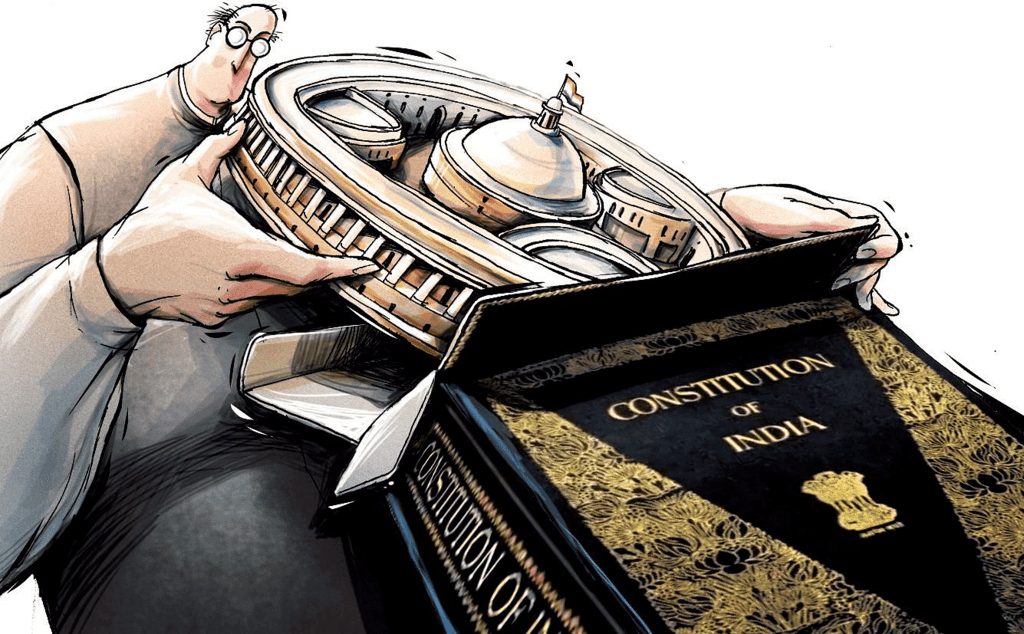
Constitution as a Living Document
The Indian Constitution is often described as a living document because it adapts to changing social, political, and economic conditions while maintaining its core principles. Like a living being, it responds to new challenges through interpretation, amendments, and judicial review.
Why is the Constitution a Living Document?
Dynamic and Evolving:
- The Constitution is not static; it grows through amendments, judicial interpretations, and evolving democratic practices.
- Example: The Basic Structure Doctrine was not originally in the Constitution but was developed by the Judiciary in the Kesavananda Bharati case (1973).
Judicial Interpretation and Adaptability:
- The Judiciary ensures that constitutional provisions are interpreted in the context of contemporary realities.
- Example: Right to Life (Article 21) was expanded to include the Right to Clean Environment, Education, and Livelihood.
Balance Between Rigidity and Flexibility:
- The Constitution provides a framework that allows changes without compromising fundamental principles.
- Example: The Kesavananda ruling set limits on Parliament’s amending power, ensuring that the Constitution’s core values remain intact.
Democratic and Institutional Maturity:
- The Constitution has survived major political crises (e.g., Emergency, judicial-executive conflicts) due to the maturity of India’s democratic institutions.
- Despite political differences, leaders and citizens respect the constitutional framework.
|
43 videos|268 docs|39 tests
|
FAQs on Constitution as a living document Class 11 Political Science
| 1. Are constitutions static or dynamic documents? |  |
| 2. What is the process to amend a constitution? | |
| 3. What constitutes a special majority in constitutional amendments? | |
| 4. What are some key amendments made to constitutions in the past? | |
| 5. What is the 'basic structure' doctrine in the context of constitutional amendments? | |




MCQs
,Free
,video lectures
,past year papers
,Important questions
,practice quizzes
,Constitution as a living document Class 11 Political Science
,Objective type Questions
,Exam
,mock tests for examination
,Constitution as a living document Class 11 Political Science
,study material
,Summary
,Semester Notes
,Constitution as a living document Class 11 Political Science
,Previous Year Questions with Solutions
,Extra Questions
,shortcuts and tricks
,ppt
,Viva Questions
,Sample Paper
;



Chapter Notes: Constitution as a living document Free PDF Download
Importance of Chapter Notes: Constitution as a living document
Chapter Notes: Constitution as a living document
Chapter Notes: Constitution as a living document Humanities/Arts Questions
Study Chapter Notes: Constitution as a living document on the App
|
© EduRev
|
Education Revolution
|


|




within 7 days!