Practice Questions: Seating Arrangement- 2 | Logical Reasoning for CLAT PDF Download

Directions for Questions 1 to 5: Read the given information carefully and answer the questions that follow.
Eleven friends M, N, O, P, Q, R, S, T, U, V and W are sitting in the first row of the stadium watching a cricket match.
(i) T is to the immediate left of P and third to the right of U.
(ii) V is the immediate neighbour of M and N and third to the left of S.
(iii) M is the second to the right of Q, who is at one of the ends.
(iv) R is sitting next to the right of P and P is second to the right of O.
Q1: Which of the following statements is true with respect to the above arrangement?
(a) There are three persons sitting between P and S
(b) W is between M and V.
(c) N is sitting between V and U
(d) S and O are neighbours sitting to the immediate right of T
Ans: (c)
The arrangement of the persons is
Q W M V N U S O T P R
Hence N is sitting between V and U.
Q2: If Q and P, O and N, M and T, and W and R interchange their positions then which of the following pairs of friends is sitting at the ends?
(a) P and Q
(b) Q and R
(c) P and W
(d) W and R
Ans: (c)
The arrangement of the persons is
Q W M V N U S O T P R
If the persons as given in the question change their positions then we have the arrangement P R T V O U S N M Q W
Hence P and W are sitting at the ends.
Q3: Which of the following people are sitting to the right of S?
(a) OTPQ
(b) OTPR
(c) UNVM
(d) UOTPR
Ans: (b)
The arrangement of the persons is
Q W M V N U S O T P R
OTPR are sitting to the right of S.
Q4: Who is sitting in the center of the row?
(a) S
(b) O
(c) T
(d) U
Ans: (d)
The arrangement of the persons is
Q W M V N U S O T P R
U is sitting in the center of the row.
Q5: Who are the immediate neighbours of T?
(a) O, P
(b) O, R
(c) N, U
(d) V, U
Ans: (a)
The arrangement of the persons is
Q W M V N U S O T P R
O and P are the immediate neighbours of T.
Directions for Questions 6 to 10: Read the following information given below and answer the questions that follow.
(i) P, Q, R, S, T, U and V are seven friends and are sitting in a circle facing the center of the circle.
(ii) V is second to the left of S and is the neighbour of T and U.
(iii) S is not a neighbour of R or T.
(iv) P is neighbour of Q and R.
Q6: Which of the following has the pair with the second person sitting to the immediate right of the first person?
(a) R and U
(b) U and V
(c) P and Q
(d) S and T
Ans: (b)
Option 2 The persons are sitting in the following way: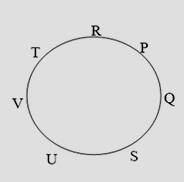
U is sitting to immediate right of V.
Q7: Which of the following has the second person sitting between the first and third persons?
(a) SPQ
(b) VRT
(c) QRP
(d) VUS
Ans: (d)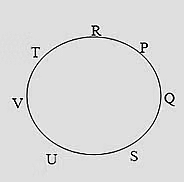
The persons are sitting in the following way: U is sitting between V and S.
Q8: Which of the following will be S’s position after T and S interchange their places?
(a) Neighbour of V and R
(b) To the immediate left of R
(c) To the immediate right of U
(d) Neighbour of R and P
Ans: (a)
The persons are sitting in the following way:
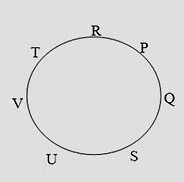
If S and T will interchange their positions then S will be the neighbour of V and R.
Q9: Which of the following is correct?
(a) Q is between P and S.
(b) S is between U and P.
(c) T is to the immediate right of V.
(d) U is to the immediate left of V.
Ans: (a)
The persons are sitting in the following way: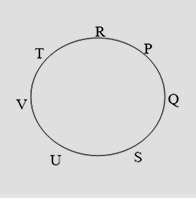
Hence Q is between P and S.
Q10: What is the position of R?
(a) Second to the left of Q
(b) Third to the right of U
(c) To the immediate left of P
(d) None of these
Ans: (d)
The persons are sitting in the following way: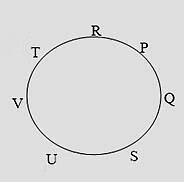
None of the options define the position of R.
|
38 videos|144 docs|75 tests
|




Viva Questions
,Previous Year Questions with Solutions
,Practice Questions: Seating Arrangement- 2 | Logical Reasoning for CLAT
,shortcuts and tricks
,Practice Questions: Seating Arrangement- 2 | Logical Reasoning for CLAT
,ppt
,Objective type Questions
,study material
,mock tests for examination
,Extra Questions
,past year papers
,Practice Questions: Seating Arrangement- 2 | Logical Reasoning for CLAT
,practice quizzes
,Exam
,Summary
,Semester Notes
,Sample Paper
,Free
,video lectures
,Important questions
,MCQs
;




Practice Questions: Seating Arrangement- 2 Free PDF Download
Importance of Practice Questions: Seating Arrangement- 2
Practice Questions: Seating Arrangement- 2 Notes
Practice Questions: Seating Arrangement- 2 CLAT
Study Practice Questions: Seating Arrangement- 2 on the App
|
© EduRev
|
Education Revolution
|


|




