


Best Study Material for JEE Exam
JEE Exam > JEE Notes > Mathematics (Maths) for JEE Main & Advanced > JEE Advanced Previous Year Questions (2018 - 2024): Complex Numbers
JEE Advanced Previous Year Questions (2018 - 2024): Complex Numbers | Mathematics (Maths) for JEE Main & Advanced PDF Download
2024
Q1: Let S = {a + b√2 : a, b ∈ ℤ},
T₁ = {(-1 + √2)ⁿ : n ∈ ℕ},
T₂ = {(1 + √2)ⁿ : n ∈ ℕ}.
Then which of the following statements is (are) TRUE? [JEE Advanced 2024 Paper 1]
(a) ℤ ∪ T₁ ∪ T₂ ⊂ S
(b) T₁ ∩ (0, 1/2024) = ϕ, where ϕ denotes the empty set.
(c) T₂ ∩ (2024, ∞) ≠ ϕ
(d) For any given a, b ∈ ℤ, cos(π(a + b√2)) + i sin(π(a + b√2)) ∈ ℤ if and only if b = 0, where i = √-1.
Ans: (a), (c), (d)
(A) (-1 + √2)ⁿ = m + √2n, m, n ∈ ℤ
(1 + √2)ⁿ = m₁ + √2n₁, m₁, n₁ ∈ ℤ
⇒ ℤ ∪ T₁ ∪ T₂ ⊆ S
but b√2 ∈ S for negative b ∈ ℤ.
So ℤ ∪ T₁ ∪ T₂ ⊂ S
(B) (√2 - 1)ⁿ = 1 / (√2 + 1)ⁿ < 1/2024
⇒ 2024 < (√2 + 1)ⁿ, ∃n ∈ ℕ
⇒ T₁ ∩ (0, 1/2024) ≠ ϕ
(C) (1 + √2)ⁿ > 2024, ∃n ∈ ℕ
⇒ T₂ ∩ (2024, ∞) ≠ ϕ
(D) sin(π(a + b√2)) = 0 ⇒ b = 0, a ∈ ℤ.
⇒ Options (A), (C), (D) are Correct.
Q2: Let f(x) = x⁴ + ax³ + bx² + c be a polynomial with real coefficients such that f(1) = -9. Suppose that i√3 is a root of the equation 4x³ + 3ax² + 2bx = 0, where i = √-1. If α₁, α₂, α₃, and α₄ are all the roots of the equation f(x) = 0, then |α₁|² + |α₂|² + |α₃|² + |α₄|² is equal to ________. [JEE Advanced 2024 Paper 1]
Ans: 20
f(1) = 1 + a + b + c = -9 ⇒ a + b + c = -10 .... (i)
4x³ + 3ax² + 2bx = 0 roots are √3i, -√3i, 0
⇒ 4x² + 3ax + 2b = 0 < √3i, -√3i
⇒ a = 0 & (2b/4) = (√3i)(-√3i)
b = 6 use a, b in (i) ⇒ c = -16
⇒ f(x) = x⁴ + 6x² - 16 = 0
(x² + 8)(x² - 2) = 0
⇒ x = ±√8i, ±√2
⇒ |α₁|² + |α₂|² + |α₃|² + |α₄|² = 20
2023
Q1: Let  . If A contains exactly one positive integer n, then the value of n is [JEE Advanced 2023 Paper 1]
Ans: 281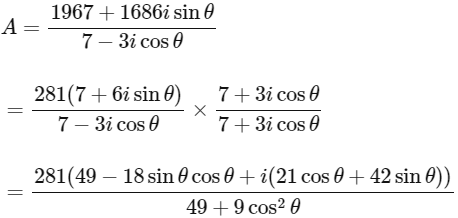
For positive integer

Q2: Let z be a complex number satisfying  , where
  denotes the complex conjugate of z. Let the imaginary part of z be nonzero.
Match each entry in List-I to the correct entries in List-II. 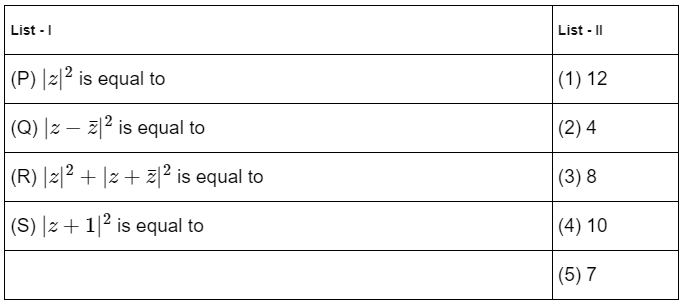
The correct option is:
(a) (P)→(1)(Q)→(3)(R)→(5)(S)→(4)
(b) (P)→(2)(Q)→(1)(R)→(3)(S)→(5)
(c) (P)→(2)(Q)→(4)(R)→(5)(S)→(1)
(d) (P)→(2)(Q)→(3)(R)→(5)(S)→(4) [JEE Advanced 2023 Paper 1]
Ans: (b)

(a) (P)→(1)(Q)→(3)(R)→(5)(S)→(4)
(b) (P)→(2)(Q)→(1)(R)→(3)(S)→(5)
(c) (P)→(2)(Q)→(4)(R)→(5)(S)→(1)
(d) (P)→(2)(Q)→(3)(R)→(5)(S)→(4) [JEE Advanced 2023 Paper 1]
Ans: (b)
Take conjugate both sides
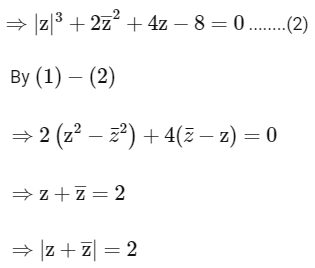
Let 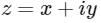

Put in (1)
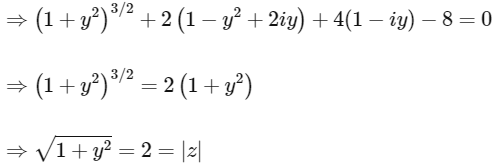
Also 
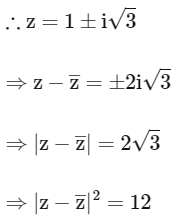
Now 
|z + 1|2 = 4 + 3 = 7
∴ (P)→(2)(Q)→(1)(R)→(3)(S)→(5)
∴ Option (b) is correct.
2022
Q1: Let z be a complex number with a non-zero imaginary part. If  is a real number, then the value of |z|2 is _________. [JEE Advanced 2022 Paper 1]
Ans: 0.49 to 0.51
For a complex number z = x + iy, it's conjugate 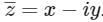 . Now z is purely real when y = 0.
When y = 0 then z = x + i × (0) = x and 
∴  when z is purely real.
Now given, 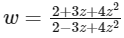 is real
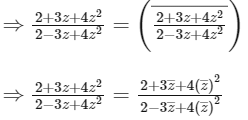

= 
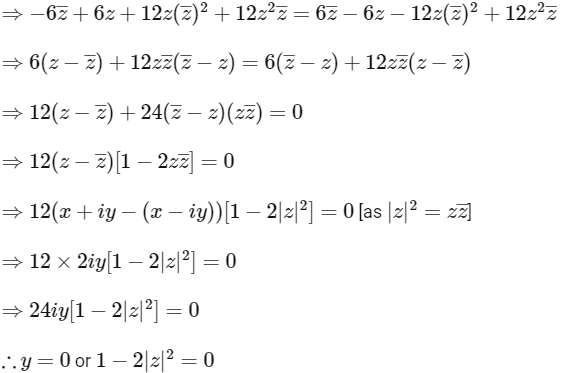
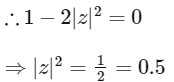
y = 0 not possible as given z is a complex number with non-zero imaginary part.
Q2: Let  denote the complex conjugate of a complex number z and let
  . In the set of complex numbers, the number of distinct roots of the equation
  is _________. [JEE Advanced 2022 Paper 1]
Ans: 4
Let z = x + iy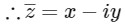
Given, 
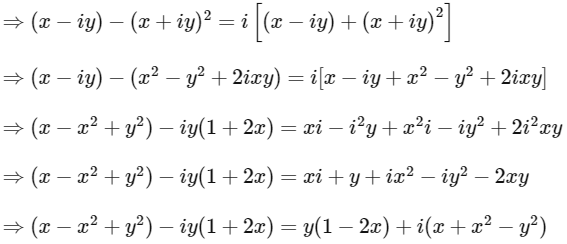
Comparing both sides real part we get,
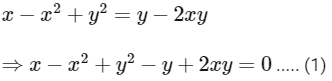
And comparing both sides imaginary part we get,
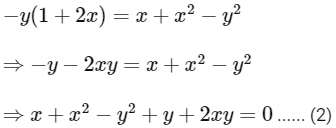
Adding equation (1) and (2) we get,

Case 1 : When x = 0 :
Put x = 0 at equation (1), we get
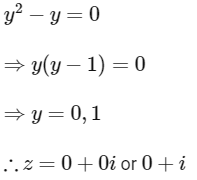
Case 2 : When y = −1/2 :
Put y = −1/2 in equation (1), we get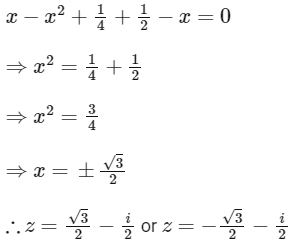
∴ Number of distinct z = 4
Q3: Let  denote the complex conjugate of a complex number z. If z is a non-zero complex number for which both real and imaginary parts of
  are integers, then which of the following is/are possible value(s) of |z| ?
(a) 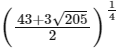
(b) 
(c) 
(d)  [JEE Advanced 2022 Paper 2]
Ans: (a)
Let, complex number  is a new complex number ω.
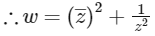
Now, Let  where r = |z| and θ = argument
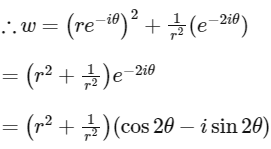
∴ Real part of 
Imaginary part of 
Given both Re(ω) and Im(ω) are integer.
∴ Let Re(ω) = I1
and Im(ω) = I2
Now, 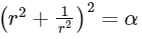
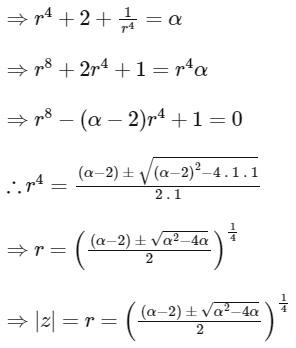
In option only positive sign is given so ignoring negative sign we get,

From option (A),
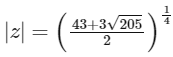
Comparing with (1), we get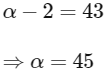
Putting α = 45 in (1), we get
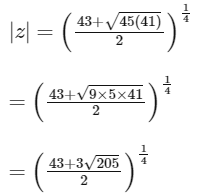
∴ Option (A) is correct.
We can re-write
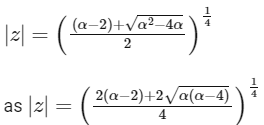
Comparing with option (B) we get,
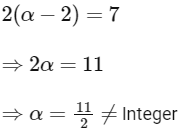
Option (B) is incorrect.
Similarly option (C) and (D) also incorrect.
2021
Q1: Let θ1, θ2, ........, θ10 = 2π. Define the complex numbers z1 = eiθ1, zk = zk − 1eiθk for k = 2, 3, ......., 10, where i = √−1. Consider the statements P and Q given below :

Then,
(a) P is TRUE and Q is FALSE
(b) Q is TRUE and P is FALSE
(c) both P and Q are TRUE
(d) both P and Q are FALSE [JEE Advanced 2021 Paper 1]
Ans: (c)
Both P and Q are true.
∵ Length of direct distance ≤ length of arc
i.e. | z2 − z1 | = length of line AB ≤ length of arc AB.
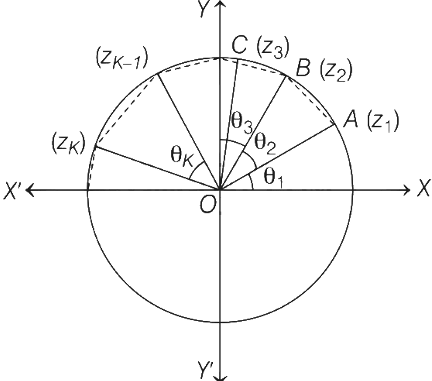
| z3 − z2 | = length of line BC ≤ length of arc BC.
∴ Sum of length of these 10 lines ≤ sum of length of arcs (i.e. 2π) (because θ1 + θ2 + θ3 + .... + θ10 = 2π (given)
∴ | z2 − z1 | + | z3 − z2 | + ..... + | z1 − z10 | ≤ 2π → P is true.
And | zk2 − zk−12 | = | zk − zk − 1 | | zk + zk − 1 |
As we know that,


≤ 4π → Q is true.
Q2: For any complex number w = c + id, let arg(ω)∈(−π, π], where i = √−1. Let α and β be real numbers such that for all complex numbers z = x + iy satisfying 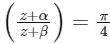 , the ordered pair (x, y) lies on the circle x2 + y2 + 5x − 3y + 4 = 0, Then which of the following statements is (are) TRUE?
(a) α = −1
(b) αβ = 4
(c) αβ = −4
(d) β = 4 [JEE Advanced 2021 Paper 1]
Ans: (d)
Circle x2 + y2 + 5x − 3y + 4 = 0 cuts the real axis (X-axis) at (−4, 0), (−1, 0).
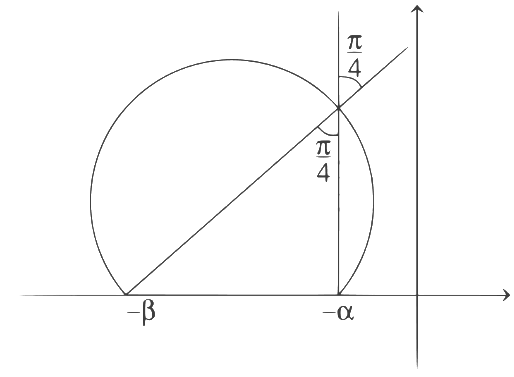
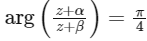 implies z is on arc and (− α, 0) and (− β, 0) subtend π/4 on z.
So, α = 1 and β = 4
Hence, αβ = 1 × 4 = 4 and β = 4
2020
Q1: For a complex number z, let Re(z) denote that real part of z. Let S be the set of all complex numbers z satisfying  , where i = √−1. Then the minimum possible value of |z1 − z2|2, where z1, z2∈S with Re(z1) > 0 and Re(z2) < 0 is _____ [JEE Advanced 2020 Paper 2]
Ans: 8
For a complex number z, it is given that,
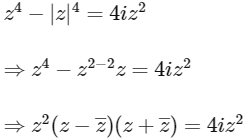
So, either 
Now, Case - I, if z2=0 and z = x + iy
So, x2 - y2 + 2ixy = 0
⇒ x2 - y2 = 0
and xy = 0
⇒ x = y = 0
⇒ z = 0 which is not possible according to given conditions.
Case - II, if  and
and
z = x + iy
So, 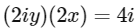
⇒ xy = 1 is an equation of rectangular hyperbola and for minimum value of |z1 − z2|2, the z1 and z2 must be vertices of the rectangular hyperbola.
Therefore, z1 = 1 + i and z2 = -1 - i
∴ Minimum value of |z1 − z2|2
= (1 + 1)2 + (1 + 1)2
= 4 + 4
= 8
Q2: Let S be the set of all complex numbers z satisfying |z2 + z + 1| = 1. Then which of the following statements is/are TRUE?
(a) |z + 1/2| ≤ 1/2 for all z ∈ S
(b) |z| ≤ 2 for all z ∈ S
(c) |z + 1/2| ≥ 1/2 for all z ∈ S
(d) The set S has exactly four elements [JEE Advanced 2020 Paper 1]
Ans: (b) & (c)
It is given that the complex number satisfying
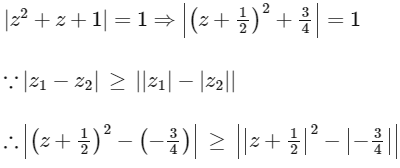
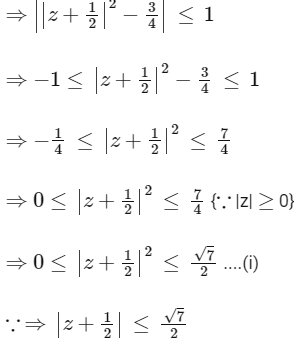
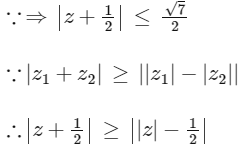

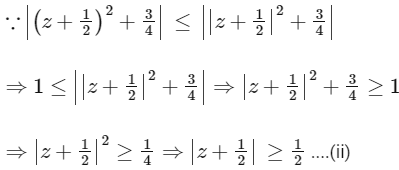
from Eqs. (i) and (ii), we get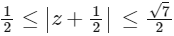
 |
Download the notes
JEE Advanced Previous Year Questions (2018 - 2024): Complex Numbers
|
Download as PDF |
Download as PDF
2019
Q1: Let ω ≠ 1 be a cube root of unity. Then the maximum of the set  distinct non-zero integers} equals _____ [JEE Advanced 2019 Paper 1]
Ans: 3
Given, ω ≠ 1 be a cube root of unity, then 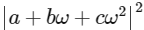
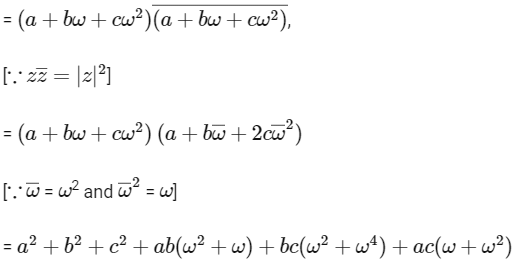
[as ω3 = 1)
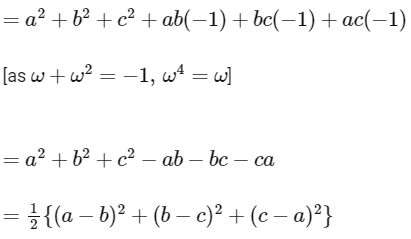
∵ a, b and c are distinct non-zero integers. For minimum value a= 1, b = 2 and c = 3
∴ 
Q2: Let S be the set of all complex numbers z satisfying  . If the complex number z0 is such that
  is the maximum of the set
 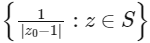 , then the principal argument of
  is
is
(a) π / 4
(b) 3π / 4
(c) - π / 2
(d) π / 2 [JEE Advanced 2019 Paper 1]
Ans: (c)
The complex number z satisfying  , which represents the region outside the circle (including the circumference) having centre (2, −1) and radius √5 units.

Now, for 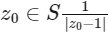 is maximum.
When |z0 − 1| is minimum. And for this it is required that z0 ∈ S, such that z0 is collinear with the points (2, −1) and (1, 0) and lies on the circumference of the circle |z − 2 + i| = √5.
So let z0 = x + iy, and from the figure 0 < x < 1 and y >0.
So, 
 is a positive real number, so
  is purely negative imaginary number.

 |
Take a Practice Test
Test yourself on topics from JEE exam
|
Practice Now |
Practice Now
2018
Q1: Let s, t, r be non-zero complex numbers and L be the set of solutions  of the equation
  where
where  = x − iy. Then, which of the following statement(s) is(are) TRUE? [JEE Advanced 2018 Paper 2]
(a) If L has exactly one element, then |s| ≠ |t|
(b) If |s| = |t|, then L has infinitely many elements
(c) The number of elements in L ∩ {z:|z − 1 + i|=5} is at most 2
(d) If L has more than one element, then L has infinitely many elements [JEE Advanced 2018 Paper 2]
Ans: (a), (c) & (d)
We have,
On taking conjugate,
On solving Eqs. (i) and (ii), we get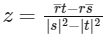
(a) For unique solutions of z It is true
(b) If |s| = |t|, then  may or may not be zero. So, z may have no solutions.∴ L may be an empty set.
It is false.
(c) If elements of set L represents line, then this line and given circle intersect at maximum two point. Hence, it is true.
(d) In this case locus of z is a line, so L has infinite elements. Hence, it is true.
The document JEE Advanced Previous Year Questions (2018 - 2024): Complex Numbers | Mathematics (Maths) for JEE Main & Advanced is a part of the JEE Course Mathematics (Maths) for JEE Main & Advanced.
All you need of JEE at this link: JEE
|
209 videos|447 docs|187 tests
|




FAQs on JEE Advanced Previous Year Questions (2018 - 2024): Complex Numbers - Mathematics (Maths) for JEE Main & Advanced
| 1. What are complex numbers and why are they important in JEE Advanced? |  |
| 2. How do you represent complex numbers on the Argand plane? | |
Ans. Complex numbers can be represented on the Argand plane as points or vectors. The horizontal axis represents the real part, while the vertical axis represents the imaginary part. For a complex number \( z = a + bi \), the point is plotted at coordinates \( (a, b) \). This graphical representation is useful for visualizing operations like addition and multiplication of complex numbers.
| 3. What are the basics of operations involving complex numbers that are essential for JEE Advanced? | |
Ans. The basic operations involving complex numbers include addition, subtraction, multiplication, and division. For addition, \( (a + bi) + (c + di) = (a + c) + (b + d)i \). For multiplication, \( (a + bi)(c + di) = (ac - bd) + (ad + bc)i \). Division is performed by multiplying the numerator and denominator by the conjugate of the denominator. Mastery of these operations is crucial for solving complex number problems in JEE Advanced.
| 4. What is the significance of the modulus and argument of a complex number in JEE Advanced? | |
Ans. The modulus of a complex number \( z = a + bi \) is given by \( |z| = \sqrt{a^2 + b^2} \), which represents the distance from the origin to the point on the Argand plane. The argument (or angle) of the complex number is defined as \( \theta = \tan^{-1}(\frac{b}{a}) \). These concepts are significant in JEE Advanced as they help in simplifying complex number expressions and solving equations involving roots of unity and polar forms.
| 5. How can De Moivre's Theorem be applied in solving complex number problems in JEE Advanced? | |
Ans. De Moivre's Theorem states that for any real number \( \theta \) and integer \( n \), \( (r(\cos \theta + i \sin \theta))^n = r^n (\cos(n\theta) + i \sin(n\theta)) \). This theorem is particularly useful in JEE Advanced for finding powers and roots of complex numbers. It simplifies calculations involving trigonometric forms of complex numbers, enabling quick solutions to problems related to polynomial equations and periodic functions.
Related Exams
About this Document

4.68/5
Rating

Apr 24, 2025
Last updated
Document Description: JEE Advanced Previous Year Questions (2018 - 2024): Complex Numbers for JEE 2025 is part of Mathematics (Maths) for JEE Main & Advanced preparation.
The notes and questions for JEE Advanced Previous Year Questions (2018 - 2024): Complex Numbers have been prepared according to the JEE exam syllabus. Information about JEE Advanced Previous Year Questions (2018 - 2024): Complex Numbers covers topics
like 2024, 2023, 2022, 2021, 2020, 2019, 2018 and JEE Advanced Previous Year Questions (2018 - 2024): Complex Numbers Example, for JEE 2025 Exam. Find important definitions, questions, notes, meanings, examples, exercises and tests below for JEE Advanced Previous Year Questions (2018 - 2024): Complex Numbers.
Introduction of JEE Advanced Previous Year Questions (2018 - 2024): Complex Numbers in English is available as part of our Mathematics (Maths) for JEE Main & Advanced
for JEE & JEE Advanced Previous Year Questions (2018 - 2024): Complex Numbers in Hindi for Mathematics (Maths) for JEE Main & Advanced course.
Download more important topics related with notes, lectures and mock test series for JEE
Exam by signing up for free. JEE: JEE Advanced Previous Year Questions (2018 - 2024): Complex Numbers | Mathematics (Maths) for JEE Main & Advanced
Description
Full syllabus notes, lecture & questions for JEE Advanced Previous Year Questions (2018 - 2024): Complex Numbers | Mathematics (Maths) for JEE Main & Advanced - JEE | Plus excerises question with solution to help you revise complete syllabus for Mathematics (Maths) for JEE Main & Advanced | Best notes, free PDF download
Information about JEE Advanced Previous Year Questions (2018 - 2024): Complex Numbers
In this doc you can find the meaning of JEE Advanced Previous Year Questions (2018 - 2024): Complex Numbers defined & explained in the simplest way possible. Besides explaining types of
JEE Advanced Previous Year Questions (2018 - 2024): Complex Numbers theory, EduRev gives you an ample number of questions to practice JEE Advanced Previous Year Questions (2018 - 2024): Complex Numbers tests, examples and also practice JEE
tests

Related Searches
Extra Questions
,past year papers
,Objective type Questions
,JEE Advanced Previous Year Questions (2018 - 2024): Complex Numbers | Mathematics (Maths) for JEE Main & Advanced
,Sample Paper
,Free
,Viva Questions
,Important questions
,JEE Advanced Previous Year Questions (2018 - 2024): Complex Numbers | Mathematics (Maths) for JEE Main & Advanced
,Previous Year Questions with Solutions
,MCQs
,shortcuts and tricks
,Semester Notes
,practice quizzes
,Summary
,JEE Advanced Previous Year Questions (2018 - 2024): Complex Numbers | Mathematics (Maths) for JEE Main & Advanced
,video lectures
,ppt
,Exam
,mock tests for examination
,study material
;




Additional Information about JEE Advanced Previous Year Questions (2018 - 2024): Complex Numbers for JEE Preparation
JEE Advanced Previous Year Questions (2018 - 2024): Complex Numbers Free PDF Download
The JEE Advanced Previous Year Questions (2018 - 2024): Complex Numbers is an invaluable resource that delves deep into the core of the JEE exam.
These study notes are curated by experts and cover all the essential topics and concepts, making your preparation more efficient and effective.
With the help of these notes, you can grasp complex subjects quickly, revise important points easily,
and reinforce your understanding of key concepts. The study notes are presented in a concise and easy-to-understand manner,
allowing you to optimize your learning process. Whether you're looking for best-recommended books, sample papers, study material,
or toppers' notes, this PDF has got you covered. Download the JEE Advanced Previous Year Questions (2018 - 2024): Complex Numbers now and kickstart your journey towards success in the JEE exam.
Importance of JEE Advanced Previous Year Questions (2018 - 2024): Complex Numbers
The importance of JEE Advanced Previous Year Questions (2018 - 2024): Complex Numbers cannot be overstated, especially for JEE aspirants.
This document holds the key to success in the JEE exam.
It offers a detailed understanding of the concept, providing invaluable insights into the topic.
By knowing the concepts well in advance, students can plan their preparation effectively.
Utilize this indispensable guide for a well-rounded preparation and achieve your desired results.
JEE Advanced Previous Year Questions (2018 - 2024): Complex Numbers Notes
JEE Advanced Previous Year Questions (2018 - 2024): Complex Numbers Notes offer in-depth insights into the specific topic to help you master it with ease.
This comprehensive document covers all aspects related to JEE Advanced Previous Year Questions (2018 - 2024): Complex Numbers.
It includes detailed information about the exam syllabus, recommended books, and study materials for a well-rounded preparation.
Practice papers and question papers enable you to assess your progress effectively.
Additionally, the paper analysis provides valuable tips for tackling the exam strategically.
Access to Toppers' notes gives you an edge in understanding complex concepts.
Whether you're a beginner or aiming for advanced proficiency, JEE Advanced Previous Year Questions (2018 - 2024): Complex Numbers Notes on EduRev are your ultimate resource for success.
JEE Advanced Previous Year Questions (2018 - 2024): Complex Numbers JEE
The "JEE Advanced Previous Year Questions (2018 - 2024): Complex Numbers JEE Questions" guide is a valuable resource for all aspiring students preparing for the
JEE exam. It focuses on providing a wide range of practice questions to help students gauge
their understanding of the exam topics. These questions cover the entire syllabus, ensuring comprehensive preparation.
The guide includes previous years' question papers for students to familiarize themselves with the exam's format and difficulty level.
Additionally, it offers subject-specific question banks, allowing students to focus on weak areas and improve their performance.
Study JEE Advanced Previous Year Questions (2018 - 2024): Complex Numbers on the App
Students of JEE can study JEE Advanced Previous Year Questions (2018 - 2024): Complex Numbers alongwith tests & analysis from the EduRev app,
which will help them while preparing for their exam. Apart from the JEE Advanced Previous Year Questions (2018 - 2024): Complex Numbers,
students can also utilize the EduRev App for other study materials such as previous year question papers, syllabus, important questions, etc.
The EduRev App will make your learning easier as you can access it from anywhere you want.
The content of JEE Advanced Previous Year Questions (2018 - 2024): Complex Numbers is prepared as per the latest JEE syllabus.
|
© EduRev
|
Education Revolution
|


|








Signup to see your scores
go up within 7 days!
Access 1000+ FREE Docs, Videos and Tests
Takes less than 10 seconds to signup