Electrical Analogies of control systems | Control Systems - Electrical Engineering (EE) PDF Download
| Table of contents |

|
| Force Voltage Analogy |
|
| Torque Voltage Analogy |
|
| Force Current Analogy |
|
| Torque Current Analogy |
|
Electrical systems and mechanical systems are two physically different systems. There are two types of electrical analogies of translational mechanical systems. Those are force voltage analogy and force current analogy.
Force Voltage Analogy
In force voltage analogy, the mathematical equations of translational mechanical system are compared with mesh equations of the electrical system.
Consider the following translational mechanical system as shown in the following figure.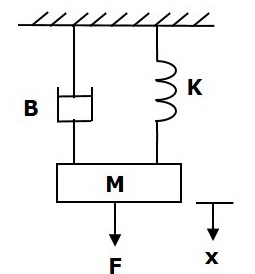
The force balanced equation for this system is
Consider the following electrical system as shown in the following figure. This circuit consists of a resistor, an inductor and a capacitor. All these electrical elements are connected in a series. The input voltage applied to this circuit is V volts and the current flowing through the circuit is i Amps.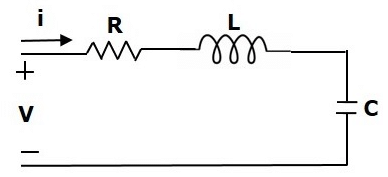
Mesh equation for this circuit is

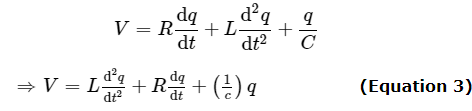 By comparing Equation 1 and Equation 3, we will get the analogous quantities of the translational mechanical system and electrical system. The following table shows these analogous quantities.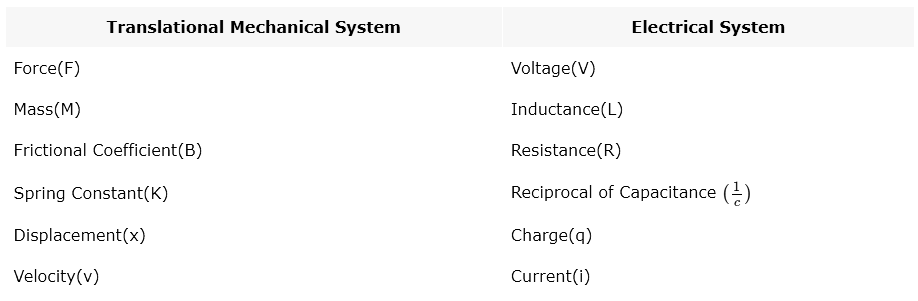
Similarly, there is torque voltage analogy for rotational mechanical systems. Let us now discuss about this analogy.

Torque Voltage Analogy
In this analogy, the mathematical equations of rotational mechanical system are compared with mesh equations of the electrical system.
Rotational mechanical system is shown in the following figure.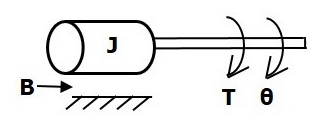 The torque balanced equation is
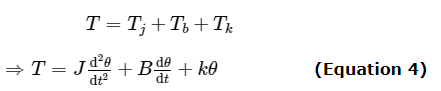 By comparing Equation 4 and Equation 3, we will get the analogous quantities of rotational mechanical system and electrical system. The following table shows these analogous quantities.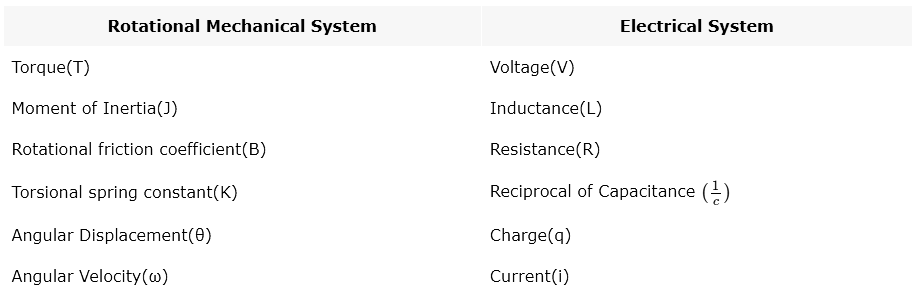
Force Current Analogy
In force current analogy, the mathematical equations of the translational mechanical system are compared with the nodal equations of the electrical system.
Consider the following electrical system as shown in the following figure. This circuit consists of current source, resistor, inductor and capacitor. All these electrical elements are connected in parallel.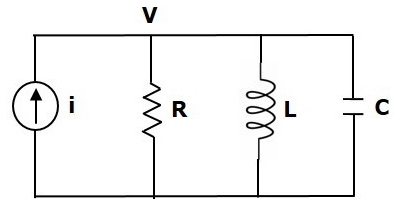 The nodal equation is

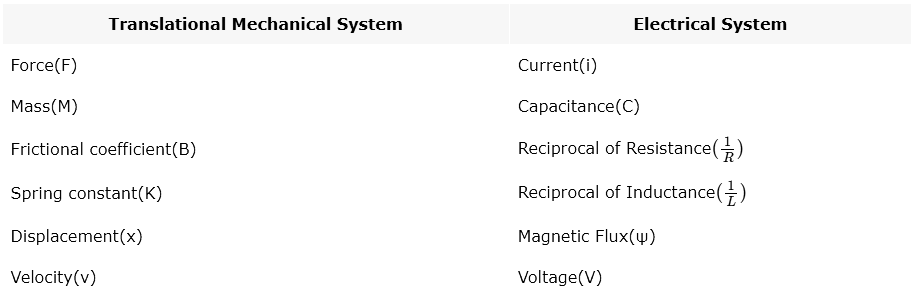
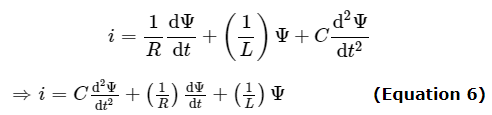 By comparing Equation 1 and Equation 6, we will get the analogous quantities of the translational mechanical system and electrical system. The following table shows these analogous quantities.
 Similarly, there is a torque current analogy for rotational mechanical systems. Let us now discuss this analogy.
 |
Download the notes
Electrical Analogies of control systems
|
Download as PDF |
Torque Current Analogy
In this analogy, the mathematical equations of the rotational mechanical system are compared with the nodal mesh equations of the electrical system.
By comparing Equation 4 and Equation 6, we will get the analogous quantities of rotational mechanical system and electrical system. The following table shows these analogous quantities.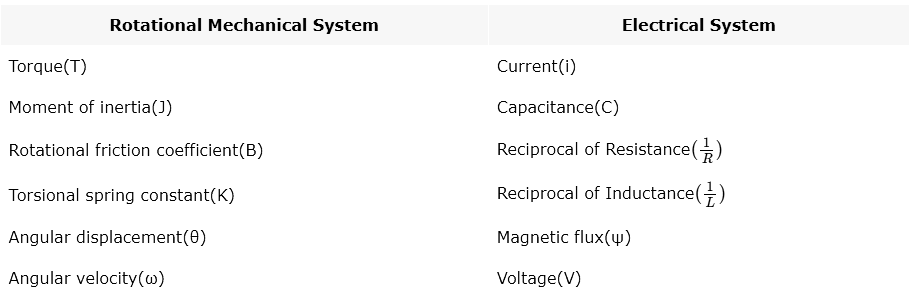
|
54 videos|83 docs|40 tests
|
FAQs on Electrical Analogies of control systems - Control Systems - Electrical Engineering (EE)
| 1. What is the importance of using analogies in control systems? |  |
| 2. How does the force-voltage analogy work in control systems? | |
| 3. What are some common components in electrical analogies of control systems? | |
| 4. How can electrical analogies be used to model and analyze control systems? | |
| 5. What are some limitations of using electrical analogies in control systems? | |



Semester Notes
,video lectures
,Electrical Analogies of control systems | Control Systems - Electrical Engineering (EE)
,Extra Questions
,Previous Year Questions with Solutions
,past year papers
,Exam
,study material
,Objective type Questions
,Electrical Analogies of control systems | Control Systems - Electrical Engineering (EE)
,Sample Paper
,Summary
,MCQs
,Electrical Analogies of control systems | Control Systems - Electrical Engineering (EE)
,Viva Questions
,practice quizzes
,ppt
,mock tests for examination
,Free
,Important questions
,shortcuts and tricks
;



Electrical Analogies of control systems Free PDF Download
Importance of Electrical Analogies of control systems
Electrical Analogies of control systems Notes
Electrical Analogies of control systems Electrical Engineering (EE) Questions
Study Electrical Analogies of control systems on the App
|
© EduRev
|
Education Revolution
|


|




