Adverbs - English Grammar Basics | Verbal Ability & Reading Comprehension (VARC) - CAT PDF Download

Function of an adverb:
Adverbs are used to give more information about the action in a sentence. They mainly modify verbs. They tell us how, where, when...etc something happens or is done.
Carol drives carefully. (How does she drive?)
I looked for her everywhere. (Where did you look for her?)
She came to London yesterday. (When did she come to London?)
Adverbs are generally divided into seven groups:
1) Manner: slowly, bravely, carefully, simply, quietly...
2) Place: there, here, up, down, near...
3) Time: yesterday, tomorrow, now, yet, still...
4) Frequency: never, always, often, once, twice...
5) Sentence: actually, really, obviously, evidently...
6) Degree: very, quite, rather, fairly, hardly...
7) Focus: just, only, simply, even, also...
Forming Adverbs
They are generally made from adjectives.
Many adverbs of manner and degree are formed by putting -ly at the end of an adjectives. 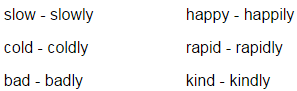
I don’t know why, but they spoke to me coldly.
The weather was awfully cold.
You should treat people gently.
Please, drive the car slowly.
When an adjective ends in consonant + y, it becomes -ily.
busy - busily
happy - happily
easy - easily
heavy - heavily
She is working busily.
Chuck passed the test easily.
When an adjective ends in -le, we omit -e and add -(l)y
noble - nobly
possible - possibly
simple - simply
gentle - gently
Ex: My mom brushes my hair gently every day.
When an adjectives ends in -e, we keep -e and add -ly.
extreme - extremely
free - freely
brave - bravely
safe - safely
His political ideas are extremely dull.
Our army fought bravely.
When an adjective ends in -ic, we add -ally.
Systematic - systematically
Phonetic - phonetically
We searched the attic systematically.
Mrs. Burns wanted us to write the words phonetically.
Degrees of Adverbs
- Positive : Expresses a quality without a comparison.
Ivan walks slowly.
- Comparative : Expresses a higher or lower degree than the positive.
Ida walks faster than Ivan.
- Superlative : Expresses the highest or the lowest degree when comparing more than two things/persons.
Brad walks the slowest.
1. Adverbs having the same form as adjectives:
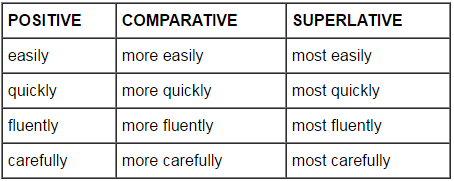
They came earlier than me.
Kenyans always win prizes in marathons because they run the fastest of all.
My parents’ plane will arrive later than my uncle's.
2. Adverbs formed with –ly. 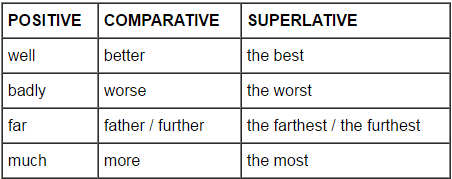
Linda drives more carefully than her husband.
Elizabeth speaks English the most fluently.
3. Irregular adverbs 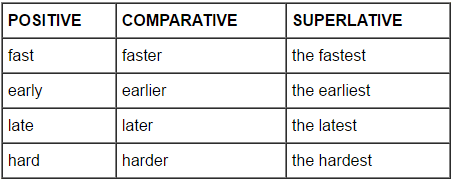
Who speaks English the best?
They do everything worse than us.
|
178 videos|787 docs|126 tests
|
FAQs on Adverbs - English Grammar Basics - Verbal Ability & Reading Comprehension (VARC) - CAT
| 1. What are adverbs? |  |
| 2. What is the function of adverbs in a sentence? | |
| 3. Can adverbs be used to compare actions or qualities? | |
| 4. Can adverbs be used to negate a statement? | |
| 5. How can I identify adverbs in a sentence? | |





Sample Paper
,MCQs
,shortcuts and tricks
,video lectures
,Adverbs - English Grammar Basics | Verbal Ability & Reading Comprehension (VARC) - CAT
,Summary
,Free
,Adverbs - English Grammar Basics | Verbal Ability & Reading Comprehension (VARC) - CAT
,Objective type Questions
,study material
,Adverbs - English Grammar Basics | Verbal Ability & Reading Comprehension (VARC) - CAT
,past year papers
,Previous Year Questions with Solutions
,Exam
,practice quizzes
,Viva Questions
,ppt
,Semester Notes
,mock tests for examination
,Extra Questions
,Important questions
;



Adverbs - English Grammar Basics Free PDF Download
Importance of Adverbs - English Grammar Basics
Adverbs - English Grammar Basics Notes
Adverbs - English Grammar Basics CAT Questions
Study Adverbs - English Grammar Basics on the App
|
© EduRev
|
Education Revolution
|


|




