Indian Climate & Factors Affecting the Climate | Geography for UPSC CSE PDF Download
| Table of contents |

|
| Introduction |
|
| Features of Indian Climate |
|
| Factors Influencing Indian Climate |
|
| Summary |
|

Introduction
India’s climate closely resembles the climate that of a tropical country although its northern part (north of tropic of cancer) is situated in the temperate belt.
- The Indian subcontinent is separated from the rest of Asia by the lofty Himalayan ranges which block the cold air masses moving southwards from Central Asia.
- As a result, during winters, the northern half of India is warmer by 3°C to 8°C than other areas located on the same latitudes.
- During summer, due to the head position of the sun, the climate in the southern parts resembles an equatorial dry climate.
- The north Indian plains are under the influence of hot dry wind called ‘loo’ blowing from the Thar, Baloch, and Iranian Deserts, increasing the temperatures to a level comparable to that of the southern parts of the country.
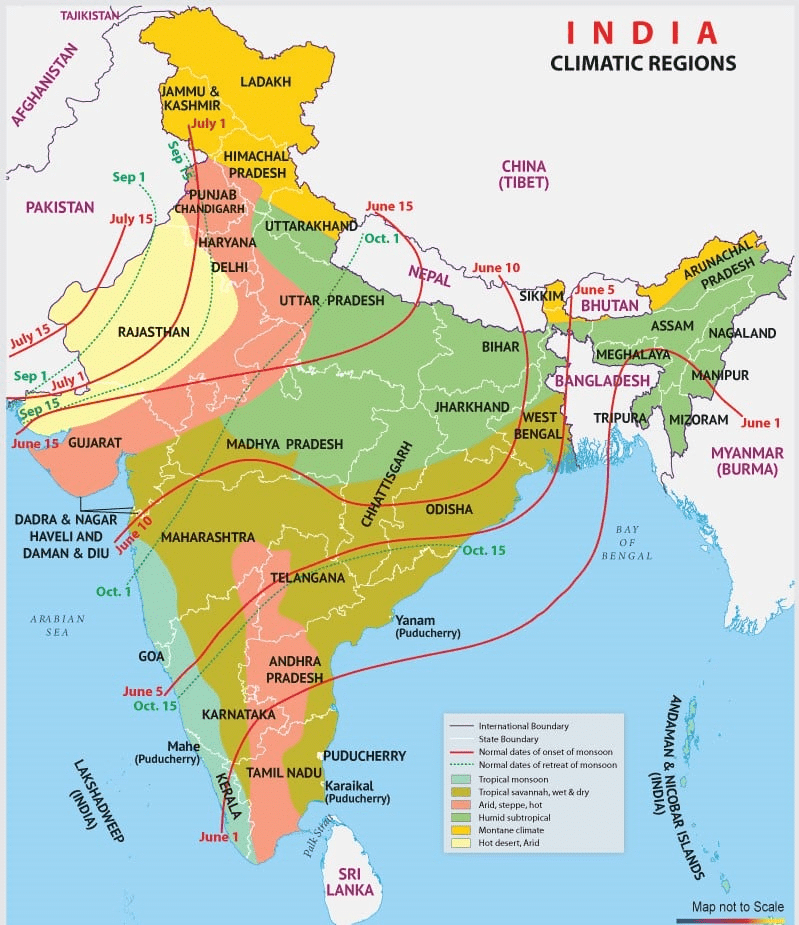
- Thus, the whole of India, south of the Himalayas can be climatically treated as a tropical country.
- The seasonal reversal of winds in the Arabian Sea and Bay of Bengal gives India a typical tropical monsoon climate.
- So Indian climate, to be precise, is tropical monsoon type (a distinct wet and dry climate) rather than just a tropical or half temperate climate.
Features of Indian Climate
India has high Regional Climatic Diversity because of its topographical diversity (location, altitude, distance from sea, and relief).
Rainfall
- The climate in most of the regions is characterized by distinct wet and dry seasons. Some places like Thar desert, Ladakh have no wet season.
- Mean annual rainfall varies substantially from region to region. Mawsynram and Cherrapunji in Meghalaya receive around 1,000 cm of annual rainfall while at Jaisalmer the annual rainfall rarely exceeds 12 cm.
- The Ganga delta and the coastal plains of Odisha see intense rainfall in July and August while the Coromandel Coast goes dry during these months.
- Places like Goa, Hyderabad, and Patna receive south-west monsoon rains by the first quarter of June while the rains are awaited till early July at places in Northwest India.Question for Indian Climate & Factors Affecting the ClimateTry yourself:Which place receives highest rainfall in India?View Solution
Temperature
- Diurnal and annual temperature ranges are substantial.
- The highest diurnal temperature ranges occur in the Thar desert and the highest annual temperature ranges are recorded in the Himalayan regions.
- Both diurnal and mean annual temperature ranges are the least in coastal regions.
- In December, the temperature may dip to – 40°C at some places in J&K while in many coastal regions average temperature is 20-25°C.
- Winters are moderately cold in most of the regions while the summers are extremely hot.
- Himalayan regions experience brutal winters while the summers are moderate.
Factors Influencing Indian Climate
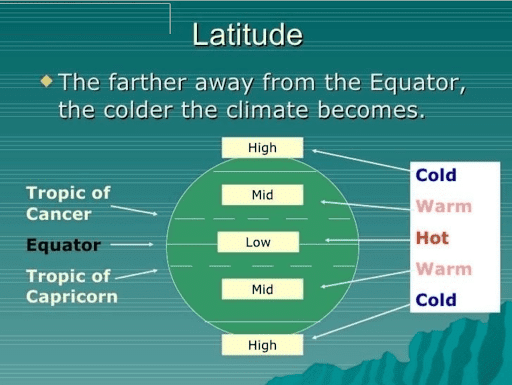
1. Latitudinal Location
- Indian climate resembles the climate of a tropical country.
- The mainland of India extends between 8°N to 37°N.
- Areas south of the Tropic of Cancer are in tropics and hence receive high solar insolation. The summer temperatures are extreme and winters temperatures are moderate in most of the regions.
- The northern parts on the other hand lie in the warm temperate zone. They receive comparatively less solar insolation. But summer is equally hot in north India because of hot local wind called ‘loo’. Winter are very cold due to cold waves brought by the western disturbances.
- Some places in Himalayas record low temperatures particularly in winter.
- Coastal regions see moderate climatic conditions irrespective of latitudinal position.
2. Distance from the Sea
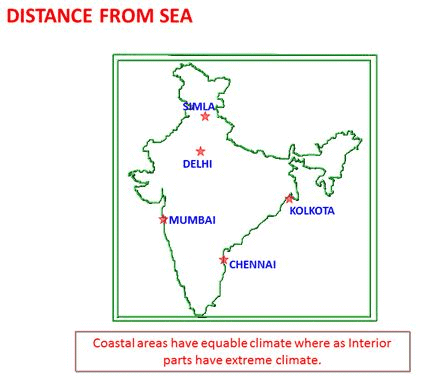
- Coastal regions have a moderate or equable or maritime climate whereas interior locations are deprived of the moderating influence of the sea and experience extreme or continental climate.
- The monsoon winds first reach the coastal regions and hence bring a good amount of rainfall.
3. The Himalayas
- This is the most important factor that influences the Indian Climate.
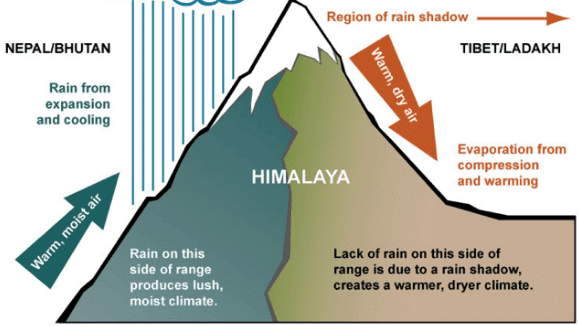
- The Himalayas act as a climatic divide between India and Central Asia.
- During winter, Himalayas protect India from the cold and dry air masses of Central Asia.
- During monsoon months these mountain ranges act as an effective physical barrier for rain-bearing south-west monsoon winds.
- The Himalayas divide the Bay of Bengal branch of monsoon winds into two branches – one branch flowing along the plain regions towards north-west India and the other towards South-East Asia.
- If the Himalayas were not present, the monsoon winds would simply move into China and most of north India would have been a desert.
Rainfall decrease from east to west in the plains region (Indus-Ganga Plains):
- In summer, there are many minor low-pressure cells that exist all over the plain region.
- As the monsoon winds move from east to west the moisture levels decrease due to successive rainfall at each low-pressure region.
- By the time winds reach western parts of the plains (Delhi, Haryana etc.) all the moisture in the monsoon winds in exhausted.
Note:
Haryana and Punjab are not deserts like Rajasthan because they receive rainfall due to Western Disturbances in winter. (In summer the rainfall is very low).
4. Physiography and Indian Climate
Physiography is the most important factor that determines the mean annual rainfall received by a region.
(a) Some parts of peninsular India are semi-arid:
- Places on the windward side of an orographic barrier receive a great amount of rainfall whereas those on the leeward side remain arid to semi-arid due to the rain-shadow effect.
Example: The southwest monsoon winds from the Arabian sea strike almost perpendicular at the Western Ghats and cause copious rainfall in the Western Coastal plain and the western slopes of the Western Ghats. - On the contrary, vast areas of Maharashtra, Karnataka, Telangana, Andhra Pradesh, and Tamil Nadu lie in rain-shadow or leeward side of the Western Ghats and receive scanty rainfall.
(b) Gujarat and Rajasthan receive no significant rainfall:
- Monsoon winds flowing in Rajasthan and Gujarat are not obstructed by any orographic barrier, and hence these regions receive no rainfall.
- Monsoon winds blow almost parallel to Aravalis and hence there is no orographic rainfall.
- No convection cell or vertical wind movements arise in Rajasthan and Gujarat: Monsoon winds blow towards low-pressure cells in Tibet and hence only horizontal wind movements exist in Gujarat and Rajasthan.
- Sub-tropical high-pressure belt: In winter the region experiences strong divergence because of the STJ – Sub-Tropical Jet.
(c) Cherrapunji and Mawsynram receive abnormally high rainfall:
- Mawsynram and Cherrapunji are the wettest places on earth with a mean annual rainfall of over 1000 cm.
- Copious rainfall in these places is due to the funneling effect followed by orographic upliftment.
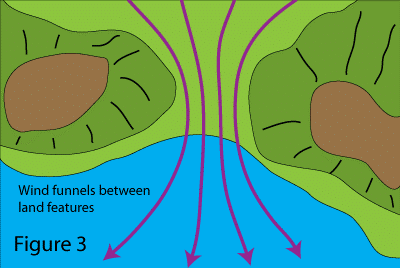
Note:
Funnelling effect = clouds are channeled into a narrow region between mountains and hence the cloud density is extraordinary.
5. Monsoon Winds and Indian Climate
- The most dominating factor of the Indian climate is the monsoon winds.
Important features of Indian Monsoons are:
(i) Sudden onset (sudden burst)
(ii) Gradual progress
(iii) Gradual retreat
(iv) Seasonal reversal of winds - The complete reversal of the monsoon winds brings about a sudden change in the seasons.
- The harsh summer season suddenly giving way to the monsoon or rainy season.
- The southwest monsoons from the Arabian sea and the Bay of Bengal bring rainfall to the entire country.
- The north-eastern winter monsoon does not cause much rainfall except along the Coromandel coast (TN coast) after getting moisture from the Bay of Bengal.
6. Upper-Air Circulation
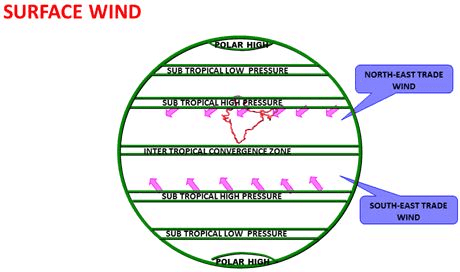
- The changes in the upper air circulation over Indian landmass is brought about by Jet streams. (Will be explained in detail in Indian Monsoons)
Westerly Jet Stream
- Westerly jet stream blows at a very high speed during winter over the sub-tropical zone.
- The southern branch of the jet stream exercises a significant influence on the winter weather conditions in India.
- This jet stream is responsible for bringing western disturbances from the Mediterranean region into the Indian sub-continent.
- Winter rain and heat storms in north-western plains and occasional heavy snowfall in hilly regions are caused by these disturbances.
- These are generally followed by cold waves in the whole of northern plains.
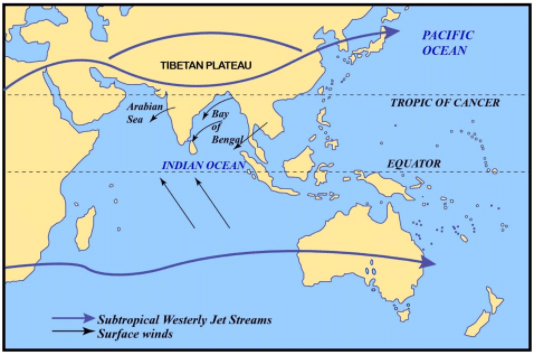 Atmospheric Conditions over the Indian Subcontinent in the Month of January
Easterly Jet Stream
- The reversal in upper air circulation takes place in summer due to the apparent shift of the sun’s vertical rays in the northern hemisphere.
- The westerly jet stream is replaced by the easterly jet stream which owes its origin to the heating of the Tibet plateau.
- This helps in the sudden onset of the south-west monsoons.
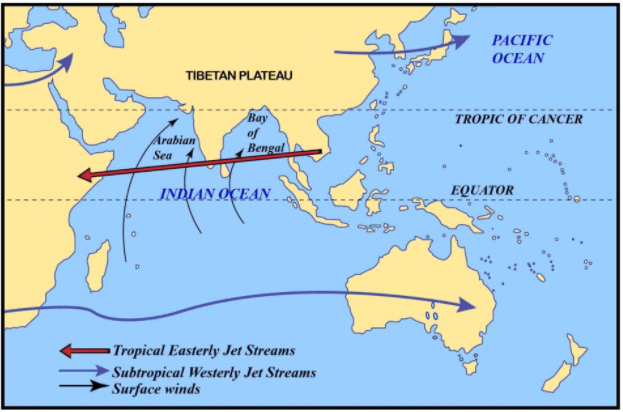 Atmospheric Conditions over the Indian Subcontinent in the Month of June
7. Tropical Cyclones and Western Disturbances
- Tropical cyclones originate in the Bay of Bengal and the Arabian Sea and influence large parts of peninsular India.
- The majority of the cyclones originate in the Bay of Bengal and influence the weather conditions during the southwest monsoon season (low-intensity cyclones).
- Some cyclones are born during the retreating monsoon season, i.e., in October and November (high-intensity cyclones), and influence the weather conditions along the eastern coast of India.
- The western disturbances originate over the Mediterranean Sea and travel eastward under the influence of westerly jet stream.
- They influence the winter weather conditions over most of the Northern-plains and Western Himalayan region.Question for Indian Climate & Factors Affecting the ClimateTry yourself:Which jet stream is the major for Indian Monsoon?View Solution
8. El-Nino, La Nina, ENSO and Indian Climate
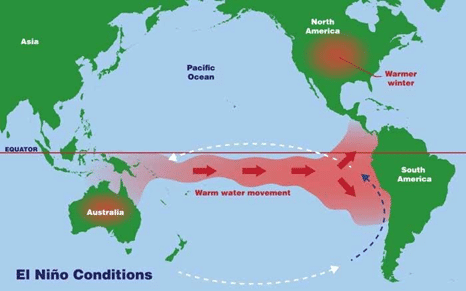
El Nino
- Adversely affects monsoon rainfall and cyclogenesis in the Bay of Bengal.
- Good for cyclogenesis in the Arabian Sea.
- Droughts are common during El Nino events due to less monsoonal and cyclonic rainfall.
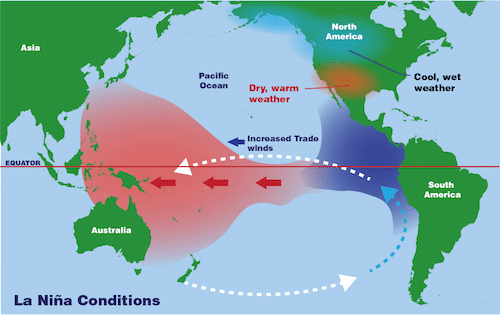
La Nina
- Good for monsoons and cyclogenesis in the Bay of Bengal.
- Suppressed cyclogenesis in the Arabian Sea.
- Floods are common.
ENSO
- Southern Oscillation is simply the oscillation or alternating positions of low pressure and high-pressure cells over eastern and western Pacific.
- Southern Oscillation coinciding with El Nino is called ENSO or El Nino Southern Oscillation. (SO usually coincides with EL Nino. This why El Nino is usually referred to as ENSO)
- ENSO = [warm water in eastern Pacific + low pressure over eastern Pacific] + [cool water in western Pacific + high pressure in western Pacific]
- Climatic conditions are same as El Nino.
Summary
India's climate is characterized by tropical features, with the northern part in the temperate belt and the Himalayas acting as a climatic barrier. The country experiences a tropical monsoon climate due to the seasonal reversal of winds in the Arabian Sea and Bay of Bengal. Factors influencing the climate include latitudinal location, distance from the sea, the presence of the Himalayas, physiography, monsoon winds, upper-air circulation, tropical cyclones, western disturbances, and the phenomena of El Nino, La Nina, and ENSO. This leads to regional climatic diversity, distinct wet and dry seasons, varied rainfall patterns, and significant temperature variations across the country, reflecting the intricate interplay of geographical, atmospheric, and oceanic influences.
|
271 videos|870 docs|231 tests
|
FAQs on Indian Climate & Factors Affecting the Climate - Geography for UPSC CSE
| 1. What are the main features of the Indian climate? |  |
| 2. What are the factors that influence the Indian climate? | |
| 3. How does the monsoon season affect agriculture in India? | |
| 4. Why is understanding India's climate important for planning? | |
| 5. How do urbanization and climate change affect the Indian climate? | |




mock tests for examination
,Viva Questions
,MCQs
,Sample Paper
,past year papers
,study material
,Objective type Questions
,Indian Climate & Factors Affecting the Climate | Geography for UPSC CSE
,practice quizzes
,shortcuts and tricks
,Extra Questions
,Important questions
,Indian Climate & Factors Affecting the Climate | Geography for UPSC CSE
,Free
,ppt
,Summary
,Previous Year Questions with Solutions
,Semester Notes
,video lectures
,Indian Climate & Factors Affecting the Climate | Geography for UPSC CSE
,Exam
;



Indian Climate & Factors Affecting the Climate Free PDF Download
Importance of Indian Climate & Factors Affecting the Climate
Indian Climate & Factors Affecting the Climate Notes
Indian Climate & Factors Affecting the Climate UPSC Questions
Study Indian Climate & Factors Affecting the Climate on the App
|
© EduRev
|
Education Revolution
|


|




