Civil Engineering (CE) Exam  >  Civil Engineering (CE) Notes  >  Civil Engineering SSC JE (Technical)  >  Permeability - Civil Engineering SSC JE (Technical) - Civil Engineering (CE)

Permeability - Civil Engineering SSC JE (Technical) - Civil Engineering (CE)

Chapter 3: Permeability

Permeability of soil

The permeability of soil is the property that controls the ability of soil to allow water to flow through its voids. Flow of water through soil occurs in the interconnected pore spaces. In reality the water moves along a winding path, but for analysis in soil mechanics an effective straight-line flow and an effective velocity are usually assumed. The velocity of flow depends mainly on the size, shape and connectivity of pores.

Darcy's law

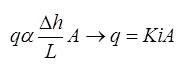
Darcy's experiments showed that for laminar flow through a porous medium the quantity of water flowing per unit time is proportional to the cross-sectional area and to the hydraulic head causing flow, and is inversely proportional to the length of the specimen. This relation is known as Darcy's law. It is valid only for laminar flow and generally holds for Reynolds number less than about 1 to 10 in soils.

(i) Rate of flow (q)

(i) Rate of flow (q)

In symbolic form, Darcy's law for one dimensional flow is written as
q = K A i
where

  • q = rate of flow (m3/s)
  • K = coefficient of permeability (m/s)
  • i = hydraulic gradient (dimensionless)
  • A = area of cross-section of sample (m2)
(i) Rate of flow (q)

The hydraulic gradient is generally expressed as the head loss per unit length:

i = HL / L = (H1 - H2) / L

(ii) Seepage velocity

(ii) Seepage velocity

The seepage velocity (sometimes called pore water velocity) is the average velocity of water through the pore space and is related to Darcy velocity (discharge velocity) by the porosity:

  • V = discharge velocity (Darcy velocity) = q / A
  • Vs = seepage (pore) velocity = V / n
  • where n = porosity (decimal fraction)

(iii) Coefficient of percolation

(iii) Coefficient of percolation

The coefficient of percolation (sometimes used in older literature) relates permeability to porosity. The relation and symbols are shown above in the image. In many practical uses the coefficient of percolation is useful to estimate equivalent permeability where porosity is a controlling factor.

NOTE: The term coefficient of percolation is rarely used in modern geotechnical practice and is mainly of historical interest.

Laboratory permeability tests

Permeability is determined in the laboratory by two common tests: the constant head permeability test and the falling head (variable head) permeability test. Choice of test depends on soil gradation and expected permeability.

Constant head permeability test

  • Soils suitable: clean sands and gravels (granular soils with high permeability).
  • Soils not suitable: fine silts and clays (very low permeability) - constant head is not appropriate for these.
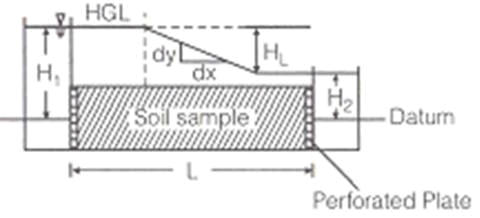
  • Objective: to determine the coefficient of permeability, k, under steady flow conditions.
  • Definition: k is the rate of flow of water through a unit area of soil under unit hydraulic gradient, under laminar flow conditions.

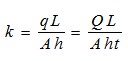
The coefficient of permeability from a constant head test is obtained from the relation

Constant head permeability test

where

  • q = discharge (m3/s), Q = total volume of water collected (m3)
  • t = time period of collection (s)
  • h = head causing the flow across the specimen (m)
  • L = length of specimen (m)
  • A = cross-sectional area of specimen (m2)

Procedure (brief)

  1. Prepare and trim the soil specimen of known length and cross-section and place it in the permeability cell.
  2. Maintain a constant head (h) across the specimen using a constant head reservoir and allow steady flow to establish.
  3. Measure the volume of water discharged (Q) over a measured time period (t).
  4. Compute k using the relation given above.

Falling head permeability test (variable head)

Falling head permeability test (variable head)

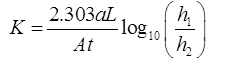
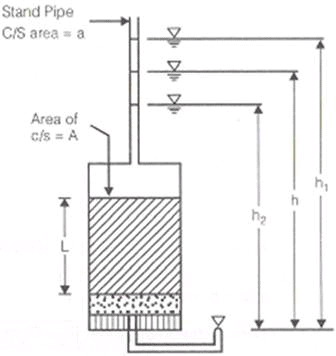
The falling head test is preferred for fine-grained soils and for cases where permeability is relatively low. In this test the head at the upstream end is allowed to fall with time and the change in height is recorded.

Falling head permeability test (variable head)

The commonly used expression for k from a falling head test is given by the image above and depends on

  • a = cross-sectional area of the standpipe (m2)
  • A = area of specimen (m2)
  • L = length of specimen (m)
  • t = time interval (s)
  • h1 = initial head in the standpipe at t = 0
  • h2 = head in the standpipe after time t

Empirical and theoretical relations for permeability

Several relations have been proposed to estimate soil permeability from grain size and surface characteristics. The following are commonly cited in soil engineering.

Kozeny-Karman equation

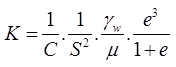
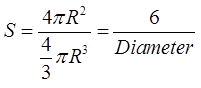
The Kozeny-Karman relation links permeability to the specific surface of particles, porosity and a shape coefficient. The precise algebraic form used in design and analysis is shown in the image(s) below. The notation used there includes the shape coefficient C (for spherical particles C is often dimentionless), the specific surface S, and particle radius for spherical particles.

Kozeny-Karman equation
S = Specific surface area Kozeny-Karman equation
Kozeny-Karman equation

 R = Radius of spherical particle.

Kozeny-Karman equation

When particles are non-spherical or of variable size (for example particles that pass a sieve of size 'a' and are retained on sieve 'b') the specific surface and the shape coefficient must be interpreted accordingly.
e = void ratio
μ = dynamic viscosity, in (N-s/m2)
γw = unit weight of water in kN/m3

Kozeny-Karman equation

Allen-Hazen equation

Allen-Hazen equation

In this empirical relation the coefficient of permeability is expressed in terms of the effective grain size D10. Common points:

  • D10 is the effective grain diameter (also called the uniformity or effective size) given in centimetres in the equation above.
  • The constant C in the equation is an empirical coefficient, typically ranging from 100 to 150 for clean sands.
  • Note: the Allen-Hazen formula is generally applicable mainly for clean sands with D₁₀ between about 0.1 mm and 3 mm and uniformity coefficient less than about 5.

Liouden (Lioudens) equation

An empirical logarithmic relation sometimes used is shown below: log10 (K S2) = a + b n
where S is the specific surface area, n is porosity, and a, b are empirical constants for a given soil type.
Consolidation relation
A relation linking permeability to consolidation parameters is commonly used in consolidation theory: K = Cv Mv γw
where

  • Cv = coefficient of consolidation (units: length2/time, e.g. cm2/s)
  • Mv = coefficient of volume compressibility (units: length2/force, e.g. cm2/N)
  • γw = unit weight of water (kN/m3)

Permeability of stratified soils

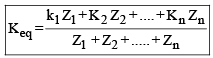
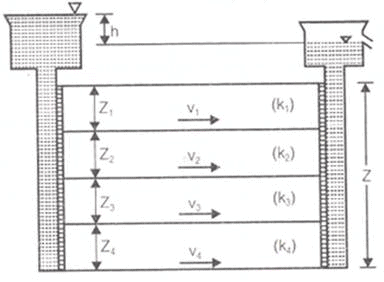
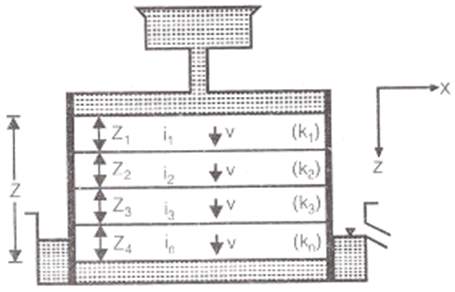
When soil is made up of horizontal layers (strata) of different permeability, the effective permeability depends on the direction of flow with respect to the bedding planes. Permeability parallel to bedding is always greater than permeability perpendicular to bedding.

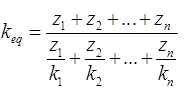
(i) Flow parallel to bedding plane

The expression for average permeability when flow is parallel to layers (bedding) is shown in the image below:

(i) Flow parallel to bedding plane

(ii) Flow perpendicular to bedding plane

The expression for average permeability when flow is perpendicular to the bedding is shown below:

(ii) Flow perpendicular to bedding plane

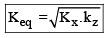
(iii) For two-dimensional flow (X and Z directions)

(iii) For two-dimensional flow (X and Z directions)

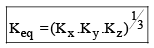
(iv) For three-dimensional flow (x, y and z directions)

(iv) For three-dimensional flow (x, y and z directions)

Coefficient of absolute permeability (Ko)

The coefficient of absolute permeability (often denoted Ko or simply K) is the permeability measured under saturated conditions for water at a specified temperature (usually 20 °C) and expressed in consistent units. The commonly used representation for this coefficient in the source material is shown below.

Coefficient of absolute permeability (Ko)

Practical considerations and applications

  • Permeability controls seepage under dams and embankments and influences the design of filters, drains and dewatering systems.
  • Permeability varies strongly with grain size distribution, void ratio, degree of saturation, and unit weight of soil.
  • Temperature and fluid viscosity affect permeability; values reported are usually corrected or quoted for a standard temperature (commonly 20 °C for water).
  • Laboratory values may differ from field values because of sample disturbance, layering, stress conditions and structure in the field.

Summary

Permeability is a fundamental hydraulic property of soils describing the ease with which water can flow through pore spaces. It is measured in the laboratory by constant head or falling head tests and estimated in design by empirical or theoretical relations such as the Kozeny-Karman and Allen-Hazen equations. Directional effects in stratified soils must be accounted for, and permeability is central to seepage analysis, consolidation behaviour and many geotechnical designs.

The document Permeability - Civil Engineering SSC JE (Technical) - Civil Engineering (CE) is a part of the Civil Engineering (CE) Course Civil Engineering SSC JE (Technical).
All you need of Civil Engineering (CE) at this link: Civil Engineering (CE)
2 videos|160 docs|55 tests

FAQs on Permeability - Civil Engineering SSC JE (Technical) - Civil Engineering (CE)

1. What is permeability?
Ans. Permeability is a property of a material that describes how easily fluids or gases can flow through it. It measures the ease with which a substance can be penetrated or traversed by another substance.
2. How is permeability determined?
Ans. Permeability can be determined through laboratory tests using various methods such as a permeameter. The permeameter measures the flow of fluids or gases through a sample of the material and calculates its permeability based on the pressure and flow rates.
3. What factors affect the permeability of a material?
Ans. Several factors can influence the permeability of a material, including its porosity, grain size, fluid viscosity, temperature, and the presence of any obstructions or barriers within the material. These factors can either enhance or hinder the material's permeability.
4. How is permeability important in various industries?
Ans. Permeability plays a crucial role in various industries. In geology, it helps determine the movement of groundwater and the suitability of soil for construction. In the oil and gas industry, permeability affects the flow of hydrocarbons through reservoir rocks. It is also significant in fields such as filtration, water treatment, and civil engineering.
5. Can permeability be altered or improved?
Ans. Yes, the permeability of a material can be altered or improved by various methods. For example, in civil engineering, soil permeability can be enhanced through techniques like soil compaction or the addition of permeable materials. In filtration systems, the use of different filter media with specific permeability properties can optimize the filtration process.
Related Searches
Permeability - Civil Engineering SSC JE (Technical) - Civil Engineering (CE), Sample Paper, Extra Questions, Permeability - Civil Engineering SSC JE (Technical) - Civil Engineering (CE), video lectures, Viva Questions, ppt, mock tests for examination, Objective type Questions, Semester Notes, Exam, Permeability - Civil Engineering SSC JE (Technical) - Civil Engineering (CE), pdf , study material, practice quizzes, past year papers, Important questions, Free, Previous Year Questions with Solutions, Summary, MCQs, shortcuts and tricks;