Retaining Wall & Earth Pressure Theories | Civil Engineering SSC JE (Technical) - Civil Engineering (CE) PDF Download

Retaining Wall/earth Pressure Theories
CONTRASTING POINTS OF ACTIVE AND PASSIVE PRESSURES
| ACTIVE | PASSIVE | ||
| 1. | Very little movement is required to mobilise the active pressure.(about 0.5% horizontal strain) | 1. | Much higher movement is required to mobilise the pressure (about 2% of horizontal strain) |
| 2. | Failure plane is inclined at 45º + Φ/2 | 2. | Failure plane is inclined at 45º – Φ/2 |
| 3. | Width of sliding wedge at the top of wall is H. Cot (45 + Φ/2) | 3. | Width of sliding wedge at the top of wall is H. Cot (45 - Φ/2) |
EARTH PRESSURE AT REST:
Earth pressure at rest rest is the horizontal pressure acting on the rigid structure.
Earth pressure is given by
For cohesive soils the Terzaghi formula for computing Kr is implemented in the program:
where,
ν=poisson's ratio
For cohesionless soils the Jáky expression is used: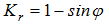
where, Φ=Angle of internal friction of soil
For overconsolidated soils the expression proposed by Schmertmann to compute the coefficient of earth pressure at rest Kr is used:
where, OCR = Over Consolidation Ratio.
Typical values of Ko:
Type of soil - K o
Dense sand - 0.4 to 0.45
Loose sand - 0.45 to 0.5
Mechanically compacted sand - 0.8 to 1.5
Normally consolidated clay - 0.5 to 0.6
Over consolidated clay - 1.0 to 4.0
ACTIVE EARTH PRESSURE:
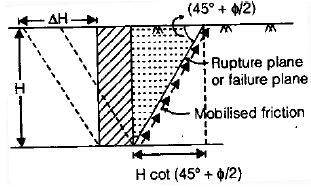
ΔH = 0.2% to 0.5% of H
-length of failure block = H.cot(450+Φ/2)
-ΔH= 0.2%of H for dense sand.
- ΔH= 0.5%of H for loss sand.
-ΔH= 0.4% of H clay
Ka=(1-sinΦ)/(1+sinΦ)=tan2(450-Φ/2)
PASSIVE EARTH PRESSURE
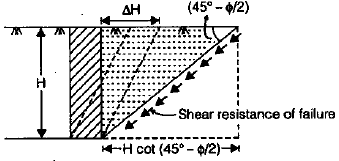
Langth of failure block =H.cot(450-Φ/2)
- ΔH= 2% of H For dense sand
-ΔH=15% of H For losse sand
-ka . kp =1
where
kp = Coefficient of passive earth pressure.
Kp=(1+sinΦ)/(1-sinΦ)=tan2(450+Φ/2)
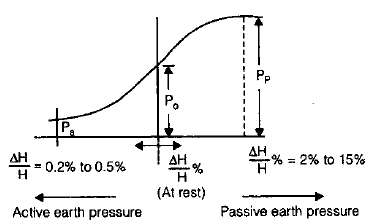
-Pa < Po < Pp
where, Pa = Active earth pressure.
Po = Earth pressure at rest.
Pp = Passive earth pressure.
ACTIVE EARTH PRESSURE BY RANKINE THEORY:
(i) Cohesionless soil on vertical smooth wall: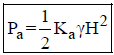
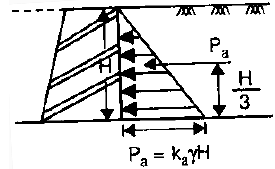
acts at (H/3) from base.
where,Pa = Active earth pressure force on unit length of wall.
(ii) Submerged Cohesionless soil on vertical smooth wall
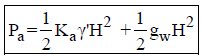
acts at (H/3) from base.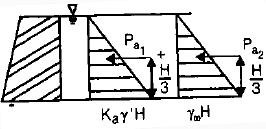
where, g ' = Submerged unit weight of soil.
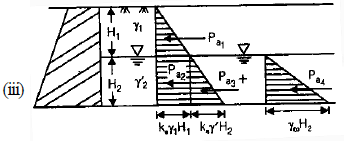
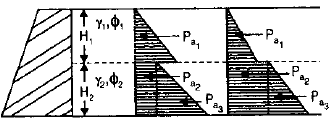
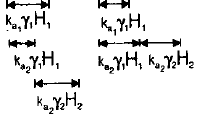
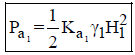
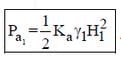 acts at a H2+H1/3 from base =
Pa2 =Kaγ1H22acts at H2/2 from base = 
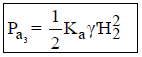 acts at
  from base =
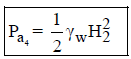 acts at from base =
Total Earth Pressure (Pa)
 acts at
  from base
where,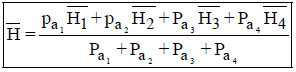
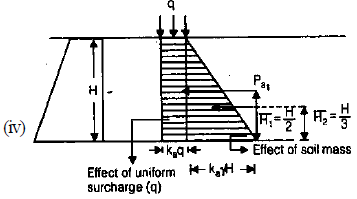
Pa1 = kaq.H acts at from base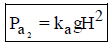
acts at  from base
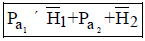
acts at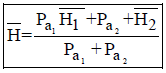
from base.
(v)

 acts at (H2 +H1) from base.
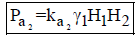 acts at
  from base.
-
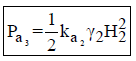 acts at H2 from base.
(vi)
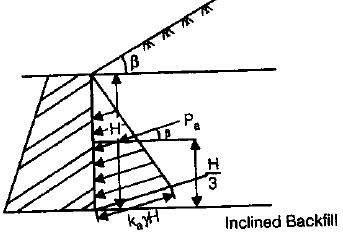
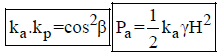
acts at H/3 from base but line of ation is parallel is parallel to backfill.
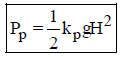
acts at H/3 from base but line of action is parallel to backfill.
(vii)
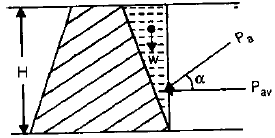
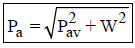
where, W= Weight of soil over inclined back of wall of unit length.
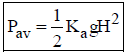
Pav = Active earth pressure on imaginary wall of vertical back.
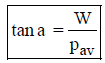
pa = Resultant active earth pressure on the wall
a = Angle of inclination of resultant Pa with the horizontal.
(viii)
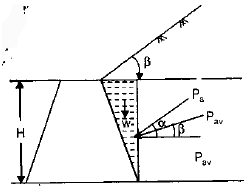

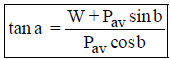
where, Pav = Active earth pressure on Imaginary vertical back of wall. Acts parallel to back fill i.e., of b angle with hori zontal
W = Weigth of soil block of unit length.
ACTIVE EARTH PRESSURE FOR COHESIVE SOIL
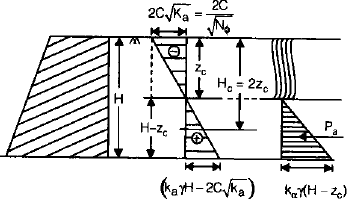
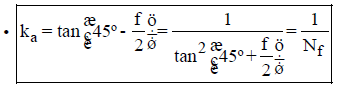
whereNf = Influence Factor.
- Active Earth Pressure of Any Depth z
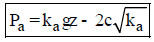
- Active Earth Pressure of Surface. i.e., at z = 0
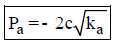
- At Z = Zc ® Pa = O
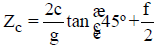
where, ZC = depth of tension crack.
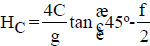
where, Hc = Cirtical depth = 27º = max. Possible unsupported depth.
PASSIVE EARTH PRESSURE FOR COHESIVE SOIL
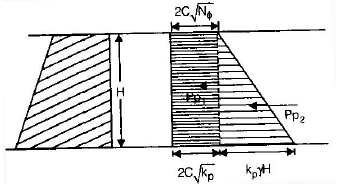
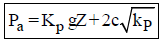
- Passive Earth Pressure at any depth ‘Z’,
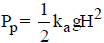
- Total Pp on Unit Length
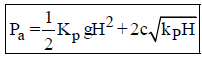
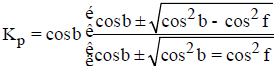
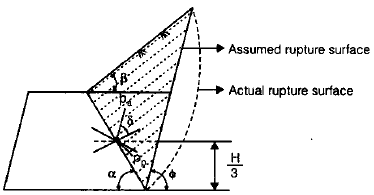
- Coulombs Wedge Theory
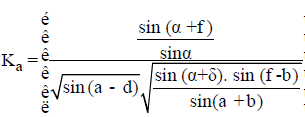
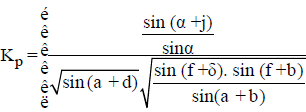
where, a = Angle of back of wall with the hori zontal
b = Angle of sloping ground.
f = Angle of roughness between soil and wall
= 0º for smooth walls
- When Tension Cracks are not Developed
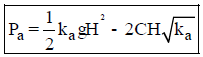
acts at centroid of trapezoidal.
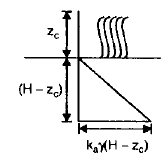
- When Tension Cracks are Developed
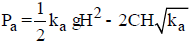
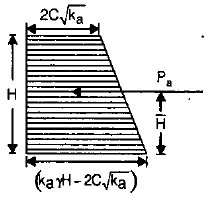
Acts at centroid of trapezoidal
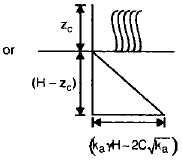
- When tension Cracks are Developed

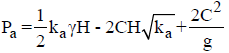 or
or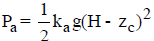
acts at
Remember:- Cohesion decreases the active earth pressure while increases the passive earth pressure.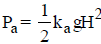
acts at (H/3) from base of an angledwith the normal of wall.
|
2 videos|133 docs|55 tests
|
FAQs on Retaining Wall & Earth Pressure Theories - Civil Engineering SSC JE (Technical) - Civil Engineering (CE)
| 1. What is a retaining wall? |  |
| 2. What are the different types of retaining walls? | |
| 3. What is earth pressure theory? | |
| 4. How is lateral earth pressure calculated? | |
| 5. What are the factors that affect earth pressure on a retaining wall? | |





Retaining Wall & Earth Pressure Theories | Civil Engineering SSC JE (Technical) - Civil Engineering (CE)
,Free
,Summary
,practice quizzes
,Objective type Questions
,shortcuts and tricks
,Semester Notes
,Important questions
,video lectures
,Retaining Wall & Earth Pressure Theories | Civil Engineering SSC JE (Technical) - Civil Engineering (CE)
,MCQs
,Viva Questions
,Previous Year Questions with Solutions
,Sample Paper
,mock tests for examination
,Retaining Wall & Earth Pressure Theories | Civil Engineering SSC JE (Technical) - Civil Engineering (CE)
,past year papers
,Exam
,ppt
,Extra Questions
,study material
;



Retaining Wall & Earth Pressure Theories Free PDF Download
Importance of Retaining Wall & Earth Pressure Theories
Retaining Wall & Earth Pressure Theories Notes
Retaining Wall & Earth Pressure Theories Civil Engineering (CE) Questions
Study Retaining Wall & Earth Pressure Theories on the App
|
© EduRev
|
Education Revolution
|


|




