


All Exams >
Interview Preparation >
Quantitative Aptitude (Quant) >
All Questions
All questions of Progressions (Sequences & Series) for Interview Preparation Exam
A bacteria gives birth to two new bacteria in each second and the life span of each bacteria is 5 seconds. The process of the reproduction is continuous until the death of the bacteria. initially there is one newly born bacteria at time t = 0, the find the total number of live bacteria just after 10 seconds :- a)310 /2
- b)310 - 210
- c)243 *(35 -1)
- d)310 -25
- e)None of these
Correct answer is option 'C'. Can you explain this answer?
A bacteria gives birth to two new bacteria in each second and the life span of each bacteria is 5 seconds. The process of the reproduction is continuous until the death of the bacteria. initially there is one newly born bacteria at time t = 0, the find the total number of live bacteria just after 10 seconds :
a)
310 /2
b)
310 - 210
c)
243 *(35 -1)
d)
310 -25
e)
None of these

|
Pallabi Deshpande answered |
Total number of bacteria after 10 seconds,
= 3^10 - 3^5
= 3^5 *(3^5 -1)
= 243 *(3^5 -1)
Since, just after 10 seconds all the bacterias (i.e. 3^5 ) are dead after living 5 seconds each.

After striking the floor, a rubber ball rebounds to 4/5th of the height from which it has fallen. Find the total distance that it travels before coming to rest if it has been gently dropped from a height of 120 metres.- a)540 m
- b)960 m
- c)1080 m
- d)1020 m
- e)1120 m
Correct answer is option 'C'. Can you explain this answer?
After striking the floor, a rubber ball rebounds to 4/5th of the height from which it has fallen. Find the total distance that it travels before coming to rest if it has been gently dropped from a height of 120 metres.
a)
540 m
b)
960 m
c)
1080 m
d)
1020 m
e)
1120 m

|
Vikas Choudhury answered |
The first drop is 120 metres. After this the ball will rise by 96 metres and fall by 96 metres. This process will continue in the form of infinite GP with common ratio 0.8 and first term 96. The required answer is given by the formula:
a/(1-r)
Now,
[{120/(1/5)}+{96/(1/5)}]
= 1080 m.
There are three numbers in an arithmetic progression. If the two larger numbers are increased by one, then the resulting numbers are prime. The product of these two primes and the smallest of the original numbers is 598. Find the sum of the three numbers.- a)45
- b)29
- c)42
- d)36
Correct answer is option 'C'. Can you explain this answer?
There are three numbers in an arithmetic progression. If the two larger numbers are increased by one, then the resulting numbers are prime. The product of these two primes and the smallest of the original numbers is 598. Find the sum of the three numbers.
a)
45
b)
29
c)
42
d)
36

|
Krishna Iyer answered |
Let three numbers are 2,12,22
Two larger numbers are increased by 1 : 13,23
New three numbers : 2,13,23
Product of these numbers is equal to 598.
=> 2*13*23 = 598
Sum of the three numbers = 2+13+23
= 36
Two larger numbers are increased by 1 : 13,23
New three numbers : 2,13,23
Product of these numbers is equal to 598.
=> 2*13*23 = 598
Sum of the three numbers = 2+13+23
= 36
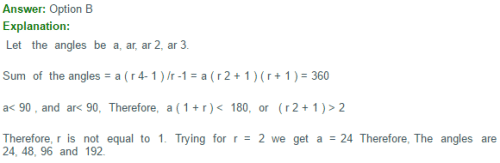
In how many ways can we select three natural numbers out of the first 10 natural numbers so that they are in a geometric progression with the common ratio greater than 1?- a)2 ways
- b)3 ways
- c)4 ways
- d)5 ways
Correct answer is option 'B'. Can you explain this answer?
In how many ways can we select three natural numbers out of the first 10 natural numbers so that they are in a geometric progression with the common ratio greater than 1?
a)
2 ways
b)
3 ways
c)
4 ways
d)
5 ways

|
Kirti Kumar answered |
Make pair of three numbers. Only sequence with 2 and 3 as the common ratio is possible.
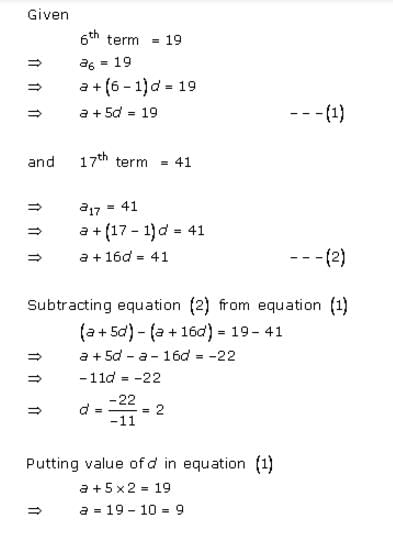
Find the first term of an AP whose 8th and 12th terms are respectively 39 and 59.- a)5
- b)6
- c)4
- d)3
- e)7
Correct answer is 'C'. Can you explain this answer?
Find the first term of an AP whose 8th and 12th terms are respectively 39 and 59.
a)
5
b)
6
c)
4
d)
3
e)
7

|
Rishabh Rajawat answered |
39=a+7d, 59=a+11d, on solving. 4d=20,so d=5,so 59=a+(11×5), 59=a+55,so a=4.

Find the 15th term of an arithmetic progression whose first term is 2 and the common difference is 3
- a)45
- b)38
- c)44
- d)40
Correct answer is option 'C'. Can you explain this answer?
Find the 15th term of an arithmetic progression whose first term is 2 and the common difference is 3
a)
45
b)
38
c)
44
d)
40

|
Aisha Gupta answered |
Method to Solve :
A ( first term ) :- 2
d ( common difference ) :- 3
n = 15
To find nth term we have formula as
an = a + ( n - 1 )d
a15 = 2 + 14 � 3
a15 = 2 + 42
a15 = 44
d ( common difference ) :- 3
n = 15
To find nth term we have formula as
an = a + ( n - 1 )d
a15 = 2 + 14 � 3
a15 = 2 + 42
a15 = 44
How many natural numbers between 300 to 500 are multiples of 7?- a)29
- b)28
- c)27
- d)30
Correct answer is option 'A'. Can you explain this answer?
How many natural numbers between 300 to 500 are multiples of 7?
a)
29
b)
28
c)
27
d)
30

|
Disha Sengupta answered |
The series will be 301, 308, …….. 497

A and B are two numbers whose AM is 25 and GM is 7. Which of the following may be a value ofA?- a)10
- b)20
- c)49
- d)25
Correct answer is option 'C'. Can you explain this answer?
A and B are two numbers whose AM is 25 and GM is 7. Which of the following may be a value ofA?
a)
10
b)
20
c)
49
d)
25

|
Ishani Rane answered |
(a + b)/2 = 25
a + b = 50
√ab = 7
ab = 49
Hence, A can either be 7 or 49.
So, 49 is the answer.
How many terms are there in 20, 25, 30......... 140- a)22
- b)25
- c)23
- d)24
Correct answer is option 'B'. Can you explain this answer?
How many terms are there in 20, 25, 30......... 140
a)
22
b)
25
c)
23
d)
24
|
|
Anaya Patel answered |
Number of terms = { (1st term - last term) / common difference} + 1
= {(140-20) / 5} + 1
⇒ (120/5) + 1
⇒ 24 + 1 = 25.
= {(140-20) / 5} + 1
⇒ (120/5) + 1
⇒ 24 + 1 = 25.
In a nuclear power plant a technician is allowed an interval of maximum 100 minutes. A timerwith a bell rings at specific intervals of time such that the minutes when the timer rings are notdivisible by 2, 3, 5 and 7. The last alarm rings with a buzzer to give time for decontamination ofthe technician. How many times will the bell ring within these 100 minutes and what is the valueof the last minute when the bell rings for the last time in a 100 minute shift?- a)25 times, 89
- b)21 times, 97
- c)22 times, 97
- d)19 times, 97
Correct answer is option 'C'. Can you explain this answer?
In a nuclear power plant a technician is allowed an interval of maximum 100 minutes. A timerwith a bell rings at specific intervals of time such that the minutes when the timer rings are notdivisible by 2, 3, 5 and 7. The last alarm rings with a buzzer to give time for decontamination ofthe technician. How many times will the bell ring within these 100 minutes and what is the valueof the last minute when the bell rings for the last time in a 100 minute shift?
a)
25 times, 89
b)
21 times, 97
c)
22 times, 97
d)
19 times, 97

|
Priyanka Datta answered |
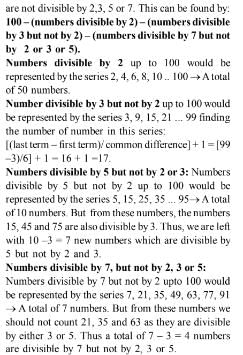
Ans.

Find the 15th term of the sequence 20, 15, 10....- a)-45
- b)-55
- c)-50
- d)0
Correct answer is option 'C'. Can you explain this answer?
Find the 15th term of the sequence 20, 15, 10....
a)
-45
b)
-55
c)
-50
d)
0

|
Ravi Singh answered |
15th term = a + 14d
⇒ 20 + 14*(-5)
⇒ 20 - 70 = -50.
⇒ 20 + 14*(-5)
⇒ 20 - 70 = -50.

Find the sum of all odd numbers lying between 100 and 200.- a)7500
- b)2450
- c)2550
- d)2650
Correct answer is option 'A'. Can you explain this answer?
Find the sum of all odd numbers lying between 100 and 200.
a)
7500
b)
2450
c)
2550
d)
2650

|
Krithika Sengupta answered |
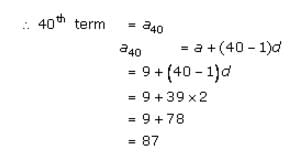
101 + 103 + 105 + … 199 = 150 × 50 = 7500
A boy agrees to work at the rate of one rupee on the first day, two rupees on the second day, and four rupees on third day and so on. How much will the boy get if he started working on the 1st of February and finishes on the 20th of February?a) 2^20b) 2^20-1c) 2^19-1d) 2^19e) None of theseCorrect answer is option 'B'. Can you explain this answer?

|
Yash Soni answered |
Can't we find with t
The sum of 5 numbers in AP is 30 and the sum of their squares is 220. Which of the following is the third term?- a)5
- b)6
- c)8
- d)9
Correct answer is option 'B'. Can you explain this answer?
The sum of 5 numbers in AP is 30 and the sum of their squares is 220. Which of the following is the third term?
a)
5
b)
6
c)
8
d)
9

|
Isha Mukherjee answered |
Since the sum of 5 numbers in AP is 30, their average would be 6. The average of 5 terms in AP is
also equal to the value of the 3rd term (logic of the middle term of an AP). Hence, the third term’s
value would be 6. Option (b) is correct.
also equal to the value of the 3rd term (logic of the middle term of an AP). Hence, the third term’s
value would be 6. Option (b) is correct.
The internal angles of a plane polygon are in AP. The smallest angle is 100o and the commondifference is 10o. Find the number of sides of the polygon.- a)8
- b)9
- c)Either 8 or 9
- d)None of these
Correct answer is option 'C'. Can you explain this answer?
The internal angles of a plane polygon are in AP. The smallest angle is 100o and the commondifference is 10o. Find the number of sides of the polygon.
a)
8
b)
9
c)
Either 8 or 9
d)
None of these

|
Rashi Nambiar answered |
The sum of the interior angles of a polygon are multiples of 180 and are given by (n – 1) × 180
where n is the number of sides of the polygon. Thus, the sum of interior angles of a polygon would
be a member of the series: 180, 360, 540, 720, 900, 1080, 1260
The sum of the series with first term 100 and common difference 10 would keep increasing when
we take more and more terms of the series. In order to see the number of sides of the polygon, we
should get a situation where the sum of the series represented by 100 + 110 + 120… should
become a multiple of 180. The number of sides in the polygon would then be the number of terms
in the series 100, 110, 120 at that point.
If we explore the sums of the series represented by 100 + 110 + 120…
We realize that the sum of the series becomes a multiple of 180 for 8 terms as well as for 9 terms.
It can be seen in: 100 + 110 + 120 + 130 + 140 + 150 + 160 + 170 = 1080
Or 100 + 110 + 120 + 130 + 140 + 150 + 160 + 170 + 180 = 1260.
where n is the number of sides of the polygon. Thus, the sum of interior angles of a polygon would
be a member of the series: 180, 360, 540, 720, 900, 1080, 1260
The sum of the series with first term 100 and common difference 10 would keep increasing when
we take more and more terms of the series. In order to see the number of sides of the polygon, we
should get a situation where the sum of the series represented by 100 + 110 + 120… should
become a multiple of 180. The number of sides in the polygon would then be the number of terms
in the series 100, 110, 120 at that point.
If we explore the sums of the series represented by 100 + 110 + 120…
We realize that the sum of the series becomes a multiple of 180 for 8 terms as well as for 9 terms.
It can be seen in: 100 + 110 + 120 + 130 + 140 + 150 + 160 + 170 = 1080
Or 100 + 110 + 120 + 130 + 140 + 150 + 160 + 170 + 180 = 1260.
If the nth term of AP is m and the nth term of the same AP is m, then (m + n)th term of AP is- a)m+n
- b)0
- c)m-n
- d)-m+n
Correct answer is option 'B'. Can you explain this answer?
If the nth term of AP is m and the nth term of the same AP is m, then (m + n)th term of AP is
a)
m+n
b)
0
c)
m-n
d)
-m+n

|
Impact Learning answered |
- Tn = m = a + (n - l ) d
- Tm = n= a + (m - l ) d
- subtracting them we get d=-1
- and a=m+n-1
- Add the two and solve through the options given.
- then (m + n)th term of AP= a+(m+n-1)d
- Putting values of a and d in the solution, we get
- = m+n-1+(m+n-1)x-1
- = 0
The sum of the first four terms of an AP is 28 and sum of the first eight terms of the same AP is 88.Find the sum of the first 16 terms of the AP?- a)346
- b)340
- c)304
- d)268
Correct answer is option 'C'. Can you explain this answer?
The sum of the first four terms of an AP is 28 and sum of the first eight terms of the same AP is 88.Find the sum of the first 16 terms of the AP?
a)
346
b)
340
c)
304
d)
268

|
Abhay Shah answered |
Think like this:
The average of the first 4 terms is 7, while the average of the first 8 terms must be 11.
Now visualize this :
The average of the first 4 terms is 7, while the average of the first 8 terms must be 11.
Now visualize this :

Hence, d = 4/2 = 2 [Note: understand this as a property of an A.P.]
Hence, the average of the 6th and 7th terms = 15 and the average of the 8th and 9th term = 19
But this (19) also represents the average of the 16 term A.P.
Hence, required answer = 16 × 19 = 304.
Hence, the average of the 6th and 7th terms = 15 and the average of the 8th and 9th term = 19
But this (19) also represents the average of the 16 term A.P.
Hence, required answer = 16 × 19 = 304.

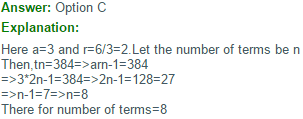
How many terms are there in the GP 5, 20, 80, 320........... 20480?- a)5
- b)6
- c)8
- d)9
- e)7
Correct answer is option 'E'. Can you explain this answer?
How many terms are there in the GP 5, 20, 80, 320........... 20480?
a)
5
b)
6
c)
8
d)
9
e)
7

|
Sameer Rane answered |
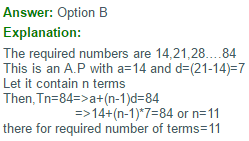
Common ratio, r = 20/5 = 4;
Last term or nth term of GP = ar^[n-1].
20480 = 5*[4^(n-1)];
Or, 4^(n-1) = 20480/5 = 4^8;
So, comparing the power,
Thus, n-1 = 8;
Or, n = 7;
Number of terms = 7.
An equilateral triangle is drawn by joining the midpoints of the sides of another equilateraltriangle. A third equilateral triangle is drawn inside the second one joining the midpoints of thesides of the second equilateral triangle, and the process continues infinitely. Find the sum of theperimeters of all the equilateral triangles, if the side of the largest equilateral triangle is 24 units.- a)288 units
- b)72 units
- c)36 units
- d)144 units
Correct answer is option 'D'. Can you explain this answer?
An equilateral triangle is drawn by joining the midpoints of the sides of another equilateraltriangle. A third equilateral triangle is drawn inside the second one joining the midpoints of thesides of the second equilateral triangle, and the process continues infinitely. Find the sum of theperimeters of all the equilateral triangles, if the side of the largest equilateral triangle is 24 units.
a)
288 units
b)
72 units
c)
36 units
d)
144 units

|
Geetika Sharma answered |
The side of the first equilateral triangle being 24 units, the first perimeter is 72 units. The second
perimeter would be half of that and so on.
72, 36, 18 …
perimeter would be half of that and so on.
72, 36, 18 …
How many terms are there in the AP 20, 25, 30,… 130.- a)22
- b)23
- c)21
- d)24
Correct answer is option 'B'. Can you explain this answer?
How many terms are there in the AP 20, 25, 30,… 130.
a)
22
b)
23
c)
21
d)
24

|
Arnav Rane answered |
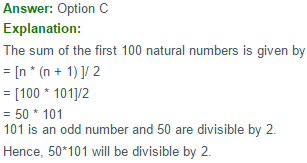
In order to count the number of terms in the AP, use the short cut:
[(last term – first term)/ common difference] + 1. In this case it would become:
[(130 – 20)/5] +1 = 23. Option (b) is correct.
[(last term – first term)/ common difference] + 1. In this case it would become:
[(130 – 20)/5] +1 = 23. Option (b) is correct.
A group of friends have some money which was in an increasing GP. The total money with the first and the last friend was Rs 66 and the product of the money that the second friend had and that the last but one friend had was Rs 128. If the total money with all of them together was Rs 126, then how many friends were there?- a)6
- b)5
- c)3
- d)Cannot be determined
Correct answer is option 'A'. Can you explain this answer?
A group of friends have some money which was in an increasing GP. The total money with the first and the last friend was Rs 66 and the product of the money that the second friend had and that the last but one friend had was Rs 128. If the total money with all of them together was Rs 126, then how many friends were there?
a)
6
b)
5
c)
3
d)
Cannot be determined

|
Prasenjit Basu answered |
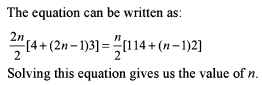
The sum of money with the first and the last friend = 66. This can be used as a hint. Let us assume the first friend was having Rs 2 and the last friend was having Rs 64. So, the money can be in the sequence 2, 4, 8, 16, 32, 64. It satisfies the given conditions. Alternatively, this can be done by using the formula for tn of GP also.
If a man saves ` 4 more each year than he did the year before and if he saves ` 20 in the first year,after how many years will his savings be more than ` 1000 altogether?- a)19 years
- b)20 years
- c)21years
- d)18 years
Correct answer is option 'A'. Can you explain this answer?
If a man saves ` 4 more each year than he did the year before and if he saves ` 20 in the first year,after how many years will his savings be more than ` 1000 altogether?
a)
19 years
b)
20 years
c)
21years
d)
18 years
|
|
Aarav Sharma answered |
Solution:
To solve this problem, we can use the formula for the sum of an arithmetic progression:
Sn = n/2[2a + (n-1)d]
where Sn is the sum of the first n terms, a is the first term, d is the common difference, and n is the number of terms.
We know that the man saves 4 more each year than he did the year before, so the common difference is d = 4.
We also know that he saves `20 in the first year, so the first term is a = 20.
We want to find out after how many years his savings will be more than `1000 altogether, so we want to find the value of n that satisfies the inequality Sn > 1000.
Substituting the values that we know into the formula, we get:
Sn = n/2[2a + (n-1)d]
Sn = n/2[2(20) + (n-1)(4)]
Sn = n/2[40 + 4n - 4]
Sn = n/2[36 + 4n]
Sn = 18n + 2n^2
Now we can set up the inequality:
Sn > 1000
18n + 2n^2 > 1000
2n^2 + 18n - 1000 > 0
We can solve this quadratic inequality by factoring or using the quadratic formula, but we can also estimate the value of n by looking at the options given.
Option A is 19 years, which means that the man's savings would be:
S19 = 19/2[2(20) + (19-1)(4)]
S19 = 19/2[40 + 72]
S19 = 19/2[112]
S19 = 1064
This is more than `1000, so option A is the correct answer.
We can also check the other options:
Option B: S20 = 20/2[2(20) + (20-1)(4)] = 1120
Option C: S21 = 21/2[2(20) + (21-1)(4)] = 1204
Option D: S18 = 18/2[2(20) + (18-1)(4)] = 988
Therefore, the correct answer is option A, 19 years.
To solve this problem, we can use the formula for the sum of an arithmetic progression:
Sn = n/2[2a + (n-1)d]
where Sn is the sum of the first n terms, a is the first term, d is the common difference, and n is the number of terms.
We know that the man saves 4 more each year than he did the year before, so the common difference is d = 4.
We also know that he saves `20 in the first year, so the first term is a = 20.
We want to find out after how many years his savings will be more than `1000 altogether, so we want to find the value of n that satisfies the inequality Sn > 1000.
Substituting the values that we know into the formula, we get:
Sn = n/2[2a + (n-1)d]
Sn = n/2[2(20) + (n-1)(4)]
Sn = n/2[40 + 4n - 4]
Sn = n/2[36 + 4n]
Sn = 18n + 2n^2
Now we can set up the inequality:
Sn > 1000
18n + 2n^2 > 1000
2n^2 + 18n - 1000 > 0
We can solve this quadratic inequality by factoring or using the quadratic formula, but we can also estimate the value of n by looking at the options given.
Option A is 19 years, which means that the man's savings would be:
S19 = 19/2[2(20) + (19-1)(4)]
S19 = 19/2[40 + 72]
S19 = 19/2[112]
S19 = 1064
This is more than `1000, so option A is the correct answer.
We can also check the other options:
Option B: S20 = 20/2[2(20) + (20-1)(4)] = 1120
Option C: S21 = 21/2[2(20) + (21-1)(4)] = 1204
Option D: S18 = 18/2[2(20) + (18-1)(4)] = 988
Therefore, the correct answer is option A, 19 years.
What is the sum of the first 15 terms of an A.P whose 11 th and 7 th terms are 5.25 and 3.25 respectively- a)56.25
- b)60
- c)52.5
- d)none of these
Correct answer is option 'A'. Can you explain this answer?
What is the sum of the first 15 terms of an A.P whose 11 th and 7 th terms are 5.25 and 3.25 respectively
a)
56.25
b)
60
c)
52.5
d)
none of these
|
|
Ishani Rane answered |
a +10d = 5.25, a+6d = 3.25, 4d = 2, d = 1/4
a +5 = 5.25, a = 0.25 = 1/4, s 15 = 15/2 ( 2 * 1/4 + 14 * 1/4 )
= 15/2 (1/2 +14/2 ) = 15/2 *15/2 =225/ 4 = 56.25
In an arithmetic series consisting of 51 terms, the sum of the first three terms is 65 and the sum of the middle three terms is 129. What is the first term and the common difference of the series?- a)64, 9/8
- b)32, 8/9
- c)187/9, 8/9
- d)72, 9/8
Correct answer is option 'C'. Can you explain this answer?
In an arithmetic series consisting of 51 terms, the sum of the first three terms is 65 and the sum of the middle three terms is 129. What is the first term and the common difference of the series?
a)
64, 9/8
b)
32, 8/9
c)
187/9, 8/9
d)
72, 9/8

|
Manoj Ghosh answered |
Given a + (a + d) + (a + 2d)= 65
=> 3a + 3d =65…. (1)
The middle terms are 25th , 26th and 27th terms
=> a + 24d + a + 25d + a + 26d = 129
=> 3a + 75d
129 ….(2)
From (1) and (2) d= 8/9 =>a= 187/9
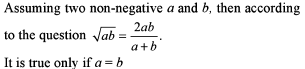
If a geometric mean of two non-negative numbers is equal to their harmonic mean, then which of the following is necessarily true?I. One of the numbers is zero.II. Both the numbers are equal.III. One of the numbers is one.- a)I and III only
- b)Either I or III
- c)III only
- d)None of these
Correct answer is option 'D'. Can you explain this answer?
If a geometric mean of two non-negative numbers is equal to their harmonic mean, then which of the following is necessarily true?I. One of the numbers is zero.II. Both the numbers are equal.III. One of the numbers is one.
a)
I and III only
b)
Either I or III
c)
III only
d)
None of these

|
Hridoy Roy answered |
A number 20 is divided into four parts that are in AP such that the product of the first and fourth is to the product of the second and third is 2 : 3. Find the largest part.- a)12
- b)4
- c)8
- d)9
Correct answer is option 'C'. Can you explain this answer?
A number 20 is divided into four parts that are in AP such that the product of the first and fourth is to the product of the second and third is 2 : 3. Find the largest part.
a)
12
b)
4
c)
8
d)
9

|
Dipika Iyer answered |
Since the four parts of the number are in AP and their sum is 20, the average of the four parts must
be 5. Looking at the options for the largest part, only the value of 8 fits in, as it leads us to think of
the AP 2, 4, 6, 8. In this case, the ratio of the product of the first and fourth (2 × 8) to the product
of the first and second (4 × 6) are equal. The ratio becomes 2:3.
be 5. Looking at the options for the largest part, only the value of 8 fits in, as it leads us to think of
the AP 2, 4, 6, 8. In this case, the ratio of the product of the first and fourth (2 × 8) to the product
of the first and second (4 × 6) are equal. The ratio becomes 2:3.
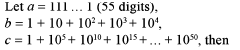

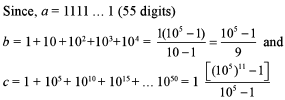

The mid-points of the adjacent sides of a square are joined. Again the mid-points of the adjacent sides of the newly formed figure are connected and this process is repeated again and again. Calculate the sum of the areas of all such figures given that the diagonal of outermost square is 6√2cm.- a)35 cm2
- b)44 cm2
- c)72 cm2
- d)58 cm2
Correct answer is option 'C'. Can you explain this answer?
The mid-points of the adjacent sides of a square are joined. Again the mid-points of the adjacent sides of the newly formed figure are connected and this process is repeated again and again. Calculate the sum of the areas of all such figures given that the diagonal of outermost square is 6√2cm.
a)
35 cm2
b)
44 cm2
c)
72 cm2
d)
58 cm2
|
|
Aarav Sharma answered |
Let the side of the outermost square be $s$. Then its diagonal is $s\sqrt{2}=6$, so $s=3\sqrt{2}$.
The first figure formed by joining the midpoints of adjacent sides is a square whose side length is $\frac{s}{\sqrt{2}}=\frac{3\sqrt{2}}{2}$. Its area is $\left(\frac{3\sqrt{2}}{2}\right)^2=\frac{27}{4}$.
The second figure formed by joining the midpoints of adjacent sides of the first figure is a square whose side length is $\frac{s}{2}$. Its area is $\left(\frac{s}{2}\right)^2=\frac{18}{4}=4.5$.
The third figure formed by joining the midpoints of adjacent sides of the second figure is a square whose side length is $\frac{s}{2\sqrt{2}}=\frac{3}{2}$. Its area is $\left(\frac{3}{2}\right)^2=\frac{9}{4}$.
This process continues indefinitely, with each successive figure being a square whose side length is half the previous square's side length. The sum of the areas of all these squares is therefore:
$$\frac{27}{4}+4.5+\frac{9}{4}+\frac{9}{16}+\frac{1}{4}+\frac{1}{64}+\cdots$$
This is an infinite geometric series with first term $\frac{27}{4}$ and common ratio $\frac{1}{8}$. Therefore, the sum is:
$$\frac{\frac{27}{4}}{1-\frac{1}{8}}=\frac{\frac{27}{4}}{\frac{7}{8}}=\frac{27}{4}\cdot\frac{8}{7}=\boxed{12}$$
The first figure formed by joining the midpoints of adjacent sides is a square whose side length is $\frac{s}{\sqrt{2}}=\frac{3\sqrt{2}}{2}$. Its area is $\left(\frac{3\sqrt{2}}{2}\right)^2=\frac{27}{4}$.
The second figure formed by joining the midpoints of adjacent sides of the first figure is a square whose side length is $\frac{s}{2}$. Its area is $\left(\frac{s}{2}\right)^2=\frac{18}{4}=4.5$.
The third figure formed by joining the midpoints of adjacent sides of the second figure is a square whose side length is $\frac{s}{2\sqrt{2}}=\frac{3}{2}$. Its area is $\left(\frac{3}{2}\right)^2=\frac{9}{4}$.
This process continues indefinitely, with each successive figure being a square whose side length is half the previous square's side length. The sum of the areas of all these squares is therefore:
$$\frac{27}{4}+4.5+\frac{9}{4}+\frac{9}{16}+\frac{1}{4}+\frac{1}{64}+\cdots$$
This is an infinite geometric series with first term $\frac{27}{4}$ and common ratio $\frac{1}{8}$. Therefore, the sum is:
$$\frac{\frac{27}{4}}{1-\frac{1}{8}}=\frac{\frac{27}{4}}{\frac{7}{8}}=\frac{27}{4}\cdot\frac{8}{7}=\boxed{12}$$
The 4th and 10th term of an GP are 1/3 and 243 respectively. Find the 2nd term.- a)3
- b)1
- c)1/27
- d)1/9
Correct answer is option 'C'. Can you explain this answer?
The 4th and 10th term of an GP are 1/3 and 243 respectively. Find the 2nd term.
a)
3
b)
1
c)
1/27
d)
1/9
|
|
Aarav Sharma answered |
Given, 4th term = 1/3 and 10th term = 243.
Let the first term be 'a' and the common ratio be 'r'.
We know that the nth term of a GP is given by ar^(n-1).
So, we can write:
ar^3 = 1/3 ...(1)
ar^9 = 243 ...(2)
Dividing equation (2) by equation (1), we get:
r^6 = 729
r = 3
Substituting this value of r in equation (1), we get:
a(3^3) = 1/3
a = 1/27
Therefore, the first term of the GP is 1/27 and the second term can be found using the formula:
ar = (1/27)*3 = 1/9
Hence, the correct answer is option (c) 1/27.
Let the first term be 'a' and the common ratio be 'r'.
We know that the nth term of a GP is given by ar^(n-1).
So, we can write:
ar^3 = 1/3 ...(1)
ar^9 = 243 ...(2)
Dividing equation (2) by equation (1), we get:
r^6 = 729
r = 3
Substituting this value of r in equation (1), we get:
a(3^3) = 1/3
a = 1/27
Therefore, the first term of the GP is 1/27 and the second term can be found using the formula:
ar = (1/27)*3 = 1/9
Hence, the correct answer is option (c) 1/27.
Find the lowest number in an AP such that the sum of all the terms is 105 and greatest term is 6 times the least.- a)5
- b)10
- c)15
- d)(a), (b) & (c)
Correct answer is option 'D'. Can you explain this answer?
Find the lowest number in an AP such that the sum of all the terms is 105 and greatest term is 6 times the least.
a)
5
b)
10
c)
15
d)
(a), (b) & (c)
|
|
Aarav Sharma answered |
Approach:
Let the first term of the AP be a and the common difference be d.
Given, Sum of all the terms = 105
Also, greatest term = 6 times the least term
Therefore, the greatest term = a + (n-1)d = 6a
where n is the number of terms in the AP.
Calculation:
1. Sum of all terms in an AP:
Sum of n terms in an AP can be given by the formula:
Sum = (n/2)[2a + (n-1)d]
Here, Sum = 105
105 = (n/2)[2a + (n-1)d]
2. Greatest term is 6 times the least term:
a + (n-1)d = 6a
5a = (n-1)d
3. Substitute the value of d in equation 1:
105 = (n/2)[2a + 5a(n-1)/(n-1)]
105 = (n/2)[(7a-5a+5a(n-1))/(n-1)]
105 = (n/2)[(2a+5a(n-1))/(n-1)]
4. Simplify the equation:
210 = n[2a + 5a(n-1)]
Divide both sides by a:
210/a = n(2 + 5n - 5)
42/a = n(5n-3)
5. Check for values of a:
We need to find the lowest value of a.
From the above equation, we can see that a must be a factor of 42.
Therefore, the possible values of a are 1, 2, 3, 6, 7, 14, 21, 42.
6. Substitute values of a to find n:
For each value of a, we can find the corresponding value of n.
If the value of n is a positive integer, then that value of a is valid.
The values of a and n are as follows:
a = 1, n = 15
a = 2, n = 6
a = 3, n = 3.6 (not valid)
a = 6, n = 2.4 (not valid)
a = 7, n = 2.1 (not valid)
a = 14, n = 1.5 (not valid)
a = 21, n = 1.2 (not valid)
a = 42, n = 0.75 (not valid)
7. Find the common difference:
From the equation, 5a = (n-1)d, we get the common difference as:
d = 5a/(n-1)
8. Check for valid values of d:
If the value of d is positive, then the corresponding value of a is valid.
The values of a, n, and d are as follows:
a = 1, n = 15, d = 1/2 (valid)
a = 2, n = 6, d = 2/5 (not valid)
a = 3, n = 3.6, d = 3 (not valid)
a = 6, n = 2.4, d = 6 (not valid)
a = 7, n = 2.1, d
Let the first term of the AP be a and the common difference be d.
Given, Sum of all the terms = 105
Also, greatest term = 6 times the least term
Therefore, the greatest term = a + (n-1)d = 6a
where n is the number of terms in the AP.
Calculation:
1. Sum of all terms in an AP:
Sum of n terms in an AP can be given by the formula:
Sum = (n/2)[2a + (n-1)d]
Here, Sum = 105
105 = (n/2)[2a + (n-1)d]
2. Greatest term is 6 times the least term:
a + (n-1)d = 6a
5a = (n-1)d
3. Substitute the value of d in equation 1:
105 = (n/2)[2a + 5a(n-1)/(n-1)]
105 = (n/2)[(7a-5a+5a(n-1))/(n-1)]
105 = (n/2)[(2a+5a(n-1))/(n-1)]
4. Simplify the equation:
210 = n[2a + 5a(n-1)]
Divide both sides by a:
210/a = n(2 + 5n - 5)
42/a = n(5n-3)
5. Check for values of a:
We need to find the lowest value of a.
From the above equation, we can see that a must be a factor of 42.
Therefore, the possible values of a are 1, 2, 3, 6, 7, 14, 21, 42.
6. Substitute values of a to find n:
For each value of a, we can find the corresponding value of n.
If the value of n is a positive integer, then that value of a is valid.
The values of a and n are as follows:
a = 1, n = 15
a = 2, n = 6
a = 3, n = 3.6 (not valid)
a = 6, n = 2.4 (not valid)
a = 7, n = 2.1 (not valid)
a = 14, n = 1.5 (not valid)
a = 21, n = 1.2 (not valid)
a = 42, n = 0.75 (not valid)
7. Find the common difference:
From the equation, 5a = (n-1)d, we get the common difference as:
d = 5a/(n-1)
8. Check for valid values of d:
If the value of d is positive, then the corresponding value of a is valid.
The values of a, n, and d are as follows:
a = 1, n = 15, d = 1/2 (valid)
a = 2, n = 6, d = 2/5 (not valid)
a = 3, n = 3.6, d = 3 (not valid)
a = 6, n = 2.4, d = 6 (not valid)
a = 7, n = 2.1, d
If a clock strikes once at one o’clock, twice at two o’clock and twelve times at 12 o’clock and again once at one o’clock and so on, how many times will the bell be struck in the course of 2days?- a)156
- b)312
- c)78
- d)288
Correct answer is option 'B'. Can you explain this answer?
If a clock strikes once at one o’clock, twice at two o’clock and twelve times at 12 o’clock and again once at one o’clock and so on, how many times will the bell be struck in the course of 2days?
a)
156
b)
312
c)
78
d)
288

|
Gayatri Sarkar answered |
In the course of 2 days the clock would strike 1 four times, 2 four times, 3 four times and so on.
Thus, the total number of times the clock would strike would be:
4 + 8 + 12 + ..48 = 26 × 12 = 312. Option (b) is correct.
Thus, the total number of times the clock would strike would be:
4 + 8 + 12 + ..48 = 26 × 12 = 312. Option (b) is correct.
Find the 1st term of an AP whose 8th and 12th terms are respectively 39 and 59.- a)5
- b)6
- c)4
- d)3
Correct answer is option 'C'. Can you explain this answer?
Find the 1st term of an AP whose 8th and 12th terms are respectively 39 and 59.
a)
5
b)
6
c)
4
d)
3
|
|
Isha Mukherjee answered |
Since the 8th and the 12th terms of the AP are given as 39 and 59 respectively, the difference
between the two terms would equal 4 times the common difference. Thus we get 4d = 59 – 39 =
20. This gives us d = 5. Also, the 8th term in the AP is represented by a + 7d, we get:
a + 7d = 39 Æ a + 7 × 5 = 39 Æ a = 4. Option (c) is correct.
between the two terms would equal 4 times the common difference. Thus we get 4d = 59 – 39 =
20. This gives us d = 5. Also, the 8th term in the AP is represented by a + 7d, we get:
a + 7d = 39 Æ a + 7 × 5 = 39 Æ a = 4. Option (c) is correct.
If the fifth term of a GP is 81 and first term is 16, what will be the 4th term of the GP?- a)36
- b)18
- c)54
- d)24
- e)27
Correct answer is option 'C'. Can you explain this answer?
If the fifth term of a GP is 81 and first term is 16, what will be the 4th term of the GP?
a)
36
b)
18
c)
54
d)
24
e)
27

|
Gowri Chakraborty answered |
5th term of GP = ar5-1 = 16*r4 = 81;
Or, r = (81/16)1/4 = 3/2;
4th term of GP = ar4-1 = 16*(3/2)3 = 54.
How many terms are there in the GP 5, 20, 80, 320,… 20480?- a)6
- b)5
- c)7
- d)8
Correct answer is option 'C'. Can you explain this answer?
How many terms are there in the GP 5, 20, 80, 320,… 20480?
a)
6
b)
5
c)
7
d)
8

|
Saanvi Sarkar answered |
The series would be 5, 20, 80, 320, 1280, 5120, 20480. Thus, there are a total of 7 terms in the
series. Option (c) is correct.
series. Option (c) is correct.
Each of the series 13 + 15 + 17+…. and 14 + 17 + 20+… is continued to 100 terms. Find howmany terms are identical between the two series.- a)35
- b)34
- c)32
- d)33
Correct answer is option 'D'. Can you explain this answer?
Each of the series 13 + 15 + 17+…. and 14 + 17 + 20+… is continued to 100 terms. Find howmany terms are identical between the two series.
a)
35
b)
34
c)
32
d)
33
|
|
Gayatri Sarkar answered |
The two series till their hundredth terms are 13, 15, 17….211 and 14, 17, 20…311. The common
terms of the series would be given by the series 17, 23, 29….209. The number of terms in this
series of common terms would be 192/6 + 1 = 33. Option (d) is correct.
terms of the series would be given by the series 17, 23, 29….209. The number of terms in this
series of common terms would be 192/6 + 1 = 33. Option (d) is correct.
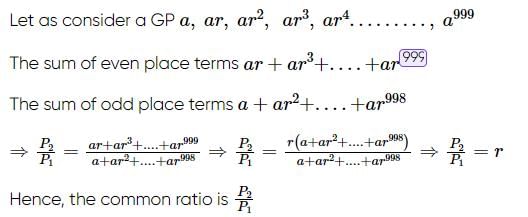
A GP consists of 1000 terms. The sum of the terms occupying the odd places is Pj and the sum of the terms occupying the even places is P2. Find the common ratio of this GP.
- a)P2/P1
- b) P1/P2
- c)(P2 - P1)/P1
- d) (P2+ P1)/P2
Correct answer is option 'A'. Can you explain this answer?
A GP consists of 1000 terms. The sum of the terms occupying the odd places is Pj and the sum of the terms occupying the even places is P2. Find the common ratio of this GP.
a)
P2/P1
b)
P1/P2
c)
(P2 - P1)/P1
d)
(P2+ P1)/P2

|
Debanshi Reddy answered |
The sum of three numbers in a GP is 14 and the sum of their squares is 84. Find the largestnumber.- a)8
- b)6
- c)4
- d)12
Correct answer is option 'A'. Can you explain this answer?
The sum of three numbers in a GP is 14 and the sum of their squares is 84. Find the largestnumber.
a)
8
b)
6
c)
4
d)
12
|
|
Aarav Sharma answered |
To solve this problem, we can use the formulas for the sum of a geometric progression (GP) and the sum of the squares of a GP.
Let's assume that the three numbers in the GP are "a/r", "a", and "ar", where "a" is the first term and "r" is the common ratio.
The sum of the three numbers is given as 14:
a/r + a + ar = 14 ----(1)
The sum of their squares is given as 84:
(a/r)^2 + a^2 + (ar)^2 = 84 ----(2)
Now, let's simplify equations (1) and (2) to solve for "a" and "r".
Simplifying equation (1):
a/r + a + ar = 14
a(1/r + 1 + r) = 14
a(r^2 + r + 1)/r = 14
a(r^2 + r + 1) = 14r ----(3)
Simplifying equation (2):
(a/r)^2 + a^2 + (ar)^2 = 84
a^2/r^2 + a^2 + a^2r^2 = 84
a^2(1/r^2 + 1 + r^2) = 84
a^2(r^2 + 1 + r^4)/r^2 = 84
a^2(r^4 + r^2 + 1) = 84r^2 ----(4)
Now, let's substitute the value of "a" from equation (3) into equation (4).
(a(r^2 + r + 1))^2 = 84r^2
(a^2(r^2 + r + 1)^2) = 84r^2
[(14r)/(r^2 + r + 1)]^2(r^2 + r + 1)^2 = 84r^2
(14r)^2 = 84r^2
196r^2 = 84r^2
112r^2 = 0
r^2 = 0
Since the common ratio "r" cannot be zero, this means that there is no valid solution for this problem. Therefore, the given information is inconsistent and there is no largest number that satisfies both conditions.
Hence, the correct answer would be considered as "None of the above" or "Not possible to determine".
Let's assume that the three numbers in the GP are "a/r", "a", and "ar", where "a" is the first term and "r" is the common ratio.
The sum of the three numbers is given as 14:
a/r + a + ar = 14 ----(1)
The sum of their squares is given as 84:
(a/r)^2 + a^2 + (ar)^2 = 84 ----(2)
Now, let's simplify equations (1) and (2) to solve for "a" and "r".
Simplifying equation (1):
a/r + a + ar = 14
a(1/r + 1 + r) = 14
a(r^2 + r + 1)/r = 14
a(r^2 + r + 1) = 14r ----(3)
Simplifying equation (2):
(a/r)^2 + a^2 + (ar)^2 = 84
a^2/r^2 + a^2 + a^2r^2 = 84
a^2(1/r^2 + 1 + r^2) = 84
a^2(r^2 + 1 + r^4)/r^2 = 84
a^2(r^4 + r^2 + 1) = 84r^2 ----(4)
Now, let's substitute the value of "a" from equation (3) into equation (4).
(a(r^2 + r + 1))^2 = 84r^2
(a^2(r^2 + r + 1)^2) = 84r^2
[(14r)/(r^2 + r + 1)]^2(r^2 + r + 1)^2 = 84r^2
(14r)^2 = 84r^2
196r^2 = 84r^2
112r^2 = 0
r^2 = 0
Since the common ratio "r" cannot be zero, this means that there is no valid solution for this problem. Therefore, the given information is inconsistent and there is no largest number that satisfies both conditions.
Hence, the correct answer would be considered as "None of the above" or "Not possible to determine".
The first and the last terms of an AP are 107 and 253. If there are five terms in this sequence, findthe sum of sequence.- a)1080
- b)720
- c)900
- d)620
Correct answer is option 'C'. Can you explain this answer?
The first and the last terms of an AP are 107 and 253. If there are five terms in this sequence, findthe sum of sequence.
a)
1080
b)
720
c)
900
d)
620
|
|
Dipika Iyer answered |
5 × average of 107 and 253 = 5 × 180 = 900. Option (c) is correct.
There is an AP 1, 3, 5…. Which term of this AP is 55?- a)27th
- b)26th
- c)25th
- d)28th
Correct answer is option 'D'. Can you explain this answer?
There is an AP 1, 3, 5…. Which term of this AP is 55?
a)
27th
b)
26th
c)
25th
d)
28th
|
|
Disha Sengupta answered |
The number of terms in a series are found by:

A sum of money kept in a bank amounts to ` 1240 in 4 years and ` 1600 in 10 years at simpleInterest. Find the sum.- a)` 800
- b)` 900
- c)` 1150
- d)` 1000
Correct answer is option 'D'. Can you explain this answer?
A sum of money kept in a bank amounts to ` 1240 in 4 years and ` 1600 in 10 years at simpleInterest. Find the sum.
a)
` 800
b)
` 900
c)
` 1150
d)
` 1000
|
|
Debanshi Sarkar answered |
The difference between the amounts at the end of 4 years and 10 years will be the simple interest
on the initial capital for 6 years.
Hence, 360/6 = 60 =(simple interest.)
Also, the Simple Interest for 4 years when added to the sum gives 1240 as the amount.
Hence, the original sum must be 1000.
on the initial capital for 6 years.
Hence, 360/6 = 60 =(simple interest.)
Also, the Simple Interest for 4 years when added to the sum gives 1240 as the amount.
Hence, the original sum must be 1000.
A series in which any term is the sum of the preceding two terms is called a Fibonacci series. The first two terms are given initially and together they determine the entire series. If the difference of the squares of the ninth and the eighth terms of a Fibonacci series is 715 then, what is the 12th term of that series?- a)157
- b)142
- c)144
- d)Cannot be determined
Correct answer is option 'C'. Can you explain this answer?
A series in which any term is the sum of the preceding two terms is called a Fibonacci series. The first two terms are given initially and together they determine the entire series. If the difference of the squares of the ninth and the eighth terms of a Fibonacci series is 715 then, what is the 12th term of that series?
a)
157
b)
142
c)
144
d)
Cannot be determined
|
|
Asha Basak answered |
The series is like 1, 1, 2, 3, 5, 8, 13, 21, 34, 55, 89, 144...
The difference is 715 and the 12th term is 144.
The difference is 715 and the 12th term is 144.
The first term of an AP = the common ratio of a GP and the first term of the GP = common difference of the AP. If the sum of the first two terms of the GP is equal to the sum of the first 2 terms of the AP, then the ratio of the first term of the GP to the first term of an AP is- a)>1
- b)Independent of first term of AP
- c)Independent of first term of GP
- d)< 1
Correct answer is option 'C'. Can you explain this answer?
The first term of an AP = the common ratio of a GP and the first term of the GP = common difference of the AP. If the sum of the first two terms of the GP is equal to the sum of the first 2 terms of the AP, then the ratio of the first term of the GP to the first term of an AP is
a)
>1
b)
Independent of first term of AP
c)
Independent of first term of GP
d)
< 1
|
|
Hridoy Roy answered |
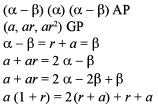
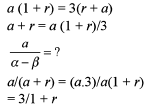
This is independent of the first term of GP.
If the roots of x3 - 12x2 + 39x - 28 = 0 are in an AP then their common difference is
- a)± 1
- b)± 2
- c)± 3
- d)± 4
Correct answer is option 'C'. Can you explain this answer?
If the roots of x3 - 12x2 + 39x - 28 = 0 are in an AP then their common difference is
a)
± 1
b)
± 2
c)
± 3
d)
± 4
|
|
Gowri Chakraborty answered |
Factorize the equation and we get ( x - 1 ) ( x - 4 ) ( x - 7 )
Explanation:
Given Equation: x³ - 12x² + 39x - 28 = 0
Roots in an AP:
Let the roots of the equation be a - d, a, a + d, where d is the common difference.
Sum of roots: = -b/a
Sum of roots = a - d + a + a + d = 3a
From the equation, we know that sum of roots = -(-12) = 12
Therefore, 3a = 12
a = 4
Product of roots: = -d/a
Product of roots = (a - d)(a)(a + d) = 4(a2 - d2) = 28
Substitute a = 4 in the equation:
42 - d² = 7
16 - d² = 7
d² = 9
d = ±3
Therefore, the correct answer is C: ±3.
Explanation:
Given Equation: x³ - 12x² + 39x - 28 = 0
Roots in an AP:
Let the roots of the equation be a - d, a, a + d, where d is the common difference.
Sum of roots: = -b/a
Sum of roots = a - d + a + a + d = 3a
From the equation, we know that sum of roots = -(-12) = 12
Therefore, 3a = 12
a = 4
Product of roots: = -d/a
Product of roots = (a - d)(a)(a + d) = 4(a2 - d2) = 28
Substitute a = 4 in the equation:
42 - d² = 7
16 - d² = 7
d² = 9
d = ±3
Therefore, the correct answer is C: ±3.
If(12+22+32+…..+102)=385,then the value of (22+42+62 + …+202) is :
- a)770
- b)1155
- c)1540
- d)(385*385)
Correct answer is option 'C'. Can you explain this answer?
If(12+22+32+…..+102)=385,then the value of (22+42+62 + …+202) is :
a)
770
b)
1155
c)
1540
d)
(385*385)
|
|
Gowri Chakraborty answered |
(1^2+2^2+3^2+....10^2)=385
(2^2+4^2+6^2+....+20^2)=2^2(1^2+2^2+ 3^2+....+10^2 )
=4(385)
=1540
Chapter doubts & questions for Progressions (Sequences & Series) - Quantitative Aptitude (Quant) 2025 is part of Interview Preparation exam preparation. The chapters have been prepared according to the Interview Preparation exam syllabus. The Chapter doubts & questions, notes, tests & MCQs are made for Interview Preparation 2025 Exam. Find important definitions, questions, notes, meanings, examples, exercises, MCQs and online tests here.
Chapter doubts & questions of Progressions (Sequences & Series) - Quantitative Aptitude (Quant) in English & Hindi are available as part of Interview Preparation exam.
Download more important topics, notes, lectures and mock test series for Interview Preparation Exam by signing up for free.
Quantitative Aptitude (Quant)
164 videos|133 docs|118 tests
|

|
© EduRev
|
Education Revolution
|


|







Signup to see your scores
go up within 7 days!
Access 1000+ FREE Docs, Videos and Tests
Takes less than 10 seconds to signup