UPSC Exam > UPSC Notes > History for UPSC CSE > Causes of the Failure: The Revolt of 1857
Causes of the Failure: The Revolt of 1857 | History for UPSC CSE PDF Download


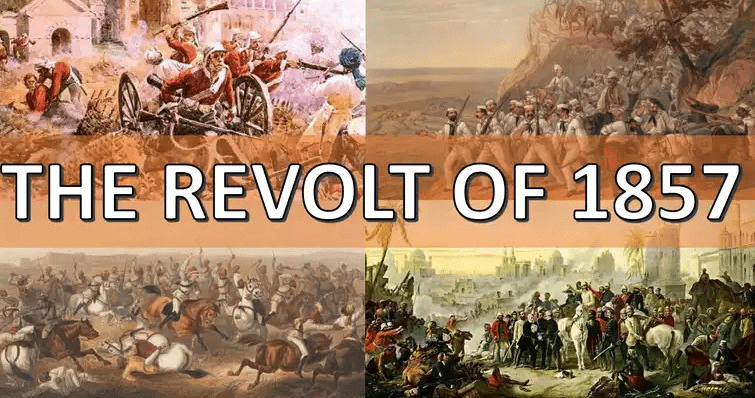
Causes of the Failure of the Rebellion
- The revolt was localised and not countrywide.
- The revolt began prematurely.
- The superiority of the English was in weapons, post and telegraph systems and in the Navy.
- Support of the native rulers to the English and lack of it to Indian mutineers.
- Lack of unity of purpose and organisation.
- Lack of leadership.
- Personal jealousies amongst the mutineers.
- Bahadur Shah, a broken reed.
- Noble efforts of Lord Canning for the pacification of the Mutiny.
- Queen Victoria’s Proclamation of November.
Major Tribal Movements In India
Area
- Year: Events
Ranchi
- 1789, 1794-95: Revolts in Taman District (Chhotanagpur).
- 1807-1808: Chhotanagpur Tribal Revolt.
- 1820, 1832: Munda Revolts.
- 1858-59: Land seizers.
- 1869-80: Sardars movements encouraged Tribals to make claims to Government land survey. District-wise survey of Tribal lands, the arrival of Catholic and Lutheran Mission.
- 1889: Sardars (Munda) leaders agitations against the British.
- 1890-91: Birsa Munda Movements in Ranchi.
- 1920-21: Tana Bhagat Movement in Chhotanagpur.
Santhal
- 1855: The Revolts of the Santhals Paragnas Districts.
- 1871-72: Agrarian Protests, a survey of lands and settlement.
- 1874-75: Famine religious-political movement led by Bhagirath.
- 1880-81: Religious movement inspired by Dubia Gosain.
- 1884-86: Review of Policy towards moneylenders by the Govt.
Andhra
- 1862, 1879: Andhra Agency Koya Pradesh Tribal Revolts against Muttdars (Petty Tribal Landlords) and their Supporters (British).
- 1922: Rampa rebellion of Koyas under Allurli Sreerama Raju against British).
- 1941: The Gond and Kilam agitations against the British Government in Adabad district of Andhra Pradesh led by Bhimu.
North East
- 1824-26: First Burmese War against the Burmese occupation of Assam in which the British first espoused Assam’s case and after defeating Burmese usurped Assam.
- 1835: Raja of the Jaintia Hills was deposed by the British owing to his anti-British activities.
Government of India Act, 1858 contained the following Clauses:
- The Company’s rule ceased in India and henceforward India was to be governed by the British Crown and the British Parliament.
- In relation to the Indian states and the rest of India, the GovernorGeneral was to be called the Viceroy in future.
- All the treaties and agreements which the East India Company had hitherto entered with the Indian states were to be completely accepted by the Crown.
- The territories of the Indian Princes were not to be annexed by the hated ‘Doctrine of Lapse’ which was not to be applied henceforward. The Indian Princes were allowed to adopt sons in future.
- Another very important constitutional effect of the Revolt of 1857 was the passing of the Indian Councils Act of the year 1861.
- According to this Act, a system of administration called decentralization was adopted and the Indians were now associated with the administration of India in the matter of legislation as well as administration
Changes in the Army
- The European element in the army was strengthened and the European officers became the permanent features of the Indian Army.
- The artillery was taken entirely from the Indians.
- This was done according to the recommendations of the Army Commission which was appointed in 1859.
- The Company’s regiments were disbanded and now all the army men became directly the servants of the Crown of England.
- The policy of territorial expansion was slackened and the states guaranteed the integrity of their territories.
- The Mughal Imperial dynasty came to an end and the last Mughal emperor, Bahadur Shah II, was sent as a State prisoner to Burma.
- Freedom of religion and equal treatment was guaranteed.
- More association of Indians in the administration of the country.
Introduction of Other Reforms
- In 1857, Universities were established at Calcutta and Madras.
- The Bengal Rent Act of 1859 gave rights of occupancy to all cultivators who possessed certain fields for more than 12 years and forbade the rents from being raised except on definite grounds specified in the Act itself.
- The Penal Code on which Macaulay’s Commission had begun to work so many years before, became the law of the land.
- The Company’s Sadar Courts and the Crown’s Supreme Court were amalgamated in the High Courts which were now established at each Presidency headquarters.
Other Popular Movements in the 19th Century
- The Khasis, a primitive tribe residing in the hilly region between Jaintia and Garo hills in Assam, revolted against the authority of the British. The first contact between the British and the Khasis was established in 1765 when the British were granted Diwani and acquired control over Sylhet.
- After the Burmese War the British, under Scott, conceived the idea of linking this territory with Sylhet by road with a view to cut short the military route. The idea of the construction of roads did not find favour with the Khasis chiefs. The chiefs of various Khasi hills states united under the leadership of Tirhut Singh. On 5th May 1892 a party of Khasis raided Nunklow and massacred the Europeans. The British tried to crush the revolt through the use of force and repression. After four years Tirhut Singh surrendered. Similarly, revolts were organised by the chiefs of Kapaschor Alps in 1835, the Nagar in 1849 and Kukis between 1826-1849.
- The Kolarian tribes were ruled by petty chieftains. They strongly resented the occupation of Singhbhum by the British. Raja of Porhat reached an agreement with the British and agreed to pay an annual tribute to them, the Hos (his subject) could not reconcile with this and continued to harass the English. The Hos submitted to the English authority in 1827. But they again joined in the Munda revolution.
- The Mundas revolted against the British in 1831. This revolt was a protest against the new policy of farming revenue to outsiders and the introduction of judicial and revenue regulations of the Bengal Government into the country. The Munda Revolt was so strong that even the military forces found it difficult to keep it under control. It was only after the British restored to massive military operations that the revolt was suppressed in March 1832.
- In the second half of the nineteenth century, the Mundas under the leadership of Birsa revolted against the British. They wanted to replace the British government with Munda self-government. The British succeeded in arresting Birsa in February 1900 and put him in prison where he died of cholera. Another Munda leader Gaya Mund was shot dead. Thus the English suppressed the Munda revolt with firmness.
- The Santhals organised a revolt in 1855-56. This revolt was organised against the oppressions of the Mahajan's and traders from Bengal and Upper India who lent money to the Santhals and charged them excessive rates of interest. At the initial stages, the revolt was primarily economic in nature and there was no anti-British feeling. They turned against the government when they found that it was trying to side with the oppressors without bothering to remedy their grievances. In June 1855 about ten thousand Santhals under the leadership of Sidhu and Kanhu, two brothers, revolted. They destroyed the postal and railway communication between Bhagalpur and Rajmahal. The Santhals also proclaimed the end of the Company’s rule and set up their own regime. It was only in 1856 the British succeeded in capturing the leaders of the Santhals. The British committed inhuman barbarities against the Santhals and completely crushed them.
- Realising that they could not achieve their objective against the English through violent methods the Santhals launched another social movement known as Karwar Movement. This movement aimed at reviving the golden age of the Santhals. In the closing years of the nineteenth century, the Karwar Movement got split into three parts viz. Sapha Hor, Samra and Babaji. The members of Sapha Hor sect played a prominent role in the Indian freedom movement in the 1930s.
- In 1879-80 the Rampas, a forest tribe, rose in revolt against the oppressive and injudicious action of the Tahsildar of Bhadrachalam. The British sent forces from Madras which suppressed the insurrection.
The document Causes of the Failure: The Revolt of 1857 | History for UPSC CSE is a part of the UPSC Course History for UPSC CSE.
All you need of UPSC at this link: UPSC
|
228 videos|855 docs|219 tests
|
FAQs on Causes of the Failure: The Revolt of 1857 - History for UPSC CSE
| 1. What were the major tribal movements in India during the 19th century? |  |
Ans. Major tribal movements in India during the 19th century included the Santhal Rebellion, Bhil Rebellion, Munda Rebellion, and Kuki Rebellion. These movements were led by various tribal communities to assert their rights, resist colonial oppression, and protect their land and resources.
| 2. What were the key provisions of the Government of India Act, 1858? | |
Ans. The Government of India Act, 1858 contained several important clauses. It abolished the East India Company's rule and transferred the powers and responsibilities to the British Crown. It also established a Secretary of State for India in the British government and created the post of Viceroy to represent the British monarch in India.
| 3. How did the changes in the army contribute to the failure of the Rebellion of 1857? | |
Ans. The changes in the army, such as the introduction of the new Enfield rifles with greased cartridges, played a significant role in the failure of the Rebellion of 1857. The rumor that the cartridges were greased with cow and pig fat outraged the Indian soldiers, as it went against their religious beliefs. This led to widespread discontent and sparked the initial rebellion, which later spread throughout the country.
| 4. What were the other popular movements in the 19th century India? | |
Ans. Apart from the Rebellion of 1857, there were several other popular movements in 19th century India. Some of these include the Indian National Congress, which was formed in 1885 and played a crucial role in the country's independence movement. Other movements include the Swadeshi Movement, the Non-Cooperation Movement, and the Quit India Movement, all of which aimed at challenging British colonial rule.
| 5. What were the main causes of the failure of the Rebellion of 1857? | |
Ans. The Rebellion of 1857, also known as the Indian Mutiny or the First War of Independence, ultimately failed to overthrow British rule. Some of the main causes of its failure were the lack of unity and coordination among the rebel forces, the superior military tactics and firepower of the British, the absence of widespread support from the princely states, and the brutal suppression tactics employed by the British forces. Additionally, the rebels lacked a centralized leadership and faced internal divisions, which weakened their overall resistance.
About this Document

3.4K Views

4.81/5
Rating

Oct 12, 2025
Last updated
Related Exams
Document Description: Causes of the Failure: The Revolt of 1857 for UPSC 2025 is part of History for UPSC CSE preparation.
The notes and questions for Causes of the Failure: The Revolt of 1857 have been prepared according to the UPSC exam syllabus. Information about Causes of the Failure: The Revolt of 1857 covers topics
like Causes of the Failure of the Rebellion, Major Tribal Movements In India, Government of India Act, 1858 contained the following Clauses:, Changes in the Army, Introduction of Other Reforms, Other Popular Movements in the 19th Century and Causes of the Failure: The Revolt of 1857 Example, for UPSC 2025 Exam. Find important definitions, questions, notes, meanings, examples, exercises and tests below for Causes of the Failure: The Revolt of 1857.
Introduction of Causes of the Failure: The Revolt of 1857 in English is available as part of our History for UPSC CSE
for UPSC & Causes of the Failure: The Revolt of 1857 in Hindi for History for UPSC CSE course.
Download more important topics related with notes, lectures and mock test series for UPSC
Exam by signing up for free. UPSC: Causes of the Failure: The Revolt of 1857 | History for UPSC CSE
Description
Full syllabus notes, lecture & questions for Causes of the Failure: The Revolt of 1857 | History for UPSC CSE - UPSC | Plus excerises question with solution to help you revise complete syllabus for History for UPSC CSE | Best notes, free PDF download
Information about Causes of the Failure: The Revolt of 1857
In this doc you can find the meaning of Causes of the Failure: The Revolt of 1857 defined & explained in the simplest way possible. Besides explaining types of
Causes of the Failure: The Revolt of 1857 theory, EduRev gives you an ample number of questions to practice Causes of the Failure: The Revolt of 1857 tests, examples and also practice UPSC
tests

Related Searches
ppt
,mock tests for examination
,Previous Year Questions with Solutions
,past year papers
,practice quizzes
,Causes of the Failure: The Revolt of 1857 | History for UPSC CSE
,video lectures
,Extra Questions
,shortcuts and tricks
,Summary
,Important questions
,Sample Paper
,Free
,Exam
,Viva Questions
,Causes of the Failure: The Revolt of 1857 | History for UPSC CSE
,MCQs
,Semester Notes
,Objective type Questions
,Causes of the Failure: The Revolt of 1857 | History for UPSC CSE
,study material
;



Additional Information about Causes of the Failure: The Revolt of 1857 for UPSC Preparation
Causes of the Failure: The Revolt of 1857 Free PDF Download
The Causes of the Failure: The Revolt of 1857 is an invaluable resource that delves deep into the core of the UPSC exam.
These study notes are curated by experts and cover all the essential topics and concepts, making your preparation more efficient and effective.
With the help of these notes, you can grasp complex subjects quickly, revise important points easily,
and reinforce your understanding of key concepts. The study notes are presented in a concise and easy-to-understand manner,
allowing you to optimize your learning process. Whether you're looking for best-recommended books, sample papers, study material,
or toppers' notes, this PDF has got you covered. Download the Causes of the Failure: The Revolt of 1857 now and kickstart your journey towards success in the UPSC exam.
Importance of Causes of the Failure: The Revolt of 1857
The importance of Causes of the Failure: The Revolt of 1857 cannot be overstated, especially for UPSC aspirants.
This document holds the key to success in the UPSC exam.
It offers a detailed understanding of the concept, providing invaluable insights into the topic.
By knowing the concepts well in advance, students can plan their preparation effectively.
Utilize this indispensable guide for a well-rounded preparation and achieve your desired results.
Causes of the Failure: The Revolt of 1857 Notes
Causes of the Failure: The Revolt of 1857 Notes offer in-depth insights into the specific topic to help you master it with ease.
This comprehensive document covers all aspects related to Causes of the Failure: The Revolt of 1857.
It includes detailed information about the exam syllabus, recommended books, and study materials for a well-rounded preparation.
Practice papers and question papers enable you to assess your progress effectively.
Additionally, the paper analysis provides valuable tips for tackling the exam strategically.
Access to Toppers' notes gives you an edge in understanding complex concepts.
Whether you're a beginner or aiming for advanced proficiency, Causes of the Failure: The Revolt of 1857 Notes on EduRev are your ultimate resource for success.
Causes of the Failure: The Revolt of 1857 UPSC Questions
The "Causes of the Failure: The Revolt of 1857 UPSC Questions" guide is a valuable resource for all aspiring students preparing for the
UPSC exam. It focuses on providing a wide range of practice questions to help students gauge
their understanding of the exam topics. These questions cover the entire syllabus, ensuring comprehensive preparation.
The guide includes previous years' question papers for students to familiarize themselves with the exam's format and difficulty level.
Additionally, it offers subject-specific question banks, allowing students to focus on weak areas and improve their performance.
Study Causes of the Failure: The Revolt of 1857 on the App
Students of UPSC can study Causes of the Failure: The Revolt of 1857 alongwith tests & analysis from the EduRev app,
which will help them while preparing for their exam. Apart from the Causes of the Failure: The Revolt of 1857,
students can also utilize the EduRev App for other study materials such as previous year question papers, syllabus, important questions, etc.
The EduRev App will make your learning easier as you can access it from anywhere you want.
The content of Causes of the Failure: The Revolt of 1857 is prepared as per the latest UPSC syllabus.
|
© EduRev
|
Education Revolution
|


|




Signup on EduRev and stay on top of your study goals
10M+ students crushing their study goals daily