Laxmikanth Summary: The Indian Federal System Overview


What is Federalism in India?
Federalism is a system of government in which constitutional powers are divided between two levels of government: the centre (Union) and its constituent units such as states or provinces. This arrangement creates two sets of political institutions - one at the national level and another at the regional level - each with its own authority and responsibilities.
- Federalism provides an institutional mechanism to accommodate and manage diversity by allowing regional governments autonomy over local matters while the centre handles national concerns.
- The Indian Constitution establishes a federal structure but with several features that give prominence to the central government; hence, India is often described as a quasi-federal or federal system with a unitary bias.
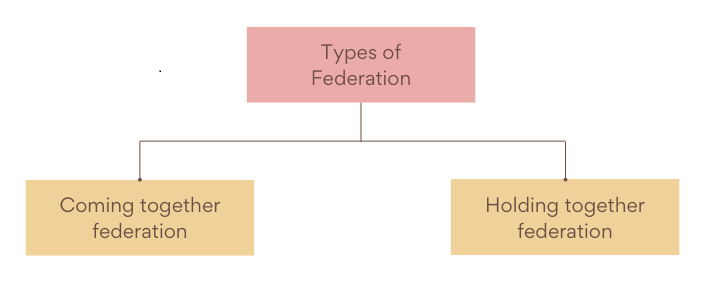
Types of Federations
Coming Together Federation
- In a coming together federation, several independent and sovereign states voluntarily unite to form a larger political unit. The constituent units retain substantial autonomy and the centre's powers are created by the agreement of those units.
- Examples: United States of America, Australia, Switzerland.
Holding Together Federation
- In a holding together federation, a previously unitary state creates constituent units and distributes powers among them, usually to accommodate regional diversity and maintain unity. Here the central authority often retains greater powers compared with the constituent units.
- Examples: India, Spain, Belgium.
Try yourself: In holding together federation, powers are generally tilted towards the central authority.
How can we define Federalism in India?
- India has a federal system of government but it displays a unitary tilt in several respects; therefore, scholars describe it as quasi-federal.
- Article 1 of the Constitution declares: 'India, that is Bharat, shall be a Union of States.' The Constitution uses the term Union rather than "federation" or "federal," but its structure embodies federal features.

- Elements of federalism in modern India were introduced earlier by the Government of India Act, 1919, which began the process of separating powers between the centre and provincial legislatures.
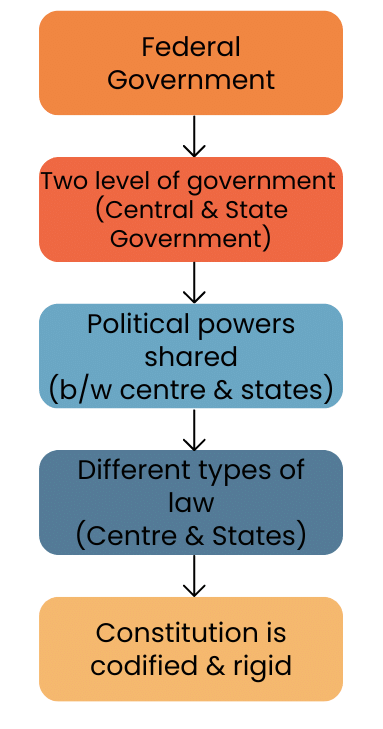
- The framers adopted federalism principally because of the large geographical size of India and its socio-cultural diversity. Federalism was intended to ensure efficient administration while accommodating regional identities.
- The Indian federal design drew inspiration from the Canadian model, which emphasises a strong central government, rather than the American model of a stronger state autonomy.
Would you like a video explanation of the federal system in India? Watch Federal System for a visual summary.
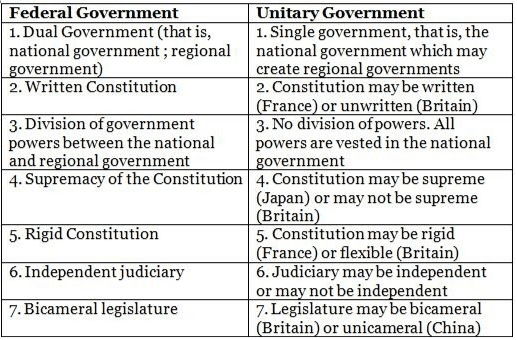
Federal Features of the Indian Union
- Governments at two levels: There are separate governments for the Union (centre) and the states, each competent to legislate and govern in specified areas.
- Division of powers: The Constitution assigns subjects to the Union and the states through the Seventh Schedule which contains three lists: Union List, State List, and Concurrent List.
- Supremacy of the Constitution: The Constitution is the supreme law of the land; all legislative and executive actions must conform to it. Judicial review protects the basic structure of the Constitution.
- Independent and integrated judiciary: The Constitution provides for an independent judiciary with the Supreme Court at the apex, followed by High Courts and subordinate courts. The judiciary resolves inter-governmental disputes.
Try yourself: What are the three lists given in the Seventh Schedule of the Constitution that divides the subjects of jurisdiction between the center and states? (more than one options are correct)
Unitary Features of the Indian Union
- Flexibility of the Constitution: The Constitution combines rigidity and flexibility. Some provisions can be amended by Parliament with relative ease; however, amendments affecting federal features require a more rigorous procedure - yet overall Parliament retains significant amendment power.
- Preponderance of central powers: The Union List contains many important subjects, and Parliament can legislate on certain state subjects under special circumstances. Where Union and State laws conflict on Concurrent List subjects, Union law prevails.
- Unequal representation in Rajya Sabha: Seats in the Rajya Sabha (Council of States) are allocated roughly in proportion to state population; larger states have many more members than smaller ones, so states are not equally represented in the upper house.
- Union executive drawn from legislature: The executive at both Centre and states is responsible to the legislature (parliament or state assembly), which differs from a strict separation of powers model.
- Lok Sabha is more powerful than Rajya Sabha: In the legislative process and financial matters, the Lok Sabha (House of the People) has supremacy over the Rajya Sabha, which reduces the federal character of bicameralism.
- Emergency powers: Under constitutional emergency provisions, the Union gains increased control over states (e.g., Centre can assume legislative powers of states), reducing state autonomy during emergencies.
- Integrated judiciary: There is a single judicial system under the Supreme Court; there is no separate constitutional court structure for the states.
- Single citizenship: India provides one citizenship for the entire country, unlike some federations which allow dual citizenship (national and state).
- Governor appointed by the Centre: The state governor is appointed by the President (Centre) and acts as the Centre's constitutional link to the state, which can affect centre-state relations.
- Formation and alteration of states: Parliament has the authority to create new states, alter boundaries, or change names of states under Articles of the Constitution.
- All-India Services: Services such as the IAS and IPS are common to both Centre and states, creating administrative links and central influence in state administration.
- Integrated election and audit machinery: Institutions like the Election Commission of India and the Comptroller and Auditor General (CAG) serve both Union and states, promoting uniformity in administration.
- Governor's reservation and presidential assent: A governor may reserve certain state bills for consideration of the President; the President has power to give assent, with limited obligations to state requests.
Read Federal & Unitary Features of the Indian Constitution for a detailed comparative explanation and examples useful for competitive examinations.
Issues and Challenges faced by Indian Federalism
Regionalism
- Regionalism refers to political movements and demands that prioritise regional identity, interests, or autonomy; it is a significant challenge to the balance between national unity and regional aspirations.
- Demand for formation of new states or reorganisation of existing ones has become more prominent - for example, the formation of Telangana in 2014 is a recent instance of successful regional mobilisation.
- Ongoing and revived demands include proposals for Gorkhaland, Bodoland, Karbi Anglong, and suggestions for reorganising large states (e.g., proposals to divide Uttar Pradesh into smaller units).
- Regional concerns can also affect inter-state and international agreements involving state resources (for example, disputes over river waters such as Teesta).
Try yourself: When was Telangana created?
Absence of Full Fiscal Federalism
- The Constitution grants substantial taxation powers to the Centre. States depend heavily on transfers from the Centre.
- An institutional mechanism, the Finance Commission, recommends distribution of central tax revenues to states to correct fiscal imbalances, and grants-in-aid are also provided.
- At present, approximately 40 per cent of central revenues (tax and non-tax) are transferred to states including grants; states remain fiscally dependent for many schemes and development programmes.
Centralised Amendment Power
- Under Article 368, Parliament has the power to amend the Constitution. Amendments affecting federal features require ratification by half of the state legislatures, but many important amendments can be made by Parliament without state concurrence, creating a centralising tendency.
Indestructible Union with Destructible Units
- The Indian Constitution makes the Union indestructible; states do not have a constitutional right to secede. This safeguards national integrity but gives the Union supremacy over constituent units.
The Office of the Governor
- The governor is appointed by the President and acts as the constitutional head of a state. The instrumentality of gubernatorial powers has sometimes been criticised for being used by the Centre to influence state politics.
- A notable instance was the political controversy and subsequent Supreme Court verdict concerning events in Arunachal Pradesh (January-July 2016), when the governor's actions and the imposition of President's Rule were contested; the Supreme Court reinstated the elected government.
Citizenship and Federalism
- India has single citizenship for all citizens, which reinforces national unity but reduces distinct legal identities between nationals of different states.
Integrated Services and Institutions
- All-India services, an integrated judiciary, and central constitutional institutions (Election Commission, CAG) create uniformity but also stronger central influence over state administration.
Centralised Planning and Policy-making
- Economic and social planning, though appearing in the Concurrent List, has often been centralised in practice. The Planning Commission (now replaced by NITI Aayog) symbolised central direction of planning; financial dependence and legislative preponderance of the Union limit state autonomy in planning.
Language Conflicts and Federal Design
- Diversity of languages is an important feature of India's federal polity. Language movements and demands for recognition or reorganisation on linguistic lines have influenced federal relations. The Constitution recognises 22 official languages in the Eighth Schedule.
For a deeper study of these issues with case laws and examples relevant to the UPSC Civil Services Examination, consult detailed resources that examine centre-state relations, Finance Commission reports, and landmark Supreme Court judgments.
Summary
- India is a quasi-federal polity with features of both federalism and unitarism. The Constitution describes India as a Union of States (Article 1).
- The Government of India Act, 1919 introduced important federal elements into modern Indian governance by separating certain powers between centre and provinces.
- The Seventh Schedule of the Constitution divides subjects into three lists: Union List, State List, and Concurrent List, each indicating legislative competence.
- Representation of states in the Rajya Sabha is based on population; for example Uttar Pradesh has 31 members while Goa has 1 member, resulting in unequal state representation in the upper house.
- Regionalism and demands for new states (such as the formation of Telangana in 2014) demonstrate how federal arrangements are continually negotiated in India.
- Controversial interventions by the Centre (for example, the imposition of President's Rule in Arunachal Pradesh in 2016, later declared unconstitutional by the Supreme Court) highlight tensions in centre-state relations.
FAQs on Laxmikanth Summary: The Indian Federal System Overview
| 1. What exactly is a federal system and how does it work in India? |  |
| 2. How are powers distributed between the Union and states in the Indian federal structure? | |
| 3. Why is India called a quasi-federal system rather than a true federal system? | |
| 4. What are the main differences between the Indian federal system and the American federal system? | |
| 5. How do emergency provisions affect federalism in India's constitutional framework? | |





