Chapter Notes: Morphology of Flowering Plants


NEET 2026 Guidance: 13 questions were asked in last 2 years and 24 questions were asked in last 5 years.
NEET Syllabus 2026: Morphology and modifications; and functions of different parts of flowering plants: Root, stem, leaf, inflorescence- cymose and racemose, flower, fruit and seed (To be dealt along with the relevant practical of the Practical Syllabus) Family (malvaceae, Cruciferae, leguminoceae, compositae, graminae).
Flowering plants, or angiosperms, are the largest and most diverse group of terrestrial plants, with roughly 300,000 described species. The study of their external form and structure - leaves, stem, roots, flowers and fruits - is known as plant morphology. Understanding morphology helps identify, classify and relate structure to function in plants.
Plant Body Organization
A typical flowering plant consists of two main systems:
- Root System: The underground part that develops from the radicle (embryonic root) of the seed. It anchors the plant and absorbs water and minerals.
- Shoot System: The above-ground part that develops from the plumule (embryonic shoot). It includes the stem, leaves, flowers, and fruits. The shoot system conducts photosynthesis and reproduction.
Key Point: All flowering plants, whether small weeds or large trees, possess both root and shoot systems with roots, stems, and leaves as fundamental organs.
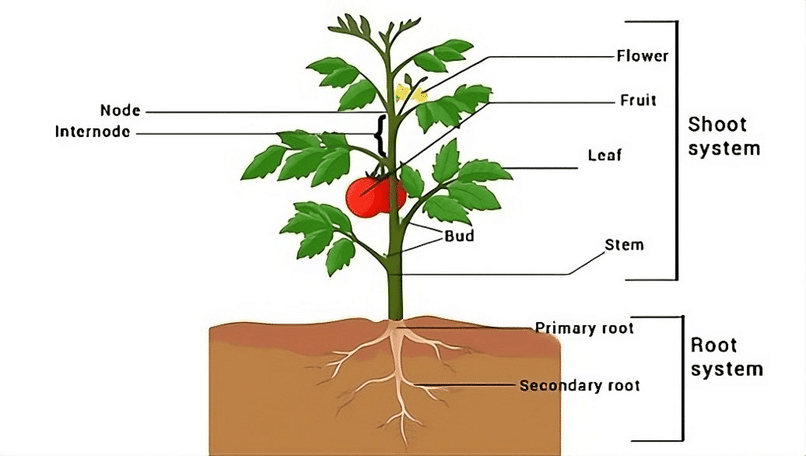 Morphology of a Flowering Plant
The Root
The root is the usually underground part of the plant axis that anchors the plant and absorbs water and mineral ions from soil. Roots also store food and may show specialised modifications.
Types of Roots
1. Taproot system
- Develops from the radicle; primary root persists and gives lateral roots of various orders.
- Typical of many dicots.
- Example: Gram, mustard.
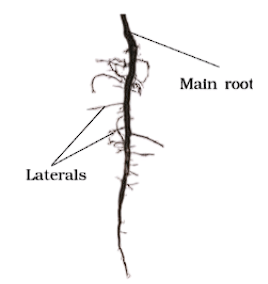 Tap Root
2. Fibrous root system
- Primary root is short-lived; replaced by numerous adventitious roots arising from the stem base.
- Typical of monocots.
- Example: Rice, wheat.
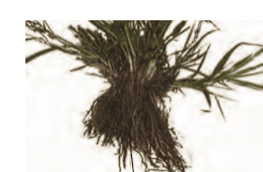 Fibrous Root
3. Adventitious roots
- Roots that arise from organs other than the radicle (stem, leaves).
- Examples: Grass (roots from nodes), Monstera, Banyan (prop roots).
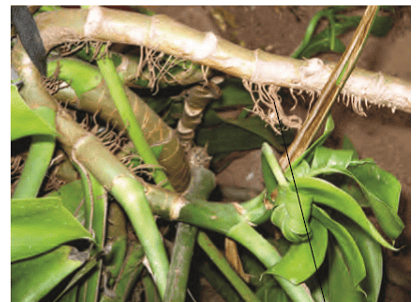 Adventitious Roots
Try yourself: Which type of root is found in monocotyledonous plants and originates at the base of the stem?
Regions of a Root
The root apex and its immediate zones are arranged longitudinally into distinct regions, each with a different function:
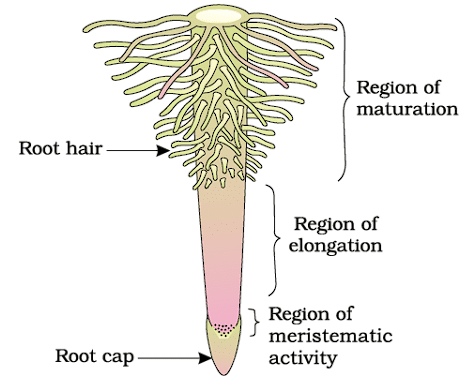 Regions of Root
 - Root cap: A thimble-like protective cap covering the root tip; protects the delicate apical meristem as the root pushes through soil.
- Region of meristematic activity: Just above the root cap; contains small, thin-walled, actively dividing cells that contribute to primary growth (length).
- Region of elongation: Cells enlarge rapidly here, causing increase in root length.
- Region of maturation (differentiation): Cells differentiate into specialised tissues. Epidermal cells develop root hairs which increase absorptive surface area.
Root hairs: Fine tubular outgrowths of epidermal cells in the maturation zone; they greatly increase the surface area for absorption of water and minerals.
Try yourself: What is the function of the root cap?
Modifications of Root
Roots may modify their shape and structure to perform specialized functions beyond absorption and anchorage:
2.3.1 Storage Roots
- Tap roots: Carrot, turnip, radish, beetroot store food and become swollen and fleshy.
- Adventitious roots: Sweet potato, Asparagus store food and become tuberous.
2.3.2 Roots for Support
- Prop Roots: Thick pillar-like adventitious roots that grow vertically downward from horizontal branches of the stem. They provide mechanical support. Example: Banyan tree (Ficus benghalensis).
- Stilt Roots: Adventitious roots arising from the lower nodes of the stem. They grow obliquely downward and provide support to the plant. Example: Maize, sugarcane.
2.3.3 Roots for Respiration
- Pneumatophores (Respiratory Roots): Found in plants growing in swampy, waterlogged, or saline soils (mangroves). These roots grow vertically upward (negatively geotropic) above the soil/water surface. They have numerous pores (lenticels) for gaseous exchange, helping the submerged roots obtain oxygen for respiration. Example: Rhizophora (mangrove), Avicennia.
The Stem
The stem is the ascending part of the plant axis. It develops from the plumule of the germinating seed. The stem is typically green when young (due to chlorophyll) and may become woody and brown with age.
(a) Characteristics and Functions of Stem
Distinguishing Features of Stem:
- Grows upward (negatively geotropic) and toward light (positively phototropic)
- Bears nodes and internodes
- Node: The region of the stem where leaves are attached. It is the point of leaf origin.
- Internode: The portion of the stem between two successive nodes.
- Bears buds:
- Terminal Bud: Present at the apex of the stem; responsible for vertical growth.
- Axillary Bud: Present in the axil of a leaf (angle between leaf base and stem); can develop into a lateral branch, flower, or remain dormant.
Functions of Stem:
- Supports and spreads out branches bearing leaves, flowers, and fruits for optimal light exposure
- Conducts water and minerals upward from roots to leaves (through xylem)
- Conducts photosynthates (food) from leaves to other parts (through phloem)
- May perform storage of food
- May provide support (tendrils) or protection (thorns)
- May function in vegetative propagation
Trap Alert: Node is where the leaf attaches; internode is the space between nodes. Axillary bud is always in the leaf axil.
(b) Modifications of Stem
Stems are modified to perform functions other than support and conduction:
Underground Stems for Storage and Perennation
These stems store food and help the plant survive unfavorable conditions (perennation). Examples:
- Rhizome: Ginger, turmeric, Canna
- Tuber: Potato (has "eyes" which are axillary buds)
- Corm: Colocasia (arvi), zaminkand (elephant foot yam)
- Bulb: Onion, garlic (stem is reduced; fleshy leaf bases store food)
Stems for Support (Climbing)
- Stem Tendrils: Slender, spirally coiled structures that develop from axillary buds. They help the plant climb by coiling around a support. Example: Gourds (cucumber, pumpkin, watermelon), grapevine, Passiflora.
Stems for Protection
- Stem Thorns: Hard, woody, pointed structures modified from axillary buds. They protect the plant from browsing animals. Example: Citrus (lemon, orange), Bougainvillea, Duranta.
Note: Distinguish stem thorns (modified buds) from leaf spines (modified leaves, as in cacti) and prickles (modified epidermal outgrowths, as in rose).
Stems for Photosynthesis
In arid regions, plants reduce leaves to minimize water loss. The stem becomes flattened or fleshy, green, and photosynthetic.
- Phylloclade: Flattened, leaf-like green stem. Example: Opuntia (prickly pear cactus).
- Cladode: Cylindrical or flattened green stem of limited growth. Example: Asparagus.
- Fleshy cylindrical green stems: Euphorbia.
Stems for Vegetative Propagation
- Stolon/Runner: Slender lateral stem that grows horizontally above or just below the soil surface. Nodes bear roots and shoots, forming new plants. Example: Grass (stolon), strawberry, mint, jasmine (runner).
- Offset: Short, lateral branch with a rosette of leaves and tuft of roots at each node. Grows horizontally in water, then detaches to form a new plant. Example: Pistia (water lettuce), Eichhornia (water hyacinth).
- Sucker: Lateral branches originating from the basal underground portion of the main stem. They grow horizontally underground, then emerge obliquely upward to form new shoots. Example: Banana, pineapple, chrysanthemum.
The Leaf
The leaf is a lateral, generally flattened organ borne at a node. It originates from the apical meristem and is arranged acropetally on the shoot. Typical leaf parts are the leaf base, petiole and lamina; small leaf-like appendages at the base are stipules. Leaves are the main photosynthetic organs.
Modifications of Leaves
- Tendrils - leaves modified into slender organs for climbing (e.g. pea).
- Spines - protective, reduced leaves in xerophytes to reduce transpiration (e.g. cactus, Berberis).
- Storage leaves - fleshy leaves that store food/water (e.g. onion, garlic).
- Phyllode - petiole flattened and photosynthetic when true leaves are reduced (e.g. Acacia).
- Pitcher - leaf modified into a pitfall trap for insects (e.g. Nepenthes).
(a) Venation
Venation refers to the arrangement or pattern of veins in the leaves of plants, typically seen when observing the leaf's surface.
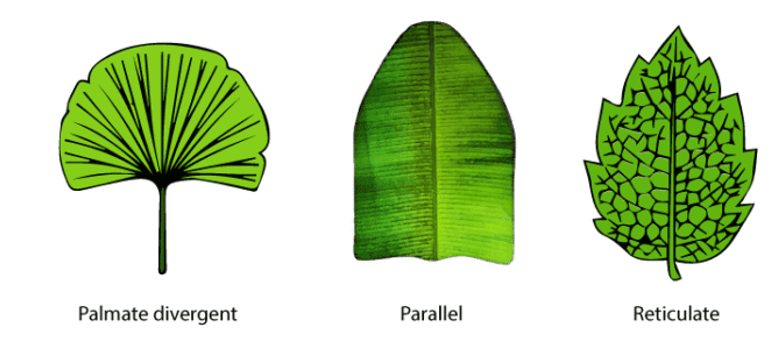 Venation in Leaves
Types of Venation
- Palmate venation - several main veins originate from a common point (like fingers from palm).
- Parallel venation - veins run parallel from base to tip (typical of monocots).
- Reticulate venation - a net-like network of veins (typical of dicots).
Try yourself: What is the characteristic type of venation found in dicotyledonous plants?
(b) Types of Leaves
Leaves may be:
1. Simple - lamina undivided; any incisions do not reach the midrib.
2. Compound - lamina divided into leaflets; divisions reach the midrib (rachis).
The two sub-types of compound leaves are as follows:
- Pinnately compound - leaflets arranged along a common axis (rachis). Example: Neem.
- Palmately compound - leaflets radiate from a single point at the petiole tip. Example: Silk cotton.
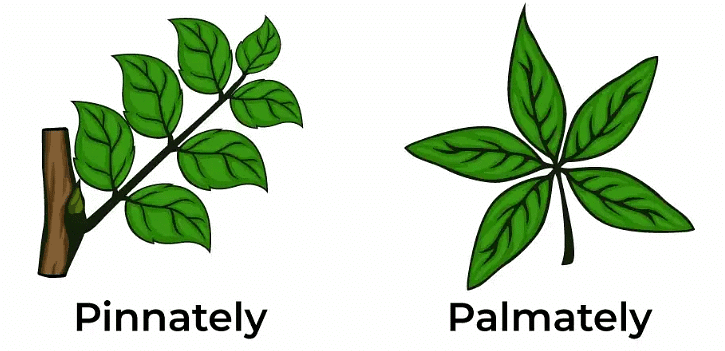 Pinnately and Palmately Compound Leaves
(c) Phyllotaxy
Phyllotaxy refers to the arrangement pattern of leaves on the stem or branch of a plant. It plays a role in optimizing light exposure and efficient use of space for plant growth and development.
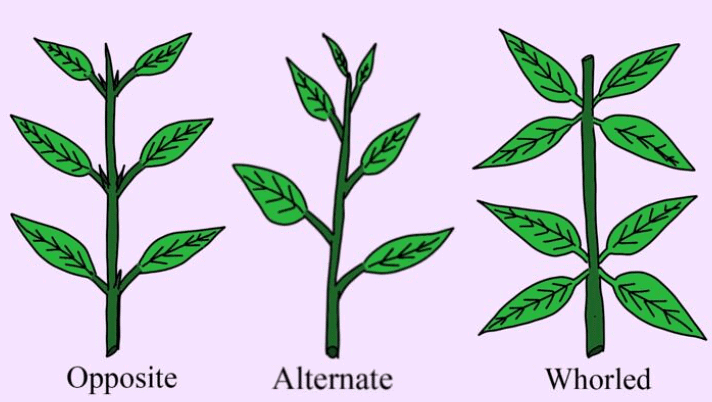 Types of Phyllotaxy
- Alternate - one leaf per node, alternate along the stem. Examples: China rose, mustard, sunflower.
- Opposite - two leaves arise at each node directly opposite one another. Examples: Calotropis, guava.
- Whorled - more than two leaves arise at a node forming a whorl. Example: Alstonia.
(d) Modifications of Leaf
Leaves may be modified to perform specialized functions other than photosynthesis:
- Leaf Tendrils (for Climbing/Support): Entire leaf or part of the leaf (terminal leaflets in pinnately compound leaves) modifies into thin, spirally coiled structures called tendrils. They help the plant climb by coiling around a support. Examples: Pea (Pisum sativum - terminal leaflets modified), sweet pea (Lathyrus).
- Leaf Spines (for Protection and Reducing Transpiration): Entire leaves or parts of leaves modify into hard, pointed spines. They protect the plant from herbivores and reduce water loss in arid regions. Examples: Cacti (entire leaves modified into spines; stem is green and photosynthetic), Opuntia, Euphorbia, barberry (Berberis - leaves modified into spines; axillary buds form branches with normal leaves).
- Storage Leaves: Leaves become thick and fleshy to store food (starch) and water. Examples: Onion, garlic (fleshy leaf bases form bulb scales), Aloe vera, ice plant.
- Phyllode (for Photosynthesis): In some plants, leaves are small and short-lived. The petiole becomes flattened, green, leaf-like, and photosynthetic. This modified, flattened petiole is called a phyllode. Example: Australian acacia (Acacia auriculiformis).
- Leaves of Insectivorous Plants: Modified to trap and digest insects to supplement nitrogen nutrition in nitrogen-deficient soils. Examples: Pitcher plant (Nepenthes - leaf modified into pitcher-like trap), Venus flytrap (Dionaea - leaf with sensitive trigger hairs), bladderwort (Utricularia), sundew (Drosera).
- Scale Leaves: Small, dry, membranous, non-green leaves that protect axillary buds. Examples: Ginger, turmeric (on rhizomes), onion (in bulbs).
Inflorescence
An inflorescence is the arrangement of flowers on the floral axis. A flower is a modified shoot in which the shoot apical meristem becomes a floral meristem. Internodes in a flower are compressed and the axis bears floral organs instead of leaves.
The two principal patterns of inflorescence are:
- Racemose - main axis continues to grow; flowers borne laterally in acropetal succession (older flowers at base, younger towards tip).
- Cymose - main axis terminates in a flower (limited growth); flowers develop in basipetal order (older flowers near the apex, younger towards base).
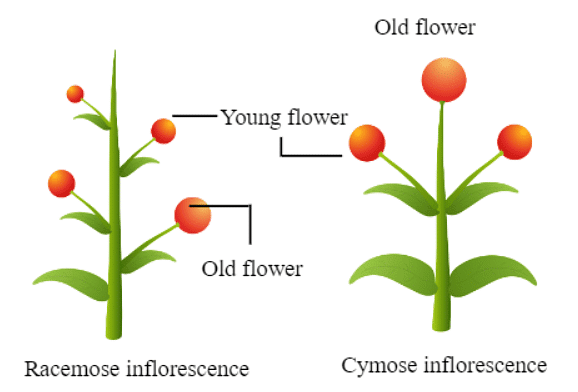
Try yourself: What is the main difference between racemose and cymose inflorescence?
Types of Racemose and Cymose Inflorescences
- Racemose - raceme, spike, umbel, capitulum (head), corymb, catkin, spadix, etc.
- Cymose - monochasial cyme (uniparous), dichasial cyme (biparous), polychasial etc.
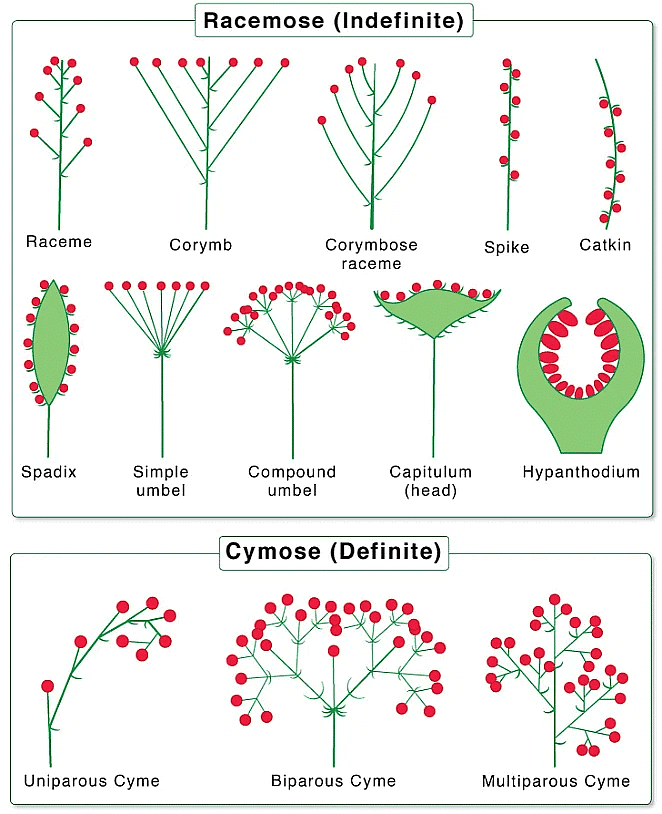
Special types of Inflorescence
- Verticillaster - a pair of cymes at a node forming a false whorl (e.g. Ocimum, Salvia).
- Cyathium - cup-shaped involucre surrounding a single female flower and many male flowers (e.g. Euphorbia).
- Hypanthodium - enclosed inflorescence with ostiole (opening) as seen in figs (Ficus).
The Flower
A flower is the reproductive shoot of angiosperms composed of modified leaves in whorls: calyx, corolla, androecium and gynoecium, borne on a receptacle (thalamus).
Flower Symmetry
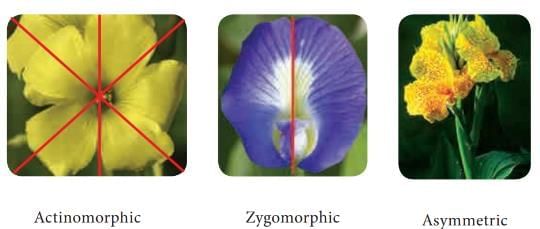
Flower symmetry (floral symmetry) describes how floral parts are arranged around the axis:
- Actinomorphic - radially symmetrical; can be divided into mirror-image halves along several planes. Examples: Chilli, Datura, Mustard.
- Zygomorphic - bilaterally symmetrical; only one vertical plane yields two mirror halves. Examples: Pea, Cassia.
- Asymmetric - no plane produces mirror images; irregular (rare).
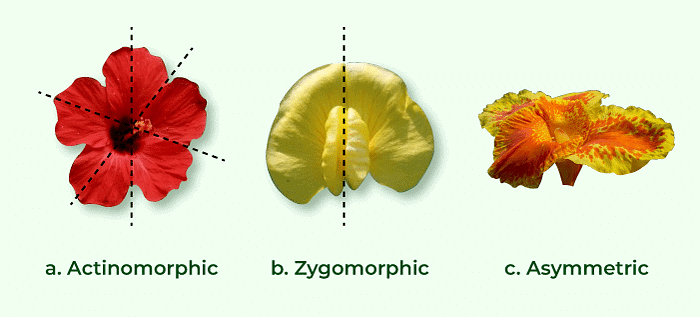
Flowers are also described by the number of parts: trimerous (parts in threes), tetramerous (in fours), pentamerous (in fives), etc.
Based on presence of bracts at the base of pedicel, flowers may be bracteate or ebracteate.
NEET PYQ from this Topic:
Which of the following is an example of a zygomorphic flower? (NEET 2025)
(a) Pea
(b) Chilli
(c) Petunia
(d) Datura
Types of flowers based on the position of the ovary, a flower can be:
Ovary position relative to attachment of other floral parts:
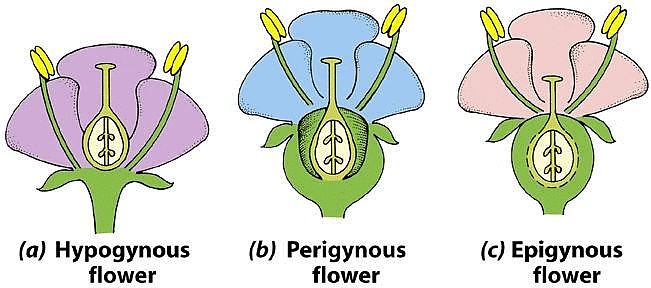
- Hypogynous - ovary superior; other parts inserted below the ovary. Examples: Brinjal, China rose, Mustard.
- Perigynous - ovary half-inferior; floral parts inserted on the margin of a cup-shaped thalamus (hypanthium). Examples: Peach, Plum, Rose.
- Epigynous - ovary inferior; other parts appear above the ovary as the thalamus encloses it. Examples: Ray florets of Sunflower, Guava, Cucumber.
NEET PYQ from this Topic:
Identify the type of flowers based on the position of calyx, corolla and androecium with respect to the ovary from the given figures (a) and (b) (NEET 2024)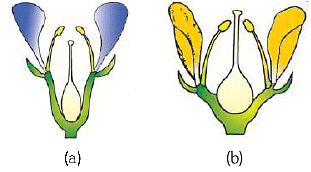 (a) (a) Epigynous; (b) Hypogynous
(b) (a) Hypogynous; (b) Epigynous
(c) (a) Perigynous; (b) Epigynous
(d) (a) Perigynous; (b) Perigynous
Parts of a Flower (Four Whorls)
The four whorls from outside to inside are: calyx, corolla, androecium and gynoecium, all attached to the thalamus.
(i) Calyx
Outermost whorl composed of sepals (usually green). Types:
- Gamosepalous - sepals fused (united).
- Polysepalous - sepals free (distinct).
(ii) Corolla
Made up of petals (usually colourful). Types:
- Gamopetalous - petals fused.
- Polypetalous - petals free.
Aestivation
It is the mode of arrangement of sepals and petals. This folding or arrangement occurs to protect the delicate floral parts or leaves from adverse environmental conditions such as extreme temperatures, excessive sunlight, or water scarcity.
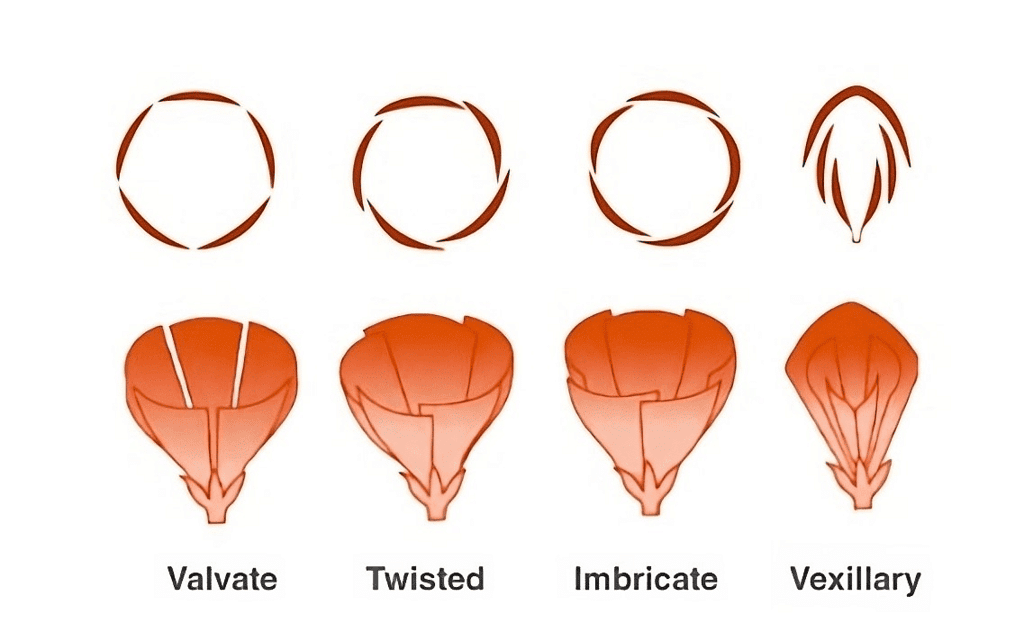 Types of Aestivation
- Valvate - margins of petals/sepals just meet, do not overlap. Example: Calotropis.
- Twisted (contorted) - each petal overlaps the next in the same direction. Examples: Cotton, China rose, Lady's finger.
- Imbricate - petals/sepal margins overlap but not in a single direction; an overlapping pattern. Examples: Gulmohar, Cassia.
- Vexillary (papilionaceous) - characteristic of many papilionaceous flowers where the largest petal (standard) overlaps two lateral petals (wings), which in turn overlap two anterior petals (keel). Examples: Beans, Peas.
(iii) Androecium
The male whorl composed of stamens; each stamen has a filament and anther (which bears pollen).
 Types of Androecium
- Staminode - sterile stamen.
- Epipetalous - stamens attached to petals.
- Polyandrous - stamens free from each other.
- Monadelphous - stamens united into a single bundle.
- Diadelphous - stamens united into two bundles.
- Polyadelphous - stamens united into more than two bundles.
NEET PYQ from this Topic:
Match List-I with List-II. (NEET 2024)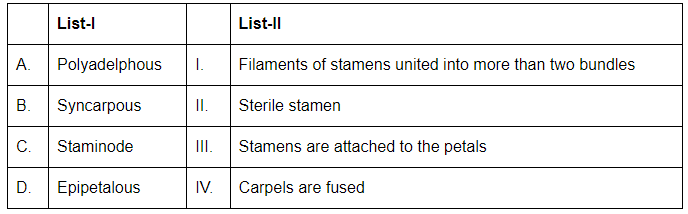
Choose the correct answer from the options given below:
(a) A-I, B-IV, C-II, D-III
(b) A-II, B-I, C-III, D-IV
(c) A-II, B-III, C-I, D-IV
(d) A-I, B-II, C-IV, D-III
Placentation
Placentation is the arrangement and positioning of ovules within the ovary of a flowering plant. The ovules are typically connected to the ovary through a structure called the funicle, and they attach to a specialized region of the ovary known as the placenta. This arrangement is crucial for seed development and eventual fruit formation.
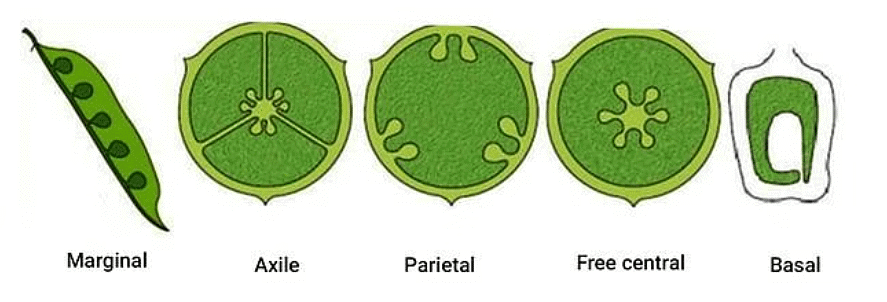 Types of Placentation
- Marginal - ovules attached along the margin of a simple unilocular ovary (e.g. Pea).
- Axile - ovules borne on a central column in a multilocular ovary (e.g. Lemon, China rose).
- Parietal - ovules attached to the inner wall of the ovary (e.g. Argemone, Mustard).
- Free central - ovules attached to a free-standing central column; septa absent (e.g. Primrose, Dianthus).
- Basal - ovules attached at the base of the ovary (e.g. Marigold, Sunflower).
NEET PYQ from this Topic:
Match List I with List II (NEET 2024)
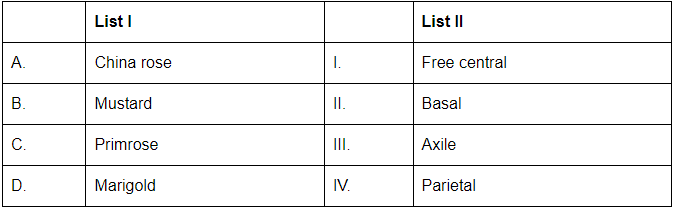
Choose the correct answer from the options given below:
(a) A- IV, B-III, C-II, D-I
(b) A- II, B-III, C-IV, D-I
(c) A- III, B-IV, C-I, D-II
(d) A- III, B-IV, C-II, D-I
The Fruit
A fruit is a mature ovary, often with accessory structures, that protects seeds and aids dispersal.
- Parthenocarpic fruits develop without fertilisation and are seedless. Examples: Banana, seedless grapes, seedless orange.
- The pericarp (fruit wall) often differentiates into three layers: epicarp (outer), mesocarp (middle), and endocarp (inner).
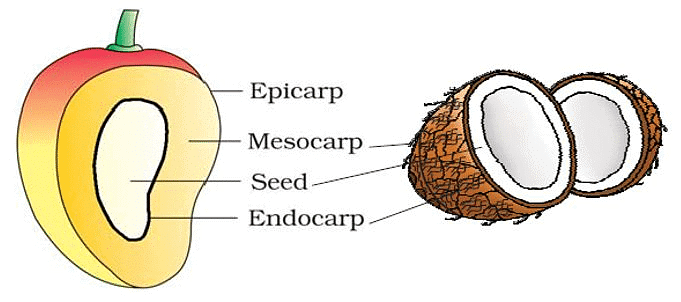
The Seed
After fertilisation, the ovule develops into a seed, containing the embryo and nutritive tissue, enclosed by a seed coat (testa).
- A seed consists of a seed coat and an embryo.
- The embryo contains the radicle (future root), the embryonal axis and one or two cotyledons depending on whether the seed is monocotyledonous or dicotyledonous.
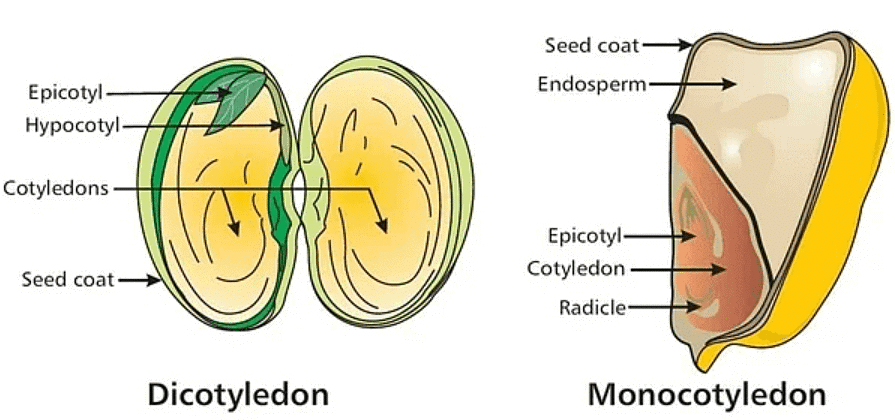
Differences between dicotyledonous and monocotyledonous seeds:
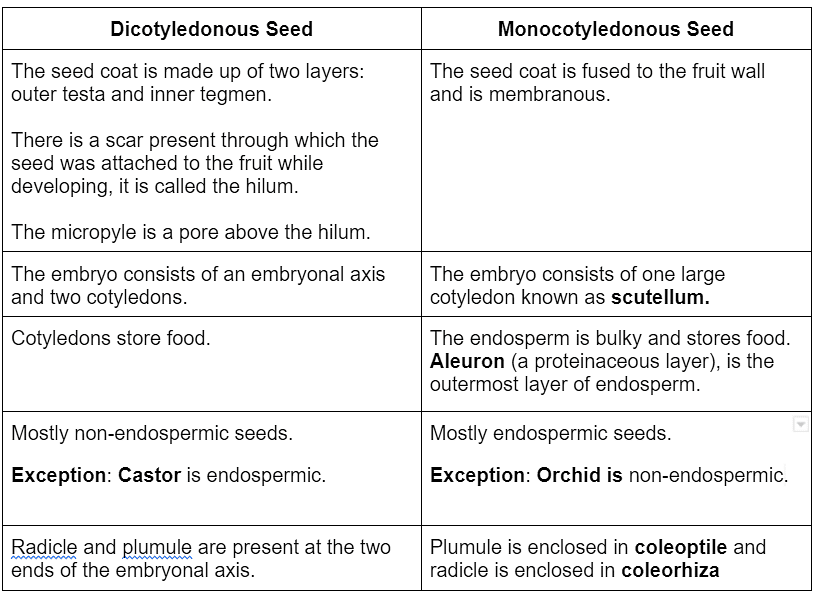 Difference between Dicot Seed and Monocot Seed
Semi-Technical Description of a Typical Flowering Plant
When describing a typical flowering plant, various morphological features are taken into account. The description should be brief, written in simple scientific language, and presented in a logical order. The plant is described starting with its habit, followed by vegetative characters such as roots,stem, and leaves. Then, floral characters including inflorescence and parts of the flower are described.
Floral Diagram and Floral Formula
After describing the various parts of the plant, a floral diagram and a floral formula are presented.
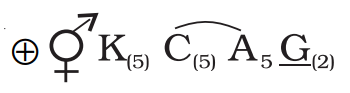
- Floral Formula: A symbolic representation of the floral parts, where:
- Br: Bracteate (presence of bracts)
- K: Sepals (calyx)
- C: Petals (corolla)
- P: Perianth
- A: Androecium (male parts)
- G: Gynoecium (female parts)
- G: Superior or inferior ovary
- ♂: Male plant
- ♀: Female plant
- ⚥: Bisexual plant
- ⊕: Actinomorphic flower
- →: Zygomorphic flower
- Fusion is indicated by enclosing figures in brackets, and adhesion by a line above the symbols.
- Floral Diagram: Illustrates the number and arrangement of flower parts, their relationships, and the position of the mother axis.
Description of Some Important Families
1. Solanaceae (Potato Family)
The Solanaceae family, commonly known as the 'potato family,' is a large and widely distributed group of plants found in tropical, subtropical, and even temperate regions.
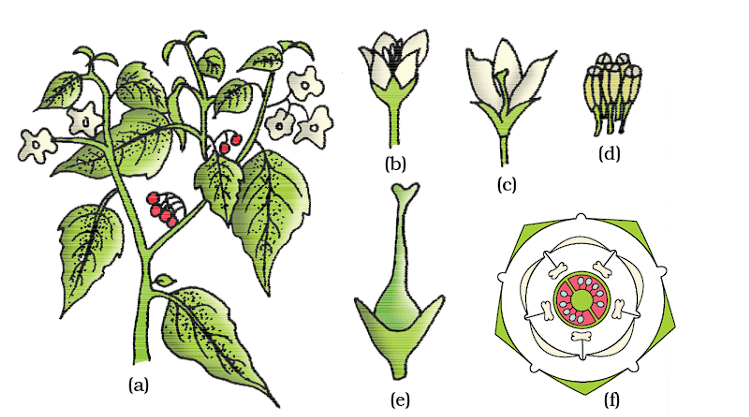
(a) Flowering twig
(b) Flower
(c) L.S. of flower
(d) Stamens
(e) Carpel
(f) Floral diagram
Vegetative Characters:
- Plants: Mostly herbs and shrubs, with some small trees.
- Stem: Herbaceous (rarely woody), aerial, erect, cylindrical, branched, solid or hollow, hairy or glabrous. The underground stem in potato (Solanum tuberosum) is an exception.
- Leaves: Alternate, simple, or rarely pinnately compound, without stipules; venation is reticulate.
Floral Characters:
- Inflorescence: Solitary, axillary, or cymose as seen in Solanum.
- Flower: Bisexual and actinomorphic.
- Calyx: Five united sepals, persistent, with valvate aestivation.
- Corolla: Five united petals with valvate aestivation.
- Androecium: Five stamens that are epipetalous.
- Gynoecium: Bicarpellary, syncarpous, with a superior ovary that is bilocular. The placenta is swollen with many ovules, arranged axile.
- Fruits: Berry or capsule.
- Seeds: Many and endospermous.
- Floral Formula:
Economic Importance:
- Many plants in this family are important sources of food(e.g., tomato, brinjal, potato),spice(e.g., chilli),medicine(e.g., belladonna, ashwagandha),fumigatory(e.g., tobacco), and ornamental(e.g., petunia) products.
2. Malvaceae
The Malvaceae family, commonly referred to as the mallow family, is a prominent family within the order Malvales. It encompasses around 244 genera and over 4225 species. The family is distributed in tropical, subtropical, and temperate regions. Members of this family are diverse, ranging from herbs and shrubs to trees and are known for their economic importance, particularly species like cotton and various ornamental plants like hibiscus.
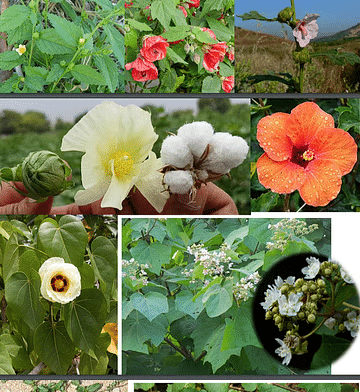 Malvaceae
Vegetative Characters of Malvaceae
Identifying plants means you need to know some basic structural features about important plants. This includes understanding their roots, stems, and the way their leaves look and how they're arranged.
(a) Stem: Stems in the Malvaceae family are typically erect and can be either herbaceous or woody. They often have a hairy surface, with stellate (star-shaped) or simple hairs, which is a distinctive feature of the family.
(b) Leave: The leaves of Malvaceae plants are usually alternate, though they can sometimes be opposite. They are characteristically palmately lobed or veined and possess stipules. The leaves are generally petiolate, and the margins can be serrate, crenate, or entire.
Floral Characters of Malvaceae
(a) Inflorescence: The inflorescence in Malvaceae is typically axillary. The flowers can be solitary or grouped in various arrangements such as cymes, panicles, or clusters.
(b) Flower: Flowers in the Malvaceae family are usually actinomorphic (radially symmetrical) and hermaphroditic. They are often large and showy, which aids in pollinator attraction.
(c) Calyx: The calyx is composed of 5 (or more) sepals, often fused at the base. An additional outer whorl of bracts, called an epicalyx, is sometimes present and can be mistaken for sepals.
(d) Corolla: The corolla typically has 5 petals, which are usually fused at the base. The petals are often brightly colored, aiding in the attraction of pollinators.
(e) Androecium: The androecium generally consists of numerous stamens. These stamens are often fused into a tube that encircles the pistil, a condition known as monadelphous.
(f) Gynoecium: The gynoecium is typically made up of multiple carpels that are united to form a single compound ovary. The ovary is usually superior with axile placentation.
(g) Fruits: The fruit in Malvaceae can vary, but they are often schizocarps (a dry fruit that splits into single-seeded parts when ripe) or capsules.
(h) Seeds: Seeds of Malvaceae plants are generally small and can be hairy or smooth. Some have endosperm, while others do not.
(i) Floral Formula
A typical floral formula for the Malvaceae family is:
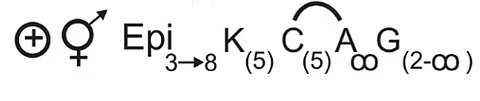 Floral Formula of Malvaceae
This represents a radially symmetrical flower with 5 fused sepals, 5 petals, numerous stamens fused into a tube, and a superior ovary with 5 or more carpels.
Economic Importance of Malvaceae
The Malvaceae family has a significant economic impact due to its diverse applications:
(i) Agriculture: Cotton (Gossypium spp.) is the most economically important genus, providing the primary natural fiber for the textile industry. Okra (Abelmoschus esculentus) is widely cultivated for its edible green pods.
(ii) Ornamental Plants: Many species, such as those from the genera Hibiscus, Malva, and Alcea, are cultivated for their attractive flowers and are used in landscaping and garden design.
(iii) Medicinal Uses: Several members of the Malvaceae family have been used traditionally for their medicinal properties. For instance, the common mallow (Malva sylvestris) is known for its soothing and anti-inflammatory effects.
(iv) Other Uses: Some species are used for their edible seeds and leaves, while others are utilized for their oil or as a source of natural dyes.
3. Cruciferae (Brassicaceae)
The Cruciferae family, also known as Brassicaceae, is a significant family in the order Brassicales. It comprises about 338 genera and more than 3,700 species. The family is commonly referred to as the mustard family and is known for its economic importance, particularly for crops like cabbage, broccoli, mustard, and rapeseed. The members are predominantly found in temperate regions of the Northern Hemisphere.
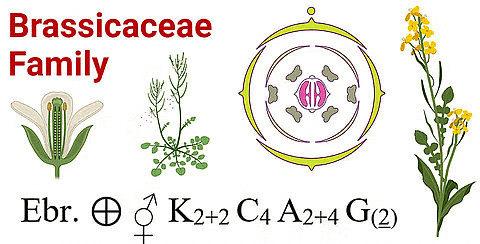 Cruciferae Family
Vegetative Characters of Cruciferae
Identifying plants means you need to know some basic structural features about important plants. This includes understanding their roots, stems, and the way their leaves look and how they're arranged.
(a) Stem
The stems in the Cruciferae family are typically erect and herbaceous, although some members can be woody. They can be simple or branched and often contain watery sap.
(b) Leaves
Leaves of Cruciferae plants are generally alternate, rarely opposite, without stipules. They can be simple or pinnately compound and often have a waxy or glaucous coating. The leaf margin can be entire, toothed, or lobed.
Floral Characters of Cruciferae
Floral characters include inflorescence, Flower, Calyx, Corolla, Androciem, Gaynocieum, fruits, Seeds and floral formula. details of each character is provided below:
(a) Inflorescence: The inflorescence is typically a raceme, which is an unbranched, indeterminate type of inflorescence bearing pedicellate flowers along its axis.
(b) Flower: Flowers in the Cruciferae family are actinomorphic (radially symmetrical) and hermaphroditic. They are usually small and not very showy, with four free petals arranged in a cross, which is a distinctive feature of the family.
(c) Calyx: The calyx consists of four free sepals, which are often erect and sometimes saccate at the base.
(d) Corolla: The corolla has four petals arranged in a cross shape, hence the name Cruciferae. The petals are typically clawed at the base.
(e) Androecium: The androecium consists of six stamens, four of which are long and two are short (tetradynamous condition). This is a characteristic feature of the family.
(f) Gynoecium: The gynoecium is composed of two carpels fused to form a single compound ovary, which is superior. It typically has two locules with a false septum called a replum.
(g) Fruits: The fruit is typically a silique or silicle, which is a dry dehiscent fruit that splits open at maturity. The presence of a replum is a distinguishing feature.
(h) Seeds: Seeds are generally small, round, and can be flat or plump. They are usually not endospermic.
(i) Floral Formula: A Typical Floral Formula of Cruciferae family is:

This represents a flower with four sepals in two whorls, four petals, six stamens (four long and two short), and a superior ovary with two carpels.
Economic Importance of Cruciferae
The Cruciferae family has significant economic value due to its diverse applications:
(i) Agriculture: Many species are cultivated as vegetables, including cabbage (Brassica oleracea), broccoli (B. oleracea var. italica), cauliflower (B. oleracea var. botrytis), and turnip (B. rapa).
(ii) Oil Production: Some members like rapeseed (B. napus) and mustard (B. juncea) are grown for their seeds, which are a source of vegetable oil.
(iii) Ornamental Plants: Several species are used as ornamentals, such as the wallflower (Erysimum) and stock (Matthiola).
(iv) Medicinal Uses: Some members of the family have been used traditionally for their medicinal properties. For example, mustard seeds are used in poultices and plasters.
(v) Other Uses: The family also includes model organisms for scientific research, such as Arabidopsis thaliana, which is widely used in plant genetics and molecular biology.
4. Compositae (Asteraceae)
The Compositae or Asteraceae family, commonly known as the aster, daisy, or sunflower family, is the largest family of flowering plants in terms of the number of species. It includes about 1,620 genera and over 23,600 species. The family is characterized by its composite inflorescences, known as capitula or heads, which are often mistaken for single flowers. Members of this family are found in a wide range of habitats across the globe and include many ornamental plants, weeds, and crops.
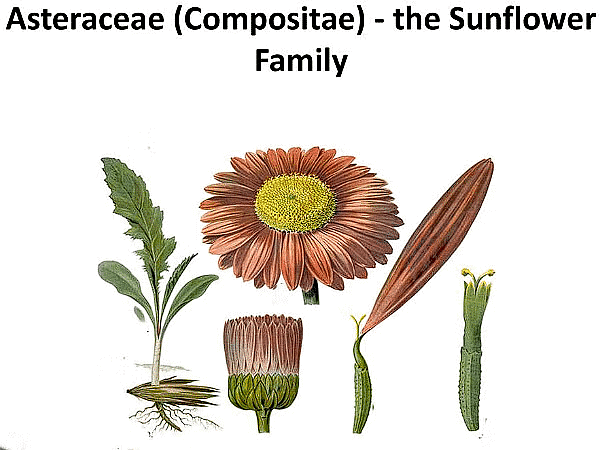
Vegetative Characters of Compositae Family
(a) Stem: Stems in the Compositae family can be herbaceous or woody, erect, prostrate, or climbing. They are often grooved and can be hollow in some species.
(b) Leaves: Leaves of Compositae plants are usually alternate, though they can be opposite or whorled in some genera. They can be simple or compound, with a wide range of shapes and margins. The leaves are often sessile or have a petiole.
Floral Characters
(a) Inflorescence: The inflorescence is a capitulum (head), which is a compact cluster of numerous small florets arranged on a receptacle, often surrounded by bracts (phyllaries) forming an involucre. Each capitulum can resemble a single flower.
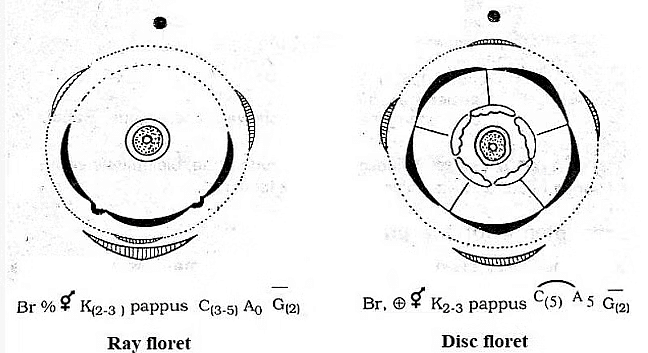
(b) Flower: The florets within a capitulum can be of two types: ray florets (sterile, ligulate, and often petal-like) and disk florets (fertile, tubular). Some capitula contain only one type, while others have both.
(c) Calyx: The calyx is modified into a structure called a pappus, which can be a ring of scales, bristles, or absent. It aids in seed dispersal.
(d) Corolla: The corolla can be tubular (in disk florets) or ligulate (in ray florets). They are usually fused at the base, forming a tube or a strap-shaped structure.
(e) Androecium: The androecium typically consists of five stamens, which are fused by their anthers, forming a tube through which the style grows.
(f) Gynoecium: The gynoecium is composed of two carpels fused to form a single ovary, which is inferior. It typically has one locule with one ovule.
(g) Fruits: The fruit is an achene, which is a small, dry, one-seeded fruit that does not open at maturity. The pappus is often attached to the achene.
(h) Seeds: The seed is contained within the achene and is usually small with a thin seed coat. It lacks endosperm, as the cotyledons store the nutrients.
(i) Floral Formula
A typical floral formula for the Compositae family is:
This represents a flower with a corolla of five fused petals, five stamens fused by their anthers, and an inferior ovary with two carpels.
Economic Importance
The Compositae family has significant economic value due to its diverse applications:
(a) Food Crops
Some species are cultivated for food, including lettuce (Lactuca sativa), artichoke (Cynara scolymus), and sunflower (Helianthus annuus) for its seeds and oil.
(b) Ornamental Plants
Many species are popular ornamentals, such as daisies, chrysanthemums, asters, and marigolds.
(c) Medicinal Uses
Several members have medicinal properties, like Echinacea for immune support and Arnica for topical pain relief.
(d) Industrial Uses
Some species are used for their natural latex (e.g., rubber from Taraxacum species) and as biofuels.
(e) Environmental and Ecological Importance
Members of the Compositae family play a crucial role in ecosystems as sources of nectar and pollen for pollinators.
5. Gramineae (Poaceae)
The Gramineae or Poaceae family, commonly known as the grass family, is one of the largest and most important plant families. It includes about 780 genera and over 12,000 species. Grasses are found worldwide in diverse habitats and are particularly known for their economic importance in agriculture. They are the primary source of calories for humans and livestock, mainly through cereals like wheat, rice, and maize.Vegetative Characters of Gramineae
(a) Stem: The stem, or culm, is typically cylindrical, hollow, and jointed, with solid nodes. It can be erect, decumbent, or creeping. Some grasses have rhizomes or stolons.
(b) Leaves: Leaves are usually alternate, arranged in two ranks. They consist of a sheath that encloses the stem, a ligule at the junction of the sheath and blade, and a flat or rolled blade. The venation is parallel.
Floral Characters of Gramineae Family
(a) Inflorescence
The inflorescence is typically a spike, raceme, or panicle composed of units called spikelets. Each spikelet consists of one to many florets, each with a pair of bracts called glumes at the base.
(b) Flower
The flowers, or florets, are usually small and not showy. They lack a distinct calyx and corolla, having instead modified structures called lodicules, lemma, and palea.
(c) Calyx
The calyx is absent in grass flowers. The role of the calyx is assumed by the glumes at the base of the spikelet.
(d) Corolla
The corolla is also absent. Instead, two or three small scales called lodicules are present, which swell at flowering and help in the opening of the floret.
(e) Androecium
The androecium typically consists of three stamens, but the number can vary. The anthers are usually large and well-exposed for wind pollination.
(f) Gynoecium
The gynoecium is composed of a single carpel, forming a superior ovary. It usually has two feathery stigmas to catch pollen grains.
(g) Fruits
The fruit is a caryopsis, a type of dry fruit where the seed coat is fused to the ovary wall.
(h) Seeds
The seed is contained within the caryopsis and is usually small. It contains endosperm, which is a significant food reserve.
(i) Floral Formula
A typical floral formula for the Gramineae family is:
This represents a flower with no perianth, six stamens, and a superior ovary with two carpels.

Economic Importance of Gramineae Family
The Gramineae family has immense economic value due to its diverse applications:
(a) Food Production: Cereals like wheat, rice, maize, barley, and oats are staple foods for a large portion of the world's population.
(b) Fodder: Grasses are a primary source of fodder for livestock, providing essential nutrients for animals.
(c) Biofuels: Some grasses, like switchgrass and miscanthus, are used in the production of biofuels.
(d) Construction and Crafts: Bamboo, a member of the grass family, is used extensively in construction, furniture, and crafts.
(e) Soil Conservation: Grasses play a crucial role in soil conservation, erosion control, and land rehabilitation.
(f) Ornamental Use: Many grasses are used for ornamental purposes in landscaping and garden design.
FAQs on Chapter Notes: Morphology of Flowering Plants
| 1. What's the difference between a simple leaf and a compound leaf in flowering plants? |  |
| 2. How do I identify whether a plant has alternate, opposite, or whorled leaf arrangement? | |
| 3. What are the main differences between the root systems of monocots and dicots? | |
| 4. Why do some flowers have sepals and petals while others don't, and what's their actual function? | |
| 5. How can I distinguish between a raceme and a spike inflorescence during exam preparation? | |





