Laxmikanth Summary: State Public Service Commission


The State Public Service Commission is established under Articles 315-323 of the Constitution of India. It is a constitutional body constituted in each state to ensure a regular and impartial method of recruitment to the state's civil services and posts. The SPSC's primary functions are to conduct examinations and interviews for recruitment and to advise the state government on matters relating to recruitment, promotion, transfer and disciplinary matters concerning state civil services.
 State Public Service Commission
 Composition
A State Public Service Commission (SPSC) consists of a Chairman and a number of members appointed by the Governor of the state. The Constitution intentionally leaves the precise strength of each commission to the discretion of the Governor so that the Commission may be tailored to the needs of the state.
- Number of members: Not specified in the Constitution; determined by the Governor according to need.
- Qualifications and experience: While the Constitution does not prescribe detailed academic qualifications, it specifies that at least half of the members should have held office under the Central or a State Government for not less than ten years, ensuring administrative experience in the Commission.
- Conditions of service: The Governor determines the conditions of service of the Chairman and members of the SPSC.
- Staff and organisation: The Governor is competent to make provisions for appointing staff for the Commission and for fixing their terms and conditions of service.
- Tenure and age limit: The Chairman and members hold office for six years or until attaining the age of 62 years, whichever is earlier. (For comparison, the UPSC members' upper age limit is normally 65 years.)
Removal of Chairman and Members
The procedure for removal of a Chairman or member of an SPSC is designed to secure their independence from arbitrary executive action. Although the Governor appoints them, the power of removal vests with the President of India.
- Authority to remove: Only the President can remove the Chairman or a member of a State Public Service Commission.
- Grounds for removal: Removal may occur on grounds similar to those applicable to Union PSC members, including conviction for an offence, insolvency, engagement in paid employment outside official duties, or incapacity due to mental or physical infirmity.
- Misbehaviour: If a question of misbehaviour is involved, the President must refer the matter to the Supreme Court for inquiry and report; if the Court upholds the charge, the President may remove the person. The Supreme Court's report is binding on the President.
- Specified forms of misbehaviour: The Constitution treats being interested in any contract or agreement with the Government of India or a State Government, or deriving profit from such contracts, as misbehaviour (with an exception for being a member of an incorporated company together with other such members).
- Interim suspension: During the period of the Supreme Court's inquiry, the Governor has the authority to suspend the concerned Chairman or member until the President takes the final decision based on the Court's report.
Functions of the State Public Service Commission
- Recruitment and selection: The Commission conducts competitive examinations and interviews and performs other selection procedures required for appointments to the services of the State.
- Advisory role: The SPSC advises the state government on a range of personnel matters. These advisory functions include:
- Methods and procedures of recruitment to the state services and posts.
- Principles to be followed in making appointments, promotions, and transfers, and in assessing the suitability of candidates.
- Disciplinary matters affecting persons serving under the state government, including consideration of petitions on such matters.
- Claims for reimbursement of legal expenses incurred by civil servants in defending legal proceedings arising out of official duties.
- Claims for pension or compensation in respect of injuries sustained in the course of service, including assessment of the amount payable.
Key Role - "Watchdog of the Merit System"
The SPSC is often described as the "watchdog of the merit system." This captures its role in ensuring that appointments and promotions are made on the basis of merit and fair procedure, insulating the civil services of the state from undue political or non-merit considerations.
- Recruitment focus: By conducting impartial examinations and interviews, the SPSC preserves standards of competence and integrity in the state bureaucracy.
- Advisory influence: Through its recommendations on promotions, transfers and disciplinary matters, the Commission promotes consistency and fairness in personnel administration.
- Administrative coordination: The Commission works in conjunction with the Department of Personnel or the General Administration Department of the state, which implements personnel policies and administrative decisions.
- Advisory nature of recommendations: The SPSC's recommendations are of an advisory character; the state government ordinarily consults the Commission and may accept or reject its advice, subject to legal and constitutional constraints and any regulations that require consultation.
- Interaction with other oversight bodies: Bodies such as the State Vigilance Commission may affect disciplinary proceedings; nevertheless, the SPSC retains an advantage as an independent constitutional body when providing impartial inputs on personnel issues.
- Judicial service appointments: In matters relating to judicial services, the Governor generally consults the High Court and the SPSC as required by state rules and conventions.
Limitations on the SPSC
Though constitutionally established and independent in its functions, the SPSC is subject to certain express limitations and exclusions.
- Exclusions from consultation: The SPSC is not consulted on certain matters which are expressly excluded from its functional jurisdiction. Prominent exclusions include:
- Reservations and backward classes: Decisions to reserve appointments or posts in favour of any backward class of citizens are matters in which the SPSC is not necessarily consulted.
- Special consideration for SC/ST claims: Consideration of claims of Scheduled Castes (SCs) and Scheduled Tribes (STs) in appointments to services and posts is typically handled under specific constitutional and statutory provisions; such matters may be excluded from routine SPSC consultation.
Governor's power to exclude: The Governor may, by regulation, specify posts, services or matters in relation to which consultation with the SPSC is not necessary. These regulations determine the field of the Commission's operational involvement in the state's personnel administration.
Legislative oversight: Every regulation made by the Governor excluding matters from the SPSC's purview must be laid before each House of the State Legislature for not less than fourteen days. The State Legislature has the power to annul or amend such regulations by resolution.
Joint State Public Service Commission (JSPSC)
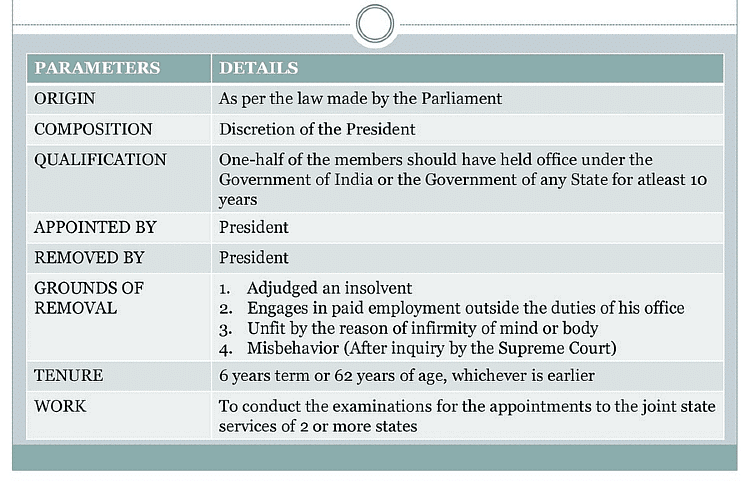 Joint State Public Service Commission
Two or more states may, if they so desire, set up a Joint State Public Service Commission to serve the participating states. A JSPSC differs from the single-state SPSC in a few important respects.
- Constitutional and statutory basis: While the UPSC and individual SPSCs are directly provided for in the Constitution, a JSPSC is typically constituted through an act of Parliament upon the request of the participating state legislatures; hence a JSPSC is a statutory rather than a purely constitutional body.
- Formation: A JSPSC is created when two or more state legislatures agree and request the Union Government; Parliament then provides for its constitution and working by statute.
- Appointment and tenure: The Chairman and members of a JSPSC are appointed by the President. They normally hold office for a term of six years or until attaining the age of 62 years, whichever is earlier.
- Authority of the President: The President has the power to suspend or remove members of the JSPSC and to accept resignations addressed to the President.
- Membership and conditions: The President determines the number of members of the JSPSC and fixes their conditions of service.
- Accountability and reporting: A JSPSC submits its annual report to the Governors of the participating states; each Governor places the report before the respective State Legislature, ensuring democratic oversight and transparency.
Conclusion
The State Public Service Commission is a cornerstone institution for maintaining an impartial, merit-based recruitment system in state administration. Its constitutional status under Articles 315-323, the safeguards for the tenure and independence of its members, and its advisory and examination functions collectively underpin the integrity and efficiency of the state civil services. At the same time, its recommendations are advisory, and the state retains certain powers-such as reservations and governor-made exclusions-that limit the Commission's scope in specified areas. Where states choose to pool resources, a JSPSC provides a statutory mechanism for joint recruitment and advice.
FAQs on Laxmikanth Summary: State Public Service Commission
| 1. What is the composition of the Joint State Public Service Commission (JSPSC)? |  |
| 2. What is the function of the Joint State Public Service Commission (JSPSC)? | |
| 3. What are the limitations of the Joint State Public Service Commission (JSPSC)? | |
| 4. How does the Joint State Public Service Commission (JSPSC) remove candidates from the recruitment process? | |
| 5. How does the Joint State Public Service Commission (JSPSC) ensure transparency in its recruitment process? | |





