NCERT Solutions: Motion in a Plane

Q3.1: State, for each of the following physical quantities, if it is a scalar or a vector:
Volume, mass, speed, acceleration, density, number of moles, velocity, angular frequency, displacement, angular velocity.
Ans: Scalar: A scalar quantity is specified by its magnitude only. It does not have any direction associated with it. Volume, mass, speed, density, number of moles, and angular frequency are examples of scalar physical quantities.
Vector: A vector quantity is specified by its magnitude as well as the direction associated with it. Acceleration, velocity, displacement, and angular velocity belong to this category. (Note: In planar motion angular frequency is treated as a scalar; angular velocity is an axial vector whose direction is given by the right-hand rule.)
Q3.2: Pick out the two scalar quantities in the following list:
force, angular momentum, work, current, linear momentum, electric field, average velocity, magnetic moment, relative velocity.
Ans: Work done is given by the dot product of force and displacement. Since the dot product of two vectors is a scalar, work is a scalar physical quantity.
Electric current, as used here, is specified by its magnitude (with sign for direction in a chosen convention) and is treated as a scalar in elementary mechanics and circuits. Hence it is listed as a scalar quantity.
Q3.3: Pick out the only vector quantity in the following list:
Temperature, pressure, impulse, time, power, total path length, energy, gravitational potential, coefficient of friction, charge.
Ans: Impulse is given by the product of force and time. Since force is a vector quantity, the product of a vector with the scalar time gives a vector quantity; thus impulse is a vector.
Q3.4: State with reasons, whether the following algebraic operations with scalar and vector physical quantities are meaningful:
(a) adding any two scalars, (b) adding a scalar to a vector of the same dimensions, (c) multiplying any vector by any scalar, (d) multiplying any two scalars, (e) adding any two vectors, (f) adding a component of a vector to the same vector.
Ans: (a) Meaningful- The addition of two scalar quantities is meaningful only if they represent the same physical quantity (for example, two lengths or two masses).
(b) Not Meaningful- The addition of a scalar to a vector is not meaningful because the two have different nature (one has direction, the other does not).
(c) Meaningful- A scalar may multiply a vector to give another vector. For example, multiplying a time interval (scalar) with a force (vector) does not give a standard physical quantity, but multiplying a scalar by a velocity vector scales the velocity.
(d) Meaningful-Two scalars of the same or different dimensions can be multiplied; the result is a scalar (for example, speed × time = distance).
(e) Meaningful- The addition of two vectors is meaningful provided they represent the same kind of vector quantity (for example, two displacements). Vector addition follows the triangle/parallelogram law.
(f) Not Meaningful in general- Whether this is meaningful depends on what is meant by "component". If "component" means the scalar projection (for example, the x-component vx of velocity), then adding that scalar to the full vector is not meaningful. If by "component" one means the component vector (for example, vx̂i, a vector along the x-direction), then adding that component vector to the original vector is meaningful. In standard usage a component is usually a scalar projection, so such an addition is not meaningful unless the component is explicitly treated as a vector.
Q3.5: Read each statement below carefully and state with reasons, if it is true or false:
(a) The magnitude of a vector is always a scalar, (b) each component of a vector is always a scalar, (c) the total path length is always equal to the magnitude of the displacement vector of a particle. (d) the average speed of a particle (defined as total path length divided by the time taken to cover the path) is either greater or equal to the magnitude of average velocity of the particle over the same interval of time, (e) Three vectors not lying in a plane can never add up to give a null vector.
Ans: (a) True- The magnitude (or length) of a vector is a positive number and hence a scalar quantity.
(b) True- Each component of a vector (for example the x-component or y-component) is a scalar number giving the projection of the vector along that axis. Hence the statement is true.
(c) False- Total path length is a scalar and usually larger than or equal to the magnitude of displacement. They are equal only when the motion is along a straight line in one direction. Thus the statement is false in general.
(d) True- Average speed = (total path length)/(time) is always greater than or equal to the magnitude of average velocity = (magnitude of displacement)/(time), because total path length ≥ magnitude of displacement.
(e) True- Three vectors that are not coplanar cannot be placed head-to-tail to form a closed triangle. For three vectors to add to zero they must form the sides of a triangle and therefore must lie in the same plane. Hence the statement is true.
Q3.6: Establish the following vector inequalities geometrically or otherwise:
(a) |a b| ≤ |a| |b|
(b) |a b| ≥ ||a| - |b||
(c) |a - b| ≤ |a| |b|
(d) |a - b| ≥ ||a| - |b||
When does the equality sign above apply?
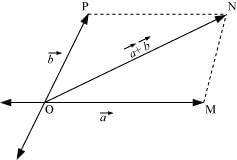
Ans: (a) Let two vectors

and

be represented by the adjacent sides of a parallelogram OMNP, as shown in the given figure.
Here, we can write:
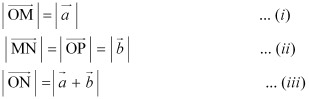
In a triangle, each side is smaller than the sum of the other two sides.
Therefore, in ΔOMN, we have:
ON < (OM MN)

If the two vectors
and
act along a straight line in the same direction, then we can write:

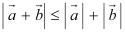
Combining equations (iv) and (v), we get:
(b) Let two vectors
and
be represented by the adjacent sides of a parallelogram OMNP, as shown in the given figure.
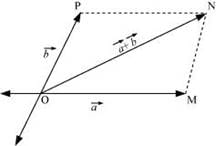
Here, we have:
In a triangle, each side is smaller than the sum of the other two sides.
Therefore, in ΔOMN, we have:
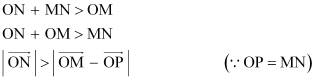

... (iv)
If the two vectors
and
act along a straight line in the same direction, then we can write:
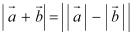
... (v)
Combining equations (iv) and (v), we get:
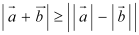
(c) Let two vectors
and
be represented by the adjacent sides of a parallelogram PORS, as shown in the given figure.
Here we have:
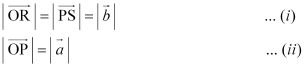
In a triangle, each side is smaller than the sum of the other two sides. Therefore, in ΔOPS, we have:

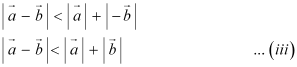
If the two vectors act in a straight line but in opposite directions, then we can write:
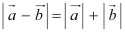
... (iv)
Combining equations (iii) and (iv), we get:

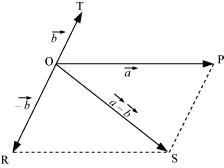
(d) Let two vectors
and
be represented by the adjacent sides of a parallelogram PORS, as shown in the given figure.
The following relations can be written for the given parallelogram.
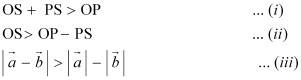
The quantity on the LHS is always positive and that on the RHS can be positive or negative. To make both quantities positive, we take modulus on both sides as:
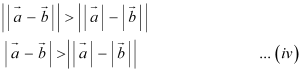
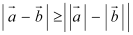
If the two vectors act in a straight line but in the opposite directions, then we can write:

Combining equations (iv) and (v), we get:
Q3.7: Given a +b+ c+ d = 0, which of the following statements are correct
(a) a, b, c, and d must each be a null vector,
(b) The magnitude of (a+c) equals the magnitude of (b+d),
(c) The magnitude of a can never be greater than the sum of the magnitudes of b, c, and d,
(d) b c must lie in the plane of a and d if a and d are not colinear, and in the line of a and d, if they are colinear?
Ans: (a) Incorrect- In order to make a+ b+ c+ d = 0, it is not necessary to have all the four given vectors as null vectors. There are many other combinations which can give the sum zero.
(b) Correct-
a + b + c + d = 0
a c = - (b + d)
Taking modulus on both the sides, we get:
| a + c | = | -(b + d)| = | b + d |
Hence, the magnitude of (a + c) is the same as the magnitude of (b + d).
(c) Correct-
a + b + c + d = 0
a = (b+ c +d)
Taking modulus both sides, we get:
| a | = | b +c + d |

... (i)
Equation (i) shows that the magnitude of a is equal to or less than the sum of the magnitudes of b, c, and d (triangle inequality).
Hence, the magnitude of vector a can never be greater than the sum of the magnitudes of b, c, and d.
(d) Correct-
For a+ b +c +d = 0
a (b + c) d = 0
The resultant sum of the three vectors a, (b + c), and d can be zero only if (b + c) lie in a plane containing a and d, assuming that these three vectors are represented by the three sides of a triangle.
If a and d are colinear, then it implies that the vector (b + c) is in the line of a and d. This implication holds only then the vector sum of all the vectors will be zero.
Q3.8: Three girls skating on a circular ice ground of radius 200 m start from a point P on the edge of the ground and reach a point Q diametrically opposite to P following different paths as shown in Fig. 3.19. What is the magnitude of the displacement vector for each? For which girl is this equal to the actual length of the path skated?
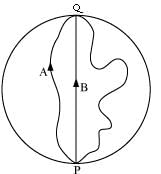
Ans: Displacement is given by the minimum distance between the initial and final positions of a particle. In the given case, all the girls start from point P and reach point Q. The magnitudes of their displacements will be equal to the diameter of the ground.
Radius of the ground = 200 m
Diameter of the ground = 2 × 200 = 400 m
Hence, the magnitude of the displacement for each girl is 400 m. This is equal to the actual length of the path skated by girl B (who travels along the straight diameter).
Q3.9: A cyclist starts from the center O of a circular park of radius 1 km, reaches the edge P of the park, then cycles along the circumference, and returns to the center along QO as shown in Fig. 3.20. If the round trip takes 10 min, what is the (a) net displacement, (b) average velocity, and (c) average speed of the cyclist?
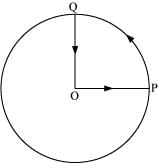
Ans: (a) Displacement is given by the minimum distance between the initial and final positions of a body. In the given case, the cyclist comes to the starting point after cycling for 10 minutes. Hence, his net displacement is zero.
(b) Average velocity is given by the relation:
Average velocity
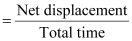
Since the net displacement of the cyclist is zero, his average velocity is zero.
(c) Average speed of the cyclist is given by the relation:
Average speed
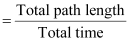
Total path length = OP + PQ + QO
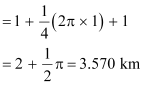
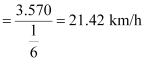
Time taken = 10 min

∴ Average speed
Q3.10: On open ground, a motorist follows a track that turns to his left by an angle of 60° after every 500 m. Starting from a given turn, specify the displacement of the motorist at the third, sixth and eighth turn. Compare the magnitude of the displacement with the total path length covered by the motorist in each case.
Ans: The path followed by the motorist is a regular hexagon with side 500 m, as shown in the given figure
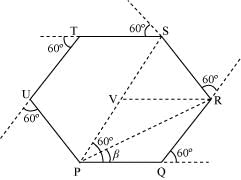
Let the motorist start from point P.
The motorist takes the third turn at S.
∴ Magnitude of displacement = PS = PV + VS = 500 + 500 = 1000 m
Total path length = PQ + QR + RS = 500 + 500 + 500 = 1500 m
The motorist takes the sixth turn at point P, which is the starting point.
∴ Magnitude of displacement = 0
Total path length = PQ + QR + RS + ST + TU + UP = 6 × 500 = 3000 m
The motorist takes the eighth turn at point R
∴ Magnitude of displacement = PR
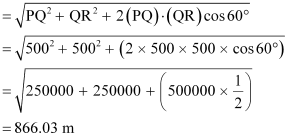

Therefore, the magnitude of displacement is 866.03 m at an angle of 30° with PR.
Total path length = 8 × 500 = 4000 m
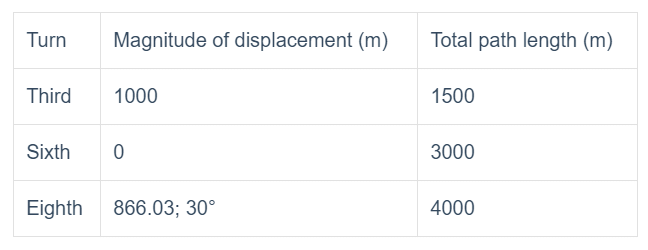
The magnitude of displacement and the total path length corresponding to the required turns is shown in the given table:
Q3.11: A passenger arriving in a new town wishes to go from the station to a hotel located 10 km away on a straight road from the station. A dishonest cabman takes him along a circuitous path 23 km long and reaches the hotel in 28 min. What is (a) the average speed of the taxi, (b) the magnitude of average velocity? Are the two equal?
Ans: (a) Total distance travelled = 23 km
Total time taken = 28 min = 28/60 h

∴Average speed of the taxi = 23 ÷ (28/60) = 23 × 60/28 ≈ 49.29 km/h

(b) Distance between the hotel and the station = 10 km = magnitude of displacement of the car
∴ Average speed in terms of displacement (magnitude of average velocity) = 10 ÷ (28/60) = 10 × 60/28 ≈ 21.43 km/h
Therefore, the two physical quantities (average speed and magnitude of average velocity) are not equal.
Q3.12: The ceiling of a long hall is 25 m high. What is the maximum horizontal distance that a ball thrown with a speed of 40 m s-1 can go without hitting the ceiling of the hall?
Ans: Speed of the ball, u = 40 m/s
Maximum allowable height, h = 25 m
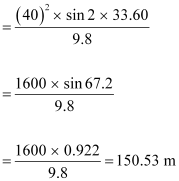
For projectile motion, the maximum height H reached when projected at angle θ is H = (u^2 sin^2 θ)/(2g).
Set H = 25 m and solve for sin^2 θ:
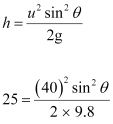
sin^2 θ = (2gh)/u^2 = 0.30625
sin θ = 0.5534
∴ θ ≈ 33.60°
Horizontal range for this angle is R = (u^2 sin 2θ)/g.

Using the computed θ gives the maximum horizontal distance the ball can travel without exceeding 25 m height.
Q3.13: A cricketer can throw a ball to a maximum horizontal distance of 100 m. How much high above the ground can the cricketer throw the same ball?
Ans: Maximum horizontal distance, R = 100 m
The maximum range for a given speed u occurs at θ = 45°, and Rmax = u^2/g. Thus u^2 = R g = 100 × g.
Using g ≈ 9.8 m/s2, u^2 ≈ 980 m2/s2, so u ≈ 31.3 m/s.
The maximum height the same ball can reach (when thrown vertically with speed u) is H = u^2/(2g) = (R g)/(2g) = R/2 = 50 m.
Hence, the cricketer can throw the ball up to about 50 m above the ground with that speed.
Q3.14: A stone tied to the end of a string 80 cm long is whirled in a horizontal circle with a constant speed. If the stone makes 14 revolutions in 25 s, what is the magnitude and direction of acceleration of the stone?
Ans: Length of the string, l = 80 cm = 0.8 m
Number of revolutions = 14
Time taken = 25 s
Frequency, ν = 14/25 s-1

Angular frequency, ω = 2πν = 2π × (14/25) rad/s

Centripetal acceleration, a_c = ω^2 r = (2πν)^2 × r

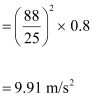
The direction of centripetal acceleration is always along the string, directed toward the centre of the circle at every instant.
Q3.15: An aircraft executes a horizontal loop of radius 1.00 km with a steady speed of 900 km/h. Compare its centripetal acceleration with the acceleration due to gravity.
Ans: Radius of the loop, r = 1 km = 1000 m
Speed of the aircraft, v = 900 km/h = 900/3.6 = 250 m/s
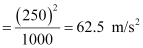
Centripetal acceleration, a_c = v^2/r = (250^2)/1000 = 62.5 m/s2

Acceleration due to gravity, g = 9.8 m/s2
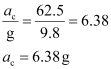
Thus a_c/g ≈ 62.5/9.8 ≈ 6.38. The centripetal acceleration is about 6.38 times the acceleration due to gravity.
Q3.16: Read each statement below carefully and state, with reasons, if it is true or false :
(a) The net acceleration of a particle in circular motion is always along the radius of the circle towards the centre
(b) The velocity vector of a particle at a point is always along the tangent to the path of the particle at that point
(c) The acceleration vector of a particle in uniform circular motion averaged over one cycle is a null vector
Ans: (a) False- The net acceleration of a particle in circular motion is purely radial toward the centre only in the special case of uniform circular motion (constant speed). If the speed changes (non-uniform circular motion), there is also a tangential component of acceleration.
(b) True- At any instant the velocity vector is tangent to the path of the particle; for circular motion it is along the tangent to the circle at that point.
(c) True- In uniform circular motion the acceleration vector always points toward the centre. Over one full cycle the vector sum (or average) of these radial accelerations is zero, so the average acceleration over a cycle is the null vector.
Q3.17: The position of a particle is given by

Where t is in seconds and the coefficients have the proper units for r to be in metres.
(a) Find the v and a of the particle?
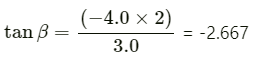
(b) What is the magnitude and direction of velocity of the particle at t = 2.0 s?
Ans:
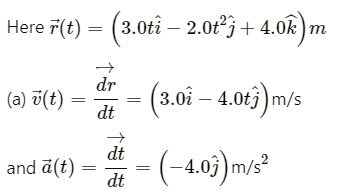
(b) Magnitude of velocity at t = 2.0 s

= 8.54-1
This velocity will subtend an angle β from x-axis, where

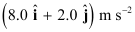
Q3.18:A particle starts from the origin at t = 0 s with a velocity of

and moves in the x-y plane with a constant acceleration of
(a) At what time is the x-coordinate of the particle 16 m? What is the y-coordinate of the particle at that time?
(b) What is the speed of the particle at the time?
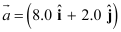
Ans: Velocity of the particle,

Acceleration of the particle
Also,
But,
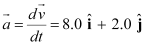
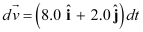
Integrating both sides:

Where,

= Velocity vector of the particle at t = 0

= Velocity vector of the particle at time t
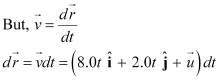
Integrating the equations with the conditions: at t = 0; r = 0 and at t = t; r = r
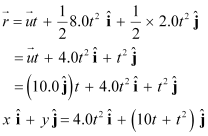
Since the motion of the particle is confined to the x-y plane, on equating the coefficients of

, we get:
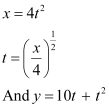
(a) When x = 16 m:
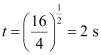
∴y = 10 × 2 (2)2 = 24 m
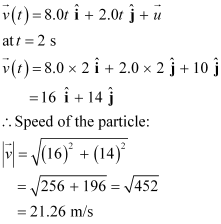
(b) Velocity of the particle is given by:
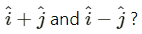
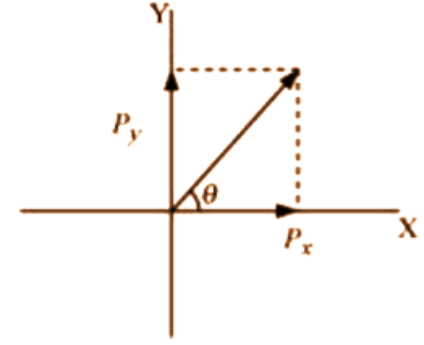
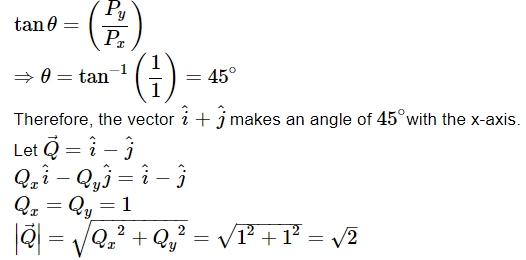
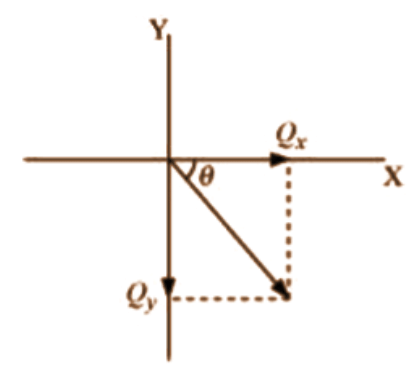
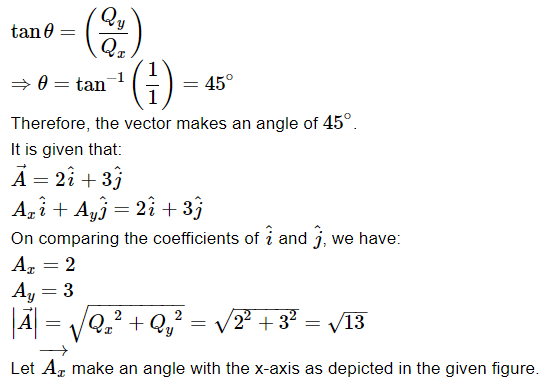
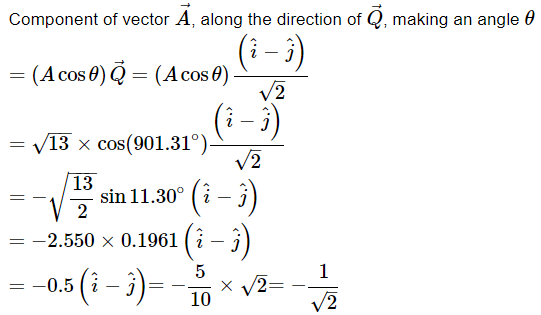
Q3.19:  are unit vectors along x- and y-axis respectively. What is the magnitude and direction of the vectors
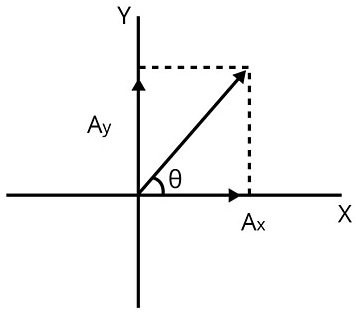
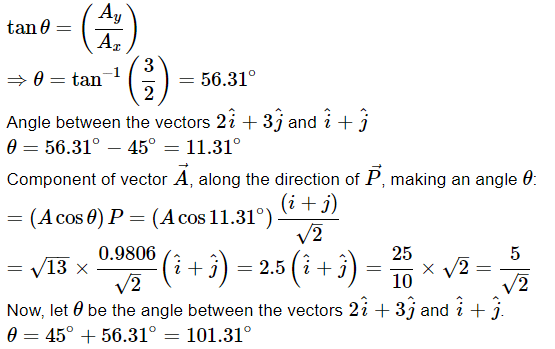
  What are the components of a vector
  [You may use graphical method]
Ans: 
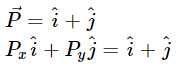
On comparing the components on both sides, we obtain:

Therefore, the magnitude of the vector is √2
Let θ be the angle made by the vector

with the x-axis, as shown in the given figure.

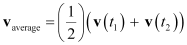
Q3.20: For any arbitrary motion in space, which of the following relations are true:
(a)
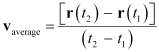
(b)
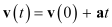
(c)
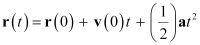
(d)
(e)
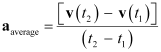
(The 'average' stands for average of the quantity over the time interval t1 to t2)
Ans: (a) False- It is given that the motion of the particle is arbitrary. Therefore, the average velocity of the particle cannot be given by this equation in general.
(b) True- The arbitrary motion of the particle can be represented by this equation.
(c) False- The motion of the particle is arbitrary. The acceleration of the particle may also be non-uniform. Hence, this equation cannot represent the motion of the particle in space in general.
(d) False- The motion of the particle is arbitrary; acceleration of the particle may also be non-uniform. Hence, this equation cannot represent the motion of particle in space in general.
(e) True- The arbitrary motion of the particle can be represented by this equation.
Q3.21: Read each statement below carefully and state, with reasons and examples, if it is true or false:
A scalar quantity is one that
(a) is conserved in a process
(b) can never take negative values
(c) must be dimensionless
(d) does not vary from one point to another in space
(e) has the same value for observers with different orientations of axes
Ans: (a) False- Being a scalar does not imply conservation. For example, mechanical energy (a scalar) need not be conserved in an inelastic collision, although total energy (including internal energy, heat, etc.) is conserved. Thus a scalar quantity may or may not be conserved depending on the physical process.
(b) False- Some scalar quantities can take negative values. For example, temperature (on certain scales) can be negative and scalar potentials (gravitational potential) can be negative.
(c) False- A scalar may have dimensions. For example, total path length is a scalar with the dimension of length.
(d) False- A scalar quantity such as gravitational potential or temperature can vary from one point to another in space.
(e) True- The value of a scalar does not change under rotation of axes; it is the same for observers using different orientations of axes.
Q3.22: An aircraft is flying at a height of 3400 m above the ground. If the angle subtended at a ground observation point by the aircraft positions 10.0 s apart is 30°, what is the speed of the aircraft?
Ans: The positions of the observer and the aircraft are shown in the given figure.
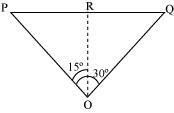
Height of the aircraft from ground, OR = 3400 m
Angle subtended between the positions, ∠POQ = 30°
Time = 10 s
In ΔPRO:
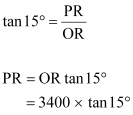
ΔPRO is similar to ΔRQO.
∴ PR = RQ
PQ = PR + RQ = 2PR = 2 × 3400 tan 15°
= 6800 × 0.268 ≈ 1822.4 m
∴ Speed of the aircraft = PQ / time = 1822.4 / 10 ≈ 182.24 m/s
Old NCERT Solution
Q1. Rain is falling vertically with a speed of 30 m s-1. A woman rides a bicycle with a speed of 10 m s-1 in the north to south direction. What is the direction in which she should hold her umbrella?Ans. The described situation is shown in the given figure.
Here,
vc = Velocity of the cyclist
vr = Velocity of falling rain
In order to protect herself from the rain, the woman must hold her umbrella in the direction of the relative velocity (v) of the rain with respect to the woman.
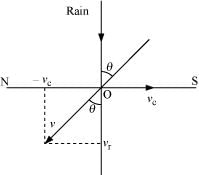
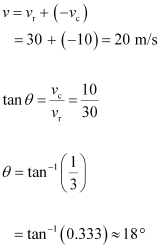
Hence, the woman must hold the umbrella toward the south, at an angle of nearly 18° with the vertical.
Q2. A man can swim with a speed of 4.0 km/h in still water. How long does he take to cross a river 1.0 km wide if the river flows steadily at 3.0 km/h and he makes his strokes normal to the river current? How far down the river does he go when he reaches the other bank?
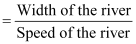
Ans. Speed of the man, vm = 4 km/h
Width of the river = 1 km
Time taken to cross the river
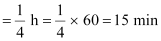
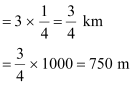
Speed of the river, vr = 3 km/h
Distance covered with flow of the river = vr × t
Q3. In a harbour, wind is blowing at the speed of 72 km/h and the flag on the mast of a boat anchored in the harbour flutters along the N-E direction. If the boat starts moving at a speed of 51 km/h to the north, what is the direction of the flag on the mast of the boat?
Ans. Velocity of the boat, vb = 51 km/h
Velocity of the wind, vw = 72 km/h
The flag is fluttering in the north-east direction. It shows that the wind is blowing toward the north-east direction. When the ship begins sailing toward the north, the flag will move along the direction of the relative velocity (vwb) of the wind with respect to the boat.
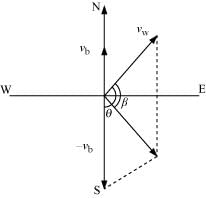
The angle between vw and (-vb) = 90° 45°
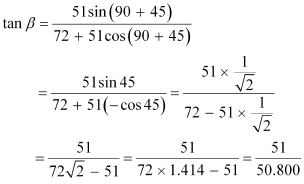

Angle with respect to the east direction = 45.11° - 45° = 0.11°
Hence, the flag will flutter almost due east.
Q4. A vector has magnitude and direction. Does it have a location in space? Can it vary with time? Will two equal vectors a and b at different locations in space necessarily have identical physical effects? Give examples in support of your answer.
Ans. No- Generally speaking, a free vector has no definite location in space. This is because a free vector remains unchanged when displaced parallel to itself without rotating; however, a position vector has a definite location (it points from origin to a point).
Yes- A vector can vary with time. For example, the displacement vector of a particle moving with a certain velocity changes with time.
No- Two equal vectors located at different positions need not produce the same physical effect. For example, two equal forces applied at different points on a rigid body can produce different torques and thus different rotational effects.
Q5. A vector has both magnitude and direction. Does it mean that anything that has magnitude and direction is necessarily a vector? The rotation of a body can be specified by the direction of the axis of rotation, and the angle of rotation about the axis. Does that make any rotation a vector
Ans. No- A physical quantity having both magnitude and direction is not necessarily a vector in the sense of obeying vector addition. For example, electric current in circuits is usually treated as a scalar with sign; current density is a vector. The essential test for a quantity to be a vector is that it should follow the law of vector addition.
No- In general, a finite rotation about an axis does not obey vector addition (rotations compose non-commutatively). Small rotations (infinitesimal) do follow vector addition approximately and are often treated as vectors in that limit. Thus rotation is not a vector in general.
Q6. Can you associate vectors with (a) the length of a wire bent into a loop, (b) a plane area, (c) a sphere? Explain.
Ans. (a) No- One cannot associate a vector with the length of a closed wire loop since length is a scalar.
(b) Yes- One can associate an area vector with a plane area. The area vector's magnitude is the area and its direction is chosen normal to the plane (by convention, outward or given orientation).
(c) No- One cannot associate a single vector with the volume of a sphere (volume is a scalar). However, surface elements of a sphere have area vectors normal to the surface at each point.
Q7. A bullet fired at an angle of 30° with the horizontal hits the ground 3.0 km away. By adjusting its angle of projection, can one hope to hit a target 5.0 km away? Assume the muzzle speed to the fixed, and neglect air resistance.
Ans. No
Range for a projectile, R = (u^2 sin 2θ)/g. For fixed u the maximum possible range is Rmax = u^2/g, which occurs at θ = 45°. From the given data for θ = 30° we have R = 3 km. This gives u^2/g = R / sin 60° = 3 km / (√3/2) = (6/√3) km, so Rmax = u^2/g = (6/√3) km which is less than 5 km. Hence one cannot reach 5 km with the same muzzle speed.
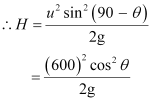
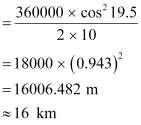
Q8. A fighter plane flying horizontally at an altitude of 1.5 km with speed 720 km/h passes directly overhead an anti-aircraft gun. At what angle from the vertical should the gun be fired for the shell with muzzle speed 600 m s-1 to hit the plane? At what minimum altitude should the pilot fly the plane to avoid being hit? (Take g = 10 m s-2).
Ans. Height of the fighter plane = 1.5 km = 1500 m
Speed of the fighter plane, v = 720 km/h = 200 m/s
Let θ be the angle with the vertical so that the shell hits the plane. The situation is shown in the given figure.
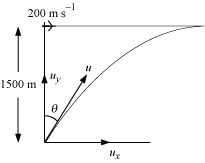
Muzzle velocity of the gun, u = 600 m/s
Time taken by the shell to hit the plane = t
Horizontal distance travelled by the shell = ux t, where ux = u sin θ (if θ measured from vertical).
Distance travelled by the plane in same time = v t.
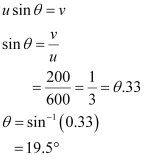
Equate the two horizontal distances and use the vertical motion of the shell to match the altitude; solving these gives the required angle θ.
To avoid being hit the pilot must fly above the maximum height reached by the shell for any firing angle. Calculating the maximum shell height from the muzzle speed gives the minimum safe altitude.
Q9. A cyclist is riding with a speed of 27 km/h. As he approaches a circular turn on the road of radius 80 m, he applies brakes and reduces his speed at the constant rate of 0.50 m/s every second. What is the magnitude and direction of the net acceleration of the cyclist on the circular turn?
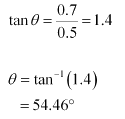
Ans. 0.86 m/s2; 54.46° with the direction of velocity
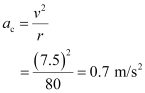
Speed of the cyclist,

Radius of the circular turn, r = 80 m
Centripetal acceleration is given as:
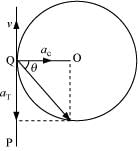
The situation is shown in the given figure:
Suppose the cyclist begins cycling from point P and moves toward point Q. At point Q, he applies the brakes and decelerates the speed of the bicycle by 0.5 m/s2.
This tangential acceleration is along the tangent at Q and opposite to the direction of motion of the cyclist.
Since the angle between the tangential and radial accelerations is 90°, the resultant acceleration a is given by:
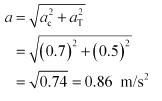

Where θ is the angle of the resultant with the direction of velocity
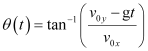
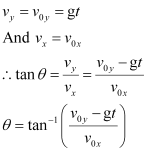
Q10. (a) Show that for a projectile the angle between the velocity and the x-axis as a function of time is given by
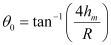
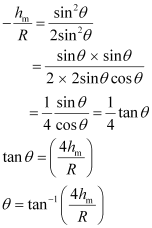
(b) Show that the projection angle

for a projectile launched from the origin is given by
Where the symbols have their usual meaning.
Ans. (a) Let and
and respectively be the initial components of the velocity of the projectile along horizontal (x) and vertical (y) directions.
Let and
and respectively be the horizontal and vertical components of velocity at a point P.
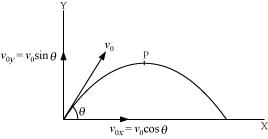
Time is taken by the projectile to reach point P = t
Applying the first equation of motion along the vertical and horizontal directions, we get:
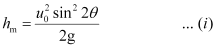
(b) Maximum vertical height,
Horizontal range,

Solving equations (i) and (ii), we get:
FAQs on NCERT Solutions: Motion in a Plane
| 1. What is motion in a plane? |  |
| 2. How is the motion in a plane different from motion in a straight line? | |
| 3. What are the key equations used to describe motion in a plane? | |
| 4. How is projectile motion related to motion in a plane? | |
| 5. What are some real-life examples of motion in a plane? | |





