Spectrum Summary: Major Approaches to the History of Modern India


Introduction
Historiography is the study of how history is written and interpreted. It examines the assumptions, methods and intellectual context that shape historical narratives rather than merely listing events. Understanding historiography helps readers recognise why historians reach different conclusions about the same past.
- Modern Indian history is commonly examined through several broad approaches: Colonial (Imperialist), Nationalist, Marxist and Subaltern.
- Other important interpretive strands that have influenced historical writing on modern India include Communalist, Cambridge, Liberal, Neo-liberal and Feminist perspectives.
- The pace and volume of historical writing on modern India have increased over time because changes in the political, social and intellectual landscape prompt historians to re-evaluate facts, sources and earlier interpretations.
- Historians therefore continually re-examine primary sources, bring new sources (for example oral accounts) into the archive, and revise interpretations in the light of fresh evidence and changing questions.
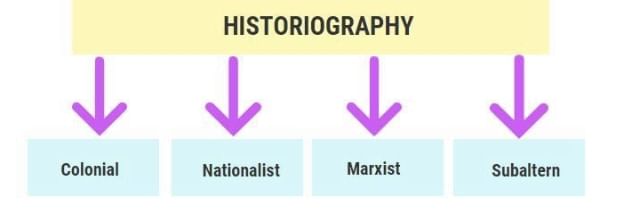 Classification of Modern History
Colonial Approach/Historiography
During the 19th century, the Colonial School held a prominent position in India. The colonial approach to the history of modern India refers to two related usages. One is descriptive: histories produced about colonial territories. The other - the more critical sense used by later historians - denotes writings shaped by colonial ideology that sought to justify rule and depict indigenous societies in ways that legitimised domination.
- Many histories written by colonial officials and European scholars in the nineteenth century sought to rationalise British rule by emphasising alleged backwardness or disorder in Indian society.
- Such works also tended to praise Western civilisation, values and the conduct of colonial administrators and military men who built the empire.
- Representative names associated with this historiographical tendency include James Mill, Mountstuart Elphinstone and Vincent Smith.
- Typical characteristics of colonial historiography:
- Representation of India in an Orientalist mould - as timeless, exotic or essentially different from the West.
- The claim that British rule brought unity to a previously fragmented subcontinent.
- Adoption of ideas akin to Social Darwinism, implying European superiority and fitness to rule.
- The portrayal of Indian society as stagnant and in need of European guidance (the rhetoric of the "White Man's burden").
- Arguments about establishing Pax Britannica - law, order and stability introduced by colonial governance.
- Because these histories were produced in a context of power imbalance, later historians have critically examined their sources, categories and assumptions.
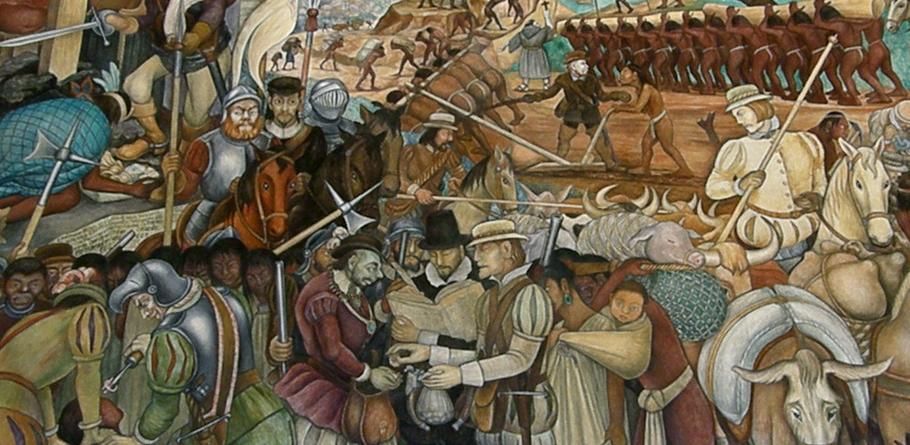 Colonial Historiography
 Nationalist Historiography/Approach
Nationalist historiography emerged as an attempt to construct a historical narrative that fostered national unity and pride and that provided a moral and political basis for anti-colonial sentiment. It read the past in ways that could unify people across caste, religion, language and region.
- Nationalist historians presented modern Indian history as a story of response to colonial exploitation and of the growth of a national movement seeking self-rule.
- Although early nationalist interest often focused on ancient and medieval glories to build a sense of shared past, after independence (post-1947) there was a stronger emphasis on modern political history and the freedom movement.
- Economic critique of colonial rule was an important strand in nationalist thought; for example, Dadabhai Naoroji developed the idea of the "drain of wealth" from India under British rule and criticised the economic effects of colonial policies.
- Several political leaders and scholars contributed to nationalist historical writing; among noted historians associated with the nationalist school are R.C. Majumdar and Tara Chand.
- Nationalist histories were important in building a narrative of legitimate anticolonial protest, but critics argue they sometimes simplified complex social divisions or marginalised non-elite voices.
Marxist Historiography
The Marxist approach reads Indian history through the analytical categories of historical materialism: class, mode of production, economic interests and social relations. It highlights structures of exploitation and the role of social classes in shaping political movements.
- In India, Marxist interpretations gained ground through writings such as Rajni Palme Dutt's India Today and A.R. Desai's Social Background of Indian Nationalism.
- India Today was first published in 1940 in England and later brought out in India in 1947. Social Background of Indian Nationalism first appeared in 1948.
- Marxists emphasise the primary contradiction between imperialist interests and the colonised population and read the national movement in terms of class alliances and conflicts.
- They also draw attention to internal contradictions within Indian society - for example, class, caste and rural-urban divides - even while analysing anti-imperialist struggles.
- Rajni Palme Dutt sometimes prioritised class struggle over anti-imperialist nationalism; critics such as Sumit Sarkar have argued that this can lead to an overly schematic or reductive account that underestimates non-class motivations.
- A.R. Desai analysed the growth of the national movement in terms of phases determined by the social classes supporting it; he identified five broad phases of social support behind nationalist mobilisation, emphasising changing class bases rather than a single, uniform nationalism.
Subaltern Approach/Historiography
The Subaltern school emerged to recover the history of groups who had been marginalised in traditional elite-centred narratives - peasants, workers, tribals, dalits and women - and to examine their agency and forms of resistance.
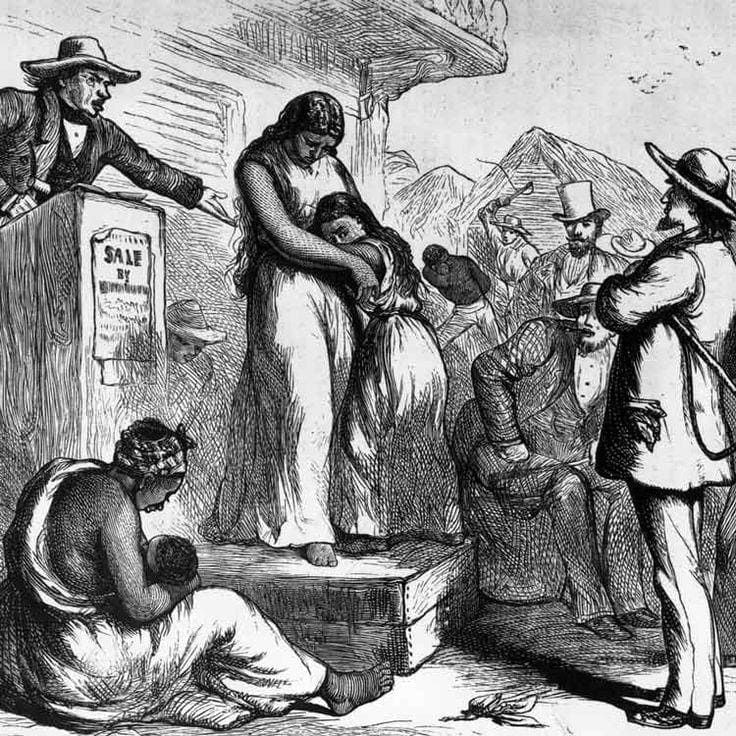 Subaltern Historiography
- Initiated in the early 1980s under the editorship of Ranajit Guha, the Subaltern Studies collective argued that much Indian historiography suffered from an elitist bias.
- Subaltern scholars criticised both colonial and conventional nationalist accounts for ignoring the perspectives and actions of ordinary people.
- They argued that the fundamental contradiction in colonial India was often between elites (including colonial intermediaries) and the subaltern groups, rather than simply between colonisers and a unified national people.
- Subalternists often emphasise local struggles, cultural forms of resistance and discontinuities in the nationalist narrative; they contend that the people were not uniformly mobilised by a single national movement.
- Subaltern Studies distinguishes between elite-led anti-imperialist politics and the separate, often fragmented, struggles of subaltern groups; it treats organisations such as the Indian National Congress as elite arenas in which power was negotiated rather than as a complete expression of popular will.
- Methodologically, subaltern historians make use of neglected archives, vernacular sources and ethnographic or oral evidence to reconstruct the voice of marginal groups.
Communalist Approach
The Communalist approach interprets much of India's modern history, especially the colonial and late colonial periods, through the lens of religious identities and inter-communal conflict.

- Historians associated with communalist explanations drew heavily on colonial-era textbooks and narratives, particularly for the medieval period, and portrayed Hindus and Muslims as communities with long histories of antagonism.
- This reading suggested that medieval India was largely defined by Hindu-Muslim conflict and that modern communal tensions were continuations of a deep historical enmity.
- In political rhetoric, this view was used by communal leaders to claim historical grievances: Muslims were sometimes represented as nostalgic for past rule, while Hindus were depicted as resentful of historical subjugation.
- Critics of communalist historiography argue that it exaggerates division, downplays shared cultural practices and syncretic traditions, and overlooks political and economic roots of conflict.
- Communalist interpretations have been implicated in inflaming mutual distrust and violent confrontations in the twentieth century, including factors that led to the partition of India.
Cambridge School
The Cambridge School of historians offered a distinctive interpretation of Indian nationalism, focusing on the interests and rivalries of the Indian elite rather than on a mass anti-imperialist movement.
- According to this school, the principal political contradictions under colonial rule lay among Indians themselves rather than between the British and all Indians.
- They argue that nationalism often emerged from conflicts among indigenous groups and elites who sought to gain status, patronage or influence from the British administration.
- The Cambridge perspective stresses that many leaders of the national movement were motivated by power and material concerns as well as by ideals.
- Critics contend that this approach underestimates the role of popular mobilisation and ideological commitments, reducing political action too severely to strategic self-interest or "animal politics".
Liberal and Neo-Liberal Interpretations
Liberal and neo-liberal historians emphasise market mechanisms, economic structures and the broader economic consequences of colonialism for both Britain and India.
- One key argument from this perspective is that the economic relationship between colonial territories and Britain did not simply enrich the British populace uniformly; in some accounts colonial ties may have distorted investment patterns and market structures.
- Scholars associated with this line of interpretation include Patrick O'Brien, Hopkins and Cain. They examine how the availability of colonial markets and opportunities for overseas investment influenced British industrial development and capital flows.
- These historians investigate whether colonialism encouraged or discouraged certain kinds of domestic investment in Britain and how imperial trade and finance shaped imperial and metropolitan economies.
Feminist Historiography
Feminist historiography focuses on the experiences, agency and representation of women, and on how gender as a category shapes social, legal and economic life. It moved from adding "women" to mainstream history towards a more complex gender history that interrogates structures and relations.
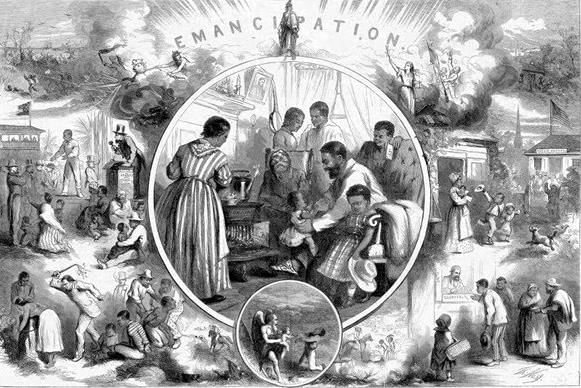 Feminist Historiography
- The modern turn in women's history began in the context of the women's movement of the 1970s, which led to the institutional growth of women's studies and gender research in India.
- Early feminist scholarship concentrated on documenting women's lives, compiling women's writings, and bringing neglected sources into historical study.
- Research examined how colonial institutions - especially laws, courts and administrative practices - affected women's rights, mobility and social position.
- Studies highlighted the vulnerability of women who lacked ownership of productive resources and analysed the impact of legal reforms and so-called "progressive laws" on gender relations.
- Notable texts that shaped international perceptions of Indian womanhood in the colonial period include Pandita Ramabai's The High Caste Hindu Woman (1887) and Katherine Mayo's Mother India (1927); feminist historians read such works critically to understand how women were represented and contested in public discourse.
- Feminist historiography also intersects with subaltern studies, marxist critiques and cultural history in exploring how gender, class, caste and community interact.
Conclusion
Each historiographical approach brings particular questions, sources and emphases. The colonial school foregrounded imperial narratives; the nationalist school sought to build communal identity and anti-colonial legitimacy; the Marxist school emphasised class and material interests; the Subaltern school recovered marginal voices; the Communalist, Cambridge, Liberal/Neo-Liberal and Feminist perspectives each contribute distinctive insights.
- Modern Indian history is best understood by engaging these approaches critically and comparatively, recognising their strengths and limitations and by using a plural methodology that draws on diverse sources and methods.
- Historiography is therefore not merely debate about the past; it is also a reflection of changing questions, new evidence and shifting political and intellectual contexts.
FAQs on Spectrum Summary: Major Approaches to the History of Modern India
| 1. What are the main interpretive frameworks historians use to study modern India's development? |  |
| 2. How does the nationalist approach differ from Marxist interpretations of modern Indian history? | |
| 3. What is subaltern history and why is it important for understanding modern India? | |
| 4. Which major historians pioneered different approaches to studying modern Indian history? | |
| 5. How do institutional and cultural approaches explain modern India differently than political narratives? | |





