


All Exams >
Electrical Engineering (EE) >
6 Months Preparation for GATE Electrical >
All Questions
All questions of Practice and Mock Tests for Electrical Engineering (EE) Exam
A single-phase 230V, 1 kW heater is connected across single-phase 230V, 50 Hz supply through a diode. Calculate power delivered to the heater element.- a)600W
- b)700W
- c)500W
- d)900W
Correct answer is option 'C'. Can you explain this answer?
a)
600W
b)
700W
c)
500W
d)
900W

|
Tanvi Rane answered |
Heater resistance R = 
RMS value of output voltage =
Therefore power absorbed by heater element =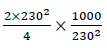 = 500W
RMS value of output voltage =
Therefore power absorbed by heater element =
= 500W
A 50 Hz, 11 kV, 3 phase alternator with earthed neutral having a reactance of 3 ohms per phase and is connected to a bus bar through a circuit breaker, if the distributed capacitance upto CB between the phase and neutral is 0.01 μ F.What is the peak re striking voltage?- a)18.36 kV
- b)17.96 kV
- c)15.96 kV
- d)12.65 kV
Correct answer is option 'B'. Can you explain this answer?
A 50 Hz, 11 kV, 3 phase alternator with earthed neutral having a reactance of 3 ohms per phase and is connected to a bus bar through a circuit breaker, if the distributed capacitance upto CB between the phase and neutral is 0.01 μ F.
What is the peak re striking voltage?
a)
18.36 kV
b)
17.96 kV
c)
15.96 kV
d)
12.65 kV

|
Pankaj Mehta answered |
Microfarad per phase, then determine the short circuit current available at the bus bar if a fault occurs at the CB.
To find the short circuit current, we need to first calculate the total impedance of the system. The reactance of the alternator per phase is given as 3 ohms, and the distributed capacitance per phase up to the CB is 0.01 microfarad.
The reactance of the distributed capacitance can be calculated as:
Xc = 1 / (2πfC) = 1 / (2π x 50 x 0.01 x 10^-6) = 318.3 ohms
The total impedance per phase is then given by:
Z = √(R^2 + Xl^2 + Xc^2) = √(3^2 + 318.3^2 + 3^2) = 318.9 ohms
Since we have a 3 phase system, the total impedance will be 3 times this value, which is 956.7 ohms.
The short circuit current can be calculated using Ohm's law:
I = V / Z
Where V is the voltage of the system, which is 11 kV or 11,000 volts.
I = 11,000 / 956.7 = 11.5 kA
Therefore, the short circuit current available at the bus bar is 11.5 kA.
To find the short circuit current, we need to first calculate the total impedance of the system. The reactance of the alternator per phase is given as 3 ohms, and the distributed capacitance per phase up to the CB is 0.01 microfarad.
The reactance of the distributed capacitance can be calculated as:
Xc = 1 / (2πfC) = 1 / (2π x 50 x 0.01 x 10^-6) = 318.3 ohms
The total impedance per phase is then given by:
Z = √(R^2 + Xl^2 + Xc^2) = √(3^2 + 318.3^2 + 3^2) = 318.9 ohms
Since we have a 3 phase system, the total impedance will be 3 times this value, which is 956.7 ohms.
The short circuit current can be calculated using Ohm's law:
I = V / Z
Where V is the voltage of the system, which is 11 kV or 11,000 volts.
I = 11,000 / 956.7 = 11.5 kA
Therefore, the short circuit current available at the bus bar is 11.5 kA.
Determine the peak inverse voltage that appear across the diode in the given circuit.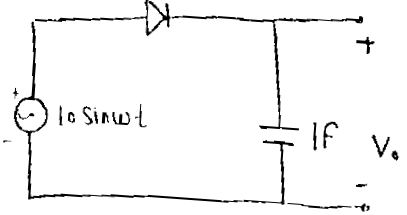
- a)0 V
- b)10 V
- c)20 V
- d)14.14 V
Correct answer is option 'C'. Can you explain this answer?
Determine the peak inverse voltage that appear across the diode in the given circuit.
a)
0 V
b)
10 V
c)
20 V
d)
14.14 V

|
Ravi Singh answered |
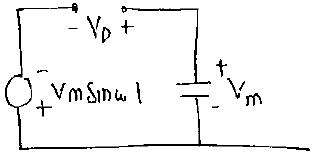
During positive half cycle capacitor get charge and during negative half cycle the equivalent circuit is shown as
so, VD = VmSinωt
so, P1V = 2Vm
here, Vm = 10 volt,
so, P1V = 20 volt
so, VD = VmSinωt
so, P1V = 2Vm
here, Vm = 10 volt,
so, P1V = 20 volt

A, B and C shoots to hit a target. If A hits the target 4 times in 5 trials, B hits in 3 times in 4 trials and C hits it 2 times in 3 trials. What is the probability that the target is hit by at least 2 persons?- a)5/6
- b)4/5
- c)3/4
- d)2/3
Correct answer is option 'A'. Can you explain this answer?
a)
5/6
b)
4/5
c)
3/4
d)
2/3
|
|
Tanvi Rane answered |
Probability that A hits the target = 4/5
Probability that B hits the target = 3/4
Probability that C hits the target = 2/3
P (at least 2) = P(2) + P(3)
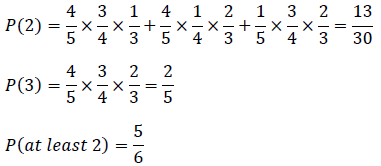
Probability that B hits the target = 3/4
Probability that C hits the target = 2/3
P (at least 2) = P(2) + P(3)
A salient pole synchronous motor is running with normal excitation it the excitation is reduced to zero than?- a)It becomes an induction motor
- b)Remains synchronous motor
- c)It becomes are reluctance motor
- d)Stop
Correct answer is option 'D'. Can you explain this answer?
A salient pole synchronous motor is running with normal excitation it the excitation is reduced to zero than?
a)
It becomes an induction motor
b)
Remains synchronous motor
c)
It becomes are reluctance motor
d)
Stop

|
Sanya Agarwal answered |
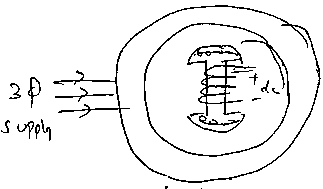
because torque developed T = TRl Telect
If extn zero electromagnetic zero by reluctance torque present incase of salient pole so it becomes reluctance motor.
A 230 V, 50Hz , one pulse SCR controlled converter is triggered at a firing angle of 400 and the load current extinguishes at an angle of 2100 . For a load of R=5Ω and L=2mH. The circuit-turn off time and average output voltage is- a)8.33μsec,84.84 V
- b)8.44m sec,83.38 V
- c)8.33 m sec 84.48 V
- d)8.33 sec, 84.48 V
Correct answer is option 'C'. Can you explain this answer?
A 230 V, 50Hz , one pulse SCR controlled converter is triggered at a firing angle of 400 and the load current extinguishes at an angle of 2100 . For a load of R=5Ω and L=2mH. The circuit-turn off time and average output voltage is
a)
8.33μsec,84.84 V
b)
8.44m sec,83.38 V
c)
8.33 m sec 84.48 V
d)
8.33 sec, 84.48 V

|
Pallavi Nair answered |
Given parameters:
- Voltage (V) = 230 V
- Frequency (f) = 50 Hz
- Firing angle (α) = 40°
- Extinction angle (β) = 210°
- Load resistance (R) = 5 Ω
- Load inductance (L) = 2 mH
To find:
- Circuit-turn off time
- Average output voltage
Solution:
1. Calculation of circuit-turn off time:
- Circuit-turn off time (tq) can be calculated using the following formula:
tq = (π - β + α) / (2πf)
- Substituting the given values in the formula, we get:
tq = (π - 210° + 40°) / (2π x 50 Hz)
tq = 8.33 ms
- Therefore, the circuit-turn off time is 8.33 ms.
2. Calculation of average output voltage:
- Average output voltage (Vo) can be calculated using the following formula:
Vo = (2V / π) x (cos α - cos β) - (2IR)
- Substituting the given values in the formula, we get:
Vo = (2 x 230 V / π) x (cos 40° - cos 210°) - (2 x 5 Ω x I)
Vo = 84.48 V - 10 I
- To find the value of I, we need to use the fact that the load current extinguishes at an angle of β = 210°. At this point, the load current is given by:
iL = Im sin (ωt + φ)
where Im = V / √(R^2 + ω^2L^2) = 45.67 A (rms value)
ω = 2πf = 314.16 rad/s
φ = tan^-1 (ωL / R) = 0.79°
- At β = 210°, we have:
iL = Im sin (ωβ + φ) = -36.64 A (rms value, negative sign indicates that the current is flowing in the opposite direction)
- Therefore, the value of I can be calculated as:
I = iL / √2 = -25.92 A (peak value, negative sign indicates that the current is flowing in the opposite direction)
- Substituting the value of I in the equation for Vo, we get:
Vo = 84.48 V - 10 x (-25.92 A)
Vo = 83.38 V
- Therefore, the average output voltage is 83.38 V.
Answer:
The circuit-turn off time is 8.33 ms and the average output voltage is 84.48 V. Therefore, the correct answer is option (c) 8.33 ms, 84.48 V.
- Voltage (V) = 230 V
- Frequency (f) = 50 Hz
- Firing angle (α) = 40°
- Extinction angle (β) = 210°
- Load resistance (R) = 5 Ω
- Load inductance (L) = 2 mH
To find:
- Circuit-turn off time
- Average output voltage
Solution:
1. Calculation of circuit-turn off time:
- Circuit-turn off time (tq) can be calculated using the following formula:
tq = (π - β + α) / (2πf)
- Substituting the given values in the formula, we get:
tq = (π - 210° + 40°) / (2π x 50 Hz)
tq = 8.33 ms
- Therefore, the circuit-turn off time is 8.33 ms.
2. Calculation of average output voltage:
- Average output voltage (Vo) can be calculated using the following formula:
Vo = (2V / π) x (cos α - cos β) - (2IR)
- Substituting the given values in the formula, we get:
Vo = (2 x 230 V / π) x (cos 40° - cos 210°) - (2 x 5 Ω x I)
Vo = 84.48 V - 10 I
- To find the value of I, we need to use the fact that the load current extinguishes at an angle of β = 210°. At this point, the load current is given by:
iL = Im sin (ωt + φ)
where Im = V / √(R^2 + ω^2L^2) = 45.67 A (rms value)
ω = 2πf = 314.16 rad/s
φ = tan^-1 (ωL / R) = 0.79°
- At β = 210°, we have:
iL = Im sin (ωβ + φ) = -36.64 A (rms value, negative sign indicates that the current is flowing in the opposite direction)
- Therefore, the value of I can be calculated as:
I = iL / √2 = -25.92 A (peak value, negative sign indicates that the current is flowing in the opposite direction)
- Substituting the value of I in the equation for Vo, we get:
Vo = 84.48 V - 10 x (-25.92 A)
Vo = 83.38 V
- Therefore, the average output voltage is 83.38 V.
Answer:
The circuit-turn off time is 8.33 ms and the average output voltage is 84.48 V. Therefore, the correct answer is option (c) 8.33 ms, 84.48 V.
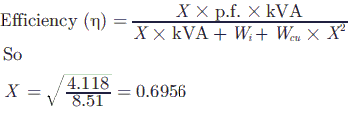
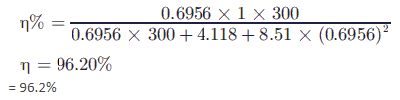
The standard deviations of linear dimensions P and Q are 3?m and 4?m, respectively. When assembled, the standard deviation (in?m) of the resulting linear dimension (P + Q) is _________. (Answer up to the nearest integer)
Correct answer is '5'. Can you explain this answer?
The standard deviations of linear dimensions P and Q are 3?m and 4?m, respectively. When assembled, the standard deviation (in?m) of the resulting linear dimension (P + Q) is _________. (Answer up to the nearest integer)

|
Pooja Patel answered |
Given
Standard deviation of P = 3?m Variance of P = 9?m
Standard deviation of Q = 4?m Variance of Q = 16?m
Variance of P + Q = Var(P + Q) = Variance P + Variance Q = 9 + 16 = 25
Standard deviation of
Henry and Ford worked together to complete a task in 10 days. Had Henry worked with half of his efficiency and Ford at 5 times of his efficiency it would have taken them to finish the job in 50% of the scheduled time. In how many days can Ford complete the job working alone?- a)12
- b)24
- c)15
- d)30
Correct answer is option 'D'. Can you explain this answer?
a)
12
b)
24
c)
15
d)
30

|
Sanjana Chopra answered |
Let henry’s one day work be x
Let ford’s one day work be y
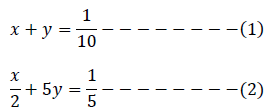
Solving 2 equations we get, y = 1/30
Hence, Ford can complete the job working alone in 30 days
Let ford’s one day work be y
Solving 2 equations we get, y = 1/30
Hence, Ford can complete the job working alone in 30 days
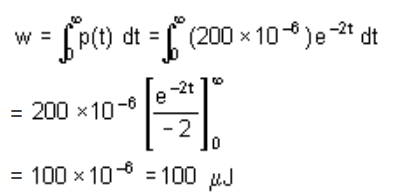
In the circuit below, two series connected capacitors of 3∝F and 6∝F having initial voltage of 4 V and 6 V are connected across a black box at t = 0.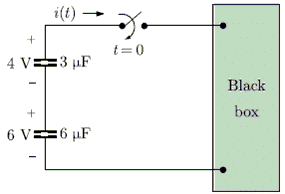 For t ≥ 0, it is given that i (t) = 20e−tμA.The total energy delivered (in μJ) to the black box will be (Answer up to the nearest integer)
Correct answer is '100'. Can you explain this answer?
In the circuit below, two series connected capacitors of 3∝F and 6∝F having initial voltage of 4 V and 6 V are connected across a black box at t = 0.
For t ≥ 0, it is given that i (t) = 20e−tμA.
The total energy delivered (in μJ) to the black box will be (Answer up to the nearest integer)

|
Cstoppers Instructors answered |
Combining the series connected capacitor,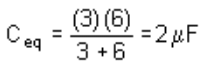
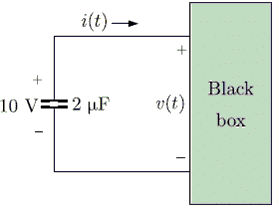
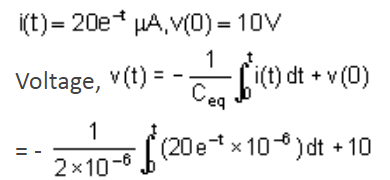
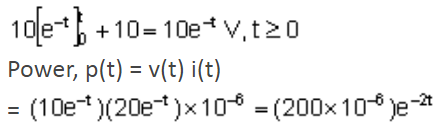
 ,
,
Energy delivered to the black box in the interval 0 < t=""><>
,
A coin tossed thrice. Let X be the event that head occurs in each of the first two tosses. Let Y be the event that a tail occurs on the third toss. Let Z be the event that two tails occurs in three tosses.Based on the above information, which one of the following statements is NOT TRUE?- a)X and Y are not independent
- b)Y and Z are dependent
- c)Y and Z are independent
- d)X and Z are independent
Correct answer is option 'C'. Can you explain this answer?
A coin tossed thrice. Let X be the event that head occurs in each of the first two tosses. Let Y be the event that a tail occurs on the third toss. Let Z be the event that two tails occurs in three tosses.
Based on the above information, which one of the following statements is NOT TRUE?
a)
X and Y are not independent
b)
Y and Z are dependent
c)
Y and Z are independent
d)
X and Z are independent
|
|
Jyoti Basak answered |
Explanation:
Events:
- X: Head occurs in each of the first two tosses.
- Y: Tail occurs on the third toss.
- Z: Two tails occur in three tosses.
Independence of Events:
Two events X and Y are independent if and only if the occurrence or non-occurrence of one event does not affect the occurrence or non-occurrence of the other event.
Analysis of the Statements:
a) X and Y are not independent:
- If X and Y are independent, it means that the occurrence of heads in the first two tosses does not affect the occurrence of a tail on the third toss.
- However, if both of the first two tosses result in heads (event X), then it is not possible for a tail to occur on the third toss (event Y).
- Therefore, X and Y are not independent.
b) Y and Z are dependent:
- If Y and Z are dependent, it means that the occurrence of a tail on the third toss affects the occurrence of two tails in three tosses.
- However, the occurrence of a tail on the third toss does not affect the occurrence of two tails in three tosses. Whether or not the first two tosses result in tails (event Z) is independent of the outcome of the third toss (event Y).
- Therefore, Y and Z are independent.
c) Y and Z are independent:
- This statement is not true. As explained above, Y and Z are actually independent events.
d) X and Z are independent:
- If X and Z are independent, it means that the occurrence of heads in the first two tosses does not affect the occurrence of two tails in three tosses.
- However, if both of the first two tosses result in heads (event X), it is not possible for two tails to occur in three tosses (event Z).
- Therefore, X and Z are not independent.
Conclusion:
The statement "Y and Z are independent" (option c) is not true. The correct answer is option c.
Events:
- X: Head occurs in each of the first two tosses.
- Y: Tail occurs on the third toss.
- Z: Two tails occur in three tosses.
Independence of Events:
Two events X and Y are independent if and only if the occurrence or non-occurrence of one event does not affect the occurrence or non-occurrence of the other event.
Analysis of the Statements:
a) X and Y are not independent:
- If X and Y are independent, it means that the occurrence of heads in the first two tosses does not affect the occurrence of a tail on the third toss.
- However, if both of the first two tosses result in heads (event X), then it is not possible for a tail to occur on the third toss (event Y).
- Therefore, X and Y are not independent.
b) Y and Z are dependent:
- If Y and Z are dependent, it means that the occurrence of a tail on the third toss affects the occurrence of two tails in three tosses.
- However, the occurrence of a tail on the third toss does not affect the occurrence of two tails in three tosses. Whether or not the first two tosses result in tails (event Z) is independent of the outcome of the third toss (event Y).
- Therefore, Y and Z are independent.
c) Y and Z are independent:
- This statement is not true. As explained above, Y and Z are actually independent events.
d) X and Z are independent:
- If X and Z are independent, it means that the occurrence of heads in the first two tosses does not affect the occurrence of two tails in three tosses.
- However, if both of the first two tosses result in heads (event X), it is not possible for two tails to occur in three tosses (event Z).
- Therefore, X and Z are not independent.
Conclusion:
The statement "Y and Z are independent" (option c) is not true. The correct answer is option c.
A 90 MVA, 11 KV water wheel generator has an inertia constant H = 3, the stored energy in the rotor at synchronous speed is- a)40 KJ
- b)270 KJ
- c)270 MJ
- d)40 MJ
Correct answer is option 'C'. Can you explain this answer?
a)
40 KJ
b)
270 KJ
c)
270 MJ
d)
40 MJ

|
Shail Nambiar answered |
Rating of the machine = 90 MVA, Inertia constant (H) = 3 MJ/MVA
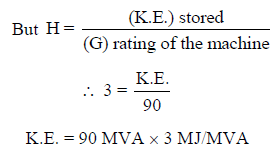
K.E. = 270 MJ
K.E. = 270 MJ
A (0-300)V Voltmeter has a guaranteed accuracy of 2% of full scale reading if the voltage measured by this instrument is 180V then the limiting error will be- a)Less than 2%
- b)Less than 3% but greater than 2%
- c)Less than 4% but greater than 3%
- d)4%
Correct answer is option 'C'. Can you explain this answer?
A (0-300)V Voltmeter has a guaranteed accuracy of 2% of full scale reading if the voltage measured by this instrument is 180V then the limiting error will be
a)
Less than 2%
b)
Less than 3% but greater than 2%
c)
Less than 4% but greater than 3%
d)
4%

|
Yashvi Shah answered |
Error = 2% of F.S.D.
= 2% of 300 V
= 2/100 x 300 = 6 V
Measured Value = 180 V
Error = 6 V
Absolute error = Measured value – True value
6 = 180 - True value
Tue Value = 174 Volt
Limiting error or % error
= 6/174 x 100 = 3.44%
The current coil of a dynamometer wattmeter is connected to a 24V dc source in series with  resistor. The potential circuit is connected through an ideal half wave rectifier in series with 50Hz source of 100V. The inductance of pressure circuit and current coil resistance are negligible. The reading of wattmeter in watts is ______________. (Correct upto nearest integer)
Correct answer is '180'. Can you explain this answer?
The current coil of a dynamometer wattmeter is connected to a 24V dc source in series with resistor. The potential circuit is connected through an ideal half wave rectifier in series with 50Hz source of 100V. The inductance of pressure circuit and current coil resistance are negligible. The reading of wattmeter in watts is ______________. (Correct upto nearest integer)
resistor. The potential circuit is connected through an ideal half wave rectifier in series with 50Hz source of 100V. The inductance of pressure circuit and current coil resistance are negligible. The reading of wattmeter in watts is ______________. (Correct upto nearest integer)

|
Naroj Boda answered |

The pressure coil is energized by an ideal half wave rectifier therefore, the pressure coil carrier current during one half cycle and in the other half cycle there is no current in it. This means that there is a deflecting torque on the meter during one half cycle.
Reading of the wattmeter = Average power over a cycle

If prices reduce by 20% and sales increase by 15%, what is the net effect on gross receipts?- a)They increase by 8%.
- b)They decrease by 8%.
- c)They remain the same.
- d)They increase by 1.
Correct answer is option 'B'. Can you explain this answer?
If prices reduce by 20% and sales increase by 15%, what is the net effect on gross receipts?
a)
They increase by 8%.
b)
They decrease by 8%.
c)
They remain the same.
d)
They increase by 1.
|
|
Ravi Singh answered |
Let original price = p, and original sales = s. Therefore, original gross receipts = ps.
Let new price = 0.80p, and new sales = 1.15s. Therefore, new gross receipts = 0.92ps.
Gross receipts are only 92% of what they were. Hence, gross receipts decrease by 8%.
For 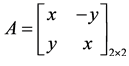 if
if  and trace of A is 2 then value of y is
- a)1
- b)0
- c)-1
- d)2
Correct answer is option 'B'. Can you explain this answer?
For if and trace of A is 2 then value of y is
if and trace of A is 2 then value of y isa)
1
b)
0
c)
-1
d)
2

|
Pioneer Academy answered |
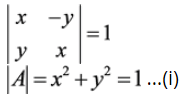
Trace = 2x = 2⇒x = 1
Put the value in equation (i),
1+y2 = 1
Y = 0
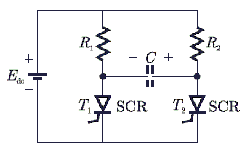
A voltage commutation circuit is shown in figure. The turn-off time of the both SCR is 60 sec and current through R1 and R2 is 20 A and voltage is 120 V. What will be the minimum value of capacitor (in μF) required for proper commutation? (Answer up to one decimal place)
 Correct answer is '14.4'. Can you explain this answer?
A voltage commutation circuit is shown in figure. The turn-off time of the both SCR is 60 sec and current through R1 and R2 is 20 A and voltage is 120 V. What will be the minimum value of capacitor (in μF) required for proper commutation? (Answer up to one decimal place)
|
|
Bhavana Reddy answered |
Given information:
- Turn-off time of both SCR is 60 sec.
- Current through R1 and R2 is 20 A.
- Voltage across R1 and R2 is 120 V.
To determine:
The minimum value of the capacitor required for proper commutation.
Approach:
- The commutation process in a voltage commutation circuit involves turning off one SCR while turning on the other SCR to ensure continuous flow of current.
- The minimum value of the capacitor required for proper commutation can be determined by considering the worst-case scenario, where the turn-off time of both SCRs is at its maximum value.
Calculation:
- The worst-case scenario occurs when both SCRs turn off simultaneously.
- The voltage across the capacitor during this worst-case scenario is given by the equation: Vc = V - Vr2 - Vr1, where V is the supply voltage, Vr2 is the voltage across resistor R2, and Vr1 is the voltage across resistor R1.
- V = 120 V (given)
- Vr1 = I * R1 = 20 A * 10 Ω = 200 V
- Vr2 = I * R2 = 20 A * 5 Ω = 100 V
- Vc = V - Vr2 - Vr1 = 120 V - 100 V - 200 V = -180 V (negative because the polarities are reversed during commutation)
- The voltage across the capacitor cannot be negative, so we need to choose a minimum value of the capacitor such that Vc is positive.
- Let C be the capacitance in Farads.
- The charge stored in the capacitor during commutation is given by the equation: Q = C * Vc.
- For proper commutation, the charge stored in the capacitor should be sufficient to maintain the voltage across the load during the turn-off time of the SCR.
- Let Toff be the turn-off time of the SCR = 60 sec.
- The charge required to maintain the voltage across the load is given by the equation: Qload = I * Toff.
- Equating the charge stored in the capacitor to the charge required to maintain the voltage across the load, we have: C * Vc = Qload.
- Substituting the values, we get: C * (-180 V) = 20 A * 60 sec.
- Solving for C, we get: C = 14.4 μF.
Therefore, the minimum value of the capacitor required for proper commutation is 14.4 μF.
- Turn-off time of both SCR is 60 sec.
- Current through R1 and R2 is 20 A.
- Voltage across R1 and R2 is 120 V.
To determine:
The minimum value of the capacitor required for proper commutation.
Approach:
- The commutation process in a voltage commutation circuit involves turning off one SCR while turning on the other SCR to ensure continuous flow of current.
- The minimum value of the capacitor required for proper commutation can be determined by considering the worst-case scenario, where the turn-off time of both SCRs is at its maximum value.
Calculation:
- The worst-case scenario occurs when both SCRs turn off simultaneously.
- The voltage across the capacitor during this worst-case scenario is given by the equation: Vc = V - Vr2 - Vr1, where V is the supply voltage, Vr2 is the voltage across resistor R2, and Vr1 is the voltage across resistor R1.
- V = 120 V (given)
- Vr1 = I * R1 = 20 A * 10 Ω = 200 V
- Vr2 = I * R2 = 20 A * 5 Ω = 100 V
- Vc = V - Vr2 - Vr1 = 120 V - 100 V - 200 V = -180 V (negative because the polarities are reversed during commutation)
- The voltage across the capacitor cannot be negative, so we need to choose a minimum value of the capacitor such that Vc is positive.
- Let C be the capacitance in Farads.
- The charge stored in the capacitor during commutation is given by the equation: Q = C * Vc.
- For proper commutation, the charge stored in the capacitor should be sufficient to maintain the voltage across the load during the turn-off time of the SCR.
- Let Toff be the turn-off time of the SCR = 60 sec.
- The charge required to maintain the voltage across the load is given by the equation: Qload = I * Toff.
- Equating the charge stored in the capacitor to the charge required to maintain the voltage across the load, we have: C * Vc = Qload.
- Substituting the values, we get: C * (-180 V) = 20 A * 60 sec.
- Solving for C, we get: C = 14.4 μF.
Therefore, the minimum value of the capacitor required for proper commutation is 14.4 μF.
For how many of the given years in the below period total production of the company was more than the average production of the company during 2005-2010?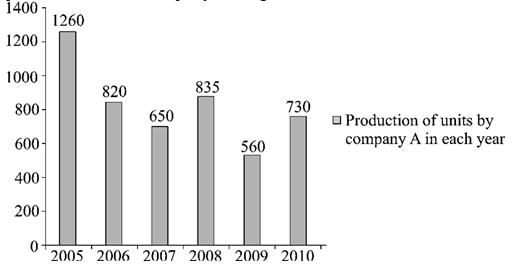
- a)4
- b)2
- c)3
- d)1
Correct answer is option 'C'. Can you explain this answer?
For how many of the given years in the below period total production of the company was more than the average production of the company during 2005-2010?
a)
4
b)
2
c)
3
d)
1
|
|
Ravi Singh answered |
Average production during the period 2005-2010

Hence, year which have production more than average production are 2005, 2006 and 2008.
Hence, the correct option is (C).
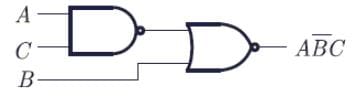
A Boolean function  is to be implemented using NAND and NOR gate. Each gate has unit cost. Only A, B and C are available.If both gates are available, the minimum cost (units) is _____. (Answer up to the nearest integer)
- a)aluminium conductor steel reinforced
- b)all conductors surface treated and realigned
- c)anodised core steel reinforced
- d)none of the above
Correct answer is '2'. Can you explain this answer?
A Boolean function is to be implemented using NAND and NOR gate. Each gate has unit cost. Only A, B and C are available.
is to be implemented using NAND and NOR gate. Each gate has unit cost. Only A, B and C are available.If both gates are available, the minimum cost (units) is _____. (Answer up to the nearest integer)
a)
aluminium conductor steel reinforced
b)
all conductors surface treated and realigned
c)
anodised core steel reinforced
d)
none of the above
|
|
Naroj Boda answered |
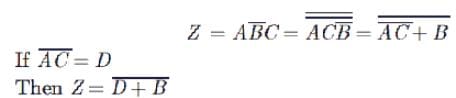
therefore one NAND and one NOR gate is required and cost will be 2 unit.
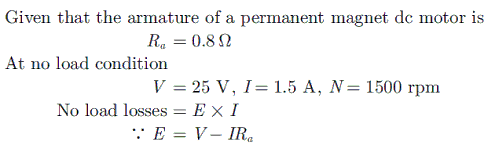
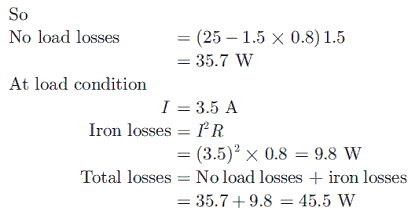
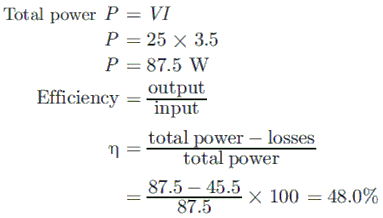
The armature resistance of a permanent magnet dc motor is 0.8 . At no load, the motor draws 1.5 A from a supply voltage of 25 V and runs at 1,500 rpm. The efficiency of the motor (in percentage), while it operates on load at 1,500 rpm and draws a current of 3.5 A from the same source, will be (Answer up to the nearest integer)
Correct answer is '48'. Can you explain this answer?
The armature resistance of a permanent magnet dc motor is 0.8 . At no load, the motor draws 1.5 A from a supply voltage of 25 V and runs at 1,500 rpm. The efficiency of the motor (in percentage), while it operates on load at 1,500 rpm and draws a current of 3.5 A from the same source, will be (Answer up to the nearest integer)
. At no load, the motor draws 1.5 A from a supply voltage of 25 V and runs at 1,500 rpm. The efficiency of the motor (in percentage), while it operates on load at 1,500 rpm and draws a current of 3.5 A from the same source, will be (Answer up to the nearest integer)|
|
Cstoppers Instructors answered |
Consider a discrete time signal x[n] and its z-transform X(z) given as: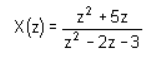 If ROC of X(z) is |z| < 1,="" then="" signal="" x[n]="" would="" />
- a)[- 2(3)n + (- 1)n] u [- n - 1]
- b)[2(3)n - (- 1)n] u [n]
- c)- 2(3)n u [- n - 1] - (- 1)n u[n]
- d)[2(3)n + 1] u [n]
Correct answer is option 'A'. Can you explain this answer?
Consider a discrete time signal x[n] and its z-transform X(z) given as:
If ROC of X(z) is |z| < 1,="" then="" signal="" x[n]="" would="" />
a)
[- 2(3)n + (- 1)n] u [- n - 1]
b)
[2(3)n - (- 1)n] u [n]
c)
- 2(3)n u [- n - 1] - (- 1)n u[n]
d)
[2(3)n + 1] u [n]
|
|
Cstoppers Instructors answered |
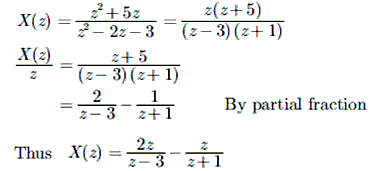
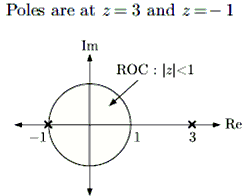
ROC: |z| < 1,="" which="" is="" not="" exterior="" of="" a="" circle="" outside="" the="" outermost="" pole="" z="3." so,="" x[n]="" is="" anticausal="" given="">
x[n] = [- 2(3)n + (- 1)n] u [- n - 1]
The given statement is followed by some courses of action. Assuming the statements to be true, decide the correct option.A world conference on Child Labour was organized in Tokyo. This widely attended conference endorsed the framework on actions for Eradicating Child Labour.Courses of action :I) India should suitably implement the action points of this conferenceII) India should also immediately organize such types of conferences.- a)Only I follows
- b)Only II follow
- c)Both I and II follow
- d)Neither follows
Correct answer is option 'A'. Can you explain this answer?
The given statement is followed by some courses of action. Assuming the statements to be true, decide the correct option.
A world conference on Child Labour was organized in Tokyo. This widely attended conference endorsed the framework on actions for Eradicating Child Labour.
Courses of action :
I) India should suitably implement the action points of this conference
II) India should also immediately organize such types of conferences.
a)
Only I follows
b)
Only II follow
c)
Both I and II follow
d)
Neither follows

|
Yash Patel answered |
The first course of action is definitely required. It is not sufficient to simply attend these conferences but also appropriately implement the consensus reached and action points agreed upon there.
Course of action (II) however does not follow because there is no urgency to organize such conferences without suitably implementing the existing frameworks. So, only (I) follows.
The output voltage of regulated power supply shown in figure is ______ V. (correct upto 2 decimal places)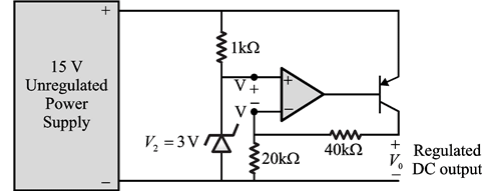
Correct answer is '9'. Can you explain this answer?
The output voltage of regulated power supply shown in figure is ______ V. (correct upto 2 decimal places)
|
|
Pioneer Academy answered |
The given figure is,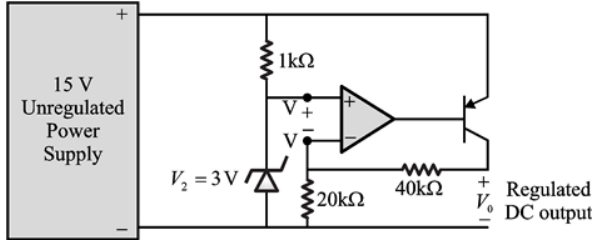
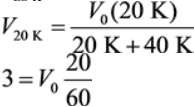 V0 = 9 V
V20K = V- = V+ = V2
V20K = 3 V
How many standard resistor are required to design a 3 bit flash type ADC? - a)7
- b)8
- c)6
- d)3
Correct answer is option 'C'. Can you explain this answer?
How many standard resistor are required to design a 3 bit flash type ADC?
a)
7
b)
8
c)
6
d)
3

|
Mansi Datta answered |
Number of resistor, = 2n
= 23
= 8
Given field, Â = 3x2yzâx x3zây (x3y - 2z)âz It can be said that A is- a)Harmonic
- b)Rotational
- c)Conservative
- d)Solenoid
Correct answer is option 'C'. Can you explain this answer?
Given field, Â = 3x2yzâx x3zây (x3y - 2z)âz It can be said that A is
a)
Harmonic
b)
Rotational
c)
Conservative
d)
Solenoid
|
|
Ishani Iyer answered |
 = 3x2yzâx x3zây (x3y - 2z)âz
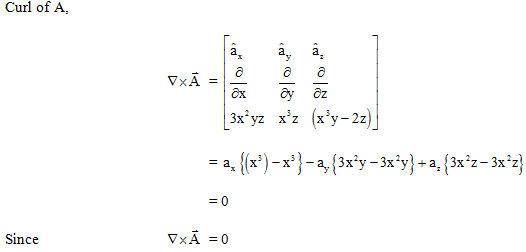
So the given field is conservative
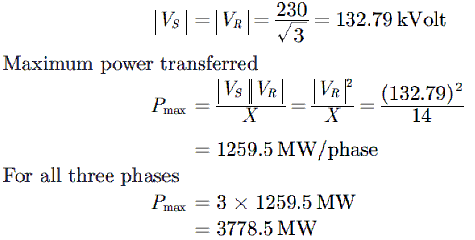
The sending-end and receiving-end voltages of a three-phase transmission line at a 200 MW load are equal at 230 kV. The per phase line impedance is 14 ohm. The maximum steady-state power that can be transmitted (MW/phase) over the line would be _______. (Answer up to one decimal place)
Correct answer is '1259.5'. Can you explain this answer?
The sending-end and receiving-end voltages of a three-phase transmission line at a 200 MW load are equal at 230 kV. The per phase line impedance is 14 ohm. The maximum steady-state power that can be transmitted (MW/phase) over the line would be _______. (Answer up to one decimal place)
|
|
Pooja Patel answered |
The self-inductance of the primary winding of a single phase 50 Hz transformer is 800 mH and that of the secondary winding is 600 mH. The mutual inductance between these two windings is 480 mH. The secondary winding of this transformer is short circuited and the primary winding is connected to a 50 Hz, single phase, sinusoidal voltage source. The current flowing in both the windings is less than their respective rated currents. The resistances of both windings can be neglected. In this connection, what is the effective inductance (in mH) seen by the source?- a)416
- b)440
- c)200
- d)920
Correct answer is option 'A'. Can you explain this answer?
The self-inductance of the primary winding of a single phase 50 Hz transformer is 800 mH and that of the secondary winding is 600 mH. The mutual inductance between these two windings is 480 mH. The secondary winding of this transformer is short circuited and the primary winding is connected to a 50 Hz, single phase, sinusoidal voltage source. The current flowing in both the windings is less than their respective rated currents. The resistances of both windings can be neglected. In this connection, what is the effective inductance (in mH) seen by the source?
a)
416
b)
440
c)
200
d)
920
|
|
Pooja Patel answered |
Consider the transformer circuit shown below.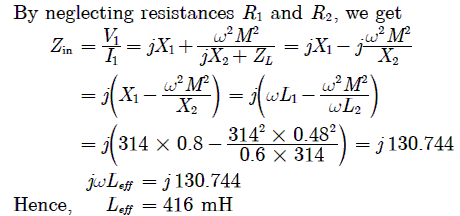
For the circuit, we have
Zin = input impedance as seen by source
or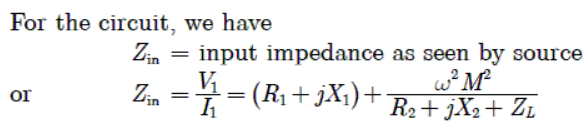
By neglecting resistances R1 and R2, we get
A 50 Hz 3 phase synchronous generator has inductance per phase of 15mH. The capacitance of generator and the circuit breaker is 0.002μ F. What is the natural frequency of oscillation?- a) 29 kHz
- b)2.9 kHz
- c) 290 kHz
- d)29 MHz
Correct answer is option 'D'. Can you explain this answer?
A 50 Hz 3 phase synchronous generator has inductance per phase of 15mH. The capacitance of generator and the circuit breaker is 0.002μ F. What is the natural frequency of oscillation?
a)
29 kHz
b)
2.9 kHz
c)
290 kHz
d)
29 MHz
|
|
Maulik Chatterjee answered |
F. Find the value of the excitation capacitance required to improve the power factor to 0.9 lagging.
First, we need to calculate the current lag angle (δ) of the generator at the current power factor (0.9 lagging).
cos(δ) = 0.9
δ = cos^-1(0.9)
δ = 25.84°
Next, we can calculate the reactive power (Q) of the generator at the current power factor:
Q = S * sin(δ)
where S is the apparent power of the generator.
Assuming the generator is rated for 100 kVA, the apparent power is:
S = 100,000 VA
Q = 100,000 * sin(25.84°)
Q = 43,212 VA
The reactive power of the generator is inductive, so we need to add a capacitive reactance to balance it out and improve the power factor. The capacitive reactance required is:
Xc = -Q / (3 * ω * V^2)
where ω is the angular frequency (2πf), V is the line-to-line voltage of the generator, and the negative sign indicates a capacitive reactance.
ω = 2π * 50 Hz
ω = 314.16 rad/s
Assuming the line-to-line voltage of the generator is 480 V, the capacitive reactance required is:
Xc = -43,212 / (3 * 314.16 * 480^2)
Xc = -0.024 Ω
Finally, we can calculate the capacitance required to achieve this reactance:
Xc = 1 / (2πfC)
C = 1 / (2πfXc)
C = 1 / (2π * 50 * 0.024)
C = 1,325 μF
Therefore, a capacitance of 1,325 μF is required to improve the power factor of the generator to 0.9 lagging.
First, we need to calculate the current lag angle (δ) of the generator at the current power factor (0.9 lagging).
cos(δ) = 0.9
δ = cos^-1(0.9)
δ = 25.84°
Next, we can calculate the reactive power (Q) of the generator at the current power factor:
Q = S * sin(δ)
where S is the apparent power of the generator.
Assuming the generator is rated for 100 kVA, the apparent power is:
S = 100,000 VA
Q = 100,000 * sin(25.84°)
Q = 43,212 VA
The reactive power of the generator is inductive, so we need to add a capacitive reactance to balance it out and improve the power factor. The capacitive reactance required is:
Xc = -Q / (3 * ω * V^2)
where ω is the angular frequency (2πf), V is the line-to-line voltage of the generator, and the negative sign indicates a capacitive reactance.
ω = 2π * 50 Hz
ω = 314.16 rad/s
Assuming the line-to-line voltage of the generator is 480 V, the capacitive reactance required is:
Xc = -43,212 / (3 * 314.16 * 480^2)
Xc = -0.024 Ω
Finally, we can calculate the capacitance required to achieve this reactance:
Xc = 1 / (2πfC)
C = 1 / (2πfXc)
C = 1 / (2π * 50 * 0.024)
C = 1,325 μF
Therefore, a capacitance of 1,325 μF is required to improve the power factor of the generator to 0.9 lagging.
From his 9 friends (4 boys and 5 girls), Mohan wanted to invite friends for picnic. If there have to be exactly 3 girls in invites, then the number of ways in which he can invite them are,- a)320
- b)80
- c)160
- d)200
Correct answer is option 'C'. Can you explain this answer?
From his 9 friends (4 boys and 5 girls), Mohan wanted to invite friends for picnic. If there have to be exactly 3 girls in invites, then the number of ways in which he can invite them are,
a)
320
b)
80
c)
160
d)
200
|
|
Mansi Choudhury answered |
Three girls can be selected from 5 girls in 5C3 ways. As number of boys to be invited is not given, hence out of 4 boys he can invite them in 24 ways, so total of
24 X 5C3 ways = 16 X  =160 ways
=160 ways Directions: In the question below are given three statements followed by two conclusion numbered I and II. You have to take the given statements to be true even if they seem to be at variance with commonly known facts. Read all the conclusions and then decide which of the given conclusions logically follows from the given statements, disregarding commonly known facts.Statements :All lizards are birdsSome ants are birdsAll ants are cobrasConclusions :I.All lizards being cobras is a possibilityII.Some cobras are birds.- a)Only conclusion I follow
- b)Only conclusion II follows
- c)Only conclusion I or II follows
- d)Both conclusions I and II follows
Correct answer is option 'D'. Can you explain this answer?
Directions: In the question below are given three statements followed by two conclusion numbered I and II. You have to take the given statements to be true even if they seem to be at variance with commonly known facts. Read all the conclusions and then decide which of the given conclusions logically follows from the given statements, disregarding commonly known facts.
Statements :
All lizards are birds
Some ants are birds
All ants are cobras
Conclusions :
I.All lizards being cobras is a possibility
II.Some cobras are birds.
a)
Only conclusion I follow
b)
Only conclusion II follows
c)
Only conclusion I or II follows
d)
Both conclusions I and II follows

|
Zoya Sharma answered |
Consider the least possible Venn diagram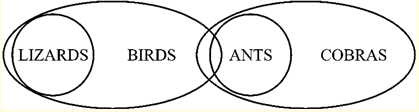
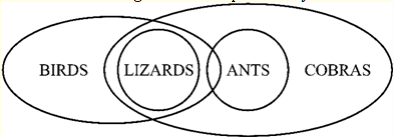
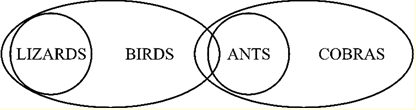
Conclusions :
I : All lizards being cobras is a possibility → Possibility is true as shown below.
II : Some cobras are birds Clearly true, as shown above.
Hence, both the conclusions follow.
For the linear network shown below, V-I characteristic is also given in the figure. The value of Norton equivalent current and resistance are respectively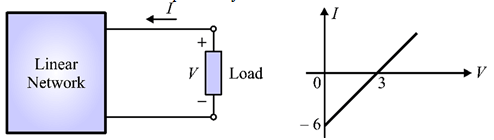
- a)

- b)

- c)

- d)

Correct answer is option 'C'. Can you explain this answer?
For the linear network shown below, V-I characteristic is also given in the figure. The value of Norton equivalent current and resistance are respectively
a)
b)
c)
d)
|
|
Zoya Sharma answered |
The circuit with Norton equivalent is,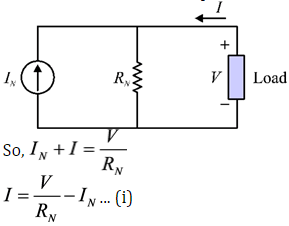
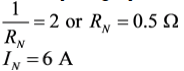
From the given graph,
The equation of line,
I = 2V - 6 .. (ii)
On comparing equation (i) and (ii),
Consider the connection of two 2✖4 decoder as shown in below figure,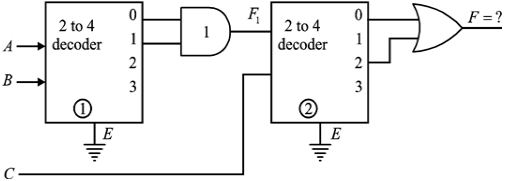 The output of the circuit F will be.
- a)1
- b)C
- c)

- d)0
Correct answer is option 'C'. Can you explain this answer?
Consider the connection of two 2✖4 decoder as shown in below figure,
The output of the circuit F will be.
a)
1
b)
C
c)
d)
0
|
|
Ravi Singh answered |
Given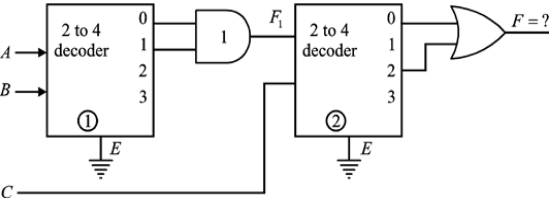

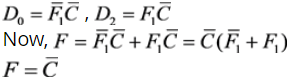
From 2 to 4 decoder-1, truth table is given by,
From the above truth table,
Now, from the circuit, 
From 2 to 4 decoder-1, truth table is given by,
From the above truth table,
For the circuit shown in the figure, the current I is 3 A.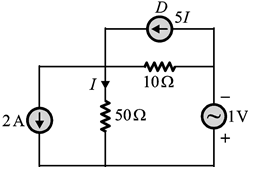 The power delivered by the dependent current source D (in watts) is _________. (in integer)
Correct answer is '1500'. Can you explain this answer?
For the circuit shown in the figure, the current I is 3 A.
The power delivered by the dependent current source D (in watts) is _________. (in integer)
|
|
Pioneer Academy answered |
Given: I = 3A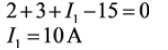
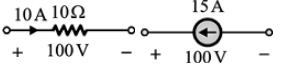
Current from the dependent current source is: 5I = 5 x 3 = 15A
Applying KCL at node 1:
Voltage drop across10Ω resistance = 100V
ஃ Voltage across current source =100V
[In parallel voltages are equal]
Power delivered by dependent source= VxI = 100x15 = 1500Watt
Which one of the statement is logically valid and can be inferred from the sentence given below?Snow White always looks into the gold mirror to comb her hair. The mirror sometimes cracks. When the mirror cracks, the glass hits the person looking into it.- a)Snow White is always hit by glass when she combs her hair.
- b)Snow White sometimes does not get hit by glass when she combs her hair.
- c)Snow White is never hit by glass when she is sleeping.
- d)When Snow White does not comb her hair, the mirror does not crack.
Correct answer is option 'C'. Can you explain this answer?
Which one of the statement is logically valid and can be inferred from the sentence given below?
Snow White always looks into the gold mirror to comb her hair. The mirror sometimes cracks. When the mirror cracks, the glass hits the person looking into it.
a)
Snow White is always hit by glass when she combs her hair.
b)
Snow White sometimes does not get hit by glass when she combs her hair.
c)
Snow White is never hit by glass when she is sleeping.
d)
When Snow White does not comb her hair, the mirror does not crack.
|
|
Zoya Sharma answered |
Option A : The passage says that the mirror cracks sometimes. We do not know if these times always coincide with the times that Snow White combs her hair. So, we cannot say that Snow White is always hit by glass when she combs her hair.
Option B : We do not know when exactly the mirror cracks; it is only mentioned that it cracks sometimes It could be possible that the mirror cracks every time Snow White combs her hair. So, we cannot say that she does not get hit by glass when she combs her hair.
Option C : The glass hits the person looking into it when it cracks. And Snow White can look into the mirror only when she is awake. So, Snow White cannot get hit by glass when she is sleeping.
Option D : Similar to the reasoning Option B, we do not know if the instances when the mirror cracks coincide with when Snow White combs her hair. So, we cannot say that when Snow White does not comb her hair the mirror does not crack.
Hence, the correct option is (C)
Consider the following statements:
The magnetic field at the centre of a circular coil of a wire carrying current is inversely proportional to the radius of the coil. Lifting power of a magnet is proportional to square of magnetic flux density. A static electric field is conservative (irrotational). If the divergence of a vector 'A' is zero, then vector 'A' can be expressed as Curl of a vector F. Which of the above statements are correct?- a)Only 1, 2 and 3
- b)Only 3 and 4
- c)Only 1, 2 and 4
- d)1, 2, 3 and 4
Correct answer is option 'D'. Can you explain this answer?
Consider the following statements:
The magnetic field at the centre of a circular coil of a wire carrying current is inversely proportional to the radius of the coil.
Lifting power of a magnet is proportional to square of magnetic flux density.
A static electric field is conservative (irrotational).
If the divergence of a vector 'A' is zero, then vector 'A' can be expressed as Curl of a vector F.
Which of the above statements are correct?
a)
Only 1, 2 and 3
b)
Only 3 and 4
c)
Only 1, 2 and 4
d)
1, 2, 3 and 4
|
|
Zoya Sharma answered |
1. The magnetic field at the centre at circular coil is given by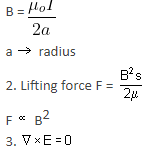

Read the following paragraph and choose the correct statement.Laura Strong is one of atleast 3.8 million Americans in 2014 who've qualified for federal programs that tie payments to income and eventually forgive debt for some struggling borrowers, leaving taxpayers to pick up the tab President Obama has praised the programs for offering a lifeline to borrowers who'd otherwise default scarring their credit. Strong pays about $100 a month on her federal loans.Income-based repayment was introduced under President Clinton, but the programs weren't heavily promoted until late 2013, when the Obama administration began sending e-mails to borrowers, includingStrong, telling them, ‘Your initial payment could be as low as $0 a month.’ The number of people using these plans has quadrupled since 2012.- a)About 4 million Americans qualified for the income based repayment programs in 2012
- b)About 2 million Americans qualified for the income based repayment programs in 2012
- c)About a million Americans qualified for the income based repayment programs in 2012
- d)About half a million Americans qualified for the income based repayment programs in 2012
Correct answer is option 'C'. Can you explain this answer?
Read the following paragraph and choose the correct statement.
Laura Strong is one of atleast 3.8 million Americans in 2014 who've qualified for federal programs that tie payments to income and eventually forgive debt for some struggling borrowers, leaving taxpayers to pick up the tab President Obama has praised the programs for offering a lifeline to borrowers who'd otherwise default scarring their credit. Strong pays about $100 a month on her federal loans.
Income-based repayment was introduced under President Clinton, but the programs weren't heavily promoted until late 2013, when the Obama administration began sending e-mails to borrowers, including
Strong, telling them, ‘Your initial payment could be as low as $0 a month.’ The number of people using these plans has quadrupled since 2012.
a)
About 4 million Americans qualified for the income based repayment programs in 2012
b)
About 2 million Americans qualified for the income based repayment programs in 2012
c)
About a million Americans qualified for the income based repayment programs in 2012
d)
About half a million Americans qualified for the income based repayment programs in 2012

|
Uday Kumar answered |
Understanding the Data
In the provided paragraph, the information regarding the number of Americans qualifying for income-based repayment programs is crucial to answering the question accurately.
Key Points from the Paragraph
- In 2014, at least 3.8 million Americans qualified for federal programs that tie payments to income.
- The paragraph notes a significant increase in the utilization of these income-based repayment plans, which have quadrupled since 2012.
- Given that the number of qualifiers increased to 3.8 million by 2014, we can infer the number in 2012.
Analyzing the Options
- Option A: About 4 million Americans qualified for the income-based repayment programs in 2012.
- This option is incorrect as it overestimates the number of qualifiers since it only reached 3.8 million in 2014.
- Option B: About 2 million Americans qualified for the income-based repayment programs in 2012.
- This option is plausible but does not align with the quadrupling growth mentioned leading up to 2014.
- Option C: About a million Americans qualified for the income-based repayment programs in 2012.
- This option is the most reasonable as it reflects a baseline figure that could logically quadruple to reach 3.8 million by 2014.
- Option D: About half a million Americans qualified for the income-based repayment programs in 2012.
- This option underestimates the situation, given the growth trend indicated.
Conclusion
Based on the data and the rate of growth mentioned, option C is the correct answer, indicating that about a million Americans likely qualified for the income-based repayment programs in 2012.
In the provided paragraph, the information regarding the number of Americans qualifying for income-based repayment programs is crucial to answering the question accurately.
Key Points from the Paragraph
- In 2014, at least 3.8 million Americans qualified for federal programs that tie payments to income.
- The paragraph notes a significant increase in the utilization of these income-based repayment plans, which have quadrupled since 2012.
- Given that the number of qualifiers increased to 3.8 million by 2014, we can infer the number in 2012.
Analyzing the Options
- Option A: About 4 million Americans qualified for the income-based repayment programs in 2012.
- This option is incorrect as it overestimates the number of qualifiers since it only reached 3.8 million in 2014.
- Option B: About 2 million Americans qualified for the income-based repayment programs in 2012.
- This option is plausible but does not align with the quadrupling growth mentioned leading up to 2014.
- Option C: About a million Americans qualified for the income-based repayment programs in 2012.
- This option is the most reasonable as it reflects a baseline figure that could logically quadruple to reach 3.8 million by 2014.
- Option D: About half a million Americans qualified for the income-based repayment programs in 2012.
- This option underestimates the situation, given the growth trend indicated.
Conclusion
Based on the data and the rate of growth mentioned, option C is the correct answer, indicating that about a million Americans likely qualified for the income-based repayment programs in 2012.
Consider the circuit shown in below figure,Given that: μnCax = 100μA/V2, W/L = 1, VT = 1V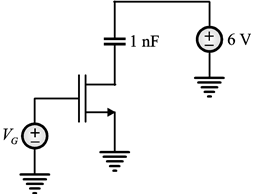 In the figure above,VG jumps from 0 to 2V at t=0 . The capacitor voltage is zero at t = 0-. The time at which the MOS transistor enters triode region is ______ (inμsec ). (correct upto 2 decimal places).
Correct answer is '100'. Can you explain this answer?
Consider the circuit shown in below figure,
Given that: μnCax = 100μA/V2, W/L = 1, VT = 1V
In the figure above,VG jumps from 0 to 2V at t=0 . The capacitor voltage is zero at t = 0-. The time at which the MOS transistor enters triode region is ______ (inμsec ). (correct upto 2 decimal places).
|
|
Pooja Patel answered |
We know as we will increase VG from 0 to 2V.
MOSFET will start conducting.
MOSFET will be in triode for under region when,
VGS>VT and VDS<>GS-VT
So, as question is about when will enter in triode region it means device initially will be in saturation. You can also see as t = 0+, VC(0) = 0 so, VD = 6V.
So, VDS > VGS -VT (Saturation)
6 > 2 - 1
∴ So device is in saturation initially.
Now, for linear VDS <>GS -VT
So switching voltage,
VDS = VGS -VT
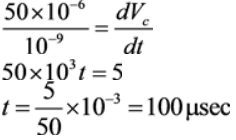
VD = 1V
Vc = 5V
We know,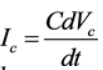
On the torque/speed curve of an induction motor shown in the figure, four points of operation are marked as W, X, Y and Z. Which of them represents the operation at a slip greater than 1?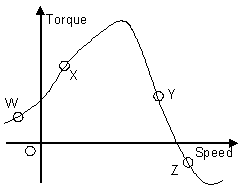
- a)w
- b)x
- c)y
- d)z
Correct answer is option 'A'. Can you explain this answer?
On the torque/speed curve of an induction motor shown in the figure, four points of operation are marked as W, X, Y and Z. Which of them represents the operation at a slip greater than 1?
a)
w
b)
x
c)
y
d)
z
|
|
Pioneer Academy answered |
Given torque/speed curve of the induction motor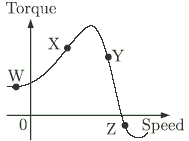
When the speed of the motor is in forward direction then slip varies from 0 to 1 but when speed of motor is in reverse direction or negative then slip is greater then 1.
So at point W slip is greater than 1.
A boat goes 48 km upstream in 6 hours and 44 km downstream in 4 hours. Find the speed of the boat in still water.- a)19 km/h
- b)8.5 km/h
- c)9.5 km/h
- d)12 km/h
Correct answer is option 'C'. Can you explain this answer?
A boat goes 48 km upstream in 6 hours and 44 km downstream in 4 hours. Find the speed of the boat in still water.
a)
19 km/h
b)
8.5 km/h
c)
9.5 km/h
d)
12 km/h
|
|
Pooja Patel answered |
Speed upstream, U = 48 ÷ 6 = 8 km/h
Speed downstream, D = 44 ÷ 4 = 11 km/h
Speed of the boat in still water =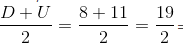 9.5 km/h
9.5 km/h The voltage ratio of a single-phase, 50 Hz transformer is 5000/500 V at no-load. The maximum value of the flux in the core is 7.82 mWb. The number of turns in primary and secondary windings respectively, are- a)1000, 100
- b)128, 13
- c)288, 29
- d)144, 15
Correct answer is option 'C'. Can you explain this answer?
The voltage ratio of a single-phase, 50 Hz transformer is 5000/500 V at no-load. The maximum value of the flux in the core is 7.82 mWb. The number of turns in primary and secondary windings respectively, are
a)
1000, 100
b)
128, 13
c)
288, 29
d)
144, 15
|
|
Divya Singh answered |
Question:
The voltage ratio of a single-phase, 50 Hz transformer is 5000/500 V at no-load. The maximum value of the flux in the core is 7.82 mWb. The number of turns in primary and secondary windings respectively, area)1000, 100b)128, 13c)288, 29d)144, 15.
Which option is correct?
Answer:
Given data:
Voltage ratio = 5000/500 V
Flux in the core = 7.82 mWb
Calculations:
The voltage ratio of a transformer is given by the formula:
V1/V2 = N1/N2
Where,
V1 = Primary voltage
V2 = Secondary voltage
N1 = Number of turns in primary coil
N2 = Number of turns in secondary coil
Given,
V1/V2 = 5000/500
So, N1/N2 = 5000/500
N1/N2 = 10
Also, the flux in the core is given by the formula:
Φ = (4.44 f N Φmax) / 10^6
Where,
f = Frequency = 50 Hz
N = Number of turns in the coil
Φmax = Maximum flux in the core
Given,
f = 50 Hz
Φmax = 7.82 mWb
So, we can find N as follows:
N = (Φ * 10^6) / (4.44 f Φmax)
N = (7.82 * 10^-3 * 10^6) / (4.44 * 50)
N = 288.28
Therefore, the number of turns in primary and secondary windings respectively are 288 and 29.
Hence, the correct option is C) 288, 29.
The voltage ratio of a single-phase, 50 Hz transformer is 5000/500 V at no-load. The maximum value of the flux in the core is 7.82 mWb. The number of turns in primary and secondary windings respectively, area)1000, 100b)128, 13c)288, 29d)144, 15.
Which option is correct?
Answer:
Given data:
Voltage ratio = 5000/500 V
Flux in the core = 7.82 mWb
Calculations:
The voltage ratio of a transformer is given by the formula:
V1/V2 = N1/N2
Where,
V1 = Primary voltage
V2 = Secondary voltage
N1 = Number of turns in primary coil
N2 = Number of turns in secondary coil
Given,
V1/V2 = 5000/500
So, N1/N2 = 5000/500
N1/N2 = 10
Also, the flux in the core is given by the formula:
Φ = (4.44 f N Φmax) / 10^6
Where,
f = Frequency = 50 Hz
N = Number of turns in the coil
Φmax = Maximum flux in the core
Given,
f = 50 Hz
Φmax = 7.82 mWb
So, we can find N as follows:
N = (Φ * 10^6) / (4.44 f Φmax)
N = (7.82 * 10^-3 * 10^6) / (4.44 * 50)
N = 288.28
Therefore, the number of turns in primary and secondary windings respectively are 288 and 29.
Hence, the correct option is C) 288, 29.
A fault current of 2000A is passing on the primary side of 400/5 CT on the secondary side of the C.T. an inverse time over current relay is connected whose plug setting is set at 50%. The PSM will be- a)25
- b)50
- c)10
- d)30
Correct answer is option 'C'. Can you explain this answer?
A fault current of 2000A is passing on the primary side of 400/5 CT on the secondary side of the C.T. an inverse time over current relay is connected whose plug setting is set at 50%. The PSM will be
a)
25
b)
50
c)
10
d)
30

|
Shivam Ghosh answered |
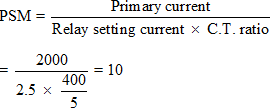
The pickup value of the relay is 5A, since the relay setting is 50%
Therefore, The operating current of the relay is
5 x 50/100 = 2.5 A
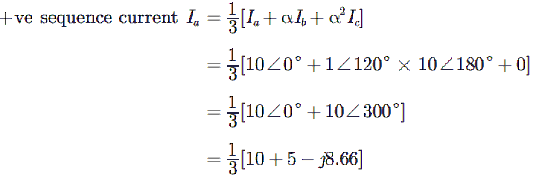
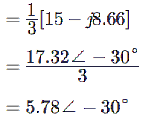
A 3-phase transmission line supplies ∆ -connected load Z. The conductor 'c' of the line develops an open circuit fault as shown in figure. The currents in the lines are also shown in the figure. The +ve sequence current component in line 'a' will be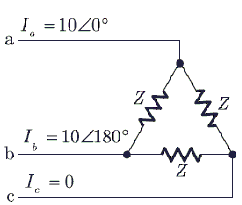
- a)5.78 ∠-300
- b)5.78∠900
- c)6.33∠900
- d)10.00∠300
Correct answer is option 'A'. Can you explain this answer?
A 3-phase transmission line supplies ∆ -connected load Z. The conductor 'c' of the line develops an open circuit fault as shown in figure. The currents in the lines are also shown in the figure. The +ve sequence current component in line 'a' will be
a)
5.78 ∠-300
b)
5.78∠900
c)
6.33∠900
d)
10.00∠300
|
|
Cstoppers Instructors answered |
Directions: Select the most appropriate word/phrase among the choices to complete the sentence.You can make your quixotic experiments with someone else, I do not wish to be your ________.- a)model
- b)victim
- c)guinea pig
- d)mannequin
Correct answer is option 'C'. Can you explain this answer?
Directions: Select the most appropriate word/phrase among the choices to complete the sentence.
You can make your quixotic experiments with someone else, I do not wish to be your ________.
a)
model
b)
victim
c)
guinea pig
d)
mannequin
|
|
Tarun Chawla answered |
Explanation:
The sentence implies that the speaker is not willing to participate in someone's experimental activities. The word/phrase that best fits in the blank should indicate that the speaker does not want to be used as a subject for someone's experiments. The options are:
a) model - This word is not appropriate as it suggests that the speaker is being used as an example to be imitated, and not as an experimental subject.
b) victim - This word is not appropriate as it suggests that the speaker is being harmed or taken advantage of, which may not be the case in this scenario.
c) guinea pig - This word is the most appropriate as it indicates that the speaker does not want to be used as a test subject for someone's experiments.
d) mannequin - This word is not appropriate as it suggests that the speaker is being used as a lifeless object, which is not the case in this scenario.
Therefore, option 'C' is the correct answer.
HTML Representation:
Explanation:
Category: Electrical Engineering (EE)
The sentence implies that the speaker is not willing to participate in someone's experimental activities. The word/phrase that best fits in the blank should indicate that the speaker does not want to be used as a subject for someone's experiments. The options are:
a) model - This word is not appropriate as it suggests that the speaker is being used as an example to be imitated, and not as an experimental subject.
b) victim - This word is not appropriate as it suggests that the speaker is being harmed or taken advantage of, which may not be the case in this scenario.
c) guinea pig - This word is the most appropriate as it indicates that the speaker does not want to be used as a test subject for someone's experiments.
d) mannequin - This word is not appropriate as it suggests that the speaker is being used as a lifeless object, which is not the case in this scenario.
Therefore, option 'C' is the correct answer.
HTML Representation:
Explanation:
The sentence implies that the speaker is not willing to participate in someone's experimental activities. The word/phrase that best fits in the blank should indicate that the speaker does not want to be used as a subject for someone's experiments. The options are:
- a) model - This word is not appropriate as it suggests that the speaker is being used as an example to be imitated, and not as an experimental subject.
- b) victim - This word is not appropriate as it suggests that the speaker is being harmed or taken advantage of, which may not be the case in this scenario.
- c) guinea pig - This word is the most appropriate as it indicates that the speaker does not want to be used as a test subject for someone's experiments.
- d) mannequin - This word is not appropriate as it suggests that the speaker is being used as a lifeless object, which is not the case in this scenario.
Therefore, option 'C' is the correct answer.
Category: Electrical Engineering (EE)
If a 3 V battery supplies 5 A of current, then the amount of energy delivered (in kJ) in one hour will be equal to ______.(Answer up to the nearest integer)- a)Insightful-imbecile
- b)Adulation-exaltation
- c)Veneration-commendation
- d)Affable-easy-going
Correct answer is '54'. Can you explain this answer?
If a 3 V battery supplies 5 A of current, then the amount of energy delivered (in kJ) in one hour will be equal to ______.
(Answer up to the nearest integer)
a)
Insightful-imbecile
b)
Adulation-exaltation
c)
Veneration-commendation
d)
Affable-easy-going
|
|
Kunal Sharma answered |
Given information:
A 3 V battery supplies 5 A of current.
Calculating energy:
The amount of energy delivered by a battery can be calculated using the formula:
Energy (E) = Power (P) × Time (t)
Power can be calculated using the formula:
Power (P) = Voltage (V) × Current (I)
Substituting the given values, we have:
Power (P) = 3 V × 5 A = 15 W
Calculating energy in one hour:
We are required to find the amount of energy delivered in one hour. Since power is given in watts and time is given in seconds, we need to convert the time to hours.
There are 3600 seconds in one hour, so:
Time (t) = 1 hour = 3600 seconds
Substituting the values into the formula:
Energy (E) = Power (P) × Time (t) = 15 W × 3600 s = 54,000 J
Converting energy to kJ:
Since the answer is required in kilojoules (kJ), we need to convert the energy from joules to kilojoules.
1 kJ = 1000 J
Therefore:
Energy (E) in kJ = 54,000 J ÷ 1000 = 54 kJ
Final answer:
The amount of energy delivered by the 3 V battery in one hour is approximately 54 kJ.
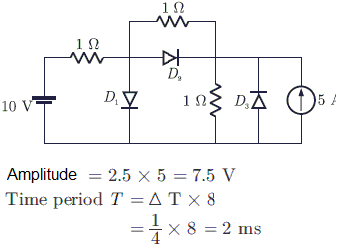
The time/div and voltage/div axes of an oscilloscope have been erased. A student connects a 1 kHz, 5 V p-p square wave calibration pulse to channel-1 of the scope and observes the screen to be as shown in the upper trace of the figure. An unknown signal is connected to channel-2 (lower trace) of the scope. If the time/div and V/div on both channels are the same, the amplitude (p-p) and period of the unknown signal are ______ and _____ respectively.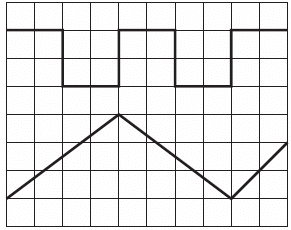
- a)5 V, 1 ms
- b)5 V, 2 ms
- c)7.5 V, 2 ms
- d)10 V, 1 ms
Correct answer is option 'C'. Can you explain this answer?
The time/div and voltage/div axes of an oscilloscope have been erased. A student connects a 1 kHz, 5 V p-p square wave calibration pulse to channel-1 of the scope and observes the screen to be as shown in the upper trace of the figure. An unknown signal is connected to channel-2 (lower trace) of the scope. If the time/div and V/div on both channels are the same, the amplitude (p-p) and period of the unknown signal are ______ and _____ respectively.
a)
5 V, 1 ms
b)
5 V, 2 ms
c)
7.5 V, 2 ms
d)
10 V, 1 ms

|
Machine Experts answered |
Find the transformer ratios a and b so that the impedance (Zin) is resistive and is equal to 2.5, when the network is excited with a sine wave voltage of angular frequency 5000 rad/s.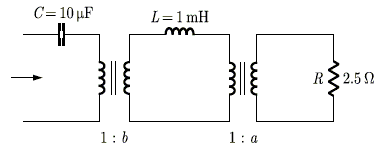
- a)a = 0.5, b = 2.0
- b)a = 2.0, b = 0.5
- c)a = 1.0, b = 1.0
- d)a = 4.0, b = 0.5
Correct answer is option 'B'. Can you explain this answer?
Find the transformer ratios a and b so that the impedance (Zin) is resistive and is equal to 2.5, when the network is excited with a sine wave voltage of angular frequency 5000 rad/s.
a)
a = 0.5, b = 2.0
b)
a = 2.0, b = 0.5
c)
a = 1.0, b = 1.0
d)
a = 4.0, b = 0.5
|
|
Cstoppers Instructors answered |
Given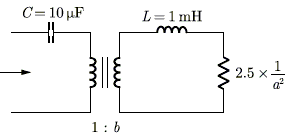
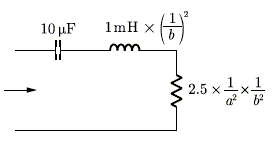
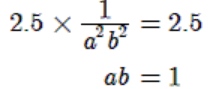
Zin = 2.5Ω (resistive); ω = 5000 rad/sec
Now, we transformer the impedance in primary side by using the formula
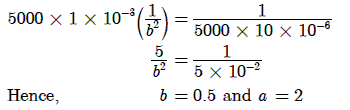
Since, input impedance is purely resistive (Zin = 2.5Ω), so
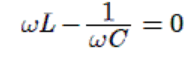
Also, the reactance is zero, i.e.
Three networks are cascaded as shown below,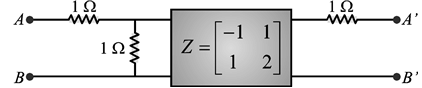 The T-parameters of cascade network is
- a)

- b)

- c)
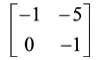
- d)

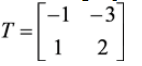
Correct answer is option 'C'. Can you explain this answer?
Three networks are cascaded as shown below,
The T-parameters of cascade network is
a)
b)
c)
d)
|
|
Cstoppers Instructors answered |
We break the network into 4 parts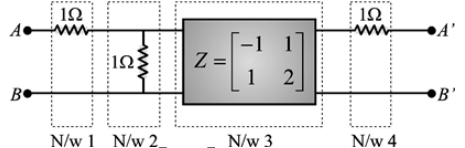
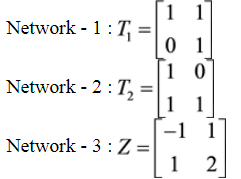
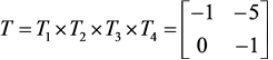 [For cascade connection abcd-parameters are multiplied]
Converting Z parameter into T parameter
Network - 4: T4
[For cascade connection abcd-parameters are multiplied] A root of the equation x3 - 3x - 5 = 0 lies between 2 and 2.5. Its value after the first iteration as obtained by using Newton-Raphson method is _____. (Answer up to two decimal places)
Correct answer is '2.33'. Can you explain this answer?
A root of the equation x3 - 3x - 5 = 0 lies between 2 and 2.5. Its value after the first iteration as obtained by using Newton-Raphson method is _____. (Answer up to two decimal places)

|
Srestha Kumar answered |
Newton-Raphson Method to Find Root of Equation
Given Equation and Initial Guess
First Iteration
Second Iteration
Final Answer
- The Newton-Raphson method is a numerical method to find the root of an equation.
- It is based on the idea of linear approximation of the function at a given point.
- The method starts with an initial guess of the root and then iteratively improves the guess until a desired level of accuracy is achieved.
- The formula for Newton-Raphson method is: x1 = x0 - (f(x0)/f'(x0)), where x0 is the initial guess, f(x) is the given function, and f'(x) is its derivative.
Given Equation and Initial Guess
- We are given the equation x3 - 3x - 5 = 0.
- We also know that the root lies between 2 and 2.5.
- Therefore, we can start with an initial guess of x0 = 2.
First Iteration
- To find the root using Newton-Raphson method, we need to calculate the value of x1 using the formula x1 = x0 - (f(x0)/f'(x0)).
- First, we need to calculate the derivative of the given function: f'(x) = 3x2 - 3.
- Then, we can substitute x0 = 2 and f(x0) = 3 into the formula to get x1 = 2 - (3/9) = 2 - 1/3 = 1.67.
Second Iteration
- We can continue the process by using x1 as the new initial guess.
- Substituting x0 = 1.67 and f(x0) = -0.635 into the formula, we get x1 = 1.67 - (-0.635)/(3*1.672 - 3) = 2.329.
Final Answer
- The value of x after the first iteration as obtained by using Newton-Raphson method is 2.33 (rounded to two decimal places).
- This value is closer to the actual root of the given equation, which is approximately 2.094.
- Further iterations can be done to improve the accuracy of the result.
Chapter doubts & questions for Practice and Mock Tests - 6 Months Preparation for GATE Electrical 2026 is part of Electrical Engineering (EE) exam preparation. The chapters have been prepared according to the Electrical Engineering (EE) exam syllabus. The Chapter doubts & questions, notes, tests & MCQs are made for Electrical Engineering (EE) 2026 Exam. Find important definitions, questions, notes, meanings, examples, exercises, MCQs and online tests here.
Chapter doubts & questions of Practice and Mock Tests - 6 Months Preparation for GATE Electrical in English & Hindi are available as part of Electrical Engineering (EE) exam.
Download more important topics, notes, lectures and mock test series for Electrical Engineering (EE) Exam by signing up for free.
6 Months Preparation for GATE Electrical
675 videos|1390 docs|885 tests
|
