


All Exams >
NEET >
Physics Class 12 >
All Questions
All questions of Current Electricity for NEET Exam
The current in a coil of resistance 90 ohms is to be reduced by 90 percent. What value of resistance should be connected in parallel with it?- a)100Ω
- b)10Ω
- c)9Ω
- d)90Ω
Correct answer is option 'B'. Can you explain this answer?
The current in a coil of resistance 90 ohms is to be reduced by 90 percent. What value of resistance should be connected in parallel with it?
a)
100Ω
b)
10Ω
c)
9Ω
d)
90Ω

|
Anjana Sharma answered |
The resistance is connected in parallel. Hence, voltage across the required resistance S and 90Ω is the same, i.e.
0.9 I x S = 0.1 I x 90
S = 90/9= 10Ω

A current of 2 ampere is passing through a metallic wire of cross-sectional area 2 x 10⁻⁶ m2. If the density of the charge carriers in the wire is 5 x 1026 m-3, then the drift velocity of the electrons will be- a)1.15 x 10⁻⁶ m/s
- b)1.5 x 10⁻⁵ m/s
- c)1.25 x 10⁻² m/s
- d)1.05 x 10⁻³ m/s
Correct answer is option 'C'. Can you explain this answer?
A current of 2 ampere is passing through a metallic wire of cross-sectional area 2 x 10⁻⁶ m2. If the density of the charge carriers in the wire is 5 x 1026 m-3, then the drift velocity of the electrons will be
a)
1.15 x 10⁻⁶ m/s
b)
1.5 x 10⁻⁵ m/s
c)
1.25 x 10⁻² m/s
d)
1.05 x 10⁻³ m/s

|
Preeti Khanna answered |
Drift velocity, v=I/nAe
=2/(2x10-6)x(5x1026)x(1.6x10-19)
=1.25x10⁻²m/s
=2/(2x10-6)x(5x1026)x(1.6x10-19)
=1.25x10⁻²m/s

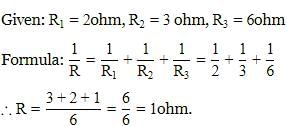
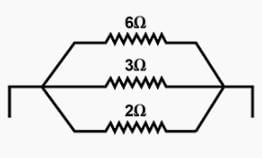
- a)

- b)

- c)

- d)

Correct answer is 'C'. Can you explain this answer?

|
Mira Joshi answered |
F=-eE .
we know that,
F= ma ,
then
a=F/m.
a=-eE/m.
we know that,
F= ma ,
then
a=F/m.
a=-eE/m.
When the position of cell and galvanometer in a Wheatstone bridge is inter-changed, its balanced condition- a)Changes and depends on galvanometer position only
- b)Changes
- c)Changes and it depends on cell position only
- d)Remains unchanged
Correct answer is option 'D'. Can you explain this answer?
When the position of cell and galvanometer in a Wheatstone bridge is inter-changed, its balanced condition
a)
Changes and depends on galvanometer position only
b)
Changes
c)
Changes and it depends on cell position only
d)
Remains unchanged

|
Krishna Iyer answered |
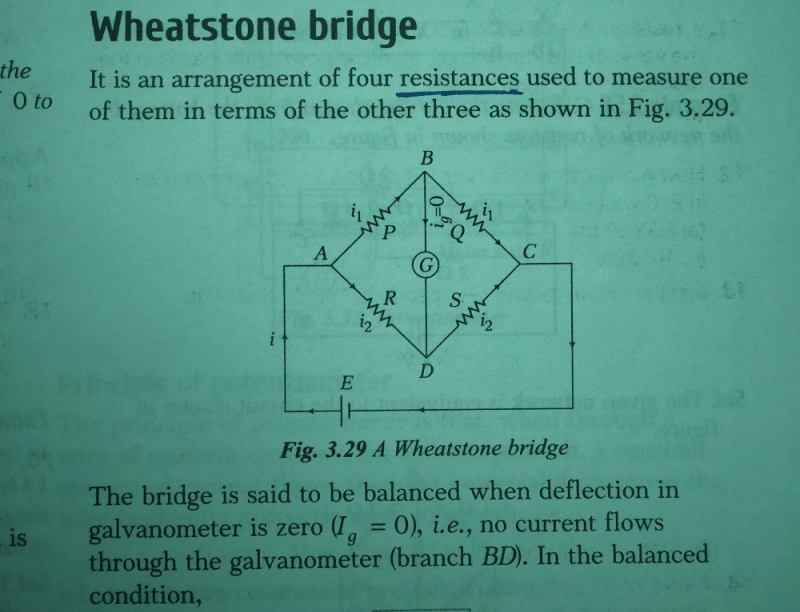
For balanced Wheatstone bridge which is shown in figure a, P/Q=S/R
If we interchange the cell and galvanometer then circuit becomes as shown in figure b.
and balanced condition, P/S=Q/R⇒P/Q=S/R
Thus, balanced point remains unchanged.
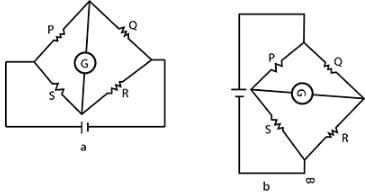
If we interchange the cell and galvanometer then circuit becomes as shown in figure b.
and balanced condition, P/S=Q/R⇒P/Q=S/R
Thus, balanced point remains unchanged.
Five resistances are connected as shown in fig. The effective resistance between points A and B is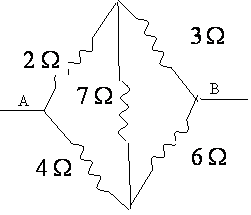
- a)20/30Ω
- b)15Ω
- c)10/3Ω
- d)6Ω
Correct answer is option 'C'. Can you explain this answer?
Five resistances are connected as shown in fig. The effective resistance between points A and B is
a)
20/30Ω
b)
15Ω
c)
10/3Ω
d)
6Ω

|
Lekshmi Basu answered |
The given circuit is a balanced Wheatstone bridge type, hence it can be simplified 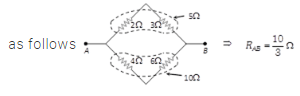
Specific resistance of a conductor increases with- a)Increase in cross-section and decrease in length
- b)Increase in cross-section
- c)Decrease in cross-section
- d)Increase in temperature
Correct answer is option 'D'. Can you explain this answer?
Specific resistance of a conductor increases with
a)
Increase in cross-section and decrease in length
b)
Increase in cross-section
c)
Decrease in cross-section
d)
Increase in temperature
|
|
Anjana Sharma answered |
Therefore resistance increases with the length. When cross sectional area increases the space of the elctrons to travel increases(simply explained). Therefore less amount of obstacles for the current. Therefore when area increases the resistance decreases.
Three resistors of 4Ω, 12Ω , and 6Ω are connected in parallel. No. of 12Ω resistors required to be connected in parallel to reduce the total resistance to half of its original is- a)6
- b)3
- c)12
- d)2
Correct answer is 'A'. Can you explain this answer?
Three resistors of 4Ω, 12Ω , and 6Ω are connected in parallel. No. of 12Ω resistors required to be connected in parallel to reduce the total resistance to half of its original is
a)
6
b)
3
c)
12
d)
2

|
Riya Banerjee answered |
Here 4 Ω, 12 Ω, 6 Ω when connected in parallel results in 2Ω. to reduce it to half we have to join 1\R original = 6\12 for reducing it to half we have to join 6 , 12 Ω resistors in parallel (6\12) + (1\ 12 × 6) = 12\12 = 1 ohm . Half of its original value therefore option a is correct.
Two cells of 1.25 V and 0.75V are connected in parallel. The effective voltage will be- a)0.5 V
- b)2.00 V
- c)1.25 V
- d)0.75 V
Correct answer is option 'A'. Can you explain this answer?
Two cells of 1.25 V and 0.75V are connected in parallel. The effective voltage will be
a)
0.5 V
b)
2.00 V
c)
1.25 V
d)
0.75 V
|
|
Anjana Sharma answered |
When two cells are conneted in parallel , then
Effective Voltage,V = V1 − V2 = 1.25 − 0.75 = 0.5 V
When Wheatstone bridge is in balance condition, the current through galvanometer will be- a)Zero
- b)Maximum
- c)Minimum
- d)Depends upon the type of galvanometer
Correct answer is option 'A'. Can you explain this answer?
When Wheatstone bridge is in balance condition, the current through galvanometer will be
a)
Zero
b)
Maximum
c)
Minimum
d)
Depends upon the type of galvanometer
|
|
Krishna Iyer answered |
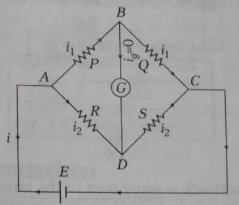
The bridge is said to be balanced when deflection in galvanometer is zero(Ig=0), i.e., no current flows through the galvanometer(branch BD).In the balanced condition,
P/Q=R/S
On mutually changing the position of the cell and galvanometer, this condition will not change.
If the potential difference V applied on a conductor is doubled, the drift velocity of electrons will become- a)vd
- b)2vd
- c)4vd
- d)

Correct answer is option 'B'. Can you explain this answer?
If the potential difference V applied on a conductor is doubled, the drift velocity of electrons will become
a)
vd
b)
2vd
c)
4vd
d)

|
EduRev JEE answered |
Drift velocity is directly proportional to potential difference.
Drift velocity is defined as the average velocity with which free electrons get drifted towards the positive end of the conductor under the influence of an external electric field.
Drift velocity is given by
vd= eEτ/ m
But, E=V/l
(if l is length of the conductor and V is constant potential difference applied across the ends of the conductor)
∴vd= eVτ/ml
⇒vd∝V
So, when the potential difference is doubled the drift velocity will be doubled.
Note - Current flowing through a conductor is directly proportional to the drift velocity.
Drift velocity is defined as the average velocity with which free electrons get drifted towards the positive end of the conductor under the influence of an external electric field.
Drift velocity is given by
vd= eEτ/ m
But, E=V/l
(if l is length of the conductor and V is constant potential difference applied across the ends of the conductor)
∴vd= eVτ/ml
⇒vd∝V
So, when the potential difference is doubled the drift velocity will be doubled.
Note - Current flowing through a conductor is directly proportional to the drift velocity.
At any junction, the sum of the currents entering the junction is equal to the sum of _______- a)potential around any closed loop
- b)voltages across the junction
- c)all the currents in the circuit
- d)currents leaving the junction
Correct answer is option 'D'. Can you explain this answer?
At any junction, the sum of the currents entering the junction is equal to the sum of _______
a)
potential around any closed loop
b)
voltages across the junction
c)
all the currents in the circuit
d)
currents leaving the junction

|
Om Kumar answered |
The correct answer is option 'D': currents leaving the junction.
Explanation:
At any junction in an electrical circuit, the sum of the currents entering the junction is equal to the sum of the currents leaving the junction. This is based on the principle of conservation of charge.
When current flows through a junction, it must split into multiple paths. The total amount of charge entering the junction must be equal to the total amount of charge leaving the junction. This is because charge cannot be created or destroyed, it can only flow through the circuit.
To better understand this concept, consider a simple circuit with three branches connected to a junction. Let's label the currents entering the junction as I1, I2, and I3, and the currents leaving the junction as I4, I5, and I6.
The principle of conservation of charge states that the total amount of charge entering the junction must be equal to the total amount of charge leaving the junction. Mathematically, this can be expressed as:
I1 + I2 + I3 = I4 + I5 + I6
This equation shows that the sum of the currents entering the junction (I1 + I2 + I3) is equal to the sum of the currents leaving the junction (I4 + I5 + I6).
This principle is a consequence of Kirchhoff's current law (KCL), which states that the algebraic sum of currents at any junction in an electrical circuit is zero. This means that the sum of currents entering the junction is equal to the sum of currents leaving the junction.
In summary, at any junction in an electrical circuit, the sum of the currents entering the junction is equal to the sum of the currents leaving the junction. This principle is based on the conservation of charge and is a consequence of Kirchhoff's current law.
Explanation:
At any junction in an electrical circuit, the sum of the currents entering the junction is equal to the sum of the currents leaving the junction. This is based on the principle of conservation of charge.
When current flows through a junction, it must split into multiple paths. The total amount of charge entering the junction must be equal to the total amount of charge leaving the junction. This is because charge cannot be created or destroyed, it can only flow through the circuit.
To better understand this concept, consider a simple circuit with three branches connected to a junction. Let's label the currents entering the junction as I1, I2, and I3, and the currents leaving the junction as I4, I5, and I6.
The principle of conservation of charge states that the total amount of charge entering the junction must be equal to the total amount of charge leaving the junction. Mathematically, this can be expressed as:
I1 + I2 + I3 = I4 + I5 + I6
This equation shows that the sum of the currents entering the junction (I1 + I2 + I3) is equal to the sum of the currents leaving the junction (I4 + I5 + I6).
This principle is a consequence of Kirchhoff's current law (KCL), which states that the algebraic sum of currents at any junction in an electrical circuit is zero. This means that the sum of currents entering the junction is equal to the sum of currents leaving the junction.
In summary, at any junction in an electrical circuit, the sum of the currents entering the junction is equal to the sum of the currents leaving the junction. This principle is based on the conservation of charge and is a consequence of Kirchhoff's current law.
Can you explain the answer of this question below:What is current I in the circuit as shown in figure?

- A:
1 A
- B:
2.0 A
- C:
1.2 A
- D:
0.5 A
The answer is b.
What is current I in the circuit as shown in figure?
1 A
2.0 A
1.2 A
0.5 A

|
Divey Sethi answered |
Three 2Ω resistors are in series. Their total resistance =6Ω. Now it is in parallel with 2Ω resistor, so total resistance,
1/R=1/2+1/6=3+1/6=4/6=2/3
R=3/2
∴I=RV=3/(3/2)=3×2/3=2A
1/R=1/2+1/6=3+1/6=4/6=2/3
R=3/2
∴I=RV=3/(3/2)=3×2/3=2A
Meter Bridge or Slide Wire Bridge is a practical form of- a)Ammeter
- b)Voltmeter
- c)Wheatstone bridge
- d)Potentiometer
Correct answer is option 'C'. Can you explain this answer?
Meter Bridge or Slide Wire Bridge is a practical form of
a)
Ammeter
b)
Voltmeter
c)
Wheatstone bridge
d)
Potentiometer
|
|
Aarav Khanna answered |
Meter Bridge or Slide Wire Bridge is a practical form of Wheatstone bridge.
Wheatstone Bridge:
The Wheatstone bridge is a circuit used to measure unknown resistance by balancing it against a known resistance. It consists of four resistors arranged in a diamond shape, with a galvanometer connected between two opposite corners and a battery connected to the other two corners. When the bridge is balanced, the galvanometer shows zero deflection, indicating that the ratio of the unknown resistance to the known resistance is equal to the ratio of the other two resistors.
Meter Bridge or Slide Wire Bridge:
The meter bridge, also known as the slide wire bridge, is a practical form of the Wheatstone bridge. It consists of a long uniform wire of uniform cross-section called the meter wire, which is stretched over a wooden board. The meter wire is usually made of manganin or constantan, which have low temperature coefficients of resistance.
Construction:
The meter bridge consists of a uniform wire AB, which is connected to a galvanometer G at its midpoint. The wire is divided into two parts by a gap at the center, where a resistance box is connected. A jockey J is used to make contact with the wire and slide along its length.
Working Principle:
To measure an unknown resistance using the meter bridge, the jockey is initially placed at the midpoint of the wire (point O). The resistance box is adjusted until the galvanometer shows zero deflection. At this point, the bridge is in a balanced condition.
The principle behind the working of the meter bridge is that when the bridge is balanced, the ratio of the lengths of the two arms of the wire (AO and OB) is equal to the ratio of the resistances (R1 and R2) in the two arms. Mathematically, this can be represented as:
R1/R2 = AO/OB
By measuring the lengths AO and OB, the ratio R1/R2 can be determined. Since one of the resistances (R1 or R2) is known, the unknown resistance can be calculated.
Advantages of Meter Bridge:
1. High Accuracy: The meter bridge offers high accuracy in measuring resistance as it is based on the principle of a balanced bridge.
2. Simple Construction: The meter bridge is relatively simple in construction and easy to use.
3. Low Cost: The materials required for constructing a meter bridge are easily available and inexpensive.
4. Versatility: The meter bridge can be used to measure a wide range of resistances, making it a versatile instrument.
In conclusion, the meter bridge or slide wire bridge is a practical form of the Wheatstone bridge and is used to measure unknown resistances accurately.
Wheatstone Bridge:
The Wheatstone bridge is a circuit used to measure unknown resistance by balancing it against a known resistance. It consists of four resistors arranged in a diamond shape, with a galvanometer connected between two opposite corners and a battery connected to the other two corners. When the bridge is balanced, the galvanometer shows zero deflection, indicating that the ratio of the unknown resistance to the known resistance is equal to the ratio of the other two resistors.
Meter Bridge or Slide Wire Bridge:
The meter bridge, also known as the slide wire bridge, is a practical form of the Wheatstone bridge. It consists of a long uniform wire of uniform cross-section called the meter wire, which is stretched over a wooden board. The meter wire is usually made of manganin or constantan, which have low temperature coefficients of resistance.
Construction:
The meter bridge consists of a uniform wire AB, which is connected to a galvanometer G at its midpoint. The wire is divided into two parts by a gap at the center, where a resistance box is connected. A jockey J is used to make contact with the wire and slide along its length.
Working Principle:
To measure an unknown resistance using the meter bridge, the jockey is initially placed at the midpoint of the wire (point O). The resistance box is adjusted until the galvanometer shows zero deflection. At this point, the bridge is in a balanced condition.
The principle behind the working of the meter bridge is that when the bridge is balanced, the ratio of the lengths of the two arms of the wire (AO and OB) is equal to the ratio of the resistances (R1 and R2) in the two arms. Mathematically, this can be represented as:
R1/R2 = AO/OB
By measuring the lengths AO and OB, the ratio R1/R2 can be determined. Since one of the resistances (R1 or R2) is known, the unknown resistance can be calculated.
Advantages of Meter Bridge:
1. High Accuracy: The meter bridge offers high accuracy in measuring resistance as it is based on the principle of a balanced bridge.
2. Simple Construction: The meter bridge is relatively simple in construction and easy to use.
3. Low Cost: The materials required for constructing a meter bridge are easily available and inexpensive.
4. Versatility: The meter bridge can be used to measure a wide range of resistances, making it a versatile instrument.
In conclusion, the meter bridge or slide wire bridge is a practical form of the Wheatstone bridge and is used to measure unknown resistances accurately.
On heating a conductor its resistance- a)depends on type of metal
- b)remains constant
- c)increases
- d)decreases
Correct answer is option 'C'. Can you explain this answer?
On heating a conductor its resistance
a)
depends on type of metal
b)
remains constant
c)
increases
d)
decreases
|
|
Rahul Bansal answered |
The resistance increases as the temperature of a metallic conductor increase, so the resistance is directly proportional to the temperature. When we increase the temperature the amplitude of vibration of atoms increases as a result of which the number of collision among the electrons and atom increases, and hence resistances increases.
Can you explain the answer of this question below:The ______ of changes in potential around any closed loop involving resistors and cells in a loop is zero.- A:product
- B:algebraic sum
- C:difference
- D:sum of absolute values
The answer is b.
The ______ of changes in potential around any closed loop involving resistors and cells in a loop is zero.
A:
product
B:
algebraic sum
C:
difference
D:
sum of absolute values

|
Lavanya Menon answered |
In accordance with Kirchhoff’s second law i.e. Kirchhoff’s voltage law (KVL), the algebraic sum of all the potential differences in a closed electric circuit or closed loop that contains one or more cells and resistors is always equal to zero.
This law is popularly called the law of conservation of voltage.
This law is popularly called the law of conservation of voltage.
The Wheatstone bridge Principle is deduced using- a)Gauss’s Law
- b)Kirchhoff’s Laws
- c)Coulomb’s Law
- d)Newton’s Laws
Correct answer is option 'B'. Can you explain this answer?
The Wheatstone bridge Principle is deduced using
a)
Gauss’s Law
b)
Kirchhoff’s Laws
c)
Coulomb’s Law
d)
Newton’s Laws
|
|
Anjana Sharma answered |
PRINCIPLE: Wheatstone bridge principle states that when the bridge is balanced, the product of the resistance of the opposite arms are equal. The files that I had attached in which I had derived Wheatstone bridge equation using Kirchhoff law is useful to you.
A wire of resistance 12 Ωm-1 is bent to form a complete circle of radius 10 cm. The resistance between its two diametrically opposite point, A and B as shown in the figure, is [2009]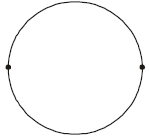
- a)3Ω
- b)6π Ω
- c)6Ω
- d)0. 6π Ω
Correct answer is option 'D'. Can you explain this answer?
A wire of resistance 12 Ωm-1 is bent to form a complete circle of radius 10 cm. The resistance between its two diametrically opposite point, A and B as shown in the figure, is [2009]
a)
3Ω
b)
6π Ω
c)
6Ω
d)
0. 6π Ω
|
|
Ram Mohith answered |
The two halves (or semicircles) are in parallel combination.
Length of each part is πr = π(0.1) m
Resistance of each part = 12(0.1π) = 1.2π
We know that when two equal resistance are kept in parallel the equivalent resistance will be half of any one resistance. So, the equivalent resistance between A and B is 0.6π
Length of each part is πr = π(0.1) m
Resistance of each part = 12(0.1π) = 1.2π
We know that when two equal resistance are kept in parallel the equivalent resistance will be half of any one resistance. So, the equivalent resistance between A and B is 0.6π
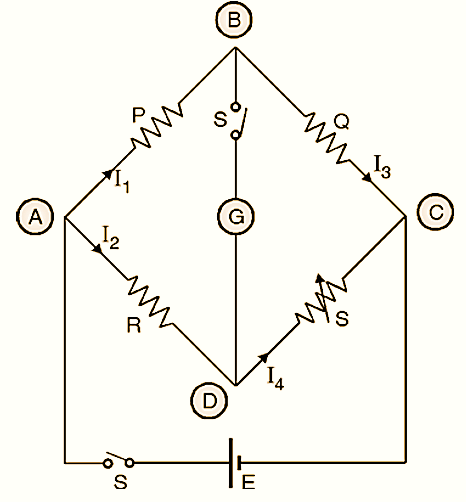
The resistance in ohms in the four arms of a Wheatstone bridge are as follows. In which combination of the following is the bridge balanced?
- a)P, R, S, Q
- b)P, R, Q, S
- c)Q, P, R, S
- d)S, R, P, Q
Correct answer is option 'B'. Can you explain this answer?
The resistance in ohms in the four arms of a Wheatstone bridge are as follows. In which combination of the following is the bridge balanced?
a)
P, R, S, Q
b)
P, R, Q, S
c)
Q, P, R, S
d)
S, R, P, Q

|
Gaurav Kumar answered |
Wheat stone bridge follows
P/Q = R/S
So 2/3 = 4/6
In a meter bridge experiment a balance point is obtained at a distance of 60 cm from the left end when unknown resistance R is in a left gap and 8 ohms resistor is connected in the right gap. When the position of R and 8 ohm resistor is interchanged the balance point will be at distance of- a)40 cm
- b)30 cm
- c)50 cm
- d)60 cm
Correct answer is option 'A'. Can you explain this answer?
In a meter bridge experiment a balance point is obtained at a distance of 60 cm from the left end when unknown resistance R is in a left gap and 8 ohms resistor is connected in the right gap. When the position of R and 8 ohm resistor is interchanged the balance point will be at distance of
a)
40 cm
b)
30 cm
c)
50 cm
d)
60 cm

|
Jyoti Sengupta answered |
60/40 = l/100-l, = R/8
so R=12
now changed position 8 is proportional to l and 12 to (100-l)
8/12 = l/100-l
l = 40ohm
Two special characteristics of the element of an electric heater:- a)low resistivity and high melting point
- b)low resistivity and low melting point
- c)high resistivity and low melting point
- d)high resistivity and high melting point
Correct answer is option 'D'. Can you explain this answer?
Two special characteristics of the element of an electric heater:
a)
low resistivity and high melting point
b)
low resistivity and low melting point
c)
high resistivity and low melting point
d)
high resistivity and high melting point

|
Samiksha Narwade answered |
Electric heater is device to heat water.... So when it have high melting pt. it we sustain heat nd won't melt....nd resistance means to oppose heat... So it should have high resistivity to heat water without getting damage....HOPE THIS WILL HELP YOU....!
The dimension of the temperature coefficient of resistivity is- a)(temperature.ohm)-1
- b)same as temperature.ohm
- c)same as (temperature)-1
- d)same as (temperature)2
Correct answer is option 'C'. Can you explain this answer?
The dimension of the temperature coefficient of resistivity is
a)
(temperature.ohm)-1
b)
same as temperature.ohm
c)
same as (temperature)-1
d)
same as (temperature)2
|
|
Ameya Pillai answered |
Temperature Coefficient of Resistivity
The temperature coefficient of resistivity is defined as the change in the electrical resistance of a material per unit change in temperature. It is denoted by the symbol α and has units of inverse temperature (K^-1) or reciprocal temperature (1/T).
Effect of Temperature on Electrical Resistance
When the temperature of a conductor increases, its electrical resistance also increases. This is due to the fact that as the temperature increases, the atoms in the conductor vibrate more vigorously, which results in more collisions between the electrons and the atoms. This increase in collisions leads to an increase in the resistance of the conductor.
Formula for Temperature Coefficient of Resistivity
The temperature coefficient of resistivity is given by the formula:
α = (1/ρ) x (dρ/dT)
where ρ is the resistivity of the material and dρ/dT is the rate of change of the resistivity with temperature.
Dimension of Temperature Coefficient of Resistivity
The dimension of the temperature coefficient of resistivity is the same as that of reciprocal temperature or (temperature)^-1. This can be seen from the formula for the temperature coefficient of resistivity:
α = (1/ρ) x (dρ/dT)
where ρ has units of ohm-meters (Ω.m) and dρ/dT has units of ohm-meters per Kelvin (Ω.m/K). Thus, the units of α are K^-1 or 1/T.
Conclusion
In conclusion, the temperature coefficient of resistivity is a measure of how the electrical resistance of a material changes with temperature. It has units of inverse temperature or reciprocal temperature, and its dimension is the same as that of (temperature)^-1.
The temperature coefficient of resistivity is defined as the change in the electrical resistance of a material per unit change in temperature. It is denoted by the symbol α and has units of inverse temperature (K^-1) or reciprocal temperature (1/T).
Effect of Temperature on Electrical Resistance
When the temperature of a conductor increases, its electrical resistance also increases. This is due to the fact that as the temperature increases, the atoms in the conductor vibrate more vigorously, which results in more collisions between the electrons and the atoms. This increase in collisions leads to an increase in the resistance of the conductor.
Formula for Temperature Coefficient of Resistivity
The temperature coefficient of resistivity is given by the formula:
α = (1/ρ) x (dρ/dT)
where ρ is the resistivity of the material and dρ/dT is the rate of change of the resistivity with temperature.
Dimension of Temperature Coefficient of Resistivity
The dimension of the temperature coefficient of resistivity is the same as that of reciprocal temperature or (temperature)^-1. This can be seen from the formula for the temperature coefficient of resistivity:
α = (1/ρ) x (dρ/dT)
where ρ has units of ohm-meters (Ω.m) and dρ/dT has units of ohm-meters per Kelvin (Ω.m/K). Thus, the units of α are K^-1 or 1/T.
Conclusion
In conclusion, the temperature coefficient of resistivity is a measure of how the electrical resistance of a material changes with temperature. It has units of inverse temperature or reciprocal temperature, and its dimension is the same as that of (temperature)^-1.
Manganin and constantan have a low temperature coefficient of resistivity which means that- a)their resistance values change very little with temperature
- b)their resistance values only change at low temperatures
- c)their resistance values change greatly with temperature
- d)their resistance values do not change with temperature
Correct answer is option 'A'. Can you explain this answer?
Manganin and constantan have a low temperature coefficient of resistivity which means that
a)
their resistance values change very little with temperature
b)
their resistance values only change at low temperatures
c)
their resistance values change greatly with temperature
d)
their resistance values do not change with temperature
|
|
Rajat Kapoor answered |
The semiconductors and insulating material are having negative temperature coefficient of resistance. Therefore, the resistance of semiconductors and insulators decrease with rise in temperature. Alloys, such as manganin, constantan etc. are having very low and positive temperature coefficient of resistance.
Consider the following two statements:
(a) Kirchhoff's junction law follows from the conservation of charge.
(b) Kirchhoff's loop law follows from the conservation of energy.Which of the following is correct? [2010]- a)Both (a) and (b) are wrong
- b)(a) is correct and (b) is wrong
- c)(a) is wrong and (b) is correct
- d)Both (a) and (b) are correct
Correct answer is option 'D'. Can you explain this answer?
Consider the following two statements:
(a) Kirchhoff's junction law follows from the conservation of charge.
(b) Kirchhoff's loop law follows from the conservation of energy.
(a) Kirchhoff's junction law follows from the conservation of charge.
(b) Kirchhoff's loop law follows from the conservation of energy.
Which of the following is correct? [2010]
a)
Both (a) and (b) are wrong
b)
(a) is correct and (b) is wrong
c)
(a) is wrong and (b) is correct
d)
Both (a) and (b) are correct

|
Nayanika Reddy answered |
Junction law follows from conservation
of charge and loop law is the conservation
of energy
of charge and loop law is the conservation
of energy
What is current I in the circuit as shown in figure?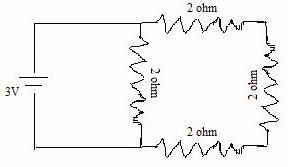
- a)1 A
- b)2.0 A
- c)1.2 A
- d)0.5 A
Correct answer is option 'B'. Can you explain this answer?
What is current I in the circuit as shown in figure?
a)
1 A
b)
2.0 A
c)
1.2 A
d)
0.5 A
|
|
Preeti Iyer answered |
Three 2Ω resistors are in series. Their total resistance =6Ω. Now it is in parallel with 2Ω resistor, so total resistance,
1/R=1/2+1/6=3+1/6=4/6=2/3
R=3/2
∴I=RV=3/(3/2)=3×2/3=2A
1/R=1/2+1/6=3+1/6=4/6=2/3
R=3/2
∴I=RV=3/(3/2)=3×2/3=2A
- a)0.04 V
- b)40.0 V
- c)0.4 V
- d)4.0 V
Correct answer is 'D'. Can you explain this answer?

|
Keerthana Iyer answered |
Given:
- e.m.f of first cell = 2V
- Balance point with first cell = 30cm
- Balance point with second cell = 60cm
To find:
- e.m.f of the second cell
Explanation:
To understand this problem, we need to understand the working principle of a potentiometer. A potentiometer is a device used to measure potential difference (or voltage) accurately. It consists of a long wire of uniform cross-section, a jockey, and a galvanometer.
When the jockey is moved along the wire, the galvanometer shows a deflection. At a certain point, the deflection becomes zero, indicating that the potential difference across that point is equal to the potential difference across the terminals of the cell being tested.
In this problem, the balance point with the first cell is at 30cm. This means that the potential difference across 30cm of the wire is equal to the e.m.f of the first cell, which is 2V.
Now, when the cell is replaced by another cell, the balance point shifts to 60cm. This means that the potential difference across 60cm of the wire is equal to the e.m.f of the second cell.
To find the e.m.f of the second cell, we can use the concept of proportionality. The potential difference across the wire is directly proportional to the length of the wire. So, we can set up the following proportion:
Potential difference across 30cm / Length of the wire = Potential difference across 60cm / Length of the wire
Since the length of the wire is the same on both sides of the equation, we can simplify the proportion to:
Potential difference across 30cm = Potential difference across 60cm
Substituting the given values:
2V = Potential difference across 60cm
Therefore, the e.m.f of the second cell is 2V.
Answer:
The e.m.f of the other cell is 4.0V (Option D).
- e.m.f of first cell = 2V
- Balance point with first cell = 30cm
- Balance point with second cell = 60cm
To find:
- e.m.f of the second cell
Explanation:
To understand this problem, we need to understand the working principle of a potentiometer. A potentiometer is a device used to measure potential difference (or voltage) accurately. It consists of a long wire of uniform cross-section, a jockey, and a galvanometer.
When the jockey is moved along the wire, the galvanometer shows a deflection. At a certain point, the deflection becomes zero, indicating that the potential difference across that point is equal to the potential difference across the terminals of the cell being tested.
In this problem, the balance point with the first cell is at 30cm. This means that the potential difference across 30cm of the wire is equal to the e.m.f of the first cell, which is 2V.
Now, when the cell is replaced by another cell, the balance point shifts to 60cm. This means that the potential difference across 60cm of the wire is equal to the e.m.f of the second cell.
To find the e.m.f of the second cell, we can use the concept of proportionality. The potential difference across the wire is directly proportional to the length of the wire. So, we can set up the following proportion:
Potential difference across 30cm / Length of the wire = Potential difference across 60cm / Length of the wire
Since the length of the wire is the same on both sides of the equation, we can simplify the proportion to:
Potential difference across 30cm = Potential difference across 60cm
Substituting the given values:
2V = Potential difference across 60cm
Therefore, the e.m.f of the second cell is 2V.
Answer:
The e.m.f of the other cell is 4.0V (Option D).
An electric bulb is rated 220 V and 100 W. Power consumed by it operated on 110 V is- a)90 W
- b)75 W
- c)25 W
- d)50 W
Correct answer is option 'C'. Can you explain this answer?
An electric bulb is rated 220 V and 100 W. Power consumed by it operated on 110 V is
a)
90 W
b)
75 W
c)
25 W
d)
50 W
|
|
Preeti Iyer answered |
P = V^2/R
If V = 220 V we have
100 W = 220^2/R
R = 220^2/100 Ω = 484 Ω. This is the resistance of the bulb.
When V = 110 V, power consumed = V^2/R = 110^2 /484 = 25 W.
Resistors can be wire bound or carbon resistors. Wire bound resistors are generally made of- a)Aluminium
- b)Carbon
- c)Copper
- d)Manganin
Correct answer is option 'D'. Can you explain this answer?
Resistors can be wire bound or carbon resistors. Wire bound resistors are generally made of
a)
Aluminium
b)
Carbon
c)
Copper
d)
Manganin
|
|
Anjana Sharma answered |
The wire material has a high resistivity, and is usually made of an alloy such as Nickel-chromium (Nichrome) or a copper-nickel-manganese alloy called Manganin. Common core materials include ceramic, plastic and glass. Wire wound resistors are the oldest type of resistors that are still manufactured today.
A steady current flows in a metallic conductor of non-uniform cross-section. The quantity/quantities constant along the length of the conductor is/are- a)Current and drift speed
- b)Current, electric field and drift velocity
- c)Speed only
- d)Current only.
Correct answer is option 'D'. Can you explain this answer?
A steady current flows in a metallic conductor of non-uniform cross-section. The quantity/quantities constant along the length of the conductor is/are
a)
Current and drift speed
b)
Current, electric field and drift velocity
c)
Speed only
d)
Current only.

|
Dr Manju Sen answered |
Current does not depend on the area of the conductor; hence it remains a constant.
Current density is inversely a constant.
Current density is inversely proportional to area (i.e.,) J∝1/A electric field drift speed is also inversely proportional to area (i.e.,) E∝1/A,Vd∝1/A
Hence current is constant along the conductor.
Current density is inversely a constant.
Current density is inversely proportional to area (i.e.,) J∝1/A electric field drift speed is also inversely proportional to area (i.e.,) E∝1/A,Vd∝1/A
Hence current is constant along the conductor.
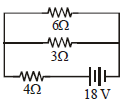
The total power dissipated in watts in the circuit shown here is [2007]
- a)40
- b)54
- c)4
- d)16
Correct answer is option 'B'. Can you explain this answer?
The total power dissipated in watts in the circuit shown here is [2007]
a)
40
b)
54
c)
4
d)
16

|
Ashwini Khanna answered |
The resistance of 6Ω and 3Ω are in parallel in the given circuit, their equivalent resistance is

In the circuit shown in the figure, if the potential at point A is taken to be zero, the potential at point B is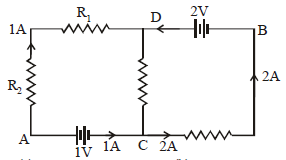
- a)–1V
- b)+ 2V
- c)–2V
- d)+ 1V
Correct answer is option 'D'. Can you explain this answer?
In the circuit shown in the figure, if the potential at point A is taken to be zero, the potential at point B is
a)
–1V
b)
+ 2V
c)
–2V
d)
+ 1V
|
|
Riya Banerjee answered |
Current from D to C = 1A
∴ VD – VC = 2 × 1 = 2V
VA = 0 ∴ VC = 1V, ∴ VD – VC = 2
⇒VD – 1 = 2 ∴ VD = 3V
∴ VD – VB = 2 ∴ 3 – VB = 2 ∴ VB = 1V
∴ VD – VC = 2 × 1 = 2V
VA = 0 ∴ VC = 1V, ∴ VD – VC = 2
⇒VD – 1 = 2 ∴ VD = 3V
∴ VD – VB = 2 ∴ 3 – VB = 2 ∴ VB = 1V
The Wheatstone bridge and its balance condition provides a practical method for the determination of- a)Unknown voltage
- b)Unknown current
- c)Unknown Resistance
- d)Unknown Resistivity
Correct answer is option 'C'. Can you explain this answer?
The Wheatstone bridge and its balance condition provides a practical method for the determination of
a)
Unknown voltage
b)
Unknown current
c)
Unknown Resistance
d)
Unknown Resistivity
|
|
Preeti Iyer answered |
A wheatstone bridge is an electrical bridge consisting of two branches of a parallel circuit joined by a galvanometer and used for determining the value of an unknown resistance in one of the branches.
The Wheatstone bridge is balanced for four resistors R1,R2,R3 and R4 with a cell of emf 1.46 V. The cell is now replaced by another cell of emf 1.08 V. To obtain the balance again
- a)All the four resistance should be changed
- b)Both the resistance R1 and R4 should be changed
- c)No resistance needs to be changed
- d)Resistance R4 should be changed only
Correct answer is option 'C'. Can you explain this answer?
The Wheatstone bridge is balanced for four resistors R1,R2,R3 and R4 with a cell of emf 1.46 V. The cell is now replaced by another cell of emf 1.08 V. To obtain the balance again
a)
All the four resistance should be changed
b)
Both the resistance R1 and R4 should be changed
c)
No resistance needs to be changed
d)
Resistance R4 should be changed only

|
Neha Sharma answered |
The balance point of the Wheatstone’s bridge is determined by the ratio of the resistances. The change in the emf of the external battery will have no effect on the balance point.
Explanation:
- Initial Balanced Wheatstone Bridge: In the initial balanced Wheatstone bridge configuration, the emf of the cell is 1.46 V and all four resistors R1, R2, R3, and R4 are set to specific values to achieve balance.
- Replacement of Cell: When the cell is replaced by another cell with an emf of 1.08 V, the balance of the Wheatstone bridge is disrupted.
- Requirement for Rebalancing: In order to rebalance the Wheatstone bridge with the new cell of emf 1.08 V, no resistance needs to be changed.
- Reasoning: The balance of the Wheatstone bridge is determined by the ratio of the resistances in the bridge arms and not by the absolute values of the resistances. As long as the ratio of the resistances remains the same, the balance will be maintained regardless of the emf of the cell.
- Conclusion: Therefore, in this scenario, no resistance needs to be changed to obtain the balance again with the new cell of emf 1.08 V.


Three resistors of 4Ω, 12Ω , and 6Ω are connected in parallel. No. of 12Ω resistors required to be connected in parallel to reduce the total resistance to half of its original is- a)6
- b)3
- c)12
- d)2
Correct answer is 'A'. Can you explain this answer?
Three resistors of 4Ω, 12Ω , and 6Ω are connected in parallel. No. of 12Ω resistors required to be connected in parallel to reduce the total resistance to half of its original is
a)
6
b)
3
c)
12
d)
2

|
Sanchita Iyer answered |
Understanding Parallel Resistance
In a parallel circuit, the total resistance (R_total) is calculated using the formula:
1/R_total = 1/R1 + 1/R2 + 1/R3 + ...
For the given resistors:
- R1 = 4 ohms
- R2 = 12 ohms
- R3 = 6 ohms
Calculating the Original Total Resistance
Let's find the total resistance with the existing resistors.
- 1/R_total = 1/4 + 1/12 + 1/6
Finding a common denominator (which is 12):
- 1/R_total = 3/12 + 1/12 + 2/12 = 6/12
Thus,
- R_total = 2 ohms.
Target Resistance
We want to reduce the total resistance to half of its original value:
- Target Resistance = 2 ohms / 2 = 1 ohm.
Adding 12 Ohm Resistors
Let 'n' be the number of additional 12 ohm resistors needed in parallel to reach 1 ohm.
The new total resistance formula becomes:
1/R_new = 1/R_total + n/R2
Where R2 is 12 ohms:
1/R_new = 1/2 + n/12.
Setting R_new to 1 ohm gives:
1 = 1/2 + n/12.
Rearranging the equation:
1 - 1/2 = n/12
1/2 = n/12
Thus, n = 6.
Conclusion
To achieve a total resistance of 1 ohm, you need to connect 6 additional 12 ohm resistors in parallel. Hence, the correct answer is:
A) 6
In a parallel circuit, the total resistance (R_total) is calculated using the formula:
1/R_total = 1/R1 + 1/R2 + 1/R3 + ...
For the given resistors:
- R1 = 4 ohms
- R2 = 12 ohms
- R3 = 6 ohms
Calculating the Original Total Resistance
Let's find the total resistance with the existing resistors.
- 1/R_total = 1/4 + 1/12 + 1/6
Finding a common denominator (which is 12):
- 1/R_total = 3/12 + 1/12 + 2/12 = 6/12
Thus,
- R_total = 2 ohms.
Target Resistance
We want to reduce the total resistance to half of its original value:
- Target Resistance = 2 ohms / 2 = 1 ohm.
Adding 12 Ohm Resistors
Let 'n' be the number of additional 12 ohm resistors needed in parallel to reach 1 ohm.
The new total resistance formula becomes:
1/R_new = 1/R_total + n/R2
Where R2 is 12 ohms:
1/R_new = 1/2 + n/12.
Setting R_new to 1 ohm gives:
1 = 1/2 + n/12.
Rearranging the equation:
1 - 1/2 = n/12
1/2 = n/12
Thus, n = 6.
Conclusion
To achieve a total resistance of 1 ohm, you need to connect 6 additional 12 ohm resistors in parallel. Hence, the correct answer is:
A) 6
A ring is made of a wire having a resistance R0 = 12 Ω. Find the points A and B as shown in the figure, at which a current carrying conductor should be connected so that the resistance R of the sub-circuit between these points is equal to 8/3 Ω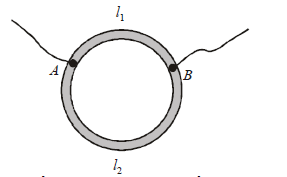
- a)

- b)

- c)

- d)

Correct answer is option 'D'. Can you explain this answer?
A ring is made of a wire having a resistance R0 = 12 Ω. Find the points A and B as shown in the figure, at which a current carrying conductor should be connected so that the resistance R of the sub-circuit between these points is equal to 8/3 Ω
a)
b)
c)
d)
|
|
EduRev JEE answered |
Let x is the resistance per unit length then
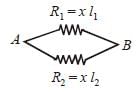
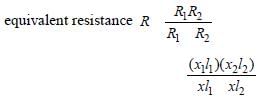
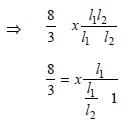
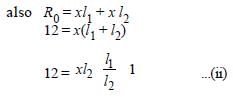
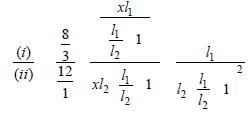
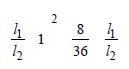
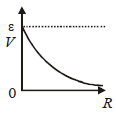
(y2 + 1 + 2y) × 8/36 y (where y l1/l2


The average time that elapses between two successive collisions of an electron is called- a)Drift velocity
- b)Free time
- c)Relaxation time
- d)Collision time
Correct answer is option 'C'. Can you explain this answer?
The average time that elapses between two successive collisions of an electron is called
a)
Drift velocity
b)
Free time
c)
Relaxation time
d)
Collision time
|
|
Rohan Singh answered |
Relaxation time is the time interval between two successive collisions of electrons in a conductor, when current flows.
I = nave --> n->no. of free electrons a->area of conductor v->drift velocity e->charge of electron
but v=(eE/m)T--> E-> field m->mass of electron T->Relaxation time
From this, you can find expression of relaxation time.Field is V/length and V=IR.From this you can modify the expression in terms of resistivity.
Potentiometer measures the potential difference more accurately than a voltmeter, because- a)It draws a heavy current from external circuit.
- b)It does not draw current from external circuit.
- c)it has a wire of low resistance.
- d)it has a wire of high resistance
Correct answer is option 'B'. Can you explain this answer?
Potentiometer measures the potential difference more accurately than a voltmeter, because
a)
It draws a heavy current from external circuit.
b)
It does not draw current from external circuit.
c)
it has a wire of low resistance.
d)
it has a wire of high resistance

|
Amar Pillai answered |
Explanation:Potentiometer measures the potential difference using null deflection method, where no current is drawn from the cell; whereas voltmeter needs a small current to show deflection. So, accurate measurement of p.d is done using a potentiometer.
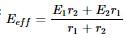
Mobility of charge carriers in a conductor is given by- a)(charge of an electron).drift velocity/ electric field
- b)drift velocity/ electric field
- c)mass of an electron.(drift velocity/ electric field)
- d)(drift velocity)(electric field)
Correct answer is option 'B'. Can you explain this answer?
Mobility of charge carriers in a conductor is given by
a)
(charge of an electron).drift velocity/ electric field
b)
drift velocity/ electric field
c)
mass of an electron.(drift velocity/ electric field)
d)
(drift velocity)(electric field)
|
|
Rohit Shah answered |
Drift velocity of charge carriers in a conductor depend upon two factors, one is the intensity of applied electric field across the conductor and other is one property of the conductor called Mobility of Charge Carrier. In other words, for applied same electric field, on different metallic conductors there will be different drift velocities of electrons. These drift velocities of electrons depend upon a typical property of conductor called mobility of charge carrier.
1 ampere current is equivalent to- a)6.25×10¹⁸ electrons s−1
- b)2.25×10¹⁸ electrons s−1
- c)6.25×10¹⁴ electrons s−1
- d)2.25×10¹⁴ electrons s−1
Correct answer is option 'A'. Can you explain this answer?
1 ampere current is equivalent to
a)
6.25×10¹⁸ electrons s−1
b)
2.25×10¹⁸ electrons s−1
c)
6.25×10¹⁴ electrons s−1
d)
2.25×10¹⁴ electrons s−1
|
|
Ajay Yadav answered |
Q = It also Q = ne [e = 1.6 × 10⁻¹⁹C]
∴ ne = It or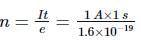
= 6.25 × 10¹⁸ electrons s−1
∴ ne = It or
= 6.25 × 10¹⁸ electrons s−1
Conversion of temperature into electric voltage is done with- a)thermometer
- b)resistor
- c)thermistor
- d)rheostat
Correct answer is option 'C'. Can you explain this answer?
Conversion of temperature into electric voltage is done with
a)
thermometer
b)
resistor
c)
thermistor
d)
rheostat
|
|
Harsh Desai answered |
To convert temperature to voltage we can do a precise measurement of the temperature in a room. A NTC resistor or a thermistor
It is used as a sensor that has a strong temperature dependence.
It is used as a sensor that has a strong temperature dependence.
A voltmeter has a resistance of G ohm and range V volt. The value of resistance used in series to convert it into voltmeter of range nV volt is- a)nG
- b)(n−1)G
- c)G/n
- d)G/(n−1)
Correct answer is option 'B'. Can you explain this answer?
A voltmeter has a resistance of G ohm and range V volt. The value of resistance used in series to convert it into voltmeter of range nV volt is
a)
nG
b)
(n−1)G
c)
G/n
d)
G/(n−1)
|
|
Avantika Mehta answered |
Understanding Voltmeter Conversion
To convert a voltmeter of range V volts into a voltmeter of range nV volts, we need to consider the resistance of the voltmeter and the additional resistance required in series.
Principle of Operation
- A voltmeter measures the potential difference across its terminals.
- When converting to a higher range, we add a series resistance to ensure that the voltmeter can handle the increased voltage without damaging its internal components.
Given Parameters
- Resistance of the voltmeter = G ohm
- Original range of the voltmeter = V volts
- New desired range = nV volts
Calculating Series Resistance
1. Voltage Division: When a voltmeter with resistance G is connected in series with another resistance R, the voltage drop across the voltmeter is a fraction of the total voltage.
2. Using Voltage Ratios: The voltage across the voltmeter can be given by the ratio:
- V / (V + R) = G / (G + R)
3. Setting Up the Equation: For the new range of nV:
- nV / (nV + R) = G / (G + R)
4. Solving for R: Rearranging gives us:
- R = (n-1)G
This means the resistance required in series to achieve the desired range of nV volts is (n - 1)G ohms.
Conclusion
Thus, the correct answer for the resistance used in series to convert the voltmeter into one of range nV volts is option B: (n - 1)G. This ensures proper functioning and safety of the voltmeter under higher voltage conditions.
To convert a voltmeter of range V volts into a voltmeter of range nV volts, we need to consider the resistance of the voltmeter and the additional resistance required in series.
Principle of Operation
- A voltmeter measures the potential difference across its terminals.
- When converting to a higher range, we add a series resistance to ensure that the voltmeter can handle the increased voltage without damaging its internal components.
Given Parameters
- Resistance of the voltmeter = G ohm
- Original range of the voltmeter = V volts
- New desired range = nV volts
Calculating Series Resistance
1. Voltage Division: When a voltmeter with resistance G is connected in series with another resistance R, the voltage drop across the voltmeter is a fraction of the total voltage.
2. Using Voltage Ratios: The voltage across the voltmeter can be given by the ratio:
- V / (V + R) = G / (G + R)
3. Setting Up the Equation: For the new range of nV:
- nV / (nV + R) = G / (G + R)
4. Solving for R: Rearranging gives us:
- R = (n-1)G
This means the resistance required in series to achieve the desired range of nV volts is (n - 1)G ohms.
Conclusion
Thus, the correct answer for the resistance used in series to convert the voltmeter into one of range nV volts is option B: (n - 1)G. This ensures proper functioning and safety of the voltmeter under higher voltage conditions.
A piece of copper and another of germanium are cooled from room temperature to 80K. The resistance- a)of each of them decreases
- b)of each of them increases
- c)copper increases and that of germanium decreases
- d)copper decreases and that of germanium increases
Correct answer is option 'D'. Can you explain this answer?
A piece of copper and another of germanium are cooled from room temperature to 80K. The resistance
a)
of each of them decreases
b)
of each of them increases
c)
copper increases and that of germanium decreases
d)
copper decreases and that of germanium increases

|
Pranjal Pillai answered |
Explanation:Copper is a conductor and we know that for conductors, resistance is directly proprtional to temperature. Therefore on decreasing temperature resistance also decreases.Whereas, germanium is a semiconductor and for semiconductors, resistance is inversely proportional to temperature. So on decreasing temperature resistance increases.
Given N resistors each of resistance R are first combined to get minimum possible resistance and then combined to get maximum possible resistance. The ratio of the minimum to maximum resistance is- a)N
- b)N2
- c)1/N2
- d)1/N
Correct answer is option 'C'. Can you explain this answer?
Given N resistors each of resistance R are first combined to get minimum possible resistance and then combined to get maximum possible resistance. The ratio of the minimum to maximum resistance is
a)
N
b)
N2
c)
1/N2
d)
1/N

|
Nishtha Bose answered |
They are connected in series to get maximum in this case resistance would be nr
and to get minimun resistance they are connected in parallel :. resistance in this case is n/r
:. ratio between minimum and maximum resistance is n/r/nr = 1/r^2
In a metre bridge experiment, null point is obtained at 20 cm from one end of the wire when resistance X is balanced against another resistance Y. If X<Y, then where will be the new position of the null point from the same end, if one decides to balance a resistance of 4X against Y ?- a)50 cm
- b)80 cm
- c)40 cm
- d)70 cm
Correct answer is option 'A'. Can you explain this answer?
In a metre bridge experiment, null point is obtained at 20 cm from one end of the wire when resistance X is balanced against another resistance Y. If X<Y, then where will be the new position of the null point from the same end, if one decides to balance a resistance of 4X against Y ?
a)
50 cm
b)
80 cm
c)
40 cm
d)
70 cm
|
|
Pranab Kapoor answered |
Understanding the Metre Bridge Experiment
In a metre bridge experiment, the balance point (null point) indicates the equality of the ratios of resistances. Here’s a detailed explanation of how to determine the new null point when balancing different resistances.
Initial Setup
- A null point is found at 20 cm from one end of the wire when resistance X is balanced against resistance Y.
- This can be expressed as:
(X / Y) = (Length from one end / Length from the other end)
Thus, (X / Y) = (20 cm / 80 cm) = 1/4.
- Given that X < y,="" we="" can="" infer="" that="" x="">
New Resistance Balancing
- Now, we are tasked with balancing a resistance of 4X against Y.
- The new equation becomes (4X / Y) = (Length from one end / Length from the other end).
Calculating New Null Point
- From the previous relationship, we know that X = (1/4)Y, therefore:
4X = 4 * (1/4)Y = Y.
- This implies that when balancing 4X against Y, they are equal.
- Hence, the new null point would be halfway along the bridge length, which is at 50 cm from one end.
Conclusion
- Therefore, when balancing a resistance of 4X against Y, the new null point will be at 50 cm from the original end.
- Thus, the correct answer is option a) 50 cm.
In a metre bridge experiment, the balance point (null point) indicates the equality of the ratios of resistances. Here’s a detailed explanation of how to determine the new null point when balancing different resistances.
Initial Setup
- A null point is found at 20 cm from one end of the wire when resistance X is balanced against resistance Y.
- This can be expressed as:
(X / Y) = (Length from one end / Length from the other end)
Thus, (X / Y) = (20 cm / 80 cm) = 1/4.
- Given that X < y,="" we="" can="" infer="" that="" x="">
New Resistance Balancing
- Now, we are tasked with balancing a resistance of 4X against Y.
- The new equation becomes (4X / Y) = (Length from one end / Length from the other end).
Calculating New Null Point
- From the previous relationship, we know that X = (1/4)Y, therefore:
4X = 4 * (1/4)Y = Y.
- This implies that when balancing 4X against Y, they are equal.
- Hence, the new null point would be halfway along the bridge length, which is at 50 cm from one end.
Conclusion
- Therefore, when balancing a resistance of 4X against Y, the new null point will be at 50 cm from the original end.
- Thus, the correct answer is option a) 50 cm.
See the electric circuit shown in the figure.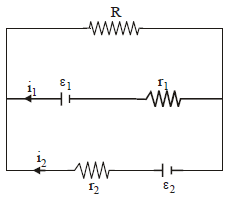 Which of the following equations is a correct equation for it? [2009]
- a)ε2 – i2 r2 – ε1 – i1 r1 = 0
- b)-ε2 – (i1 + i2) R+ i2 r2 = 0
- c)ε1 – (i1 + i2) R + i1 r1 = 0
- d)ε1 – (i1 + i2) R– i1 r1 = 0
Correct answer is option 'D'. Can you explain this answer?
See the electric circuit shown in the figure.
Which of the following equations is a correct equation for it? [2009]
a)
ε2 – i2 r2 – ε1 – i1 r1 = 0
b)
-ε2 – (i1 + i2) R+ i2 r2 = 0
c)
ε1 – (i1 + i2) R + i1 r1 = 0
d)
ε1 – (i1 + i2) R– i1 r1 = 0

|
Shanaya Rane answered |
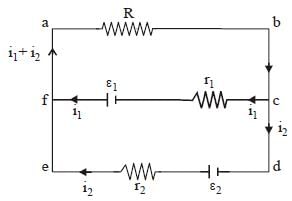
Applying Kirchhoff ’s rule in loop abcfa
ε1 – (i1 + i2) R – i1 r1 = 0.
ε1 – (i1 + i2) R – i1 r1 = 0.
A student measures the terminal potentialdifference (V) of a cell (of emf E and internalresistance r) as a function of the current (I)flowing through it. The slope and intercept, ofthe graph between V and I, then, respectively,equal: [2009]- a)– r and E
- b)r and – E
- c)– E and r
- d)E and – r
Correct answer is option 'A'. Can you explain this answer?
A student measures the terminal potentialdifference (V) of a cell (of emf E and internalresistance r) as a function of the current (I)flowing through it. The slope and intercept, ofthe graph between V and I, then, respectively,equal: [2009]
a)
– r and E
b)
r and – E
c)
– E and r
d)
E and – r

|
Madhavan Patel answered |
The slope of the graph between V and I represents the internal resistance of the cell, r. This is because according to Ohm's Law, V = E - Ir, where E is the emf of the cell. Rearranging this equation, we get Ir = E - V, which shows that the current I is directly proportional to the difference between the emf and the terminal potential difference. Therefore, the slope of the graph is equal to the internal resistance, r.
The intercept of the graph represents the emf of the cell, E. This is because when the current I is zero, the equation V = E - Ir simplifies to V = E, meaning that the terminal potential difference is equal to the emf. Therefore, the intercept of the graph is equal to the emf, E.
The intercept of the graph represents the emf of the cell, E. This is because when the current I is zero, the equation V = E - Ir simplifies to V = E, meaning that the terminal potential difference is equal to the emf. Therefore, the intercept of the graph is equal to the emf, E.
Chapter doubts & questions for Current Electricity - Physics Class 12 2026 is part of NEET exam preparation. The chapters have been prepared according to the NEET exam syllabus. The Chapter doubts & questions, notes, tests & MCQs are made for NEET 2026 Exam. Find important definitions, questions, notes, meanings, examples, exercises, MCQs and online tests here.
Chapter doubts & questions of Current Electricity - Physics Class 12 in English & Hindi are available as part of NEET exam.
Download more important topics, notes, lectures and mock test series for NEET Exam by signing up for free.
Physics Class 12
74 videos|347 docs|82 tests
|
