


Quant Exam > Quant Questions > Refer to the data below and answer the questi... Start Learning for Free
Refer to the data below and answer the questions that follow Anoop and Sandeep can dig a well each in 10 and 5 days respectively. But on a particularly difficult terrain the work is such that due to fatigue every' subsequent day the efficiency of a worker falls by 10%.
Q.
If both Anoop and Sandeep work together to finish two such wells then, in how many days will the work finish?
- a)11th day
- b)12th day
- c)8th day
- d)Never
Correct answer is option 'C'. Can you explain this answer?

Most Upvoted Answer
Refer to the data below and answer the questions that follow Anoop and...
Free Test
FREE
| Start Free Test |
Community Answer
Refer to the data below and answer the questions that follow Anoop and...
Solution:
Given data:
Anoop can dig a well in 10 days.
Sandeep can dig a well in 5 days.
Due to fatigue, efficiency falls by 10% every subsequent day.
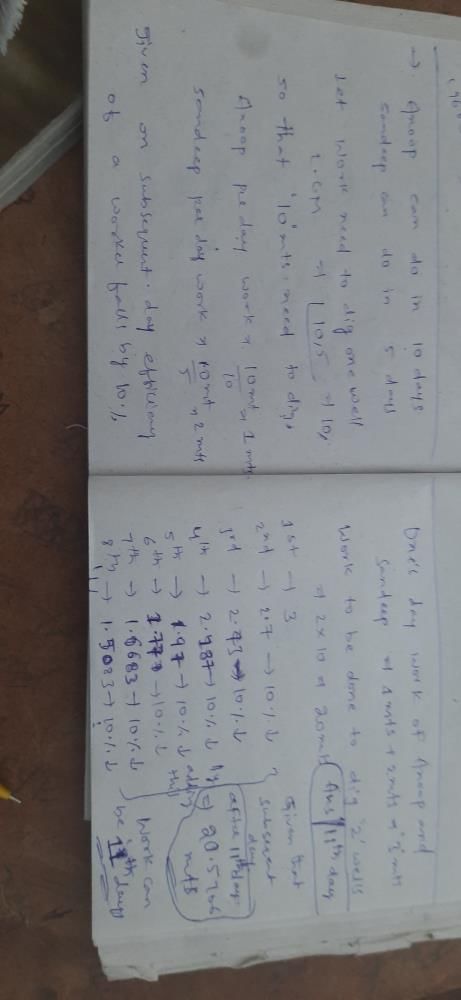
Let's assume that the total work required to dig a well is 100 units.
Efficiency of Anoop:
On the first day, Anoop can dig 10 units.
On the second day, Anoop's efficiency falls by 10%, so he can only dig 9 units.
On the third day, Anoop's efficiency falls by another 10%, so he can only dig 8.1 units.
Anoop's efficiency will keep decreasing by 10% every subsequent day.
Efficiency of Sandeep:
On the first day, Sandeep can dig 20 units.
On the second day, Sandeep's efficiency falls by 10%, so he can only dig 18 units.
On the third day, Sandeep's efficiency falls by another 10%, so he can only dig 16.2 units.
Sandeep's efficiency will keep decreasing by 10% every subsequent day.
Now, let's calculate the number of units dug by both Anoop and Sandeep together on each day:
On the first day, they can dig 30 units (10 units by Anoop and 20 units by Sandeep).
On the second day, they can dig 27 units (9 units by Anoop and 18 units by Sandeep).
On the third day, they can dig 24.3 units (8.1 units by Anoop and 16.2 units by Sandeep).
Their total efficiency will keep decreasing by 10% every subsequent day.
To calculate the total number of days required to dig two wells, we need to calculate the total number of units they can dig together on each day and divide it by the total work required to dig two wells (200 units).
On the first day, they can dig 30 units.
On the second day, they can dig 27 units.
On the third day, they can dig 24.3 units.
On the fourth day, they can dig 21.87 units.
On the fifth day, they can dig 19.683 units.
On the sixth day, they can dig 17.7147 units.
On the seventh day, they can dig 15.9432 units.
On the eighth day, they can dig 14.3489 units.
Total units dug in 8 days = 151.8148 units
Total units required to dig two wells = 200 units
Since they cannot complete the work in 8 days, the answer is never (d).
Therefore, the correct answer is option (c) 8th day.
Given data:
Anoop can dig a well in 10 days.
Sandeep can dig a well in 5 days.
Due to fatigue, efficiency falls by 10% every subsequent day.
Let's assume that the total work required to dig a well is 100 units.
Efficiency of Anoop:
On the first day, Anoop can dig 10 units.
On the second day, Anoop's efficiency falls by 10%, so he can only dig 9 units.
On the third day, Anoop's efficiency falls by another 10%, so he can only dig 8.1 units.
Anoop's efficiency will keep decreasing by 10% every subsequent day.
Efficiency of Sandeep:
On the first day, Sandeep can dig 20 units.
On the second day, Sandeep's efficiency falls by 10%, so he can only dig 18 units.
On the third day, Sandeep's efficiency falls by another 10%, so he can only dig 16.2 units.
Sandeep's efficiency will keep decreasing by 10% every subsequent day.
Now, let's calculate the number of units dug by both Anoop and Sandeep together on each day:
On the first day, they can dig 30 units (10 units by Anoop and 20 units by Sandeep).
On the second day, they can dig 27 units (9 units by Anoop and 18 units by Sandeep).
On the third day, they can dig 24.3 units (8.1 units by Anoop and 16.2 units by Sandeep).
Their total efficiency will keep decreasing by 10% every subsequent day.
To calculate the total number of days required to dig two wells, we need to calculate the total number of units they can dig together on each day and divide it by the total work required to dig two wells (200 units).
On the first day, they can dig 30 units.
On the second day, they can dig 27 units.
On the third day, they can dig 24.3 units.
On the fourth day, they can dig 21.87 units.
On the fifth day, they can dig 19.683 units.
On the sixth day, they can dig 17.7147 units.
On the seventh day, they can dig 15.9432 units.
On the eighth day, they can dig 14.3489 units.
Total units dug in 8 days = 151.8148 units
Total units required to dig two wells = 200 units
Since they cannot complete the work in 8 days, the answer is never (d).
Therefore, the correct answer is option (c) 8th day.

 | Explore Courses for Quant exam |  |
Top Courses for QuantView all





Top Courses for Quant
Question Description
Refer to the data below and answer the questions that follow Anoop and Sandeep can dig a well each in 10 and 5 days respectively. But on a particularly difficult terrain the work is such that due to fatigue every' subsequent day the efficiency of a worker falls by 10%.Q.If both Anoop and Sandeep work together to finish two such wells then, in how many days will the work finish?a)11th dayb)12th dayc)8th dayd)NeverCorrect answer is option 'C'. Can you explain this answer? for Quant 2026 is part of Quant preparation. The Question and answers have been prepared according to the Quant exam syllabus. Information about Refer to the data below and answer the questions that follow Anoop and Sandeep can dig a well each in 10 and 5 days respectively. But on a particularly difficult terrain the work is such that due to fatigue every' subsequent day the efficiency of a worker falls by 10%.Q.If both Anoop and Sandeep work together to finish two such wells then, in how many days will the work finish?a)11th dayb)12th dayc)8th dayd)NeverCorrect answer is option 'C'. Can you explain this answer? covers all topics & solutions for Quant 2026 Exam. Find important definitions, questions, meanings, examples, exercises and tests below for Refer to the data below and answer the questions that follow Anoop and Sandeep can dig a well each in 10 and 5 days respectively. But on a particularly difficult terrain the work is such that due to fatigue every' subsequent day the efficiency of a worker falls by 10%.Q.If both Anoop and Sandeep work together to finish two such wells then, in how many days will the work finish?a)11th dayb)12th dayc)8th dayd)NeverCorrect answer is option 'C'. Can you explain this answer?.
Refer to the data below and answer the questions that follow Anoop and Sandeep can dig a well each in 10 and 5 days respectively. But on a particularly difficult terrain the work is such that due to fatigue every' subsequent day the efficiency of a worker falls by 10%.Q.If both Anoop and Sandeep work together to finish two such wells then, in how many days will the work finish?a)11th dayb)12th dayc)8th dayd)NeverCorrect answer is option 'C'. Can you explain this answer? for Quant 2026 is part of Quant preparation. The Question and answers have been prepared according to the Quant exam syllabus. Information about Refer to the data below and answer the questions that follow Anoop and Sandeep can dig a well each in 10 and 5 days respectively. But on a particularly difficult terrain the work is such that due to fatigue every' subsequent day the efficiency of a worker falls by 10%.Q.If both Anoop and Sandeep work together to finish two such wells then, in how many days will the work finish?a)11th dayb)12th dayc)8th dayd)NeverCorrect answer is option 'C'. Can you explain this answer? covers all topics & solutions for Quant 2026 Exam. Find important definitions, questions, meanings, examples, exercises and tests below for Refer to the data below and answer the questions that follow Anoop and Sandeep can dig a well each in 10 and 5 days respectively. But on a particularly difficult terrain the work is such that due to fatigue every' subsequent day the efficiency of a worker falls by 10%.Q.If both Anoop and Sandeep work together to finish two such wells then, in how many days will the work finish?a)11th dayb)12th dayc)8th dayd)NeverCorrect answer is option 'C'. Can you explain this answer?.
Solutions for Refer to the data below and answer the questions that follow Anoop and Sandeep can dig a well each in 10 and 5 days respectively. But on a particularly difficult terrain the work is such that due to fatigue every' subsequent day the efficiency of a worker falls by 10%.Q.If both Anoop and Sandeep work together to finish two such wells then, in how many days will the work finish?a)11th dayb)12th dayc)8th dayd)NeverCorrect answer is option 'C'. Can you explain this answer? in English & in Hindi are available as part of our courses for Quant. Download more important topics, notes, lectures and mock test series for Quant Exam by signing up for free.
Here you can find the meaning of Refer to the data below and answer the questions that follow Anoop and Sandeep can dig a well each in 10 and 5 days respectively. But on a particularly difficult terrain the work is such that due to fatigue every' subsequent day the efficiency of a worker falls by 10%.Q.If both Anoop and Sandeep work together to finish two such wells then, in how many days will the work finish?a)11th dayb)12th dayc)8th dayd)NeverCorrect answer is option 'C'. Can you explain this answer? defined & explained in the simplest way possible. Besides giving the explanation of Refer to the data below and answer the questions that follow Anoop and Sandeep can dig a well each in 10 and 5 days respectively. But on a particularly difficult terrain the work is such that due to fatigue every' subsequent day the efficiency of a worker falls by 10%.Q.If both Anoop and Sandeep work together to finish two such wells then, in how many days will the work finish?a)11th dayb)12th dayc)8th dayd)NeverCorrect answer is option 'C'. Can you explain this answer?, a detailed solution for Refer to the data below and answer the questions that follow Anoop and Sandeep can dig a well each in 10 and 5 days respectively. But on a particularly difficult terrain the work is such that due to fatigue every' subsequent day the efficiency of a worker falls by 10%.Q.If both Anoop and Sandeep work together to finish two such wells then, in how many days will the work finish?a)11th dayb)12th dayc)8th dayd)NeverCorrect answer is option 'C'. Can you explain this answer? has been provided alongside types of Refer to the data below and answer the questions that follow Anoop and Sandeep can dig a well each in 10 and 5 days respectively. But on a particularly difficult terrain the work is such that due to fatigue every' subsequent day the efficiency of a worker falls by 10%.Q.If both Anoop and Sandeep work together to finish two such wells then, in how many days will the work finish?a)11th dayb)12th dayc)8th dayd)NeverCorrect answer is option 'C'. Can you explain this answer? theory, EduRev gives you an ample number of questions to practice Refer to the data below and answer the questions that follow Anoop and Sandeep can dig a well each in 10 and 5 days respectively. But on a particularly difficult terrain the work is such that due to fatigue every' subsequent day the efficiency of a worker falls by 10%.Q.If both Anoop and Sandeep work together to finish two such wells then, in how many days will the work finish?a)11th dayb)12th dayc)8th dayd)NeverCorrect answer is option 'C'. Can you explain this answer? tests, examples and also practice Quant tests.
| Explore Courses for Quant exam | |
Top Courses for Quant
Explore Courses
Signup for Free!
Signup to see your scores go up within 7 days! Learn & Practice with 1000+ FREE Notes, Videos & Tests.


