3 Days Timetable: Motion in a Plane (2026)

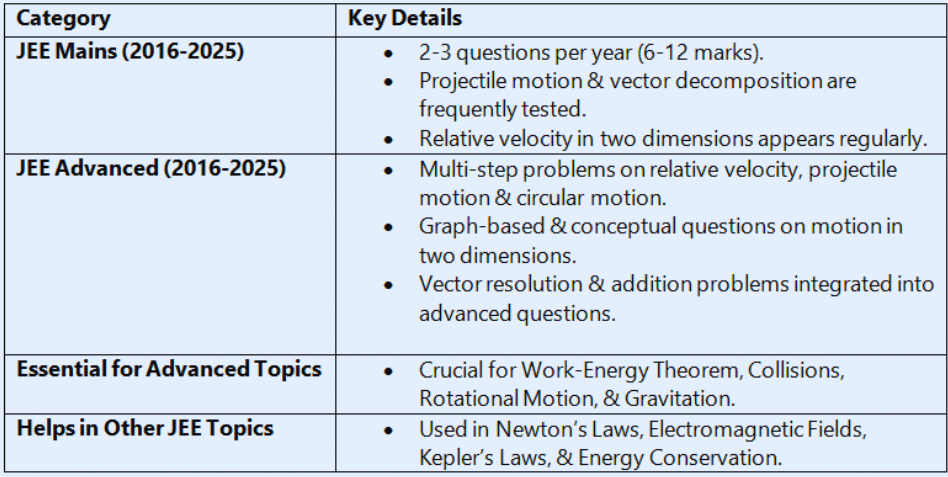
The chapter "Motion in a Plane" is a fundamental topic in JEE Physics, as it builds the foundation for understanding kinematics in two dimensions, projectile motion, uniform circular motion, and vector resolution. This chapter is essential for mastering mechanics, and its concepts are frequently tested in JEE Mains & Advanced.
Motion in a Plane: Key Insights
Based on 2025 prediction, here is a table provided below on expected no. of questions from particular topics.
Day 1: Vector & Scalar Quantities, Resolution of Vectors
- You can start the chapter first with the concepts of Vector & Scalar Quantities.
- Then, try to understand how to resolve vectors in the context of Motion in a Plane.
- After that, you can watch video on the topic Resolution of Vectors into Components for better understanding of the topic.
- Now, you will try to solve numericals from different resources available like H.C. Verma, D.C. Pandey etc.
Day 2: Projectile Motion, Relative Velocity in Two Dimensions
- You can start by exploring Projectile Motion and understanding its key principles.
- Then, you can move on to the Relative Velocity in Two Dimensions topic and its applications.
- After that, try to solve problems related to both topics.
- Now, continue practicing questions from H.C. Verma, D.C. Pandey, and Irodov books.
- You can make use of the Chapter-wise test for Motion in a Plane for JEE Main & Advanced on EduRev to assess your knowledge.
Visualization Tip: Imagine a boat crossing a river-what forces and velocities act on it?
Day 3: Uniform Circular Motion
- You can start studying the principles of Uniform Circular Motion.
- Then, solve problems to grasp the concepts better.
- Again, you can try to practice questions from H.C. Verma, D.C. Pandey, and Irodov books.
- Now, you can utilize the comprehensive resources on EduRev, such as PPT for Motion in a Plane.
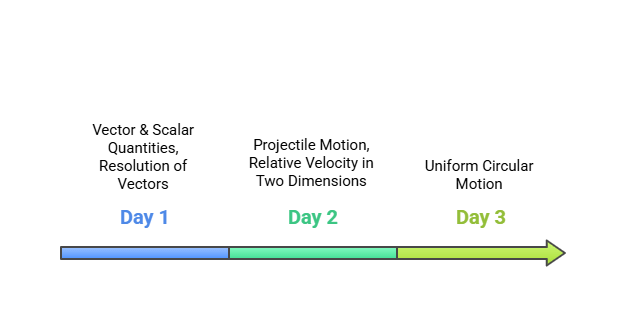 3 Day Study Table
Revision + Tests
- You can go to Revision Notes and revise all topics.
- Then, you can do JEE Previous Year Questions Mains & Advanced Questions available on EduRev. Attempt full chapter tests available on EduRev.
- Take advantage of the Short Tricks for Motion in a Plane video on EduRev for quick revision.
- Check out the NCERT Textbook & Solutions for Motion in a Plane for additional practice.
By diligently following this study plan and making the most of the resources on EduRev, you'll be well-prepared to excel in the "Motion in a Plane" chapter and the JEE Physics exam.
Important Formulas: Kinematics: Access Here
Note: Linking to EduRev resources, such as daily practice problems, chapter-wise tests, and additional study materials, will provide you with a comprehensive preparation experience for the JEE exam.
JEE Exam Resources:
- JEE Past Year Paper of Motion in a Plane
- H.C. Verma & Irodov Solutions
- Daily practice problems for JEE
- How to prepare for JEE Mains and advanced
- How to Prepare for JEE Physics
- Chapter wise test for Motion in a Plane for JEE Main & Advanced
- Basic Mathematics for Physics
- Short Tricks for Motion in a Plane video
- Motion in a Plane in one shot (NCERT)
- NCERT Textbook & Solutions for Motion in a Plane (Textbook)
- NCERT Textbook & Solutions for Motion in a Plane (Solutions)
- PPT for Motion in a Plane
- Important Formulas: Kinematics
Good luck with your studies!
FAQs on 3 Days Timetable: Motion in a Plane (2026)
| 1. What are the differences between vector and scalar quantities? |  |
| 2. How do you resolve a vector into its components? | |
| 3. What are the key equations of motion for projectile motion? | |
| 4. How is relative velocity calculated in two dimensions? | |
| 5. What is uniform circular motion and what are its characteristics? | |




