


All Exams >
Class 6 >
6 Months Preparation for Class 6 (CBSE) >
All Questions
All questions of Mindful Eating: A Path to a Healthy Body for Class 6 Exam
Which of the following vitamins and their deficiency disease is NOT correctly paired?
- a)Vitamin A → Night blindness
- b)Vitamin B1→ Scurvy
- c)Iron → Anaemia
- d)Vitamin D → Rickets
Correct answer is option 'B'. Can you explain this answer?
Which of the following vitamins and their deficiency disease is NOT correctly paired?
a)
Vitamin A → Night blindness
b)
Vitamin B1→ Scurvy
c)
Iron
→ Anaemiad)
Vitamin D → Rickets

|
Sanskriti Tiwari answered |
Deficiency of vitamin B1 causes Beri-Beri. Beriberi is a disease in which the body does not have enough thiamine.

Which of the following classes of food is present in pulses?
- a)Vitamins
- b)Fats
- c)Carbohydrates
- d)Proteins
Correct answer is option 'D'. Can you explain this answer?
Which of the following classes of food is present in pulses?
a)
Vitamins
b)
Fats
c)
Carbohydrates
d)
Proteins

|
Arjun Desai answered |
Explanation for the correct option:
- Pulses are known to be an excellent source of protein nutrients.
- Along with Proteins, they also contain minerals and vitamins. It is also a very cheap source of protein.
- Storage proteins like albumin and globulin make up the majority of the proteins found in pulses.
- The primary storage proteins in pulse seeds are globulins, which account for 35-72% of the total protein in the seeds. Albumins make up the majority of the remaining protein component.
How is roughage important to humans?- a)Prevents constipation
- b)Builds and repairs tissues
- c)Maintains the health to the body
- d)Produces hemoglobin in red blood cells
Correct answer is option 'A'. Can you explain this answer?
How is roughage important to humans?
a)
Prevents constipation
b)
Builds and repairs tissues
c)
Maintains the health to the body
d)
Produces hemoglobin in red blood cells

|
Vaibhav Shah answered |
The given information is about dietary fibre. Fibres prevent constipation.
Match the following pairs and choose the correct answer.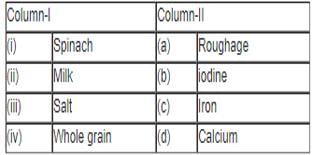
- a)(i)−d,(ii)−a,(iii)−c,(iv)−d
- b)(i)−d,(ii)−c,(iii)−a,(iv)−b
- c)(i)−c,(ii)−a,(iii)−d,(iv)−b
- d)(i)−c,(ii)−d,(iii)−b,(iv)−a
Correct answer is option 'D'. Can you explain this answer?
Match the following pairs and choose the correct answer.
a)
(i)−d,(ii)−a,(iii)−c,(iv)−d
b)
(i)−d,(ii)−c,(iii)−a,(iv)−b
c)
(i)−c,(ii)−a,(iii)−d,(iv)−b
d)
(i)−c,(ii)−d,(iii)−b,(iv)−a

|
Devansh Singh answered |
Spinach - Iron Milk - Calcium Salt - Iodine Whole grain - Roughage
Which of the following statements is/are correct with regard to our diet?
- a)Eat a diet rich in carbohydrates and proteins.
- b)Drink plenty of water
- c)Eat green vegetables every day.
- d)All of these
Correct answer is option 'D'. Can you explain this answer?
Which of the following statements is/are correct with regard to our diet?
a)
Eat a diet rich in carbohydrates and proteins.
b)
Drink plenty of water
c)
Eat green vegetables every day.
d)
All of these

|
Akshita Basu answered |
A balanced and nutritious diet is essential for maintaining good health. Here’s why each of the statements is correct:
-
Eat a diet rich in carbohydrates and proteins: Carbohydrates are the body's primary source of energy, while proteins are crucial for the growth, repair, and maintenance of body tissues. Including both in your diet ensures that your body has the necessary energy to function and the building blocks to maintain and repair itself.
-
Drink plenty of water: Water is vital for various bodily functions, including digestion, absorption of nutrients, regulation of body temperature, and removal of waste products. Staying hydrated helps keep these processes running smoothly.
-
Eat green vegetables every day: Green vegetables are packed with essential vitamins, minerals, and fiber. They are also low in calories and rich in antioxidants, which help protect the body from various diseases. Regular consumption of green vegetables supports overall health and well-being.
Conclusion: All three practices are important components of a healthy diet, which is why the correct answer is "All of these." Each plays a unique role in ensuring that your body gets the necessary nutrients, stays hydrated, and remains healthy.
4o
Priya placed two drops of a liquid on cooked rice which turned the rice blue- black. What could be the liquid?- a)Vegetable oil
- b)Iodine solution
- c)Benedict's solution
- d)Nitrate solution
Correct answer is option 'B'. Can you explain this answer?
Priya placed two drops of a liquid on cooked rice which turned the rice blue- black. What could be the liquid?
a)
Vegetable oil
b)
Iodine solution
c)
Benedict's solution
d)
Nitrate solution

|
Ananya Mishra answered |
Rice is a rich source of starch. When iodine solution is added. It will turn to blue-black colour.
Which of the following vitamins is lost by heating?
- a)Vitamin A
- b)Vitamin C
- c)Vitamin D
- d)Vitamin K
Correct answer is option 'B'. Can you explain this answer?
Which of the following vitamins is lost by heating?
a)
Vitamin A
b)
Vitamin C
c)
Vitamin D
d)
Vitamin K

|
Aruna nair answered |
Vitamin C is a water-soluble vitamin that helps in growth and development and is also called ascorbic acid. It is a temperature-sensitive vitamin that gets destroyed at elevated temperatures.
Which of the following sources of protein is different from others?- a)Peas
- b)Gram
- c)Soybeans
- d)Cottage cheese (paneer)
Correct answer is option 'D'. Can you explain this answer?
a)
Peas
b)
Gram
c)
Soybeans
d)
Cottage cheese (paneer)

|
Rohini Seth answered |
Cottage cheese (paneer) is an animal-based protein, whereas the other options are plant-based sources of protein.
Why are millets called nutri-cereals?- a)They are large in size
- b)They are expensive
- c)They are rich in nutrients
- d)They are used only for animals
Correct answer is option 'C'. Can you explain this answer?
a)
They are large in size
b)
They are expensive
c)
They are rich in nutrients
d)
They are used only for animals

|
Coders Trust answered |
Millets are called nutri-cereals because they are rich in a variety of nutrients such as proteins, vitamins (especially B-complex vitamins), minerals (like iron, calcium, and magnesium), and dietary fibre. These nutrients make millets a healthier choice compared to many other cereals. Their high nutritional value is why they are referred to as 'nutri-cereals' and are recommended as part of a balanced diet for better health.
Which nutrient is primarily responsible for giving instant energy?- a)Fats
- b)Proteins
- c)Carbohydrates
- d)Vitamins
Correct answer is option 'C'. Can you explain this answer?
Which nutrient is primarily responsible for giving instant energy?
a)
Fats
b)
Proteins
c)
Carbohydrates
d)
Vitamins
|
|
Coders Trust answered |
- Carbohydrates are the body's primary source of energy.
- They are broken down into glucose, which is readily used by our cells.
- Foods rich in carbohydrates include bread, pasta, fruits, and grains.
- Unlike fats and proteins, carbohydrates can be quickly converted into energy.
- This rapid conversion makes them ideal for immediate energy needs, especially during physical activities.
- Hence, when you need a quick boost, carbohydrates are your best bet.
- They are broken down into glucose, which is readily used by our cells.
- Foods rich in carbohydrates include bread, pasta, fruits, and grains.
- Unlike fats and proteins, carbohydrates can be quickly converted into energy.
- This rapid conversion makes them ideal for immediate energy needs, especially during physical activities.
- Hence, when you need a quick boost, carbohydrates are your best bet.
Why not other options?
- Fat: While fat is a significant energy source, it's not as readily available as carbohydrates for immediate energy. Fat is stored for long-term energy use.
- Protein: Protein's primary function is to build and repair tissues, not provide instant energy. Although the body can use protein for energy in extreme situations, it's not its main role.
- Vitamins: Vitamins are essential for various bodily functions, but they don't directly provide energy. They play a role in many metabolic processes, including energy utilization, but they are not the primary source of energy.
White of an egg turns violet when two drops of copper sulphate and ten drops of caustic soda are added to it. This indicates the presence of which of the following components of food?- a)Starch
- b)Proteins
- c)Fats
- d)Vitamins
Correct answer is option 'B'. Can you explain this answer?
White of an egg turns violet when two drops of copper sulphate and ten drops of caustic soda are added to it. This indicates the presence of which of the following components of food?
a)
Starch
b)
Proteins
c)
Fats
d)
Vitamins

|
Anisha Nambiar answered |
When food turns to violet colour when treated with copper sulphate solution and caustic soda indicates the presence of proteins.
Which of the following nutrients is called “energy giving food”?
- a)fats
- b)carbohydrates
- c)both
- d)none
Correct answer is option 'C'. Can you explain this answer?
Which of the following nutrients is called “energy giving food”?
a)
fats
b)
carbohydrates
c)
both
d)
none
|
|
Rohini Seth answered |
Fat and Carbohydrated both are the nutrients called as "Energy giving Food".
Which of the following vitamins are produced in our body when exposed to sunlight in the morning?- a)Vitamin A
- b)Vitamin B
- c)Vitamin D
- d)Vitamin K
Correct answer is option 'C'. Can you explain this answer?
Which of the following vitamins are produced in our body when exposed to sunlight in the morning?
a)
Vitamin A
b)
Vitamin B
c)
Vitamin D
d)
Vitamin K

|
Harshitha Mukherjee answered |
Sunlight exposure in the summer can equip your body to stock up on vitamin D3 that can last throughout the fall and yield for the production of more vitamin D, which leads to higher serotonin levels. Skin that is exposed to ultraviolet (UV) rays release a compound, nitric oxide, that lowers blood pressure.
Nutrient is defined as__________.- a)Constituent of food that helps in body functioning
- b)Substance which alters body functioning
- c)Constituent of food that doesn't helps in body functioning
- d)Substance which are not useful for body functioning
Correct answer is option 'A'. Can you explain this answer?
Nutrient is defined as__________.
a)
Constituent of food that helps in body functioning
b)
Substance which alters body functioning
c)
Constituent of food that doesn't helps in body functioning
d)
Substance which are not useful for body functioning

|
EduRev Class 6 answered |
Nutrients are the constituents of food that help in body functioning in one way or the other such as providing energy, repair cells, and growth. There are six major types of nutrients are carbohydrates, lipids, proteins, vitamins, minerals, and water.
Thus, option A is correct.
Thus, option A is correct.
Which of the following nutrients is not present in milk?- a)Protein
- b)Vitamin C
- c)Calcium
- d)Vitamin D
Correct answer is option 'B'. Can you explain this answer?
a)
Protein
b)
Vitamin C
c)
Calcium
d)
Vitamin D

|
Priyanka Mukherjee answered |
Nutrients in Milk
Milk is a nutritious beverage that provides a variety of essential nutrients, making it an important part of many diets. Let's explore the nutrients commonly found in milk and highlight which one is not present.
1. Protein
- Milk is rich in high-quality protein, which is essential for growth, repair, and maintenance of body tissues.
- It contains both casein and whey proteins, offering a complete amino acid profile.
2. Calcium
- Milk is an excellent source of calcium, crucial for building and maintaining strong bones and teeth.
- Calcium also plays a vital role in muscle function and nerve signaling.
3. Vitamin D
- Many milk products are fortified with vitamin D, which aids in calcium absorption and promotes bone health.
- It is particularly important for preventing conditions like rickets in children.
4. Vitamin C
- Unlike the other nutrients mentioned, milk does not naturally contain significant amounts of vitamin C.
- Vitamin C is primarily found in fruits and vegetables, such as oranges, strawberries, and bell peppers.
Conclusion
In summary, while milk is a powerhouse of nutrients like protein, calcium, and often vitamin D, it lacks vitamin C. This is why option 'B' is the correct answer to the question regarding which nutrient is not present in milk. For a balanced diet, it’s important to include various food sources to ensure adequate intake of all essential nutrients.
Milk is a nutritious beverage that provides a variety of essential nutrients, making it an important part of many diets. Let's explore the nutrients commonly found in milk and highlight which one is not present.
1. Protein
- Milk is rich in high-quality protein, which is essential for growth, repair, and maintenance of body tissues.
- It contains both casein and whey proteins, offering a complete amino acid profile.
2. Calcium
- Milk is an excellent source of calcium, crucial for building and maintaining strong bones and teeth.
- Calcium also plays a vital role in muscle function and nerve signaling.
3. Vitamin D
- Many milk products are fortified with vitamin D, which aids in calcium absorption and promotes bone health.
- It is particularly important for preventing conditions like rickets in children.
4. Vitamin C
- Unlike the other nutrients mentioned, milk does not naturally contain significant amounts of vitamin C.
- Vitamin C is primarily found in fruits and vegetables, such as oranges, strawberries, and bell peppers.
Conclusion
In summary, while milk is a powerhouse of nutrients like protein, calcium, and often vitamin D, it lacks vitamin C. This is why option 'B' is the correct answer to the question regarding which nutrient is not present in milk. For a balanced diet, it’s important to include various food sources to ensure adequate intake of all essential nutrients.
Which nutrient is crucial for the absorption of vitamins?- a)Carbohydrates
- b)Fats
- c)Proteins
- d)Minerals
Correct answer is option 'B'. Can you explain this answer?
Which nutrient is crucial for the absorption of vitamins?
a)
Carbohydrates
b)
Fats
c)
Proteins
d)
Minerals
|
|
Priya Pillai answered |
Nutrient Crucial for Vitamin Absorption
Vitamins are essential nutrients that our bodies need to function properly. Among the various nutrients, fats play a significant role in the absorption of certain vitamins.
Types of Vitamins
- Fat-Soluble Vitamins: These include Vitamins A, D, E, and K.
- Water-Soluble Vitamins: These include Vitamin C and all B vitamins.
The Role of Fats
- Facilitating Absorption: Fat-soluble vitamins cannot be absorbed efficiently without dietary fats. When you consume these vitamins with a source of fat, they dissolve in the fat, making it easier for your body to absorb them through the intestinal walls.
- Digestive Process: The presence of fats triggers the release of bile from the liver, which emulsifies the fats and helps in the absorption process. Without fats, these vitamins can pass through the digestive system without being utilized.
Importance of Including Fats in Diet
- Healthy Fats: Incorporating healthy fats such as avocados, nuts, seeds, and olive oil into your diet is crucial. These not only aid in vitamin absorption but also provide additional health benefits.
- Balanced Diet: A balanced diet that includes an appropriate amount of fats is essential for optimal health and ensuring that the body can absorb and utilize vitamins effectively.
In summary, fats are the key nutrient that enables the absorption of fat-soluble vitamins, making them vital for maintaining good health.
Vitamins are essential nutrients that our bodies need to function properly. Among the various nutrients, fats play a significant role in the absorption of certain vitamins.
Types of Vitamins
- Fat-Soluble Vitamins: These include Vitamins A, D, E, and K.
- Water-Soluble Vitamins: These include Vitamin C and all B vitamins.
The Role of Fats
- Facilitating Absorption: Fat-soluble vitamins cannot be absorbed efficiently without dietary fats. When you consume these vitamins with a source of fat, they dissolve in the fat, making it easier for your body to absorb them through the intestinal walls.
- Digestive Process: The presence of fats triggers the release of bile from the liver, which emulsifies the fats and helps in the absorption process. Without fats, these vitamins can pass through the digestive system without being utilized.
Importance of Including Fats in Diet
- Healthy Fats: Incorporating healthy fats such as avocados, nuts, seeds, and olive oil into your diet is crucial. These not only aid in vitamin absorption but also provide additional health benefits.
- Balanced Diet: A balanced diet that includes an appropriate amount of fats is essential for optimal health and ensuring that the body can absorb and utilize vitamins effectively.
In summary, fats are the key nutrient that enables the absorption of fat-soluble vitamins, making them vital for maintaining good health.
Which of the following is a fat free and rich source of Vitamin A?- a)Carrot
- b)Potato
- c)Honey
- d)Eggs
Correct answer is option 'A'. Can you explain this answer?
Which of the following is a fat free and rich source of Vitamin A?
a)
Carrot
b)
Potato
c)
Honey
d)
Eggs

|
Harshad Shah answered |
Carrot is a rich source of vitamin-A.
Which one of the following Vitamins deficiency leads to bleeding of gums, slow healing of wounds and aching limbs?- a)Vitamin A
- b)Vitamin B
- c)Vitamin C
- d)Vitamin D
Correct answer is option 'C'. Can you explain this answer?
Which one of the following Vitamins deficiency leads to bleeding of gums, slow healing of wounds and aching limbs?
a)
Vitamin A
b)
Vitamin B
c)
Vitamin C
d)
Vitamin D
|
|
Anisha Nambiar answered |
Deficiency of vitamin C causes scurvy. Vitamin C is necessary for keeping gums and joints healthy and building resistance to infections.
Which of the following symptoms is shown by a person whose diet is deficient in proteins?- a)Swelling of face
- b)Obesity
- c)Bent bones
- d)Poor vision
Correct answer is option 'A'. Can you explain this answer?
Which of the following symptoms is shown by a person whose diet is deficient in proteins?
a)
Swelling of face
b)
Obesity
c)
Bent bones
d)
Poor vision

|
Raj Mukherjee answered |
If a person does not get enough proteins in his/her food, he/she is likely to have stunted growth and a swollen face.
Which mineral is essential for strong bones and teeth?- a)Iodine
- b)Calcium
- c)Sodium
- d)Iron
Correct answer is option 'B'. Can you explain this answer?
Which mineral is essential for strong bones and teeth?
a)
Iodine
b)
Calcium
c)
Sodium
d)
Iron

|
Dr Manju Sen answered |
Calcium is the mineral is essential for strong bones and teeth.
Nutrients are classified into________ types.- a)5
- b)6
- c)3
- d)7
Correct answer is option 'D'. Can you explain this answer?
Nutrients are classified into________ types.
a)
5
b)
6
c)
3
d)
7

|
Get Idea answered |
Nutrients are classified into 7 types (5 major and 2 additional) based on their functions and the role they play in maintaining good health. These include:
5 major nutrients
- carbohydrates.
- fats
- proteins.
- vitamins.
- minerals
2 additional nutrients
- water.
- dietary fibre
Which cooking advancement is NOT part of modern methods?- a)Gas stoves
- b)Electric grinders
- c)Silbattas
- d)Microwave ovens
Correct answer is option 'C'. Can you explain this answer?
a)
Gas stoves
b)
Electric grinders
c)
Silbattas
d)
Microwave ovens

|
Yashina Kapoor answered |
Silbattas (traditional grinding stones) are an old method of food preparation, unlike modern appliances like microwaves and grinders.
Read the food items given below:
(i) Wheat
(ii) Ghee
(iii) Iodized salt
(iv) Spinach (palak)
Which of the above food items are “energy-giving foods”?- a)(i) and (iv)
- b)(ii) and (iv)
- c)(i) and (ii)
- d)(iii) and (iv)
Correct answer is option 'C'. Can you explain this answer?
(i) Wheat
(ii) Ghee
(iii) Iodized salt
(iv) Spinach (palak)
Which of the above food items are “energy-giving foods”?
a)
(i) and (iv)
b)
(ii) and (iv)
c)
(i) and (ii)
d)
(iii) and (iv)

|
Geetika Patel answered |
Understanding Energy-Giving Foods
Energy-giving foods are essential for providing the body with the necessary energy to perform daily activities. They primarily consist of carbohydrates and fats. Let’s analyze the food items listed:
1. Wheat (i)
- Wheat is a rich source of carbohydrates.
- Carbohydrates are the body's main source of energy.
- When consumed, wheat is broken down into glucose, which fuels our activities.
2. Ghee (ii)
- Ghee is a form of clarified butter, rich in fats.
- Fats are another significant source of energy.
- A small amount of ghee can provide a high caloric value, making it an energy-dense food.
3. Iodized Salt (iii)
- Iodized salt is primarily a mineral and does not provide energy.
- It plays a crucial role in thyroid function but does not contribute calories.
4. Spinach (palak) (iv)
- Spinach is a leafy green vegetable, low in calories.
- While nutritious and full of vitamins and minerals, it is not a significant source of energy.
Conclusion
Based on the analysis, the correct answer is option 'c' (i) and (ii) because:
- Both wheat and ghee are energy-giving foods.
- They provide carbohydrates and fats, which are essential for energy production in the body.
Understanding the role of these food items helps in making informed dietary choices that ensure adequate energy levels throughout the day.
Energy-giving foods are essential for providing the body with the necessary energy to perform daily activities. They primarily consist of carbohydrates and fats. Let’s analyze the food items listed:
1. Wheat (i)
- Wheat is a rich source of carbohydrates.
- Carbohydrates are the body's main source of energy.
- When consumed, wheat is broken down into glucose, which fuels our activities.
2. Ghee (ii)
- Ghee is a form of clarified butter, rich in fats.
- Fats are another significant source of energy.
- A small amount of ghee can provide a high caloric value, making it an energy-dense food.
3. Iodized Salt (iii)
- Iodized salt is primarily a mineral and does not provide energy.
- It plays a crucial role in thyroid function but does not contribute calories.
4. Spinach (palak) (iv)
- Spinach is a leafy green vegetable, low in calories.
- While nutritious and full of vitamins and minerals, it is not a significant source of energy.
Conclusion
Based on the analysis, the correct answer is option 'c' (i) and (ii) because:
- Both wheat and ghee are energy-giving foods.
- They provide carbohydrates and fats, which are essential for energy production in the body.
Understanding the role of these food items helps in making informed dietary choices that ensure adequate energy levels throughout the day.
Which of the following is considered a body-building nutrient?- a)Carbohydrates
- b)Fats
- c)Proteins
- d)Vitamins
Correct answer is option 'C'. Can you explain this answer?
a)
Carbohydrates
b)
Fats
c)
Proteins
d)
Vitamins

|
Anisha Iyer answered |
Understanding Body-Building Nutrients
In the context of body-building and muscle growth, nutrients play a crucial role. Among the different types of nutrients, proteins are recognized as the primary body-building nutrient. Let’s explore why proteins are essential.
Role of Proteins
- Muscle Repair and Growth: Proteins are made up of amino acids, which are the building blocks of muscle tissue. When you perform strength training, tiny tears occur in your muscle fibers. Proteins help repair these tears, leading to muscle growth.
- Supports Metabolism: Proteins help in the production of enzymes and hormones that regulate various metabolic processes in the body. This includes protein synthesis, which is vital for muscle recovery and growth.
Comparison with Other Nutrients
- Carbohydrates: While carbohydrates are important for energy, especially during workouts, they do not directly contribute to muscle building. They serve as fuel for your body.
- Fats: Fats are essential for overall health and provide energy, but they do not play a direct role in muscle development like proteins do.
- Vitamins: Vitamins are crucial for many bodily functions, including immune support and energy metabolism, but they do not serve as building blocks for muscle tissue.
Conclusion
In summary, while all nutrients play vital roles in overall health, proteins are specifically recognized for their body-building properties. To effectively build muscle, a diet rich in proteins, combined with carbohydrates and healthy fats, is essential.
In the context of body-building and muscle growth, nutrients play a crucial role. Among the different types of nutrients, proteins are recognized as the primary body-building nutrient. Let’s explore why proteins are essential.
Role of Proteins
- Muscle Repair and Growth: Proteins are made up of amino acids, which are the building blocks of muscle tissue. When you perform strength training, tiny tears occur in your muscle fibers. Proteins help repair these tears, leading to muscle growth.
- Supports Metabolism: Proteins help in the production of enzymes and hormones that regulate various metabolic processes in the body. This includes protein synthesis, which is vital for muscle recovery and growth.
Comparison with Other Nutrients
- Carbohydrates: While carbohydrates are important for energy, especially during workouts, they do not directly contribute to muscle building. They serve as fuel for your body.
- Fats: Fats are essential for overall health and provide energy, but they do not play a direct role in muscle development like proteins do.
- Vitamins: Vitamins are crucial for many bodily functions, including immune support and energy metabolism, but they do not serve as building blocks for muscle tissue.
Conclusion
In summary, while all nutrients play vital roles in overall health, proteins are specifically recognized for their body-building properties. To effectively build muscle, a diet rich in proteins, combined with carbohydrates and healthy fats, is essential.
Which region of India is known for dishes like dosa and idli?- a)Punjab
- b)West Bengal
- c)Maharashtra
- d)Tamil Nadu
Correct answer is option 'D'. Can you explain this answer?
a)
Punjab
b)
West Bengal
c)
Maharashtra
d)
Tamil Nadu

|
Praveen Kumar answered |
- Tamil Nadu is located in the southern part of India, known for its rich cultural heritage and diverse cuisine.
- Dosa is a thin, crispy pancake made from fermented rice and lentil batter, often served with chutneys and sambar.
- Idli is a soft, steamed cake made from the same batter, typically enjoyed for breakfast.
- These dishes are staples in Tamil Nadu and are also popular in other South Indian states, reflecting the region's culinary traditions.
- Dosa is a thin, crispy pancake made from fermented rice and lentil batter, often served with chutneys and sambar.
- Idli is a soft, steamed cake made from the same batter, typically enjoyed for breakfast.
- These dishes are staples in Tamil Nadu and are also popular in other South Indian states, reflecting the region's culinary traditions.
Which of the following is NOT typically found in junk food?- a)High fats
- b)High vitamins
- c)High sugar
- d)Low dietary fibre
Correct answer is option 'B'. Can you explain this answer?
a)
High fats
b)
High vitamins
c)
High sugar
d)
Low dietary fibre
|
|
Coders Trust answered |
Junk food is typically high in fats and sugar, and low in dietary fibre. It is low in essential nutrients like vitamins, so 'high vitamins' is NOT typically found in junk food.
Which of the following foods is a good source of Vitamin C?- a)Amla
- b)Wheat
- c)Butter
- d)Paneer
Correct answer is option 'A'. Can you explain this answer?
a)
Amla
b)
Wheat
c)
Butter
d)
Paneer
|
|
Preethi Dasgupta answered |
Vitamin C and Its Importance
Vitamin C, also known as ascorbic acid, is an essential nutrient that plays a vital role in various bodily functions. It is crucial for the growth and repair of tissues, the production of collagen, and the functioning of the immune system.
Good Source of Vitamin C
Among the options provided, amla (Indian gooseberry) is well-known for its high Vitamin C content. Here are some reasons why amla is a great source of this vitamin:
Other Options Explained
- Wheat: While it is a good source of carbohydrates and some vitamins, it is not a notable source of Vitamin C.
- Butter: This dairy product is rich in fats but contains negligible amounts of Vitamin C.
- Paneer: Similar to butter, paneer is high in protein and calcium but lacks significant Vitamin C content.
Conclusion
In conclusion, among the options listed, amla is the best source of Vitamin C, making it an important addition to a balanced diet.
Vitamin C, also known as ascorbic acid, is an essential nutrient that plays a vital role in various bodily functions. It is crucial for the growth and repair of tissues, the production of collagen, and the functioning of the immune system.
Good Source of Vitamin C
Among the options provided, amla (Indian gooseberry) is well-known for its high Vitamin C content. Here are some reasons why amla is a great source of this vitamin:
- High Concentration: Amla contains one of the highest concentrations of Vitamin C found in any fruit. Just a small serving can provide a significant portion of the daily recommended intake.
- Antioxidant Properties: The Vitamin C in amla acts as a powerful antioxidant, helping to protect the body from oxidative stress and damage caused by free radicals.
- Boosts Immunity: Regular consumption of amla can help strengthen the immune system, making the body more resistant to infections and diseases.
- Supports Skin Health: Vitamin C is vital for collagen synthesis, which is important for maintaining healthy skin and preventing signs of aging.
Other Options Explained
- Wheat: While it is a good source of carbohydrates and some vitamins, it is not a notable source of Vitamin C.
- Butter: This dairy product is rich in fats but contains negligible amounts of Vitamin C.
- Paneer: Similar to butter, paneer is high in protein and calcium but lacks significant Vitamin C content.
Conclusion
In conclusion, among the options listed, amla is the best source of Vitamin C, making it an important addition to a balanced diet.
Goitre is caused by the deficiency of which mineral?- a)Calcium
- b)Iron
- c)Iodine
- d)Zinc
Correct answer is option 'C'. Can you explain this answer?
a)
Calcium
b)
Iron
c)
Iodine
d)
Zinc
|
|
Coders Trust answered |
Iodine deficiency can cause goitre, which leads to swelling in the neck.
Which region of India is known for the dish “vada pav”?- a)Punjab
- b)Tamil Nadu
- c)West Bengal
- d)Maharashtra
Correct answer is option 'D'. Can you explain this answer?
a)
Punjab
b)
Tamil Nadu
c)
West Bengal
d)
Maharashtra
|
|
Pallavi Roy answered |
Understanding Vada Pav
Vada Pav is a popular street food that originates from the vibrant state of Maharashtra, India. It is often referred to as the "Indian burger" and is loved by many for its unique flavors and easy preparation.
Key Ingredients
- Vada: This is a spicy potato filling, seasoned with various spices, and then coated in a chickpea flour batter before being deep-fried.
- Pav: This is a soft bread roll that serves as the bun for the vada.
- Chutneys: Vada Pav is typically served with green chutney (made from coriander and green chilies) and tamarind chutney, adding a burst of flavor.
Popularity and Cultural Significance
- Street Food Culture: Vada Pav is an essential part of Mumbai's street food scene, available at numerous stalls and eateries across the city.
- Affordable and Filling: It is not only delicious but also affordable, making it a favorite among students and working professionals.
- Iconic Representation: As a symbol of Mumbai's culinary diversity, Vada Pav represents the city’s bustling lifestyle and is often enjoyed on the go.
Conclusion
Maharashtra, particularly Mumbai, is the heart of Vada Pav culture. Its simple ingredients and delightful taste make it a cherished snack across India and beyond. Whether you are in a bustling market or a quiet corner of the city, indulging in a Vada Pav is a must for anyone seeking to experience authentic Indian street food.
Vada Pav is a popular street food that originates from the vibrant state of Maharashtra, India. It is often referred to as the "Indian burger" and is loved by many for its unique flavors and easy preparation.
Key Ingredients
- Vada: This is a spicy potato filling, seasoned with various spices, and then coated in a chickpea flour batter before being deep-fried.
- Pav: This is a soft bread roll that serves as the bun for the vada.
- Chutneys: Vada Pav is typically served with green chutney (made from coriander and green chilies) and tamarind chutney, adding a burst of flavor.
Popularity and Cultural Significance
- Street Food Culture: Vada Pav is an essential part of Mumbai's street food scene, available at numerous stalls and eateries across the city.
- Affordable and Filling: It is not only delicious but also affordable, making it a favorite among students and working professionals.
- Iconic Representation: As a symbol of Mumbai's culinary diversity, Vada Pav represents the city’s bustling lifestyle and is often enjoyed on the go.
Conclusion
Maharashtra, particularly Mumbai, is the heart of Vada Pav culture. Its simple ingredients and delightful taste make it a cherished snack across India and beyond. Whether you are in a bustling market or a quiet corner of the city, indulging in a Vada Pav is a must for anyone seeking to experience authentic Indian street food.
Read the following statements about diseases:(i) They are caused by germs.
(ii) They are caused due to a lack of nutrients in our diet.
(iii) They can be passed on to another person through contact.
(iv) They can be prevented by taking a balanced diet.Which pair of statements best describes a deficiency disease?a) (i) and (ii)
b) (ii) and (iii)
c) (ii) and (iv)
d) (i) and (iii)- a)(i) and (ii)
- b)(ii) and (iii)
- c)(ii) and (iv)
- d)(i) and (iii)
Correct answer is option 'C'. Can you explain this answer?
Read the following statements about diseases:
(i) They are caused by germs.
(ii) They are caused due to a lack of nutrients in our diet.
(iii) They can be passed on to another person through contact.
(iv) They can be prevented by taking a balanced diet.
(ii) They are caused due to a lack of nutrients in our diet.
(iii) They can be passed on to another person through contact.
(iv) They can be prevented by taking a balanced diet.
Which pair of statements best describes a deficiency disease?
a) (i) and (ii)
b) (ii) and (iii)
c) (ii) and (iv)
d) (i) and (iii)
b) (ii) and (iii)
c) (ii) and (iv)
d) (i) and (iii)
a)
(i) and (ii)
b)
(ii) and (iii)
c)
(ii) and (iv)
d)
(i) and (iii)

|
Sounak Ghoshal answered |
Understanding Deficiency Diseases
Deficiency diseases occur when the body lacks essential nutrients necessary for maintaining health. Let's break down the statements to understand why option 'C' (ii and iv) is the correct answer.
Statement Analysis
- (i) They are caused by germs.
This statement refers to infectious diseases, not deficiency diseases. Infectious diseases are caused by pathogens like bacteria and viruses.
- (ii) They are caused due to a lack of nutrients in our diet.
This statement accurately describes deficiency diseases. Conditions like scurvy (vitamin C deficiency) and rickets (vitamin D deficiency) arise from insufficient nutrients.
- (iii) They can be passed on to another person through contact.
This statement applies to infectious diseases, not deficiency diseases. Deficiency diseases are not contagious.
- (iv) They can be prevented by taking a balanced diet.
This statement is also correct for deficiency diseases. A balanced diet provides all necessary nutrients, preventing these diseases.
Conclusion
In summary, deficiency diseases are specifically linked to a lack of nutrients (statement ii) and can be prevented through a balanced diet (statement iv). Thus, the pair of statements that best describes a deficiency disease is option 'C' (ii and iv).
Understanding these distinctions helps us appreciate the importance of nutrition in maintaining good health!
Deficiency diseases occur when the body lacks essential nutrients necessary for maintaining health. Let's break down the statements to understand why option 'C' (ii and iv) is the correct answer.
Statement Analysis
- (i) They are caused by germs.
This statement refers to infectious diseases, not deficiency diseases. Infectious diseases are caused by pathogens like bacteria and viruses.
- (ii) They are caused due to a lack of nutrients in our diet.
This statement accurately describes deficiency diseases. Conditions like scurvy (vitamin C deficiency) and rickets (vitamin D deficiency) arise from insufficient nutrients.
- (iii) They can be passed on to another person through contact.
This statement applies to infectious diseases, not deficiency diseases. Deficiency diseases are not contagious.
- (iv) They can be prevented by taking a balanced diet.
This statement is also correct for deficiency diseases. A balanced diet provides all necessary nutrients, preventing these diseases.
Conclusion
In summary, deficiency diseases are specifically linked to a lack of nutrients (statement ii) and can be prevented through a balanced diet (statement iv). Thus, the pair of statements that best describes a deficiency disease is option 'C' (ii and iv).
Understanding these distinctions helps us appreciate the importance of nutrition in maintaining good health!
Which disease is caused by deficiency of Vitamin D?- a)Rickets
- b)Beriberi
- c)Scurvy
- d)Anaemia
Correct answer is option 'A'. Can you explain this answer?
a)
Rickets
b)
Beriberi
c)
Scurvy
d)
Anaemia

|
Bibek Verma answered |
Understanding Rickets
Rickets is a disease that primarily affects children and is caused by a deficiency of Vitamin D, calcium, or phosphate. This condition leads to weak or soft bones, which can result in deformities.
Role of Vitamin D
- Vitamin D is essential for the body to absorb calcium and phosphate from food.
- It helps in maintaining proper bone structure and health.
Symptoms of Rickets
- Delayed growth and development
- Muscle weakness
- Bone pain and tenderness
- Deformities such as bowed legs or a curved spine
Sources of Vitamin D
- Sunlight exposure: The skin produces Vitamin D when exposed to sunlight.
- Dietary sources: Foods such as fatty fish, fortified dairy products, and egg yolks.
Prevention of Rickets
- Ensuring adequate sunlight exposure for children.
- Including Vitamin D-rich foods in their diet.
- Supplementation may be necessary in cases of severe deficiency.
Conclusion
Recognizing the importance of Vitamin D is crucial in preventing rickets. Proper nutrition and lifestyle can significantly reduce the risk of this disease and promote healthy bone development in children.
Rickets is a disease that primarily affects children and is caused by a deficiency of Vitamin D, calcium, or phosphate. This condition leads to weak or soft bones, which can result in deformities.
Role of Vitamin D
- Vitamin D is essential for the body to absorb calcium and phosphate from food.
- It helps in maintaining proper bone structure and health.
Symptoms of Rickets
- Delayed growth and development
- Muscle weakness
- Bone pain and tenderness
- Deformities such as bowed legs or a curved spine
Sources of Vitamin D
- Sunlight exposure: The skin produces Vitamin D when exposed to sunlight.
- Dietary sources: Foods such as fatty fish, fortified dairy products, and egg yolks.
Prevention of Rickets
- Ensuring adequate sunlight exposure for children.
- Including Vitamin D-rich foods in their diet.
- Supplementation may be necessary in cases of severe deficiency.
Conclusion
Recognizing the importance of Vitamin D is crucial in preventing rickets. Proper nutrition and lifestyle can significantly reduce the risk of this disease and promote healthy bone development in children.
What are millets known for?- a)Being a source of fats
- b)Being easy to cultivate and highly nutritious
- c)Being a type of fruit
- d)Being a source of vitamins only
Correct answer is option 'B'. Can you explain this answer?
a)
Being a source of fats
b)
Being easy to cultivate and highly nutritious
c)
Being a type of fruit
d)
Being a source of vitamins only

|
Vp Classes answered |
Millets are nutritious grains that are easy to grow in dry regions and provide essential nutrients like fiber and protein.
Which one of the following food items does not provide dietary fiber?- a)Whole grains
- b)Whole pulses
- c)Fruits and vegetables
- d)Milk
Correct answer is option 'D'. Can you explain this answer?
a)
Whole grains
b)
Whole pulses
c)
Fruits and vegetables
d)
Milk
|
|
Rohini Seth answered |
Milk does not contain fiber; dietary fiber is mainly found in plant-based foods like grains, pulses, and vegetables.
What is used to test for the presence of starch in food?- a)Iodine solution
- b)Copper sulfate
- c)Caustic soda
- d)Litmus paper
Correct answer is option 'A'. Can you explain this answer?
a)
Iodine solution
b)
Copper sulfate
c)
Caustic soda
d)
Litmus paper
|
|
Vp Classes answered |
Iodine solution turns blue-black when starch is present, making it a common test for detecting starch in food.
What does “food miles” refer to?- a)Distance traveled by food from farm to plate
- b)Nutritional value of food
- c)Number of meals consumed in a day
- d)Amount of food waste
Correct answer is option 'A'. Can you explain this answer?
a)
Distance traveled by food from farm to plate
b)
Nutritional value of food
c)
Number of meals consumed in a day
d)
Amount of food waste

|
Edgy Education answered |
"Food miles" indicate the distance food travels from production to consumption, affecting its freshness and environmental impact.
Which of the following is a test used to detect starch in food?- a)Biuret test
- b)Iodine test
- c)Benedict’s test
- d)Litmus test
Correct answer is option 'B'. Can you explain this answer?
a)
Biuret test
b)
Iodine test
c)
Benedict’s test
d)
Litmus test
|
|
Coders Trust answered |
Iodine turns blue-black in the presence of starch.
Which of the following is a rich source of dietary fibers?- a)Milk
- b)Butter
- c)Brown rice
- d)Chicken
Correct answer is option 'C'. Can you explain this answer?
a)
Milk
b)
Butter
c)
Brown rice
d)
Chicken
|
|
Coders Trust answered |
- Brown rice is a whole grain, meaning it contains all parts of the grain, including the bran, germ, and endosperm.
- The bran and germ are rich in dietary fiber, which is essential for healthy digestion.
- Dietary fiber helps regulate bowel movements, lowers cholesterol levels, and can aid in weight management.
- In contrast, milk, butter, and chicken contain minimal to no dietary fiber, making brown rice the clear choice for fiber intake.
- The bran and germ are rich in dietary fiber, which is essential for healthy digestion.
- Dietary fiber helps regulate bowel movements, lowers cholesterol levels, and can aid in weight management.
- In contrast, milk, butter, and chicken contain minimal to no dietary fiber, making brown rice the clear choice for fiber intake.
Which of the following vitamins is present in the given substances? 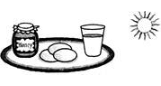
- a)Vitamin E
- b)Vitamin D
- c)Vitamin K
- d)Vitamin C
Correct answer is option 'B'. Can you explain this answer?
Which of the following vitamins is present in the given substances?
a)
Vitamin E
b)
Vitamin D
c)
Vitamin K
d)
Vitamin C

|
Preethi Basak answered |
Vitamin D helps our body to use calcium for bones and teeth, it is found in sunlight, eggs, butter and milk.
Chapter doubts & questions for Mindful Eating: A Path to a Healthy Body - 6 Months Preparation for Class 6 (CBSE) 2025 is part of Class 6 exam preparation. The chapters have been prepared according to the Class 6 exam syllabus. The Chapter doubts & questions, notes, tests & MCQs are made for Class 6 2025 Exam. Find important definitions, questions, notes, meanings, examples, exercises, MCQs and online tests here.
Chapter doubts & questions of Mindful Eating: A Path to a Healthy Body - 6 Months Preparation for Class 6 (CBSE) in English & Hindi are available as part of Class 6 exam.
Download more important topics, notes, lectures and mock test series for Class 6 Exam by signing up for free.
6 Months Preparation for Class 6 (CBSE)
303 videos|1455 docs|206 tests
|

|
© EduRev
|
Education Revolution
|


|







Signup on EduRev and stay on top of your study goals
10M+ students crushing their study goals daily