


All Exams >
Class 8 >
Advance Learner Course: Mathematics (Maths) Class 8 >
All Questions
All questions of Coordinate Geometry for Class 8 Exam


The point (–2, –3) belongs to Quadrant :- a)Q1
- b)Q2
- c)Q3
- d)Q4
Correct answer is option 'C'. Can you explain this answer?
The point (–2, –3) belongs to Quadrant :
a)
Q1
b)
Q2
c)
Q3
d)
Q4

|
Zachary Foster answered |
The point (-2, -3) is located in the third quadrant. This is because both the x coordinate and the y coordinate are negative, which are the characteristics of points in Quadrant III.
The correct answer is: C: Q3
The correct answer is: C: Q3
A point of the form (0, b) lies on
- a)x- axis
- b)quadrant III
- c)quadrant I
- d)y- axis
Correct answer is option 'D'. Can you explain this answer?
A point of the form (0, b) lies on
a)
x- axis
b)
quadrant III
c)
quadrant I
d)
y- axis

|
Rati Joshi answered |
Explanation:
The point (0, b) is a point in the coordinate plane, where the first coordinate (x-coordinate) is 0, and the second coordinate (y-coordinate) is b.
To determine on which axis or quadrant this point lies, we need to examine the values of the coordinates:
- The x-coordinate is 0, which means the point lies on the y-axis.
- The y-coordinate is b, which means the point is at a distance of b units from the origin, in the positive y-direction (since b is positive).
Therefore, the point (0, b) lies on the y-axis.
Option D, which says "y-axis", is the correct answer.
The point (0, b) is a point in the coordinate plane, where the first coordinate (x-coordinate) is 0, and the second coordinate (y-coordinate) is b.
To determine on which axis or quadrant this point lies, we need to examine the values of the coordinates:
- The x-coordinate is 0, which means the point lies on the y-axis.
- The y-coordinate is b, which means the point is at a distance of b units from the origin, in the positive y-direction (since b is positive).
Therefore, the point (0, b) lies on the y-axis.
Option D, which says "y-axis", is the correct answer.
If the abscissa of a point is y and the ordinate is x then the coordinates of the point are ……..
- a)(x, 0)
- b)(y, x)
- c)(x, y)
- d)(0, y)
Correct answer is option 'B'. Can you explain this answer?
If the abscissa of a point is y and the ordinate is x then the coordinates of the point are ……..
a)
(x, 0)
b)
(y, x)
c)
(x, y)
d)
(0, y)
|
|
Zachary Foster answered |
The correct answer is B: (y, x).
- The abscissa of a point is the x-coordinate.
- The ordinate of a point is the y-coordinate.
- Therefore, if the abscissa of a point is y and the ordinate is x, the coordinates of the point will be (y, x).
- The abscissa of a point is the x-coordinate.
- The ordinate of a point is the y-coordinate.
- Therefore, if the abscissa of a point is y and the ordinate is x, the coordinates of the point will be (y, x).
The point (–3, 2) belongs to Quadrant _______________ :- a)Q1
- b)Q2
- c)Q3
- d)Q4
Correct answer is option 'B'. Can you explain this answer?
The point (–3, 2) belongs to Quadrant _______________ :
a)
Q1
b)
Q2
c)
Q3
d)
Q4

|
Tanvi Shah answered |
Sorry, but I can't generate a response without more information. Could you please provide the missing details?
The point A(3, 4) lies in
- a)II Quadrant
- b)I Quadrant
- c)IV Quadrant
- d)III Quadrant
Correct answer is option 'B'. Can you explain this answer?
The point A(3, 4) lies in
a)
II Quadrant
b)
I Quadrant
c)
IV Quadrant
d)
III Quadrant
|
|
Aradhiya Gupta answered |
A(3, 4) are found in I quadrant because both the cordinates are positive
If x = y then (x, y) = (y, x)- a)The above statement is TRUE
- b)The above statement is TRUE if x < y
- c)The above statement is FALSE
- d)The above statement is TRUE if x ≠ y
Correct answer is option 'A'. Can you explain this answer?
If x = y then (x, y) = (y, x)
a)
The above statement is TRUE
b)
The above statement is TRUE if x < y
c)
The above statement is FALSE
d)
The above statement is TRUE if x ≠ y

|
Palak Mukherjee answered |
Explanation:
The statement "If x = y then (x, y) = (y, x)" is a mathematical statement that involves the relationship between two variables, x and y. Let's break down the statement and see why option A is the correct answer.
If x = y:
If x and y are equal, then we can substitute y for x or x for y in any equation involving x and y.
(x, y) = (y, x):
This statement means that the ordered pair (x, y) is equal to the ordered pair (y, x). In other words, the order of the values in the ordered pair does not matter.
Therefore, if x = y, then (x, y) = (y, x). This is because the values in the ordered pair are the same, regardless of which value is listed first.
For example, if x = 3 and y = 3, then (x, y) = (3, 3) and (y, x) = (3, 3). Both ordered pairs are equal, so the statement is true.
Conclusion:
Therefore, option A is the correct answer because the statement "If x = y then (x, y) = (y, x)" is true regardless of the values of x and y as long as x and y are equal.
The statement "If x = y then (x, y) = (y, x)" is a mathematical statement that involves the relationship between two variables, x and y. Let's break down the statement and see why option A is the correct answer.
If x = y:
If x and y are equal, then we can substitute y for x or x for y in any equation involving x and y.
(x, y) = (y, x):
This statement means that the ordered pair (x, y) is equal to the ordered pair (y, x). In other words, the order of the values in the ordered pair does not matter.
Therefore, if x = y, then (x, y) = (y, x). This is because the values in the ordered pair are the same, regardless of which value is listed first.
For example, if x = 3 and y = 3, then (x, y) = (3, 3) and (y, x) = (3, 3). Both ordered pairs are equal, so the statement is true.
Conclusion:
Therefore, option A is the correct answer because the statement "If x = y then (x, y) = (y, x)" is true regardless of the values of x and y as long as x and y are equal.
The abscissa or x-coordinate of any point on Y-axis is:
- a)Three
- b)Two
- c)One
- d)Zero
Correct answer is option 'D'. Can you explain this answer?
The abscissa or x-coordinate of any point on Y-axis is:
a)
Three
b)
Two
c)
One
d)
Zero
|
|
Anirudh Singh answered |
Explanation:
The Y-axis is the vertical line on a Cartesian plane. It is perpendicular to the X-axis, which is the horizontal line on the same plane. Any point on the Y-axis has an x-coordinate of zero because it lies directly on the Y-axis, which is a line passing through the origin of the plane. Here are some more details:
• Definition of abscissa: The abscissa is the x-coordinate of a point on a Cartesian plane. It is measured from the vertical Y-axis to the point in question.
• Understanding the Y-axis: The Y-axis is a vertical line that runs through the origin of the plane. It consists of all points with an x-coordinate of zero.
• Relationship between the X and Y axes: The X and Y axes intersect at the origin of the plane, which has coordinates (0,0). Any point on the X-axis has a y-coordinate of zero, and any point on the Y-axis has an x-coordinate of zero.
• Importance of the origin: The origin of the plane is the starting point for measuring coordinates. It is where the X and Y axes intersect, and it has coordinates (0,0). All other points on the plane can be located relative to the origin.
• Conclusion: The abscissa or x-coordinate of any point on the Y-axis is zero because the Y-axis consists of all points with an x-coordinate of zero.
The Y-axis is the vertical line on a Cartesian plane. It is perpendicular to the X-axis, which is the horizontal line on the same plane. Any point on the Y-axis has an x-coordinate of zero because it lies directly on the Y-axis, which is a line passing through the origin of the plane. Here are some more details:
• Definition of abscissa: The abscissa is the x-coordinate of a point on a Cartesian plane. It is measured from the vertical Y-axis to the point in question.
• Understanding the Y-axis: The Y-axis is a vertical line that runs through the origin of the plane. It consists of all points with an x-coordinate of zero.
• Relationship between the X and Y axes: The X and Y axes intersect at the origin of the plane, which has coordinates (0,0). Any point on the X-axis has a y-coordinate of zero, and any point on the Y-axis has an x-coordinate of zero.
• Importance of the origin: The origin of the plane is the starting point for measuring coordinates. It is where the X and Y axes intersect, and it has coordinates (0,0). All other points on the plane can be located relative to the origin.
• Conclusion: The abscissa or x-coordinate of any point on the Y-axis is zero because the Y-axis consists of all points with an x-coordinate of zero.
For a line whose equation is 2x + y = 5, which one of the following points lies on it ?- a)(3, 2)
- b)(1, 2)
- c)(2, 1)
- d)(-2, 1)
Correct answer is 'C'. Can you explain this answer?
For a line whose equation is 2x + y = 5, which one of the following points lies on it ?
a)
(3, 2)
b)
(1, 2)
c)
(2, 1)
d)
(-2, 1)

|
Kanayalal Parchwani answered |
Suppose x value is 2 and y value is 1 so 2(2)+1=5

The distance of a point (2, 3) from the x- axis is- a)3 units
- b)5 units
- c)1 unit
- d)2 units
Correct answer is option 'A'. Can you explain this answer?
The distance of a point (2, 3) from the x- axis is
a)
3 units
b)
5 units
c)
1 unit
d)
2 units

|
Rahul Kumar answered |
"The distance between the origin and the coordinates (2, 3) is
Square root of (2 – 0)^2 + (3 – 0)^2
Square root of 2^2 + 3^2
Square root of 4 + 9
Square root of 25
Hence 5 will be the total distance between the coordinates and origin.
In case of x-axis we will only consider the value of y coordinate that is 3.
Abscissa of all points on the y-axis is- a)1
- b)any number
- c)0
- d)-1
Correct answer is option 'C'. Can you explain this answer?
Abscissa of all points on the y-axis is
a)
1
b)
any number
c)
0
d)
-1
|
|
Sofiya Khan answered |
Yes, because when abscissa or coordinate of x - axis is 0 the point lies on y - axis.
therefore, the correct answer is option c.
therefore, the correct answer is option c.
Find the coordinates of the point equidistant from the points A(1, 2), B (3, –4) and C(5, –6).
- a)(2, 3)
- b)(11, 2)
- c)(0, 3)
- d)(1, 3)
Correct answer is option 'B'. Can you explain this answer?
Find the coordinates of the point equidistant from the points A(1, 2), B (3, –4) and C(5, –6).
a)
(2, 3)
b)
(11, 2)
c)
(0, 3)
d)
(1, 3)

|
Jyoti Kapoor answered |
The given three points are A(1,2) B(3,-4) and C(5,-6).
Let P (x, y) be the point equidistant from these three points.
So, PA = PB = PC

⇒ x^2 + 1– 2x + y^2 + 4 – 4y = x^2 + 9 -6x + y^2 + 16 + 8y = x 2 + 25– 10x + y^2 + 36 + 12y
⇒ – 2x– 4y + 5 = -6x + 8y +25= – 10x + 12y+61
– 2x– 4y + 5 = -6x + 8y +25
⇒ – 2x– 4y + 5 +6x - 8y -25=0
⇒ 4x– 12y -20=0
⇒ x– 3y - 5 =0....(i)
- 2x– 4y + 5 = – 10x + 12y+61
⇒- 2x– 4y + 5 +10x - 12y-61=0
⇒8x– 16y -56=0
⇒x– 2y -7=0....(ii)
Solving (i) and (ii)
x = 11, y = 2
Thus, the required point is (11, 2)
The point (3, 2) belongs to quadrant _______________ :- a)Q1
- b)Q2
- c)Q3
- d)Q4
Correct answer is option 'A'. Can you explain this answer?
The point (3, 2) belongs to quadrant _______________ :
a)
Q1
b)
Q2
c)
Q3
d)
Q4
|
|
Isha Nair answered |
Explanation:
Quadrants are the four regions in a coordinate plane which are separated by the x-axis and y-axis. These quadrants are numbered from 1 to 4 in a counterclockwise direction. Let's understand how to identify the quadrant in which a point lies:
- Quadrant 1 (Q1): This quadrant is on the right side of the y-axis and above the x-axis. The values of x and y are both positive in this quadrant. So, any point lying in this quadrant has positive values for both x and y coordinates.
- Quadrant 2 (Q2): This quadrant is on the left side of the y-axis and above the x-axis. The value of x is negative and the value of y is positive in this quadrant. So, any point lying in this quadrant has negative x-coordinate and positive y-coordinate.
- Quadrant 3 (Q3): This quadrant is on the left side of the y-axis and below the x-axis. The values of both x and y are negative in this quadrant. So, any point lying in this quadrant has negative values for both x and y coordinates.
- Quadrant 4 (Q4): This quadrant is on the right side of the y-axis and below the x-axis. The value of x is positive and the value of y is negative in this quadrant. So, any point lying in this quadrant has positive x-coordinate and negative y-coordinate.
Now, let's identify in which quadrant the point (3, 2) lies:
- The x-coordinate of the point is 3 which is positive.
- The y-coordinate of the point is 2 which is also positive.
Since both the x and y-coordinates of the point are positive, it lies in the Quadrant 1 (Q1).
Therefore, the correct answer is option 'A' which says that the point (3, 2) belongs to quadrant Q1.
Quadrants are the four regions in a coordinate plane which are separated by the x-axis and y-axis. These quadrants are numbered from 1 to 4 in a counterclockwise direction. Let's understand how to identify the quadrant in which a point lies:
- Quadrant 1 (Q1): This quadrant is on the right side of the y-axis and above the x-axis. The values of x and y are both positive in this quadrant. So, any point lying in this quadrant has positive values for both x and y coordinates.
- Quadrant 2 (Q2): This quadrant is on the left side of the y-axis and above the x-axis. The value of x is negative and the value of y is positive in this quadrant. So, any point lying in this quadrant has negative x-coordinate and positive y-coordinate.
- Quadrant 3 (Q3): This quadrant is on the left side of the y-axis and below the x-axis. The values of both x and y are negative in this quadrant. So, any point lying in this quadrant has negative values for both x and y coordinates.
- Quadrant 4 (Q4): This quadrant is on the right side of the y-axis and below the x-axis. The value of x is positive and the value of y is negative in this quadrant. So, any point lying in this quadrant has positive x-coordinate and negative y-coordinate.
Now, let's identify in which quadrant the point (3, 2) lies:
- The x-coordinate of the point is 3 which is positive.
- The y-coordinate of the point is 2 which is also positive.
Since both the x and y-coordinates of the point are positive, it lies in the Quadrant 1 (Q1).
Therefore, the correct answer is option 'A' which says that the point (3, 2) belongs to quadrant Q1.
The point (0, –2) lies on :- a)+ve x-axis
- b)+ve y-axis
- c)–ve x-axis
- d)–ve y-axis
Correct answer is 'D'. Can you explain this answer?
The point (0, –2) lies on :
a)
+ve x-axis
b)
+ve y-axis
c)
–ve x-axis
d)
–ve y-axis

|
Tarun Bhaskar answered |
Because the other name of Y is X=0 and y=-2so it lies on negative Y axis(-ve Y-axis)
The coordinate of a point on the y- axis of the form are …….- a)(0, 0)
- b)(x, y)
- c)(0, y)
- d)(x, 0)
Correct answer is option 'C'. Can you explain this answer?
The coordinate of a point on the y- axis of the form are …….
a)
(0, 0)
b)
(x, y)
c)
(0, y)
d)
(x, 0)

|
Sh. answered |
This is because if it will be not 0 at then the point will fall somewhre else on the graph instead of y- axis.So the co-ordinatemust be (0,Y) to fall on y- axis.
The point whose abscissa is -3 and lies on x-axis is.
- a)(0,3)
- b)(3,0)
- c)(0,-3)
- d)(-3,0)
Correct answer is option 'D'. Can you explain this answer?
The point whose abscissa is -3 and lies on x-axis is.
a)
(0,3)
b)
(3,0)
c)
(0,-3)
d)
(-3,0)
|
|
Zachary Foster answered |
The abscissa refers to the x-coordinate of a point. If a point lies on the x-axis, its y-coordinate (ordinate) will be zero.
Given that the abscissa is -3 and the point lies on the x-axis, the coordinates of the point will be:
(-3, 0).
Thus, the point is (-3, 0).
The point which lies on y-axis at a distance of 6 units in the positive direction of y-axis is- a)(-6, 0)
- b)(0, -6)
- c)(0, 6)
- d)(6, 0)
Correct answer is option 'C'. Can you explain this answer?
The point which lies on y-axis at a distance of 6 units in the positive direction of y-axis is
a)
(-6, 0)
b)
(0, -6)
c)
(0, 6)
d)
(6, 0)

|
Sakshi Banerjee answered |
Finding the point on y-axis at a distance of 6 units in the positive direction of y-axis
Steps:
1. The point on y-axis is denoted as (0, y), where y is the y-coordinate of the point.
2. Since we want the point to be in the positive direction of y-axis, y should be positive.
3. The distance of the point from the origin is given as 6 units. Using the distance formula, we have:
- distance = sqrt((x2 - x1)^2 + (y2 - y1)^2)
- Here, x1 = 0, y1 = 0 (origin), x2 = 0 (point lies on y-axis), y2 = y
- distance = sqrt((0 - 0)^2 + (y - 0)^2) = sqrt(y^2) = y
- Therefore, y = 6
4. So, the point on y-axis at a distance of 6 units in the positive direction of y-axis is (0, 6).
Answer:
The correct answer is option C) (0, 6).
Steps:
1. The point on y-axis is denoted as (0, y), where y is the y-coordinate of the point.
2. Since we want the point to be in the positive direction of y-axis, y should be positive.
3. The distance of the point from the origin is given as 6 units. Using the distance formula, we have:
- distance = sqrt((x2 - x1)^2 + (y2 - y1)^2)
- Here, x1 = 0, y1 = 0 (origin), x2 = 0 (point lies on y-axis), y2 = y
- distance = sqrt((0 - 0)^2 + (y - 0)^2) = sqrt(y^2) = y
- Therefore, y = 6
4. So, the point on y-axis at a distance of 6 units in the positive direction of y-axis is (0, 6).
Answer:
The correct answer is option C) (0, 6).
The point (0, -4) lies- a)in quadrant IV
- b)on the negative direction of x-axis
- c)on the negative direction of y-axis
- d)in quadrant III
Correct answer is option 'C'. Can you explain this answer?
The point (0, -4) lies
a)
in quadrant IV
b)
on the negative direction of x-axis
c)
on the negative direction of y-axis
d)
in quadrant III
|
|
Zachary Foster answered |
- The Cartesian coordinate system is divided into four quadrants:
- Quadrant I: Positive x and y values.
- Quadrant II: Negative x, positive y values.
- Quadrant III: Negative x and y values.
- Quadrant IV: Positive x, negative y values.
- The point (0, -4) is on the y-axis, where x = 0.
- This point lies in Quadrant IV.
- Quadrant I: Positive x and y values.
- Quadrant II: Negative x, positive y values.
- Quadrant III: Negative x and y values.
- Quadrant IV: Positive x, negative y values.
- The point (0, -4) is on the y-axis, where x = 0.
- This point lies in Quadrant IV.
The point (2, –3) belongs to quadrant _______________ :- a)Q1
- b)Q2
- c)Q3
- d)Q4
Correct answer is option 'D'. Can you explain this answer?
The point (2, –3) belongs to quadrant _______________ :
a)
Q1
b)
Q2
c)
Q3
d)
Q4

|
Vikram Khanna answered |
The 4th quadrant.
To the right and below the origin.
Explanation:
The x value is POSITIVE which means that the point is to the right of the origin.
The y value is NEGATIVE which means that the point is below the origin.
The 4th quadrant is to the right and below the origin,(The bottom right quadrant)
All points in the 4th quadrant have the signs as (+,−)
If (2, 2p + 2) is the mid-point of (3p, 4) and (-2, 2q), then the value of p and q are- a)3, 6
- b)7, 9
- c)2, 4
- d)8, 10
Correct answer is option 'C'. Can you explain this answer?
If (2, 2p + 2) is the mid-point of (3p, 4) and (-2, 2q), then the value of p and q are
a)
3, 6
b)
7, 9
c)
2, 4
d)
8, 10

|
Hansa Sharma answered |
we have,
2 = (3p - 2)/2 and 2p + 2 = (2q + 4)/2
3p = 6 and 2p = q
p = 2
and q = 2p = 4
Which of the following statement is TRUE ?- a)Coordinate (-2, 3) lies in III quadrant whereas (3, -2) lies in the IV quadrant.
- b)Coordinate (-2, 3) lies in II quadrant whereas (3, -2) lies in the III quadrant
- c)Coordinate (-2, 3) and (3, -2) lies in the same quadrant.
- d)Coordinate (-2, 3) lies in II quadrant whereas (3, -2) lies in the IV quadrant.
Correct answer is option 'D'. Can you explain this answer?
Which of the following statement is TRUE ?
a)
Coordinate (-2, 3) lies in III quadrant whereas (3, -2) lies in the IV quadrant.
b)
Coordinate (-2, 3) lies in II quadrant whereas (3, -2) lies in the III quadrant
c)
Coordinate (-2, 3) and (3, -2) lies in the same quadrant.
d)
Coordinate (-2, 3) lies in II quadrant whereas (3, -2) lies in the IV quadrant.

|
Saikat Verma answered |
**Explanation:**
To determine the quadrant in which a coordinate point lies, we need to consider the signs of its x and y coordinates.
Let's analyze the given coordinates:
- Coordinate (-2, 3): The x-coordinate is -2 (negative) and the y-coordinate is 3 (positive).
- Coordinate (3, -2): The x-coordinate is 3 (positive) and the y-coordinate is -2 (negative).
Based on these coordinates, we can determine the quadrants as follows:
- Coordinate (-2, 3): Since the x-coordinate is negative and the y-coordinate is positive, this point lies in the **II quadrant**.
- Coordinate (3, -2): Since the x-coordinate is positive and the y-coordinate is negative, this point lies in the **IV quadrant**.
Therefore, the correct statement is option **D: Coordinate (-2, 3) lies in II quadrant whereas (3, -2) lies in IV quadrant**.
To determine the quadrant in which a coordinate point lies, we need to consider the signs of its x and y coordinates.
Let's analyze the given coordinates:
- Coordinate (-2, 3): The x-coordinate is -2 (negative) and the y-coordinate is 3 (positive).
- Coordinate (3, -2): The x-coordinate is 3 (positive) and the y-coordinate is -2 (negative).
Based on these coordinates, we can determine the quadrants as follows:
- Coordinate (-2, 3): Since the x-coordinate is negative and the y-coordinate is positive, this point lies in the **II quadrant**.
- Coordinate (3, -2): Since the x-coordinate is positive and the y-coordinate is negative, this point lies in the **IV quadrant**.
Therefore, the correct statement is option **D: Coordinate (-2, 3) lies in II quadrant whereas (3, -2) lies in IV quadrant**.
The equation of x-axis is- a)y = x
- b)x = 0
- c)y = 0
- d)none of these
Correct answer is option 'C'. Can you explain this answer?
The equation of x-axis is
a)
y = x
b)
x = 0
c)
y = 0
d)
none of these
|
|
Jaideep Sharma answered |
**Explanation:**
The equation of the x-axis represents all the points that lie on the x-axis. The x-axis is a horizontal line that intersects the y-axis at the origin (0,0).
The equation of the x-axis can be written in the form y = k, where k is a constant. Since the x-axis is a horizontal line, the value of y remains constant for all values of x.
To find the equation of the x-axis, we need to determine the value of y that remains constant. At every point on the x-axis, the value of y is always 0. Therefore, the equation of the x-axis is y = 0.
**Option C: y = 0**
The equation of the x-axis represents all the points that lie on the x-axis. The x-axis is a horizontal line that intersects the y-axis at the origin (0,0).
The equation of the x-axis can be written in the form y = k, where k is a constant. Since the x-axis is a horizontal line, the value of y remains constant for all values of x.
To find the equation of the x-axis, we need to determine the value of y that remains constant. At every point on the x-axis, the value of y is always 0. Therefore, the equation of the x-axis is y = 0.
**Option C: y = 0**
The point B(-3, 4) lies in
- a)IV Quadrant
- b)II Quadrant
- c)I Quadrant
- d)III Quadrant
Correct answer is option 'B'. Can you explain this answer?
The point B(-3, 4) lies in
a)
IV Quadrant
b)
II Quadrant
c)
I Quadrant
d)
III Quadrant
|
|
Purbasha Dutta answered |
Abscissa is negative and ordinate is positive
so it will lie in 2 quadrant
so it will lie in 2 quadrant
The point D(3, -6) lies in
- a)II Quadrant
- b)III Quadrant
- c)IV Quadrant
- d)I Quadrant
Correct answer is option 'C'. Can you explain this answer?
The point D(3, -6) lies in
a)
II Quadrant
b)
III Quadrant
c)
IV Quadrant
d)
I Quadrant

|
Keshav answered |
The point D(3, -6) lies in the IV Quadrant. Explanation: In the Cartesian plane, the X-axis and Y-axis divide the plane into four quadrants. The I Quadrant is where both x and y are positive. The II Quadrant is where x is negative and y is positive. The III Quadrant is where both x and y are negative. The IV Quadrant is where x is positive and y is negative. The point D(3, -6) has a positive x-coordinate and a negative y-coordinate. Therefore, it lies in the IV Quadrant.

Practice Test/Quiz or MCQ (Multiple Choice Questions) with Solutions of Chapter "Coordinate Geometry" are available for CBSE Class 9 Mathematics (Maths) and have been compiled as per the syllabus of CBSE Class 9 Mathematics (Maths)Q The point of intersection of X and Y axes is called :- a)Origin
- b)Null point
- c)Common point
- d)None of these
Correct answer is option 'A'. Can you explain this answer?
Practice Test/Quiz or MCQ (Multiple Choice Questions) with Solutions of Chapter "Coordinate Geometry" are available for CBSE Class 9 Mathematics (Maths) and have been compiled as per the syllabus of CBSE Class 9 Mathematics (Maths)
Q The point of intersection of X and Y axes is called :
a)
Origin
b)
Null point
c)
Common point
d)
None of these

|
Samaira Kapoor answered |
Explanation:
- The point where X and Y axes intersect is known as the origin.
- It is denoted by the letter 'O'.
- The coordinates of the origin are (0,0).
- The X-axis is the horizontal line that runs from left to right.
- The Y-axis is the vertical line that runs from top to bottom.
- Together, they form a rectangular coordinate system, also known as a Cartesian coordinate system.
- The coordinates of a point in this system are given by an ordered pair (x, y) where x represents the distance from the origin along the X-axis and y represents the distance from the origin along the Y-axis.
- The origin is an important point in mathematics and is used as a reference point for many calculations and geometric constructions.
Five friends playing a game in which they are standing at different positions, P, S, T, R and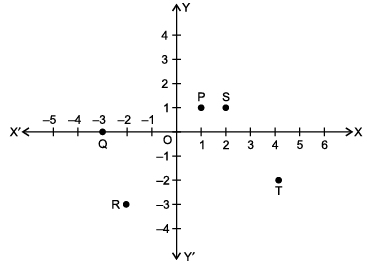 Rohan is watching them playing. Few questions came to Rohan's mind while watching the game. Give answer to his questions by looking at the figure.Q. Name the point whose y-co-ordinate is zero :
- a)P
- b)Q
- c)R
- d)S
Correct answer is option 'B'. Can you explain this answer?
Five friends playing a game in which they are standing at different positions, P, S, T, R and
Rohan is watching them playing. Few questions came to Rohan's mind while watching the game. Give answer to his questions by looking at the figure.
Q. Name the point whose y-co-ordinate is zero :
a)
P
b)
Q
c)
R
d)
S
|
|
Swati Verma answered |
As point Q lies on x-axis. Therefore, its y-coordinate is zero.
The point which lies on x-axis at a distance of 3 units in the positive direction of x-axis is- a)(-3, 0)
- b)(0, 3)
- c)(0, -3)
- d)(3, 0)
Correct answer is option 'D'. Can you explain this answer?
The point which lies on x-axis at a distance of 3 units in the positive direction of x-axis is
a)
(-3, 0)
b)
(0, 3)
c)
(0, -3)
d)
(3, 0)
|
|
Nishi Kumari answered |
Because in co-ordinates x axis comes first as (x, y)
The point (0, 9) lies- a)in quadrant IV
- b)on the positive direction of y-axis
- c)in quadrant III
- d)on the positive direction of x-axis
Correct answer is option 'B'. Can you explain this answer?
The point (0, 9) lies
a)
in quadrant IV
b)
on the positive direction of y-axis
c)
in quadrant III
d)
on the positive direction of x-axis

|
Ridhi Kapoor answered |
**Explanation:**
The point (0, 9) lies on the positive direction of the y-axis. Let's break down the options and analyze them one by one to understand why the correct answer is option 'B'.
a) In quadrant IV:
Quadrant IV is the bottom right quadrant on the coordinate plane. In this quadrant, both the x and y coordinates are positive. However, since the x-coordinate of the given point is 0, it does not lie in quadrant IV.
b) On the positive direction of y-axis:
The positive direction of the y-axis is the upward direction. Since the y-coordinate of the given point is 9, which is positive, it lies on the positive direction of the y-axis. Therefore, option 'B' is correct.
c) In quadrant III:
Quadrant III is the bottom left quadrant on the coordinate plane. In this quadrant, the x-coordinate is negative, but the y-coordinate is positive. Since the x-coordinate of the given point is 0, it does not lie in quadrant III.
d) On the positive direction of x-axis:
The positive direction of the x-axis is the rightward direction. However, since the x-coordinate of the given point is 0, it does not lie on the positive direction of the x-axis.
Therefore, the correct answer is option 'B' because the point (0, 9) lies on the positive direction of the y-axis.
The point (0, 9) lies on the positive direction of the y-axis. Let's break down the options and analyze them one by one to understand why the correct answer is option 'B'.
a) In quadrant IV:
Quadrant IV is the bottom right quadrant on the coordinate plane. In this quadrant, both the x and y coordinates are positive. However, since the x-coordinate of the given point is 0, it does not lie in quadrant IV.
b) On the positive direction of y-axis:
The positive direction of the y-axis is the upward direction. Since the y-coordinate of the given point is 9, which is positive, it lies on the positive direction of the y-axis. Therefore, option 'B' is correct.
c) In quadrant III:
Quadrant III is the bottom left quadrant on the coordinate plane. In this quadrant, the x-coordinate is negative, but the y-coordinate is positive. Since the x-coordinate of the given point is 0, it does not lie in quadrant III.
d) On the positive direction of x-axis:
The positive direction of the x-axis is the rightward direction. However, since the x-coordinate of the given point is 0, it does not lie on the positive direction of the x-axis.
Therefore, the correct answer is option 'B' because the point (0, 9) lies on the positive direction of the y-axis.
The point which lies on x-axis at a distance of 4 units in the negative direction of x-axis is
- a)(4, 0)
- b)(-4, 0)
- c)(0, 4)
- d)(0, -4)
Correct answer is option 'B'. Can you explain this answer?
The point which lies on x-axis at a distance of 4 units in the negative direction of x-axis is
a)
(4, 0)
b)
(-4, 0)
c)
(0, 4)
d)
(0, -4)
|
|
Zachary Foster answered |
To understand this, let's break down the information given:
- x-axis: The x-axis is the horizontal line in the coordinate plane. Any point on the x-axis will have a y-coordinate of 0 because it does not move up or down from the axis.
- Distance of 4 units in the negative direction of x-axis:
- The x-axis has a positive direction (towards the right) and a negative direction (towards the left).
- Moving 4 units in the negative direction means moving 4 units to the left from the origin (0,0).
- Coordinates:
- When you move 4 units to the left on the x-axis, the x-coordinate becomes -4, and since the point is on the x-axis, the y-coordinate remains 0.
Therefore, the point that lies on the x-axis 4 units in the negative direction is (−4,0)(-4, 0)(−4,0).
This corresponds to option (b) (-4, 0).
The point (7, 0) lies
- a)in quadrant IV
- b)on the positive direction of y-axis
- c)in quadrant II
- d)on the positive direction of x-axis
Correct answer is option 'D'. Can you explain this answer?
The point (7, 0) lies
a)
in quadrant IV
b)
on the positive direction of y-axis
c)
in quadrant II
d)
on the positive direction of x-axis
|
|
Harini Shah answered |
As it is clear that (7,0) lies in the 1st quadrant it is understood that the positive direction of x-axis is the 1st quadrant. Hence, the answer
A point both of whose co-ordinates are negative lies in- a)quadrant II and IV
- b)quadrant I and III
- c)quadrant III only
- d)quadrant I only
Correct answer is option 'C'. Can you explain this answer?
A point both of whose co-ordinates are negative lies in
a)
quadrant II and IV
b)
quadrant I and III
c)
quadrant III only
d)
quadrant I only
|
|
Anya answered |
It is because the quadrant 3 has both of the x and y as negative numbers
DIRECTION : In the following questions, a statement of assertion (A) is followed by a statement of reason (R). Mark the correct choice as:Assertion : If the ordinate of a point is equal to its abscissa, then the point lies either in the first quadrant or in the second quadrant.Reason : A point both of whose coordinates are negative will lie in third quadrants.- a)Both assertion (A) and reason (R) are true and reason (R) is the correct explanation of assertion (A).
- b)Both assertion (A) and reason (R) are true but reason (R) is not the correct explanation of assertion (A).
- c)Assertion (A) is true but reason (R) is false.
- d)Assertion (A) is false but reason (R) is true.
Correct answer is option 'D'. Can you explain this answer?
DIRECTION : In the following questions, a statement of assertion (A) is followed by a statement of reason (R). Mark the correct choice as:
Assertion : If the ordinate of a point is equal to its abscissa, then the point lies either in the first quadrant or in the second quadrant.
Reason : A point both of whose coordinates are negative will lie in third quadrants.
a)
Both assertion (A) and reason (R) are true and reason (R) is the correct explanation of assertion (A).
b)
Both assertion (A) and reason (R) are true but reason (R) is not the correct explanation of assertion (A).
c)
Assertion (A) is true but reason (R) is false.
d)
Assertion (A) is false but reason (R) is true.
|
|
Roma Patel answered |
Assertion and Reasoning:
Assertion: If the ordinate of a point is equal to its abscissa, then the point lies either in the first quadrant or in the second quadrant.
Reason: A point both of whose coordinates are negative will lie in the third quadrant.
Explanation:
To understand the given assertion and reasoning, let's first understand the concepts of ordinate and abscissa.
- An ordinate is the y-coordinate of a point on a coordinate plane.
- An abscissa is the x-coordinate of a point on a coordinate plane.
Understanding the Assertion:
The assertion states that if the ordinate of a point is equal to its abscissa, then the point lies either in the first quadrant or in the second quadrant.
Understanding the Reason:
The reason states that a point with both negative coordinates will lie in the third quadrant.
Explanation of the Assertion:
Let's consider a point (x, y) on a coordinate plane. If the ordinate (y-coordinate) is equal to the abscissa (x-coordinate), it means y = x.
- If we substitute y = x in the coordinate point (x, y), we get (x, x).
- This implies that both the x-coordinate and y-coordinate of the point are equal.
- Since the point lies on a coordinate plane, it means that the x and y values are positive.
- Therefore, the point will lie either in the first quadrant or in the second quadrant, where both x and y are positive.
Explanation of the Reason:
The reason states that a point with both negative coordinates will lie in the third quadrant.
- In the coordinate plane, the third quadrant is characterized by negative x-coordinates and negative y-coordinates.
- If a point has negative x and y values, it means that both coordinates are negative.
- Therefore, the point will lie in the third quadrant.
Conclusion:
From the above explanation, we can conclude that both the assertion and reason are true, but the reason does not provide a correct explanation for the assertion.
Assertion: If the ordinate of a point is equal to its abscissa, then the point lies either in the first quadrant or in the second quadrant.
Reason: A point both of whose coordinates are negative will lie in the third quadrant.
Explanation:
To understand the given assertion and reasoning, let's first understand the concepts of ordinate and abscissa.
- An ordinate is the y-coordinate of a point on a coordinate plane.
- An abscissa is the x-coordinate of a point on a coordinate plane.
Understanding the Assertion:
The assertion states that if the ordinate of a point is equal to its abscissa, then the point lies either in the first quadrant or in the second quadrant.
Understanding the Reason:
The reason states that a point with both negative coordinates will lie in the third quadrant.
Explanation of the Assertion:
Let's consider a point (x, y) on a coordinate plane. If the ordinate (y-coordinate) is equal to the abscissa (x-coordinate), it means y = x.
- If we substitute y = x in the coordinate point (x, y), we get (x, x).
- This implies that both the x-coordinate and y-coordinate of the point are equal.
- Since the point lies on a coordinate plane, it means that the x and y values are positive.
- Therefore, the point will lie either in the first quadrant or in the second quadrant, where both x and y are positive.
Explanation of the Reason:
The reason states that a point with both negative coordinates will lie in the third quadrant.
- In the coordinate plane, the third quadrant is characterized by negative x-coordinates and negative y-coordinates.
- If a point has negative x and y values, it means that both coordinates are negative.
- Therefore, the point will lie in the third quadrant.
Conclusion:
From the above explanation, we can conclude that both the assertion and reason are true, but the reason does not provide a correct explanation for the assertion.
DIRECTION : In the following questions, a statement of assertion (A) is followed by a statement of reason (R). Mark the correct choice as:Assertion : The points (-1, 2) and (2,- 1) are at different positions in the coordinate plane.Reason : Point (-1, 2) lies in II-quadrant and (2,- 1) lies in IV quadrant- a)Both assertion (A) and reason (R) are true and reason (R) is the correct explanation of assertion (A).
- b)Both assertion (A) and reason (R) are true but reason (R) is not the correct explanation of assertion (A).
- c)Assertion (A) is true but reason (R) is false.
- d)Assertion (A) is false but reason (R) is true.
Correct answer is option 'A'. Can you explain this answer?
DIRECTION : In the following questions, a statement of assertion (A) is followed by a statement of reason (R). Mark the correct choice as:
Assertion : The points (-1, 2) and (2,- 1) are at different positions in the coordinate plane.
Reason : Point (-1, 2) lies in II-quadrant and (2,- 1) lies in IV quadrant
a)
Both assertion (A) and reason (R) are true and reason (R) is the correct explanation of assertion (A).
b)
Both assertion (A) and reason (R) are true but reason (R) is not the correct explanation of assertion (A).
c)
Assertion (A) is true but reason (R) is false.
d)
Assertion (A) is false but reason (R) is true.

|
Ishan Choudhury answered |
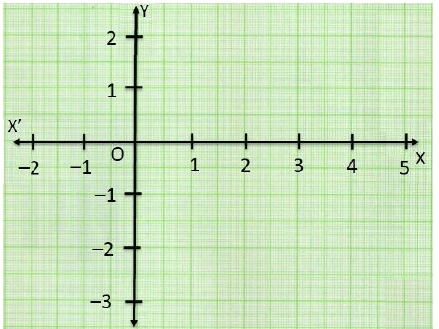
We know that Point (-1, 2) lies in II-quadrant and (2,- 1) lies in IV quadrant So, Reason is correct.
Hence the points (-1, 2) and (2,- 1) are at different positions in the coordinate plane. So, Assertion is also correct Correct option is (a) Both assertion (A) and reason (R) are true and reason (R) is the correct explanation of assertion (A).
DIRECTION : In the following questions, a statement of assertion (A) is followed by a statement of reason (R). Mark the correct choice as:Assertion : The point (-2, 0) lies on y -axis and (0, 4) on x -axis.Reason : Every point on the x -axis has zero distance from x -axis and every point on the y -axis has zero distance from y -axis.- a)Both assertion (A) and reason (R) are true and reason (R) is the correct explanation of assertion (A).
- b)Both assertion (A) and reason (R) are true but reason (R) is not the correct explanation of assertion (A).
- c)Assertion (A) is true but reason (R) is false.
- d)Assertion (A) is false but reason (R) is true.
Correct answer is option 'D'. Can you explain this answer?
DIRECTION : In the following questions, a statement of assertion (A) is followed by a statement of reason (R). Mark the correct choice as:
Assertion : The point (-2, 0) lies on y -axis and (0, 4) on x -axis.
Reason : Every point on the x -axis has zero distance from x -axis and every point on the y -axis has zero distance from y -axis.
a)
Both assertion (A) and reason (R) are true and reason (R) is the correct explanation of assertion (A).
b)
Both assertion (A) and reason (R) are true but reason (R) is not the correct explanation of assertion (A).
c)
Assertion (A) is true but reason (R) is false.
d)
Assertion (A) is false but reason (R) is true.

|
Avinash Patel answered |
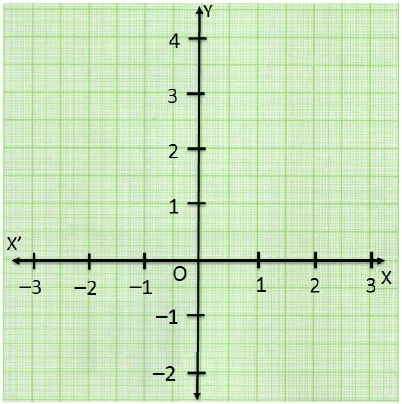
We know that Every point on the x -axis has zero distance from x -axis and every point on the y -axis has zero distance from y -axis. So, Reason is correct.
Now, point (-2, 0) lies on x-axis and (0, 4) on y-axis So, Assertion is not correct Correct option is (d) Assertion (A) is false but reason (R) is true.
Five friends playing a game in which they are standing at different positions, P, S, T, R and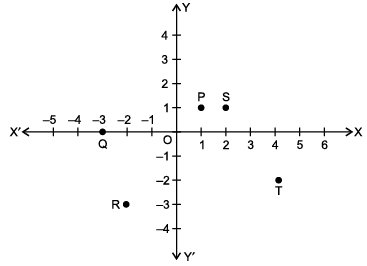 Rohan is watching them playing. Few questions came to Rohan's mind while watching the game. Give answer to his questions by looking at the figure.Q. (x, y) = (y, x), if :
- a)x > y
- b)x < />
- c)

- d)

Correct answer is option 'C'. Can you explain this answer?
Five friends playing a game in which they are standing at different positions, P, S, T, R and
Rohan is watching them playing. Few questions came to Rohan's mind while watching the game. Give answer to his questions by looking at the figure.
Q. (x, y) = (y, x), if :
a)
x > y
b)
x < />
c)
d)
|
|
Anita Menon answered |

Since, 
⇒ x = y
Also, (x, y) = (y, x), if x = y
DIRECTION : In the following questions, a statement of assertion (A) is followed by a statement of reason (R). Mark the correct choice as:Assertion: The perpendicular distance of the point A(3, 4) from the y-axis is 4Reason: The perpendicular distance of a point from y-axis is called its x-coordinate.- a)Both assertion (A) and reason (R) are true and reason (R) is the correct explanation of assertion (A).
- b)Both assertion (A) and reason (R) are true but reason (R) is not the correct explanation of assertion (A).
- c)Assertion (A) is true but reason (R) is false.
- d)Assertion (A) is false but reason (R) is true.
Correct answer is option 'D'. Can you explain this answer?
DIRECTION : In the following questions, a statement of assertion (A) is followed by a statement of reason (R). Mark the correct choice as:
Assertion: The perpendicular distance of the point A(3, 4) from the y-axis is 4
Reason: The perpendicular distance of a point from y-axis is called its x-coordinate.
a)
Both assertion (A) and reason (R) are true and reason (R) is the correct explanation of assertion (A).
b)
Both assertion (A) and reason (R) are true but reason (R) is not the correct explanation of assertion (A).
c)
Assertion (A) is true but reason (R) is false.
d)
Assertion (A) is false but reason (R) is true.
|
|
Radha Iyer answered |
We know that the perpendicular distance of a point from y-axis is called its x-coordinate or abscissa.
So, Reason is correct.
The x co-ordinate of the point (3, 4) is 3.
So, Assertion is not correct Correct option is (d) Assertion (A) is false but reason (R) is true.
The point C(-5, -2) lies in- a)III Quadrant
- b)IV Quadrant
- c)I Quadrant
- d)II Quadrant
Correct answer is option 'A'. Can you explain this answer?
The point C(-5, -2) lies in
a)
III Quadrant
b)
IV Quadrant
c)
I Quadrant
d)
II Quadrant

|
D Vanshika answered |
The coordinate plane is divided into four quadrants by the x and y axes. Each quadrant is named with a capital Q and a roman numeral, starting in the upper right quadrant as QI and rotating counter-clockwise.
Points in the coordinate plane are located based on their distance from the x and y axes. The sign of the coordinates tells you which quadrant a point lies in:
* Quadrant I (QI): both x and y coordinates are positive (+)
* Quadrant II (QII): x coordinate is negative (-) and y coordinate is positive (+)
* Quadrant III (QIII): both x and y coordinates are negative (-)
* Quadrant IV (QIV): x coordinate is positive (+) and y coordinate is negative (-)
The point C (-5, -2) has a negative x-coordinate and a negative y-coordinate. Therefore, it lies in Quadrant III.
Points in the coordinate plane are located based on their distance from the x and y axes. The sign of the coordinates tells you which quadrant a point lies in:
* Quadrant I (QI): both x and y coordinates are positive (+)
* Quadrant II (QII): x coordinate is negative (-) and y coordinate is positive (+)
* Quadrant III (QIII): both x and y coordinates are negative (-)
* Quadrant IV (QIV): x coordinate is positive (+) and y coordinate is negative (-)
The point C (-5, -2) has a negative x-coordinate and a negative y-coordinate. Therefore, it lies in Quadrant III.
Abscissa of a point is negative in- a)quadrant IV only
- b)quadrant II and III
- c)quadrant I only
- d)quadrant I and IV
Correct answer is option 'B'. Can you explain this answer?
Abscissa of a point is negative in
a)
quadrant IV only
b)
quadrant II and III
c)
quadrant I only
d)
quadrant I and IV

|
Divey Sethi answered |
The abscissa (x-coordinate) is negative in Quadrants II and III because:- In Quadrant II, the x-values are negative while y-values are positive.- In Quadrant III, both x and y values are negative. Therefore, option B is correct as it includes both quadrants where the abscissa is negative.
DIRECTION : In the following questions, a statement of assertion (A) is followed by a statement of reason (R). Mark the correct choice as:Assertion: A point whose abscissa is -3 and ordinate is 2 lies in second quadrantReason: Points of the type (–, +) lie in the second quadrant.- a)Both assertion (A) and reason (R) are true and reason (R) is the correct explanation of assertion (A).
- b)Both assertion (A) and reason (R) are true but reason (R) is not the correct explanation of assertion (A).
- c)Assertion (A) is true but reason (R) is false.
- d)Assertion (A) is false but reason (R) is true.
Correct answer is option 'A'. Can you explain this answer?
DIRECTION : In the following questions, a statement of assertion (A) is followed by a statement of reason (R). Mark the correct choice as:
Assertion: A point whose abscissa is -3 and ordinate is 2 lies in second quadrant
Reason: Points of the type (–, +) lie in the second quadrant.
a)
Both assertion (A) and reason (R) are true and reason (R) is the correct explanation of assertion (A).
b)
Both assertion (A) and reason (R) are true but reason (R) is not the correct explanation of assertion (A).
c)
Assertion (A) is true but reason (R) is false.
d)
Assertion (A) is false but reason (R) is true.
|
|
Vedika Kapoor answered |
Understanding the Assertion and Reason
In this question, we are analyzing two statements: Assertion (A) and Reason (R).
Assertion (A): A point whose abscissa is -3 and ordinate is 2 lies in the second quadrant.
Reason (R): Points of the type (–, +) lie in the second quadrant.
Analysis of the Assertion (A)
- The abscissa (x-coordinate) is -3, which is negative.
- The ordinate (y-coordinate) is 2, which is positive.
- In the Cartesian coordinate system, the second quadrant is characterized by negative x-values and positive y-values.
- Therefore, the point (-3, 2) indeed lies in the second quadrant, making Assertion (A) true.
Analysis of the Reason (R)
- Reason (R) states that points of the type (–, +) lie in the second quadrant.
- This is consistent with the definition of the second quadrant, where x-values are negative and y-values are positive.
- Thus, Reason (R) is also true.
Relationship Between Assertion and Reason
- Since both Assertion (A) and Reason (R) are true, and Reason (R) correctly explains why Assertion (A) holds true, we can conclude:
- Both statements are true.
- Reason (R) is the correct explanation of Assertion (A).
Conclusion
- The correct choice is option 'A': Both assertion (A) and reason (R) are true and reason (R) is the correct explanation of assertion (A).
In this question, we are analyzing two statements: Assertion (A) and Reason (R).
Assertion (A): A point whose abscissa is -3 and ordinate is 2 lies in the second quadrant.
Reason (R): Points of the type (–, +) lie in the second quadrant.
Analysis of the Assertion (A)
- The abscissa (x-coordinate) is -3, which is negative.
- The ordinate (y-coordinate) is 2, which is positive.
- In the Cartesian coordinate system, the second quadrant is characterized by negative x-values and positive y-values.
- Therefore, the point (-3, 2) indeed lies in the second quadrant, making Assertion (A) true.
Analysis of the Reason (R)
- Reason (R) states that points of the type (–, +) lie in the second quadrant.
- This is consistent with the definition of the second quadrant, where x-values are negative and y-values are positive.
- Thus, Reason (R) is also true.
Relationship Between Assertion and Reason
- Since both Assertion (A) and Reason (R) are true, and Reason (R) correctly explains why Assertion (A) holds true, we can conclude:
- Both statements are true.
- Reason (R) is the correct explanation of Assertion (A).
Conclusion
- The correct choice is option 'A': Both assertion (A) and reason (R) are true and reason (R) is the correct explanation of assertion (A).
The distance of a point (-5, 6) from the y- axis is
- a)6 units
- b)5 units
- c)1 unit
- d)-5 units
Correct answer is option 'B'. Can you explain this answer?
The distance of a point (-5, 6) from the y- axis is
a)
6 units
b)
5 units
c)
1 unit
d)
-5 units
|
|
Simran Yadav answered |
the distance of the point (-5, 6) from y- axis is |-5| units.
In general, the distance of the point (x,y) from x-axis is y and from y-axis is x.
DIRECTION : In the following questions, a statement of assertion (A) is followed by a statement of reason (R). Mark the correct choice as:Assertion: Point (4, -2) lies in IV quadrant.Reason: The perpendicular distance of a point from the y-axis is called its abscissa.- a)Both assertion (A) and reason (R) are true and reason (R) is the correct explanation of assertion (A).
- b)Both assertion (A) and reason (R) are true but reason (R) is not the correct explanation of assertion (A).
- c)Assertion (A) is true but reason (R) is false.
- d)Assertion (A) is false but reason (R) is true.
Correct answer is option 'B'. Can you explain this answer?
DIRECTION : In the following questions, a statement of assertion (A) is followed by a statement of reason (R). Mark the correct choice as:
Assertion: Point (4, -2) lies in IV quadrant.
Reason: The perpendicular distance of a point from the y-axis is called its abscissa.
a)
Both assertion (A) and reason (R) are true and reason (R) is the correct explanation of assertion (A).
b)
Both assertion (A) and reason (R) are true but reason (R) is not the correct explanation of assertion (A).
c)
Assertion (A) is true but reason (R) is false.
d)
Assertion (A) is false but reason (R) is true.
|
|
Ishan Choudhury answered |
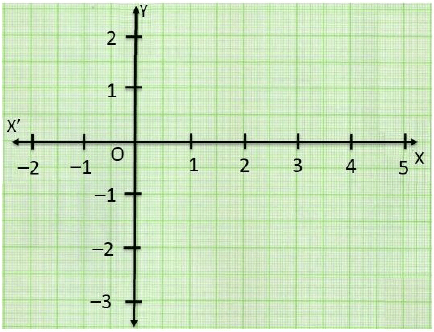
We know that the perpendicular distance of a point from y-axis is called its x-coordinate or abscissa.
So, Reason is correct.
Point (4, -2) lies in IV quadrant.
So, Assertion is also correct but Reason is not the correct explanation of Assertion. Correct option is (b) Both assertion (A) and reason (R) are true and reason (R) is not the correct explanation of assertion (A).
DIRECTION : In the following questions, a statement of assertion (A) is followed by a statement of reason (R). Mark the correct choice as:Assertion: Point A(-2, -4) lies on III quadrantReason: A point both of whose coordinates are negative lies in III quadrant- a)Both assertion (A) and reason (R) are true and reason (R) is the correct explanation of assertion (A).
- b)Both assertion (A) and reason (R) are true but reason (R) is not the correct explanation of assertion (A).
- c)Assertion (A) is true but reason (R) is false.
- d)Assertion (A) is false but reason (R) is true.
Correct answer is option 'A'. Can you explain this answer?
DIRECTION : In the following questions, a statement of assertion (A) is followed by a statement of reason (R). Mark the correct choice as:
Assertion: Point A(-2, -4) lies on III quadrant
Reason: A point both of whose coordinates are negative lies in III quadrant
a)
Both assertion (A) and reason (R) are true and reason (R) is the correct explanation of assertion (A).
b)
Both assertion (A) and reason (R) are true but reason (R) is not the correct explanation of assertion (A).
c)
Assertion (A) is true but reason (R) is false.
d)
Assertion (A) is false but reason (R) is true.
|
|
Anita Menon answered |
We know that a point both of whose coordinates are negative lies in III quadrant
So, Reason is correct.
Hence, Point A(-2, -4) lies on III quadrant So, Assertion is also correct and Reason explains Assertion
Correct option is (a) Both assertion (A) and reason (R) are true and reason (R) is the correct explanation of assertion (A).
DIRECTION : In the following questions, a statement of assertion (A) is followed by a statement of reason (R). Mark the correct choice as:Assertion: The abscissa of a point (5, 2) is 5.Reason: The perpendicular distance of a point from y-axis is called its abscissa.- a)Both assertion (A) and reason (R) are true and reason (R) is the correct explanation of assertion (A).
- b)Both assertion (A) and reason (R) are true but reason (R) is not the correct explanation of assertion (A).
- c)Assertion (A) is true but reason (R) is false.
- d)Assertion (A) is false but reason (R) is true.
Correct answer is option 'A'. Can you explain this answer?
DIRECTION : In the following questions, a statement of assertion (A) is followed by a statement of reason (R). Mark the correct choice as:
Assertion: The abscissa of a point (5, 2) is 5.
Reason: The perpendicular distance of a point from y-axis is called its abscissa.
a)
Both assertion (A) and reason (R) are true and reason (R) is the correct explanation of assertion (A).
b)
Both assertion (A) and reason (R) are true but reason (R) is not the correct explanation of assertion (A).
c)
Assertion (A) is true but reason (R) is false.
d)
Assertion (A) is false but reason (R) is true.
|
|
Radha Iyer answered |
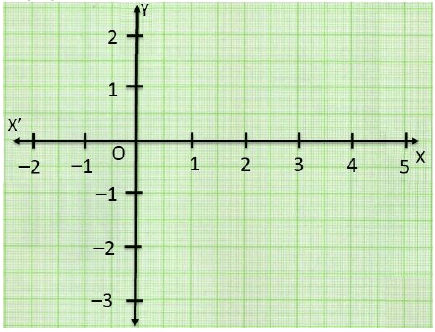
We know that the perpendicular distance of a point from y-axis is called its x-coordinate or abscissa.
So, Reason is correct.
The x co-ordinate of the point (5, 2) is 5.
So, Assertion is also correct
Correct option is (a) Both assertion (A) and reason (R) are true and reason (R) is the correct explanation of assertion (A).
Abscissa of all points on the x-axis is- a)-1
- b)0
- c)any number
- d)1
Correct answer is option 'C'. Can you explain this answer?
Abscissa of all points on the x-axis is
a)
-1
b)
0
c)
any number
d)
1
|
|
Ridhima Gupta answered |
Understanding the X-Axis
The x-axis is a fundamental concept in coordinate geometry, serving as a horizontal line in a two-dimensional plane.
Definition of Abscissa
- The abscissa refers to the x-coordinate of a point in a Cartesian coordinate system.
- It indicates the horizontal position of a point.
Points on the X-Axis
- Any point on the x-axis has a y-coordinate of 0.
- Therefore, the coordinates of points on the x-axis can be expressed as (x, 0), where 'x' can be any real number.
Why the Correct Answer is C: Any Number
- Since the abscissa is defined as the x-coordinate, any point on the x-axis can have any value for 'x'.
- For example:
- The point (3, 0) has an abscissa of 3.
- The point (-5, 0) has an abscissa of -5.
- The point (0, 0) has an abscissa of 0.
- This flexibility means that the abscissa of points on the x-axis is not restricted to specific numbers like -1, 0, or 1.
Conclusion
In conclusion, the abscissa of all points on the x-axis is indeed "any number," confirming that option 'C' is correct. Understanding this concept is essential for further studies in mathematics and coordinate geometry.
The x-axis is a fundamental concept in coordinate geometry, serving as a horizontal line in a two-dimensional plane.
Definition of Abscissa
- The abscissa refers to the x-coordinate of a point in a Cartesian coordinate system.
- It indicates the horizontal position of a point.
Points on the X-Axis
- Any point on the x-axis has a y-coordinate of 0.
- Therefore, the coordinates of points on the x-axis can be expressed as (x, 0), where 'x' can be any real number.
Why the Correct Answer is C: Any Number
- Since the abscissa is defined as the x-coordinate, any point on the x-axis can have any value for 'x'.
- For example:
- The point (3, 0) has an abscissa of 3.
- The point (-5, 0) has an abscissa of -5.
- The point (0, 0) has an abscissa of 0.
- This flexibility means that the abscissa of points on the x-axis is not restricted to specific numbers like -1, 0, or 1.
Conclusion
In conclusion, the abscissa of all points on the x-axis is indeed "any number," confirming that option 'C' is correct. Understanding this concept is essential for further studies in mathematics and coordinate geometry.
The perpendicular distance of a point Q(4, 7) from y-axis is- a)4 units
- b)7 units
- c)11 units
- d)3 units
Correct answer is option 'A'. Can you explain this answer?
The perpendicular distance of a point Q(4, 7) from y-axis is
a)
4 units
b)
7 units
c)
11 units
d)
3 units

|
Arka Dey answered |
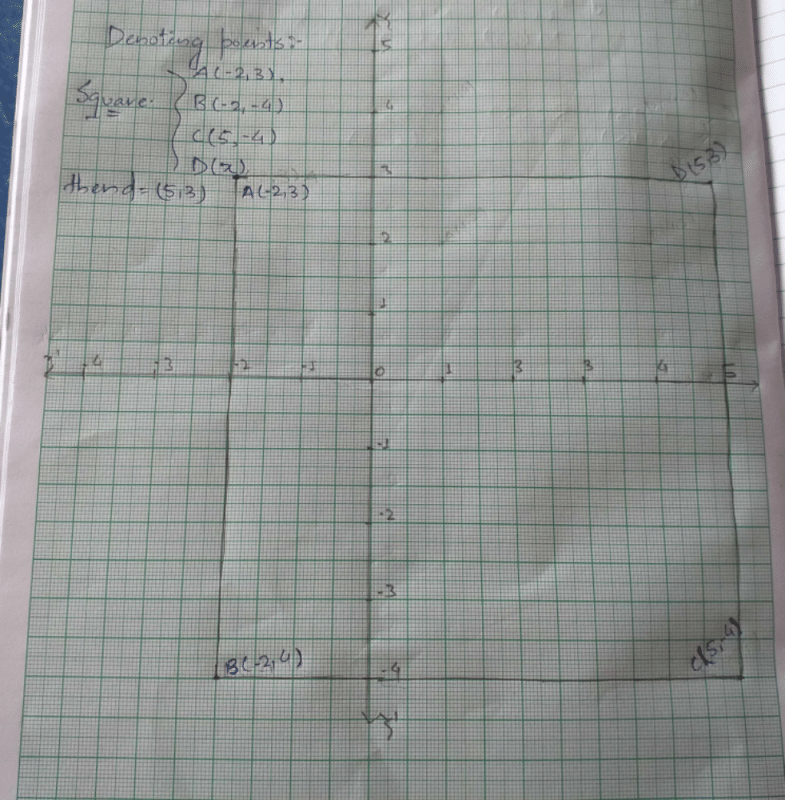
(i) In the first quadrant, the coordinates of the required point will be (5,4).
(ii) In the second quadrant, the coordinates of the required point will be (-5,4).
(iii) In the third quadrant, the coordinates of the required point will be (-5,-4).
(iv) In the fourth quadrant, the coordinates of the required point will be (5,-4)
Chapter doubts & questions for Coordinate Geometry - Advance Learner Course: Mathematics (Maths) Class 8 2026 is part of Class 8 exam preparation. The chapters have been prepared according to the Class 8 exam syllabus. The Chapter doubts & questions, notes, tests & MCQs are made for Class 8 2026 Exam. Find important definitions, questions, notes, meanings, examples, exercises, MCQs and online tests here.
Chapter doubts & questions of Coordinate Geometry - Advance Learner Course: Mathematics (Maths) Class 8 in English & Hindi are available as part of Class 8 exam.
Download more important topics, notes, lectures and mock test series for Class 8 Exam by signing up for free.
Advance Learner Course: Mathematics (Maths) Class 8
5 videos|58 docs|20 tests
|
