


NEET Exam > NEET Questions > Two particles of equal charges after being ac... Start Learning for Free
Two particles of equal charges after being accelerated through the same potential difference enter in a uniform transverse magnetic field and describe circular paths of radii R1 and R2. Then the ratio of their respective masses (M1/M2) is
- a)R1/R2
- b)(R1/R2)2
- c)R2/R1
- d)(R2/R1)2
Correct answer is option 'B'. Can you explain this answer?

Verified Answer
Two particles of equal charges after being accelerated through the sam...
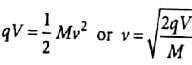
And Bqv = Mv2/R Or
 Using (i)
or
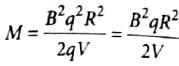
∴ M ∝ R2 (∵ B, q and V are same for the given two particles)
Hence (M1/M2) = (R1/R2)2
Most Upvoted Answer
Two particles of equal charges after being accelerated through the sam...
Explanation:
Given:
- Two particles of equal charges
- Accelerated through the same potential difference
- Enter in a uniform transverse magnetic field
- Describe circular paths of radii R1 and R2
To find:
- The ratio of their respective masses (M1/M2)
Formula:
The centripetal force for a charged particle moving in a magnetic field is given by the formula:
F = qvB
The centripetal force is also given by the formula:
F = mv²/R
Where:
- F is the centripetal force
- q is the charge of the particle
- v is the velocity of the particle
- B is the magnetic field
- m is the mass of the particle
- R is the radius of the circular path
Derivation:
- Since the particles have the same charge and are accelerated through the same potential difference, the magnitude of their velocities (v1 and v2) will be the same.
- Therefore, the centripetal forces for both particles will be the same.
- Equating the two formulas for centripetal force:
qv1B = mv1²/R1
qv2B = mv2²/R2
- Dividing the second equation by the first equation:
(v2/v1) = (m2/m1) * (R1/R2)
- Since (v2/v1) = 1 (as the velocities are the same), the equation simplifies to:
1 = (m2/m1) * (R1/R2)
- Rearranging the equation:
(m2/m1) = (R1/R2)²
Therefore, the ratio of their respective masses is equal to the square of the ratio of their radii. Hence, the correct answer is option 'B' (R1/R2)^2.
Given:
- Two particles of equal charges
- Accelerated through the same potential difference
- Enter in a uniform transverse magnetic field
- Describe circular paths of radii R1 and R2
To find:
- The ratio of their respective masses (M1/M2)
Formula:
The centripetal force for a charged particle moving in a magnetic field is given by the formula:
F = qvB
The centripetal force is also given by the formula:
F = mv²/R
Where:
- F is the centripetal force
- q is the charge of the particle
- v is the velocity of the particle
- B is the magnetic field
- m is the mass of the particle
- R is the radius of the circular path
Derivation:
- Since the particles have the same charge and are accelerated through the same potential difference, the magnitude of their velocities (v1 and v2) will be the same.
- Therefore, the centripetal forces for both particles will be the same.
- Equating the two formulas for centripetal force:
qv1B = mv1²/R1
qv2B = mv2²/R2
- Dividing the second equation by the first equation:
(v2/v1) = (m2/m1) * (R1/R2)
- Since (v2/v1) = 1 (as the velocities are the same), the equation simplifies to:
1 = (m2/m1) * (R1/R2)
- Rearranging the equation:
(m2/m1) = (R1/R2)²
Therefore, the ratio of their respective masses is equal to the square of the ratio of their radii. Hence, the correct answer is option 'B' (R1/R2)^2.
 | Explore Courses for NEET exam |  |
Top Courses for NEETView all





Top Courses for NEET
Question Description
Two particles of equal charges after being accelerated through the same potential difference enter in a uniform transverse magnetic field and describe circular paths of radii R1and R2. Then the ratio of their respective masses (M1/M2) isa)R1/R2b)(R1/R2)2c)R2/R1d)(R2/R1)2Correct answer is option 'B'. Can you explain this answer? for NEET 2026 is part of NEET preparation. The Question and answers have been prepared according to the NEET exam syllabus. Information about Two particles of equal charges after being accelerated through the same potential difference enter in a uniform transverse magnetic field and describe circular paths of radii R1and R2. Then the ratio of their respective masses (M1/M2) isa)R1/R2b)(R1/R2)2c)R2/R1d)(R2/R1)2Correct answer is option 'B'. Can you explain this answer? covers all topics & solutions for NEET 2026 Exam. Find important definitions, questions, meanings, examples, exercises and tests below for Two particles of equal charges after being accelerated through the same potential difference enter in a uniform transverse magnetic field and describe circular paths of radii R1and R2. Then the ratio of their respective masses (M1/M2) isa)R1/R2b)(R1/R2)2c)R2/R1d)(R2/R1)2Correct answer is option 'B'. Can you explain this answer?.
Two particles of equal charges after being accelerated through the same potential difference enter in a uniform transverse magnetic field and describe circular paths of radii R1and R2. Then the ratio of their respective masses (M1/M2) isa)R1/R2b)(R1/R2)2c)R2/R1d)(R2/R1)2Correct answer is option 'B'. Can you explain this answer? for NEET 2026 is part of NEET preparation. The Question and answers have been prepared according to the NEET exam syllabus. Information about Two particles of equal charges after being accelerated through the same potential difference enter in a uniform transverse magnetic field and describe circular paths of radii R1and R2. Then the ratio of their respective masses (M1/M2) isa)R1/R2b)(R1/R2)2c)R2/R1d)(R2/R1)2Correct answer is option 'B'. Can you explain this answer? covers all topics & solutions for NEET 2026 Exam. Find important definitions, questions, meanings, examples, exercises and tests below for Two particles of equal charges after being accelerated through the same potential difference enter in a uniform transverse magnetic field and describe circular paths of radii R1and R2. Then the ratio of their respective masses (M1/M2) isa)R1/R2b)(R1/R2)2c)R2/R1d)(R2/R1)2Correct answer is option 'B'. Can you explain this answer?.
Solutions for Two particles of equal charges after being accelerated through the same potential difference enter in a uniform transverse magnetic field and describe circular paths of radii R1and R2. Then the ratio of their respective masses (M1/M2) isa)R1/R2b)(R1/R2)2c)R2/R1d)(R2/R1)2Correct answer is option 'B'. Can you explain this answer? in English & in Hindi are available as part of our courses for NEET. Download more important topics, notes, lectures and mock test series for NEET Exam by signing up for free.
Here you can find the meaning of Two particles of equal charges after being accelerated through the same potential difference enter in a uniform transverse magnetic field and describe circular paths of radii R1and R2. Then the ratio of their respective masses (M1/M2) isa)R1/R2b)(R1/R2)2c)R2/R1d)(R2/R1)2Correct answer is option 'B'. Can you explain this answer? defined & explained in the simplest way possible. Besides giving the explanation of Two particles of equal charges after being accelerated through the same potential difference enter in a uniform transverse magnetic field and describe circular paths of radii R1and R2. Then the ratio of their respective masses (M1/M2) isa)R1/R2b)(R1/R2)2c)R2/R1d)(R2/R1)2Correct answer is option 'B'. Can you explain this answer?, a detailed solution for Two particles of equal charges after being accelerated through the same potential difference enter in a uniform transverse magnetic field and describe circular paths of radii R1and R2. Then the ratio of their respective masses (M1/M2) isa)R1/R2b)(R1/R2)2c)R2/R1d)(R2/R1)2Correct answer is option 'B'. Can you explain this answer? has been provided alongside types of Two particles of equal charges after being accelerated through the same potential difference enter in a uniform transverse magnetic field and describe circular paths of radii R1and R2. Then the ratio of their respective masses (M1/M2) isa)R1/R2b)(R1/R2)2c)R2/R1d)(R2/R1)2Correct answer is option 'B'. Can you explain this answer? theory, EduRev gives you an ample number of questions to practice Two particles of equal charges after being accelerated through the same potential difference enter in a uniform transverse magnetic field and describe circular paths of radii R1and R2. Then the ratio of their respective masses (M1/M2) isa)R1/R2b)(R1/R2)2c)R2/R1d)(R2/R1)2Correct answer is option 'B'. Can you explain this answer? tests, examples and also practice NEET tests.
| Explore Courses for NEET exam | |
Top Courses for NEET
Explore Courses
Signup for Free!
Signup to see your scores go up within 7 days! Learn & Practice with 1000+ FREE Notes, Videos & Tests.


