Chapter Notes: Addition


What is Addition?
Have you ever helped set the table for dinner? What if you put two plates on the table, and then add one more? How many plates do you have now?
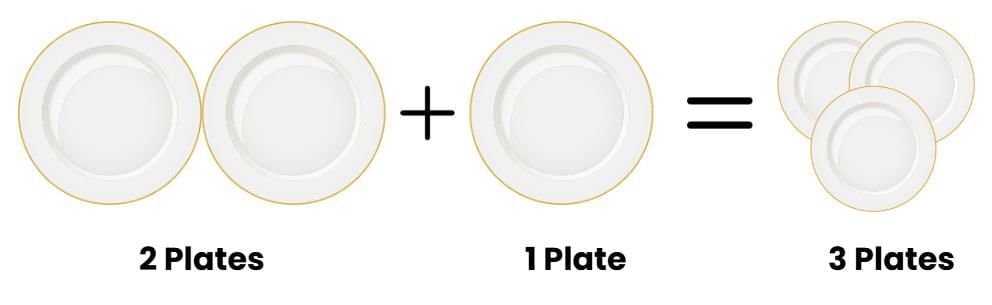 Or imagine you have four toy cars, and a friend gives you three more. What happens?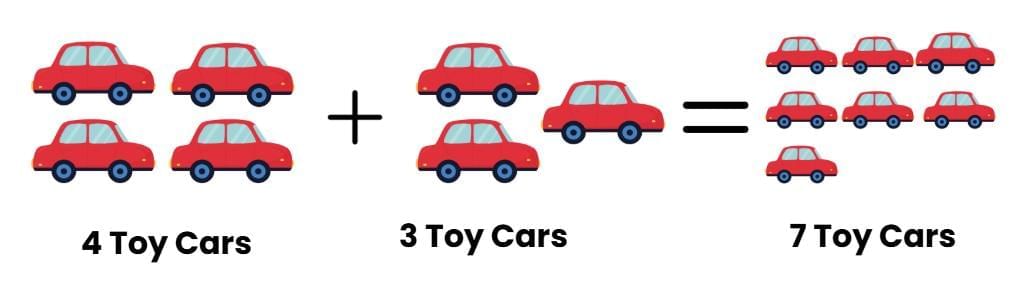
That's right! The number gets bigger when we add things together!
Addition is all about bringing things together to make a bigger number. The plus sign (+) is like a special helper that tells us to add.
Addition is fun and easy-let's learn how to do it together!
Recap to 2-Digit Addition
When adding two-digit numbers, we always start by writing the numbers in columns according to their place value - Tens and Ones.
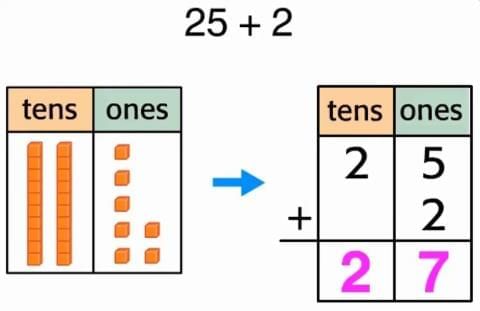 Two Digit Addition
- This helps us keep the numbers aligned correctly.
- Then, we begin with the Ones place and add the digits in that column.
- If the sum is 10 or more, we carry over the extra value to the Tens place.
- Next, we move to the Tens place and add those digits along with any carry-over. Finally, we write the total sum.
Lets understand with the help of an example:
Add 47 to 35.Step 1:
Add the ones place such that 7 + 5 = 12 (write 2, carry over 1)
Step 2:
Add the tens place such that 4 + 3 = 7
Step 3:
Add the carry over from Step 1 which will be 8 (7 + 1). The final result will on adding 47 and 35 will be 82.
Simple Addition of 3-Digit Numbers (Without Carrying)
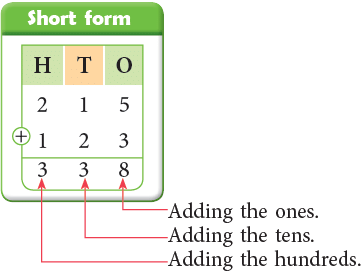
Adding 3-digit numbers is just like adding smaller numbers, but now we have three places: Ones, Tens, and Hundreds. Let's look at an example!Example: 215 students from Delhi and 123 students from Chennai participated in a dance competition. How many students in all participated in the dance competition?
You need to add 215 and 123.
Thus, 338 students in all participated in the dance competition.
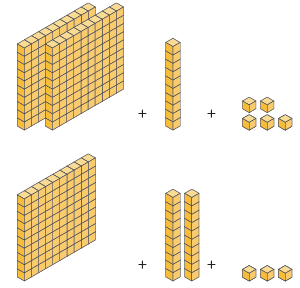
Addition of 3-digit Numbers (With Carrying)
Sometimes, when adding numbers, the sum in one column is 10 or more. That's when we carry over to the next column. Let's see how it works!
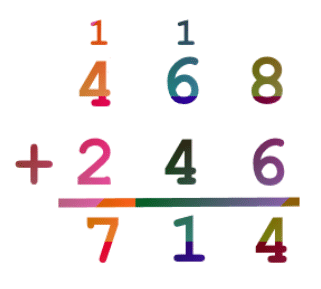
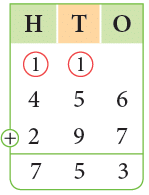
Example: Add 456 and 297.
Write the numbers in column form as shown.
Step 1: Add the ones.
6 ones + 7 ones = 13 ones = 10 ones + 3 ones
= 1 ten 3 ones.
Write 3 under the ones column and carry over 1 to the tens column.
Step 2:Add the tens.
5 tens + 9 tens + 1 ten (carried over) = 15 tens
= 10 tens + 5 tens = 1 hundred 5 tens. Write 5 under the tens column and carry over 1 to the hundreds column.
Step 3: Add the hundreds.
4 hundreds + 2 hundreds + 1 hundred (carried over) = 7 hundreds
Write 7 under the hundreds column.
Thus, 456 + 297 = 753.
Properties of Addition
Addition has several important properties that help us understand how numbers work when we put them together. Here are a few key properties:
1. The Order Property of Addition
Changing the order of addends does not change the sum. This is known as the order property of addition.
- There are 2 students jumping rope. Then, 4 students join them.
How many students are jumping rope in all?
2 + 4 =
- If 4 students are jumping rope and 2 students join them.
How many students are jumping rope in all?
4 + 2 =
2. The Grouping Property of Addition
While adding three numbers, either the first two or the last two numbers may be grouped. Grouping the addends in any manner does not change the sum. This property is called the grouping property of addition.
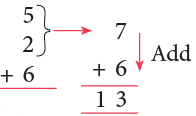
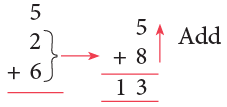
- Aman caught 5 fish, Ravi caught 2 fish and Ankur caught 6 fish. How many fish did they catch altogether?
The problem can be written as 5 + 2 + 6 = or in column form as shown below.
- You will have to find the sum of three numbers in two steps because you can add only two numbers at a time. One way to add is to begin at the top, add the first two numbers and then add their sum to the last number.
- Another way to add is to begin at the bottom, add the last two numbers, and then add their sum to the first number.
- Begin at the top
- Begin at the bottom
3. Zero Property of Addition
The sum of any number and zero is the number itself. This is known as the zero property of addition.
Try yourself: 520 + 0 = _____
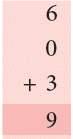
Example: Aadhya put 6 books on the top shelf. She left the middle shelf empty. She put 3 books on the bottom shelf. How many books did she have on all the shelves?
In the language of mathematics, the problem can be written as 6 + 0 + 3 =
The number 0 shows not any bookson the middle shelf. The statement can also be written in column form as shown. Notice that adding zero to a number does not change the value of the number.
Thus, there are 9 books in all on the shelf.
Addition of 4-digit Numbers (Without Carrying)
Now, let's move to bigger numbers! Adding 4-digit numbers without carrying is just like adding smaller numbers, but with more digits.
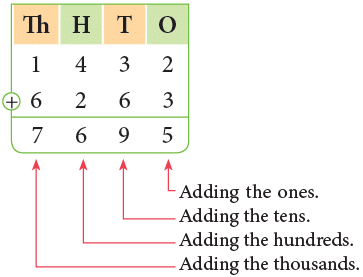
Example: Add 1432 and 6263.
Write the numbers in column form.
Step 1: Add the ones.
2 ones + 3 ones = 5 ones
Write 5 under the ones column.
Step 2: Add the tens.
3 tens + 6 tens = 9 tens
Write 9 under the tens column.
Step 3: Add the hundreds.
4 hundreds + 2 hundreds = 6 hundreds
Write 6 under the hundreds column.
Step 4: Add the thousands.
1 thousand + 6 thousands = 7 thousands
Write 7 under the thousands column.
Thus, 1432 + 6263 = 7695.
Addition of 4-digit Numbers (With Carrying)
When adding 4-digit numbers, sometimes we need to carry over. It's like moving extra to the next column - let's learn how!
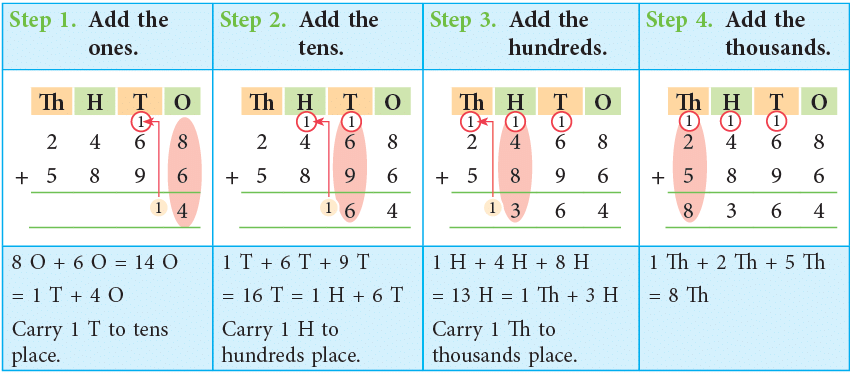
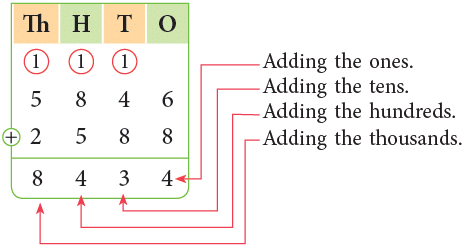
Example 1: Add 2468 and 5896.
Follow the same method as explained in the addition of 3-digit numbers. Look at the following steps.
Thus, 2468 + 5896 = 8364.
Example 2: Add 5846 and 2588.
Thus, 5846 + 2588 =8434.
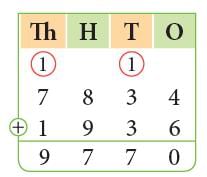
Try yourself: Adding 7834 and 1936, We will get:
How to Add More Than Two Numbers?
What if we need to add more than two numbers? Don't worry - it's just as easy! Let's add them step by step.
Example 1: The number of students visiting a zoo on the first four days of the week are as shown in the table. How many students in all visited the zoo?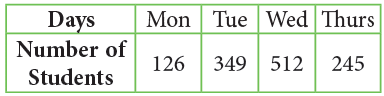
We add the number of students who visited the zoo on all four days as shown on the right.
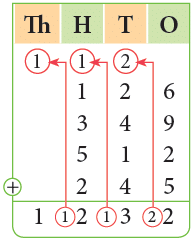
Step 1:Add all the digits at the ones place.
6 + 9 + 2 + 5 = 22 ones = 20 O + 2 O = 2 T + 2 O
Carry 2 T to tens column.
Step 2: Add all the digits at the tens place.
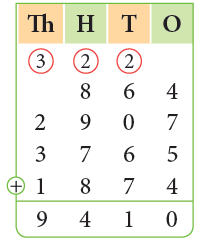
2 (carried over) + 2 + 4 + 1 + 4 = 13 tens = 10 T + 3 T = 1 H + 3 T
Carry 1 H to hundreds column.
Step 3: Add all the digits at thehundreds place.
1 (carried over) + 1 + 3 + 5 + 2 = 12 hundreds = 10 H + 2 H = 1 Th + 2 H
Carry 1 Th to thousands place.
Step 4:Add all the digits at thousands place.
There is only 1 digit, which is 1.
Thus, the number of students who visited the zoo on the first four days is 1232.
Example 2: Add: 864 + 2907 + 3765 + 1874.
Thus, 864 + 2907 + 3765 + 1874 = 9410.
Ways to Verify the Correctness of Addition
It's always good to double-check our work. Let's learn some simple ways to make sure our addition is correct!
- Double-Check Your Work: It's always wise to verify your answer. Regular practice helps you develop a habit, reducing the chances of making mistakes.
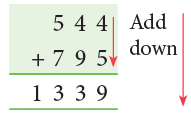
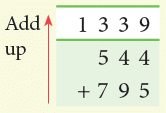
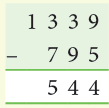
- Example: Adding 544 and 795
Method 1: Recalculate the Addition
You can check the addition by performing the calculation again.
Method 2: Subtract to Find the Missing Number
Alternatively, you can check your answer by subtracting one of the numbers from the total. This will give you the other number.
Tip: You can use either method to check your answer mentally, depending on your comfort level with mental math.
Problems Based on Real-Life Situations
Addition isn't just for math class - it's used in real life too! Let's solve some fun problems based on everyday situations.
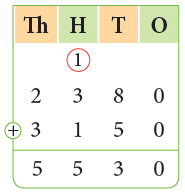
Example 12: The students had to sell the tickets for a play. In the first week, they sold 2,380 tickets and in the second week, they sold 3,150 tickets. How many total tickets did they sell in all?
Number of tickets sold in the first week = 2380
Number of tickets sold in the second week = 3150
Total number of tickets sold = 2380 + 3150 = 5530.
FAQs on Chapter Notes: Addition
| 1. How do I add two-digit numbers without counting on my fingers? |  |
| 2. What's the easiest way to check if my addition answer is correct? | |
| 3. Why do we sometimes need to carry numbers when adding, and how do I do it properly? | |
| 4. Can I add three or more numbers together at once, or do I have to do it in pairs? | |
| 5. What tricks help me add numbers faster without using a calculator for Class 3 exams? | |