How to Master Morphology of Flowering Plants for NEET? | Topic-wise MCQ Tests for NEET PDF Download

Morphology is the branch of science that deals with the study of organisms’ structure, characteristics, and forms. The chapter Morphology of flowering plants is an important concept while preparing for NEET Biology.
The chapter of morphology in flowering plants typically covers the study of the external and internal structures of plants, including their parts, shapes, sizes, and arrangements. Specifically, in the context of flowering plants, morphology refers to the study of the structures and functions of the reproductive organs, such as the flowers, fruits, and seeds.
Here are some tips that you can follow to master the Morphology of Flowering Plants chapter for NEET Biology:
- Follow NCERT only: NCERT must be the go-to source when it comes to NEET as 90-95% of the question paper comprises questions from NCERT sources. Morphology of flowering plants is a chapter that is full of examples, write down all the examples on a piece of paper for easy reference later. Don’t go beyond NCERT unless you are really interested in the chapter as using other sources which contains too much extra information that can be confusing.
- Focus on Mnemonics and diagrams: Memorise all the examples with mnemonics only. Make your own mnemonics. Revise them as much as possible. Learn floral formulas and then try drawing floral diagrams repeatedly. Half of the characteristics are already done if you know every aspect of floral diagrams.
- Relate things with real-life examples: Get really interested in plants & vegetables! Discover the characteristics of various vegetables. Try to relate things with real-life examples. For example, brinjal has persistant sepals. One can easily notice this in ones kept in your kitchen. Real interaction with plants will help you a lot in this chapter.
- Practice Questions in a Strategic Manner: While preparing for NEET, you get a limited time and you need to prepare effectively in that limited time. Students are advised not to waste their precious time by practicing questions of this chapter from many different sources.
What to Read in the Chapter of Morphology of Flowering Plants?
- Introduction: Start with the introduction to Morphology of Flowering Plants, including the different types of plant organs such as roots, stems, leaves, flowers, and fruits. Understand the importance of studying plant morphology and its significance in the field of Biology.
- Root System: Learn about the structure and functions of the root system, including its different types, modifications, and adaptations. Roots are crucial for anchorage, absorption, and storage of nutrients, making it essential to study.
- Stem: Study the structure, types, and modifications of stems, including their role in support, transportation, and storage of nutrients. Understanding the stem is important to differentiate between different types of plants.
- Leaf: Learn about the structure, types, modifications, and functions of leaves. Leaves are responsible for photosynthesis, respiration, and transpiration, making it crucial to study.
- Flower: Study the structure, types, and modifications of flowers, including the process of pollination, fertilization, and seed formation. Understanding the flower is important to differentiate between different types of plants and their reproductive strategies.
- Fruit: Learn about the structure, types, and modifications of fruits, including their role in seed dispersal. Understanding the fruit is important to differentiate between different types of plants and their dispersal strategies.
- Inflorescence: Study the structure and types of inflorescence, including their role in reproduction and adaptation. Inflorescence is important to study as it affects the efficiency of pollination and seed formation.
- Floral Formula and Diagram: Learn to represent the floral formula and diagram, which provides a concise representation of the structure of the flower. Understanding floral formula and diagram is important for the identification and classification of flowering plants.
- Economic Importance: Study the economic importance of flowering plants, including their uses in agriculture, medicine, and industry. Understanding the economic importance of plants is important for their conservation and sustainable utilization.
To better understand the topic, it is recommended that you refer to the notes specific to particular topics. These notes can help you clear any doubts and gain a deeper understanding of the subject matter:
- The Root: Types, Regions & Modifications
- The Flower: Parts & Functions
- Important Notes for NEET: Morphology of Flowering Plants
- Venation & Modification of Leaves
- The Inflorescence
- The Fruit: Parts, Structure, Uses & Classification
- The Stem & Its Modifications
- The Leaf: Types of Leaves, Phyllotaxy, Venation & Modifications of Leaves
- Seed: Development, Types & Germination
- Family Description: Solanaceae, Fabaceae & Liliaceae
- Semitechnical Description of a Flowering Plant & Some Important Families
Here’s how you can practice questions of the chapter “Biological Classification” in a strategic manner for NEET
Topic Wise Tests
After covering the topics thoroughly. You should practice topic-wise questions from the chapter, which will help you to retain the concepts for a longer period of time.
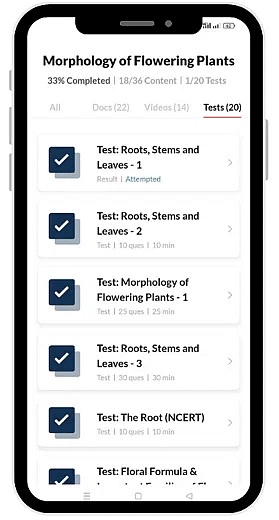 Topic-wise tests of Morphology of Flowering PlantsHere are the topic-wise tests of Morphology of Flowering Plants Chapter which you can attempt for a stronger understanding:
OneTime: Test: Roots, Stems and Leaves - 1
OneTime: Test: Roots, Stems and Leaves - 2
OneTime: Test: Roots, Stems and Leaves - 3
OneTime: Test: The Flower, Fruit & Seed
OneTime: Test: Families of Angiosperms
OneTime: Test: The Root (NCERT)
OneTime: Test: The Stem (NCERT)
OneTime: Test: The Leaf (NCERT)
OneTime: Test: The Flower (NCERT)
OneTime: Test: The Fruit (NCERT)
OneTime: Test: The Seed (NCERT)
OneTime: Test: Description of Some Important Families (NCERT)
Chapter Wise Tests and PYQs
After strengthening your topics make sure you practice the questions of entire chapter well enough. Solving chapter-wise previous year questions is the most important part during NEET preparation. Many questions in NEET Exam are repeated from previous years questions only. PYQs make you aware of the important topics and their weightage and give you immense confidence.
Here are the chapter-wise tests and chapter-wise NEET PYQs that you can attempt for this chapter:
OneTime: 31 Years NEET Previous Year Questions: Morphology of Flowering - 1
OneTime: 31 Years NEET Previous Year Questions: Morphology of Flowering - 2
OneTime: 31 Years NEET Previous Year Questions: Morphology of Flowering - 3
OneTime: Assertion & Reason Test: Morphology of Flowering Plants
OneTime: Test: Morphology of Flowering Plants - 1
OneTime: Test: Morphology of Flowering Plants - 2
OneTime: Test: Plant Morphology
|
9 docs|806 tests
|
FAQs on How to Master Morphology of Flowering Plants for NEET? - Topic-wise MCQ Tests for NEET
| 1. How can I study the morphology of flowering plants for NEET? |  |
| 2. What are some important topics to read in the chapter of morphology of flowering plants? | |
| 3. Can you provide some frequently asked questions related to the morphology of flowering plants for NEET? | |
| 4. What are some chapter-wise tests available for the morphology of flowering plants? | |
| 5. What are some important previous year questions related to the morphology of flowering plants for NEET? | |





Free
,Viva Questions
,How to Master Morphology of Flowering Plants for NEET? | Topic-wise MCQ Tests for NEET
,Previous Year Questions with Solutions
,Objective type Questions
,practice quizzes
,MCQs
,ppt
,Extra Questions
,Semester Notes
,Exam
,study material
,shortcuts and tricks
,Sample Paper
,How to Master Morphology of Flowering Plants for NEET? | Topic-wise MCQ Tests for NEET
,mock tests for examination
,Summary
,past year papers
,video lectures
,How to Master Morphology of Flowering Plants for NEET? | Topic-wise MCQ Tests for NEET
,Important questions
;




How to Master Morphology of Flowering Plants for NEET? Free PDF Download
Importance of How to Master Morphology of Flowering Plants for NEET?
How to Master Morphology of Flowering Plants for NEET? Notes
How to Master Morphology of Flowering Plants for NEET? NEET Questions
Study How to Master Morphology of Flowering Plants for NEET? on the App
|
© EduRev
|
Education Revolution
|


|




within 7 days!