


All Exams >
JEE >
3 Months Class 12 Board Preparation (Non-Medical) >
All Questions
All questions of Application of Derivatives for JEE Exam
The function f(x) = ax, 0 < a < 1 is- a)increasing
- b)strictly decreasing on R
- c)neither increasing or decreasing
- d)decreasing
Correct answer is option 'D'. Can you explain this answer?
The function f(x) = ax, 0 < a < 1 is
a)
increasing
b)
strictly decreasing on R
c)
neither increasing or decreasing
d)
decreasing

|
Krishna Iyer answered |
f(x) = ax
Taking log bth the sides, log f(x) = xloga
f’(x)/ax = loga
f’(x) = ax loga {ax > 0 for all x implies R,
for loga e<a<1 that implies loga < 0}
Therefore, f’(x) < 0, for all x implies R
f(x) is a decreasing function.
Taking log bth the sides, log f(x) = xloga
f’(x)/ax = loga
f’(x) = ax loga {ax > 0 for all x implies R,
for loga e<a<1 that implies loga < 0}
Therefore, f’(x) < 0, for all x implies R
f(x) is a decreasing function.

Using approximation find the value of 
- a)2.025
- b)2.001
- c)2.01
- d)2.0025
Correct answer is option 'D'. Can you explain this answer?
Using approximation find the value of
a)
2.025
b)
2.001
c)
2.01
d)
2.0025

|
Gunjan Lakhani answered |
Let x=4, Δx=0.01
y=x^½ = 2
y+Δy = (x+ Δx)^½ = (4.01)^½
Δy = (dy/dx) * Δx
Δy = (x^(-1/2))/2 * Δx
Δy = (½)*(½) * 0.01
Δy = 0.25 * 0.01
Δy = 0.0025
So, (4.01)^½ = 2 + 0.0025 = 2.0025
The maximum value of f (x) = sin x in the interval [π,2π] is
a) 6
b) 0
c) -2
d) -4
Correct answer is option 'B'. Can you explain this answer?
|
|
Kiran Mehta answered |
f(x) = sin x
f’(x) =cosx
f”(x) = -sin x
f”(3pi/2) = -sin(3pi/2)
= -(-1)
=> 1 > 0 (local minima)
f(pi) = sin(pi) = 0
f(2pi) = sin(2pi) = 0
Hence, 0 is the maxima.
f’(x) =cosx
f”(x) = -sin x
f”(3pi/2) = -sin(3pi/2)
= -(-1)
=> 1 > 0 (local minima)
f(pi) = sin(pi) = 0
f(2pi) = sin(2pi) = 0
Hence, 0 is the maxima.
Find the maximum and minimum values of f (x) = 2x3 – 24x + 107 in the interval [1, 3].- a)89, 69
- b)89, 75
- c)59, 56
- d)89, -9
Correct answer is option 'B'. Can you explain this answer?
Find the maximum and minimum values of f (x) = 2x3 – 24x + 107 in the interval [1, 3].
a)
89, 69
b)
89, 75
c)
59, 56
d)
89, -9

|
Anjana Sharma answered |
Toolbox:d/dx(x^n) = nx^n−1Maxima & Minima = f′(x) = 0Step 1:f(x) = 2x^3−24x+107Differentiating with
Find slope of normal to the curve y=5x2-10x + 7 at x=1- a)not defined
- b)-1
- c)1
- d)zero
Correct answer is option 'A'. Can you explain this answer?
Find slope of normal to the curve y=5x2-10x + 7 at x=1
a)
not defined
b)
-1
c)
1
d)
zero

|
Neha Sharma answered |
y = 5x2 - 10x + 7
dy/dx = 10x - 10
(At x = 1) 10(1) - 10
m1 = 0
As we know that slope, m1m2 = -1
=> 0(m2) = -1
m2 = -1/0 (which is not defined)
dy/dx = 10x - 10
(At x = 1) 10(1) - 10
m1 = 0
As we know that slope, m1m2 = -1
=> 0(m2) = -1
m2 = -1/0 (which is not defined)
Find the maximum profit that a company can make, if the profit function is given by P(x) = 41 + 24 x – 18x2- a)56
- b)49
- c)23
- d)89
Correct answer is option 'B'. Can you explain this answer?
Find the maximum profit that a company can make, if the profit function is given by P(x) = 41 + 24 x – 18x2
a)
56
b)
49
c)
23
d)
89
|
|
Aryan Khanna answered |
p’(x) = -24 - 36x
p”(x) = -36
Now, p’(x) = 0 ⇒ x = (-24)/36
x = -⅔
Also, p”(-⅔) = -36 < 0
By the second derivative test, x = -⅔
Therefore, maximum profit = p(-⅔)
= 41 - 24(-⅔) - 18(-⅔)^2
= 41 +16 - 8
⇒ 49
p”(x) = -36
Now, p’(x) = 0 ⇒ x = (-24)/36
x = -⅔
Also, p”(-⅔) = -36 < 0
By the second derivative test, x = -⅔
Therefore, maximum profit = p(-⅔)
= 41 - 24(-⅔) - 18(-⅔)^2
= 41 +16 - 8
⇒ 49
A stone is dropped into a quiet lake and waves move in circles at a speed of 2cm per second. At the instant, when the radius of the circular wave is 12 cm, how fast is the enclosed area changing ?- a)Decreasing at the rate of 48π cm2 / sec
- b)Increasing at the rate of 24π cm2 / sec
- c)Increasing at the rate of 48π cm2 / sec
- d)Decreasing at the rate of 24π cm2 / sec
Correct answer is option 'C'. Can you explain this answer?
A stone is dropped into a quiet lake and waves move in circles at a speed of 2cm per second. At the instant, when the radius of the circular wave is 12 cm, how fast is the enclosed area changing ?
a)
Decreasing at the rate of 48π cm2 / sec
b)
Increasing at the rate of 24π cm2 / sec
c)
Increasing at the rate of 48π cm2 / sec
d)
Decreasing at the rate of 24π cm2 / sec

|
Hansa Sharma answered |
Rate of increase of radius dr/dt = 2 cm/s
Area of circle A = πr2
dA/dt = π*(2r)*(dr/dt)
= π*(24)*2
= 48π cm2/s
Rate of increase of area is 48π cm2/s (increasing as it is positive).
Area of circle A = πr2
dA/dt = π*(2r)*(dr/dt)
= π*(24)*2
= 48π cm2/s
Rate of increase of area is 48π cm2/s (increasing as it is positive).
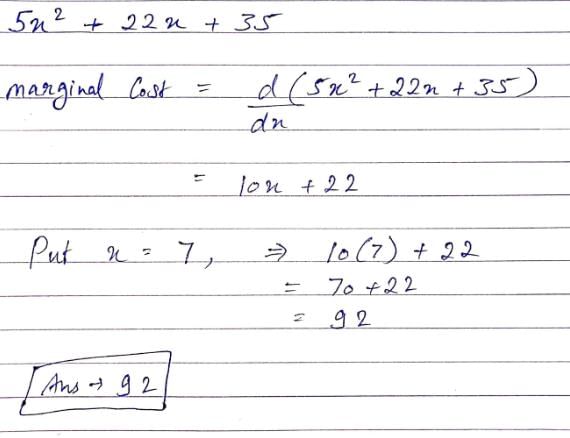
The total revenue in Rupees received from the sale of x units of a product is given by R(x) = 5x2 + 22x + 35. Find the marginal revenue, when x = 7, where by marginal revenue we mean the rate of change of total revenue with respect to the number of items sold at an instant- a)Rs 7
- b)Rs 127
- c)Rs 92
- d)Rs 48
Correct answer is option 'C'. Can you explain this answer?
The total revenue in Rupees received from the sale of x units of a product is given by R(x) = 5x2 + 22x + 35. Find the marginal revenue, when x = 7, where by marginal revenue we mean the rate of change of total revenue with respect to the number of items sold at an instant
a)
Rs 7
b)
Rs 127
c)
Rs 92
d)
Rs 48

|
Gaurav Kumar answered |
Find the approximate value of f(10.01) where f(x) = 5x2 +6x + 3- a)564.06
- b)564.01
- c)563.00
- d)563.01
Correct answer is option 'A'. Can you explain this answer?
Find the approximate value of f(10.01) where f(x) = 5x2 +6x + 3
a)
564.06
b)
564.01
c)
563.00
d)
563.01
|
|
Naina Sharma answered |
f(x) = 5x2 +6x + 3
f(10.01) = 5*(10.01)2 + 6*(10.01) + 3
To find (10.01)2
Let p=10, Δp=0.01
y=p2 = 100
y+Δy = (p+ Δp)2 = (10.01)2
Δy = (dy/dp) * Δp
Δy = 2*p* Δx
Δy = 2*10* 0.01
Δy = 20 * 0.01
Δy = 0.2
So, (10.01)2 = y + Δy
= 100.2
So,
f(10.01) = 5*(100.2) + 6*(10.01) + 3
= 501 + 60.06 + 3
= 564.06
f(10.01) = 5*(10.01)2 + 6*(10.01) + 3
To find (10.01)2
Let p=10, Δp=0.01
y=p2 = 100
y+Δy = (p+ Δp)2 = (10.01)2
Δy = (dy/dp) * Δp
Δy = 2*p* Δx
Δy = 2*10* 0.01
Δy = 20 * 0.01
Δy = 0.2
So, (10.01)2 = y + Δy
= 100.2
So,
f(10.01) = 5*(100.2) + 6*(10.01) + 3
= 501 + 60.06 + 3
= 564.06
The equation of the normal to the curve x2 = 4y which passes through the point (1, 2) is.- a)x + y – 3 = 0
- b)4x – y = 2
- c)4x – 2y = 0
- d)4x – 3y + 2= 0
Correct answer is option 'B'. Can you explain this answer?
The equation of the normal to the curve x2 = 4y which passes through the point (1, 2) is.
a)
x + y – 3 = 0
b)
4x – y = 2
c)
4x – 2y = 0
d)
4x – 3y + 2= 0

|
Sushil Kumar answered |
h2 = 4k
slope of normal=−1/(dy/dx) = −2h
equation of normal(y − k)= −2h(x−h)
k = 2 + 2/h(1 − h)
(h2) / 4 = 2 + 2/h (1 − h)
h = 2, k = 1
equation of line (y - 1)= -1(x - 2)
x + y = 3
slope of normal=−1/(dy/dx) = −2h
equation of normal(y − k)= −2h(x−h)
k = 2 + 2/h(1 − h)
(h2) / 4 = 2 + 2/h (1 − h)
h = 2, k = 1
equation of line (y - 1)= -1(x - 2)
x + y = 3
The radius of air bubble is increasing at the rate of 0. 25 cm/s. At what rate the volume of the bubble is increasing when the radius is 1 cm.- a)4π cm3/s
- b)22π cm3/s
- c)2π cm3/s
- d)π cm3/s
Correct answer is option 'D'. Can you explain this answer?
The radius of air bubble is increasing at the rate of 0. 25 cm/s. At what rate the volume of the bubble is increasing when the radius is 1 cm.
a)
4π cm3/s
b)
22π cm3/s
c)
2π cm3/s
d)
π cm3/s

|
Rohan Yadav answered |
Given, the rate of increase of radius of the air bubble = 0.25 cm/s
We need to find the rate of increase of volume of the bubble when the radius is 1 cm.
Formula used:
Volume of a sphere = (4/3)πr^3
Differentiating both sides with respect to time t, we get:
dV/dt = 4πr^2(dr/dt)
where dV/dt is the rate of change of volume of the sphere with respect to time t and dr/dt is the rate of change of radius of the sphere with respect to time t.
Substituting the given values, we get:
dV/dt = 4π(1)^2(0.25) = π cm^3/s
Therefore, the rate of increase of volume of the bubble when the radius is 1 cm is π cm^3/s, which is the correct answer.
We need to find the rate of increase of volume of the bubble when the radius is 1 cm.
Formula used:
Volume of a sphere = (4/3)πr^3
Differentiating both sides with respect to time t, we get:
dV/dt = 4πr^2(dr/dt)
where dV/dt is the rate of change of volume of the sphere with respect to time t and dr/dt is the rate of change of radius of the sphere with respect to time t.
Substituting the given values, we get:
dV/dt = 4π(1)^2(0.25) = π cm^3/s
Therefore, the rate of increase of volume of the bubble when the radius is 1 cm is π cm^3/s, which is the correct answer.
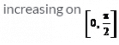
Separate the interval  open square brackets 0 comma straight pi over 2 close square brackets into sub-intervals in which f (x) = sin4 x + cos4 x is increasing or decreasing
- a)

- b)

- c)

- d)
Correct answer is option 'B'. Can you explain this answer?
Separate the interval open square brackets 0 comma straight pi over 2 close square brackets into sub-intervals in which f (x) = sin4 x + cos4 x is increasing or decreasing
open square brackets 0 comma straight pi over 2 close square brackets into sub-intervals in which f (x) = sin4 x + cos4 x is increasing or decreasinga)
b)
c)
d)

|
Infinity Academy answered |
f’(x) = 4sin3x cosx - 4cos3x sinx
= - sin4x
As x is in the interval [0, ∏/2] hence 4x is in the interval [0, 2∏]
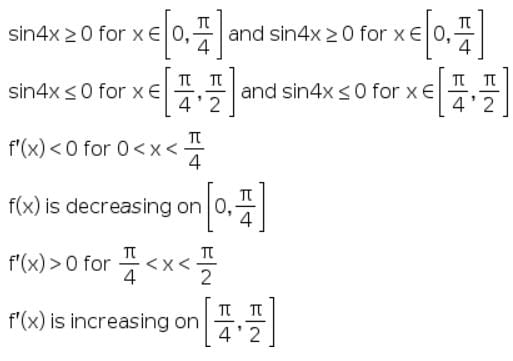
= - sin4x
As x is in the interval [0, ∏/2] hence 4x is in the interval [0, 2∏]
 is monotonically decreasing in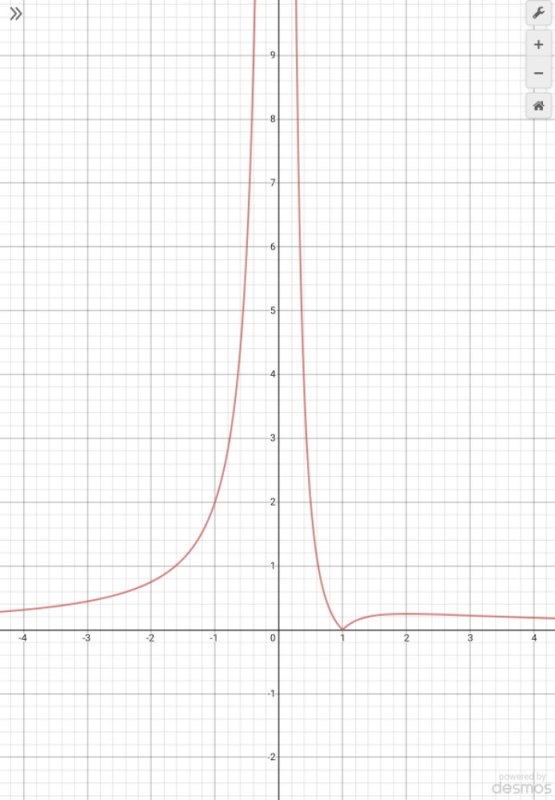
The set of all x for which ln (1 + x) ≤ x is equal to- a) x > 0
- b)x>–1
- c)–1<x<0
- d) Null set
Correct answer is option 'B'. Can you explain this answer?
The set of all x for which ln (1 + x) ≤ x is equal to
a)
x > 0
b)
x>–1
c)
–1<x<0
d)
Null set

|
Praveen Kumar answered |
f(x) = ln(1+x) - x ≤ 0
f(x) = ln(1+x) - x
f’(x) = 1/(1+x) - 1
= (1 - 1 - x)/(1+x)
= -x/(1+x)
f’(x) ≤ 0
-x/(1+x) ≤ 0
0 ≤ x /(1+x)
for(x = 2) (-2)/(1-2)
= 2 > 0, therefore x > - 1
f(x) = ln(1+x) - x
f’(x) = 1/(1+x) - 1
= (1 - 1 - x)/(1+x)
= -x/(1+x)
f’(x) ≤ 0
-x/(1+x) ≤ 0
0 ≤ x /(1+x)
for(x = 2) (-2)/(1-2)
= 2 > 0, therefore x > - 1
The function  increases in
- a)(0, 1)
- b)(-∞,e)
- c)(e,∞)
- d)(1, e)
Correct answer is option 'C'. Can you explain this answer?
The function increases in
increases ina)
(0, 1)
b)
(-∞,e)
c)
(e,∞)
d)
(1, e)

|
Vikas Kapoor answered |
f'(x) = [(logx).2−2x.1/x](logx)2
= 2(logx−1)/(logx)^2
∴f'(x)>0
⇔logx−1>0
⇔logx>1
⇔logx>loge
⇔x>e
∴f(x) is increasing in (e,∞)
= 2(logx−1)/(logx)^2
∴f'(x)>0
⇔logx−1>0
⇔logx>1
⇔logx>loge
⇔x>e
∴f(x) is increasing in (e,∞)
Let f be a real valued function defined on (0, 1) ∪ (2, 4) such that f ‘ (x) = 0 for every x, then- a)f is constant function if f 1/2 = f (3)
- b)f is a constant function
- c)f is a constant function if f 1/2 = 0
- d)f is not a constant function
Correct answer is option 'A'. Can you explain this answer?
Let f be a real valued function defined on (0, 1) ∪ (2, 4) such that f ‘ (x) = 0 for every x, then
a)
f is constant function if f 1/2 = f (3)
b)
f is a constant function
c)
f is a constant function if f 1/2 = 0
d)
f is not a constant function

|
Nandini Choudhury answered |
f ‘ (x) = 0 ⇒ f (x)is constant in (0 , 1)and also in (2, 4). But this does not mean that f (x) has the same value in both the intervals . However , if f (c) = f (d) , where c ∈ (0 , 1) and d ∈ (2, 4) then f (x) assumes the same value at all x ∈ (0 ,1) U (2, 4) and hence f is a constant function.
The curve y = f(x) which satisfies the condition f'(x) > 0 and f"(x) < 0 for all real x, is- a)

- b)

- c)

- d)

Correct answer is option 'D'. Can you explain this answer?
The curve y = f(x) which satisfies the condition f'(x) > 0 and f"(x) < 0 for all real x, is
a)
b)
c)
d)
|
|
Geetika Shah answered |
f’(x) > 0
=> f(x) is increasing
f’’(x) < 0 => f(x) is convex
=> f(x) is increasing
f’’(x) < 0 => f(x) is convex
The maximum and minimum values of f(x) = 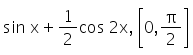 are
are- a)

- b)

- c)

- d)

Correct answer is option 'B'. Can you explain this answer?
The maximum and minimum values of f(x) = are
area)
b)
c)
d)
|
|
Aryan Khanna answered |
f(x) = sinx + 1/2cos2x
⇒ f'(x) = cos x – sin2x
Now, f'(x) = 0 gives cosx – sin2x = 0
⇒ cos x (1 – 2 sinx) = 0
⇒ cos x = 0, (1 – 2 sinx) = 0
⇒ cos x = 0, sinx = 1/2
⇒ x = π/6 , π/2
Now, f(0) = 1/2,
f(π/6) = 1/2 + 1/4 = 3/4,
f(π/2) = 1 – 1/2 = 1/2
Therefore, the absolute max value = 3/4 and absolute min = 1/2
⇒ f'(x) = cos x – sin2x
Now, f'(x) = 0 gives cosx – sin2x = 0
⇒ cos x (1 – 2 sinx) = 0
⇒ cos x = 0, (1 – 2 sinx) = 0
⇒ cos x = 0, sinx = 1/2
⇒ x = π/6 , π/2
Now, f(0) = 1/2,
f(π/6) = 1/2 + 1/4 = 3/4,
f(π/2) = 1 – 1/2 = 1/2
Therefore, the absolute max value = 3/4 and absolute min = 1/2
The function f (x) = -3x + 12 on R.is- a)increasing
- b)strictly decreasing
- c)decreasing
- d)neither increasing or decreasing
Correct answer is option 'B'. Can you explain this answer?
The function f (x) = -3x + 12 on R.is
a)
increasing
b)
strictly decreasing
c)
decreasing
d)
neither increasing or decreasing
|
|
Aryan Khanna answered |
f(x) = -3x + 12
f(0) = -3(0) + 12 = 0 - 12 = 0
f(1) = 9
f(2)= 6
f(3) = 3
f(4) = 0
f(5) = -3
f(0) = -3(0) + 12 = 0 - 12 = 0
f(1) = 9
f(2)= 6
f(3) = 3
f(4) = 0
f(5) = -3
The equation of the tangent line to the curve y =  which is parallel to the line 4x -2y + 3 = 0 is
- a)80x +40y – 193 = 0
- b)4x – 2y – 3 = 0
- c)80x – 40y + 193 = 0
- d)80x – 40y – 103 = 0
Correct answer is option 'D'. Can you explain this answer?
The equation of the tangent line to the curve y = which is parallel to the line 4x -2y + 3 = 0 is
which is parallel to the line 4x -2y + 3 = 0 isa)
80x +40y – 193 = 0
b)
4x – 2y – 3 = 0
c)
80x – 40y + 193 = 0
d)
80x – 40y – 103 = 0

|
Dabhi Bharat answered |
Given curve y=√5x-3 -2
y+2=√5x-3
dy/dx=5/2×√5x-3
m1=5/2(y+2)
given that line 4x-2y+3=0is parallel to tangent of curve
slope of line m2=2
m1=m2
5/2(y+2)=2
5/4=(y+2)
y=-3/4
from y+2=√5x-3
-3/4+2=√5x-3
5/4=√5x-3
5x=25/16+3
X=73/80
points are p(73/80,-3/4)
equ. of tangent :y-y1=m(x-x1)
y+3/4=2(x-73/80)
80x-73=40y+30
80x-40y-103=0
y+2=√5x-3
dy/dx=5/2×√5x-3
m1=5/2(y+2)
given that line 4x-2y+3=0is parallel to tangent of curve
slope of line m2=2
m1=m2
5/2(y+2)=2
5/4=(y+2)
y=-3/4
from y+2=√5x-3
-3/4+2=√5x-3
5/4=√5x-3
5x=25/16+3
X=73/80
points are p(73/80,-3/4)
equ. of tangent :y-y1=m(x-x1)
y+3/4=2(x-73/80)
80x-73=40y+30
80x-40y-103=0
The maximum value of  is
is- a)(1/e)1/e
- b)(e)2/e
- c)(e)-1/e
- d)(e)1/e
Correct answer is option 'D'. Can you explain this answer?
The maximum value of is
isa)
(1/e)1/e
b)
(e)2/e
c)
(e)-1/e
d)
(e)1/e

|
Shiksha Academy answered |
For every real number (or) valued function f(x), the values of x which satisfies the equation f1(x)=0 are the point of it's local and global maxima or minima.
This occurs due to the fact that, at the point of maxima or minima, the curve of the function has a zero slope.
We have function f(x) = (1/x)x
We will be using the equation, y = (1/x)x
Taking in both sides we get
ln y = −xlnx
Differentiating both sides with respect to x.y.
dy/dx = −lnx−1
dy/dx =−y(lnx+1)
Equating dy/dx to 0, we get
−y(lnx+1)=0
Since y is an exponential function it can never be equal to zero, hence
lnx +1 = 0
lnx = −1
x = e(−1)
So, for the maximum value we put x = e^(−1)in f(x) to get the value of f(x) at the point.
f(e^−1) = e(1/e).
Hence the maximum value of the function is (e)1/e
This occurs due to the fact that, at the point of maxima or minima, the curve of the function has a zero slope.
We have function f(x) = (1/x)x
We will be using the equation, y = (1/x)x
Taking in both sides we get
ln y = −xlnx
Differentiating both sides with respect to x.y.
dy/dx = −lnx−1
dy/dx =−y(lnx+1)
Equating dy/dx to 0, we get
−y(lnx+1)=0
Since y is an exponential function it can never be equal to zero, hence
lnx +1 = 0
lnx = −1
x = e(−1)
So, for the maximum value we put x = e^(−1)in f(x) to get the value of f(x) at the point.
f(e^−1) = e(1/e).
Hence the maximum value of the function is (e)1/e
The volume of cube is increasing at the constant rate of 3 cm3/s. Find the rate of change of edge of the cube when its edge is 5 cm.- a)25 cm3/sec
- b)25 cm/s
- c)1/25 cm/s
- d)1/25 cm3/s
Correct answer is option 'C'. Can you explain this answer?
The volume of cube is increasing at the constant rate of 3 cm3/s. Find the rate of change of edge of the cube when its edge is 5 cm.
a)
25 cm3/sec
b)
25 cm/s
c)
1/25 cm/s
d)
1/25 cm3/s
|
|
Aryan Khanna answered |
Let V be the instantaneous volume of the cube.
dV/dt = 3 cm3/s
Let x be the side of the cube.
V = x3
dV/dt = 3x2 * (dx/dt)
3 = 3*(52)*(dx/dt)
So, dx/dt = 1/25 cm/s
dV/dt = 3 cm3/s
Let x be the side of the cube.
V = x3
dV/dt = 3x2 * (dx/dt)
3 = 3*(52)*(dx/dt)
So, dx/dt = 1/25 cm/s
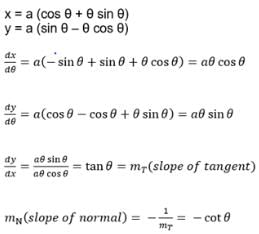
Find the equation of tangent to 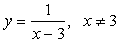 which has slope 2.
- a)2x – y = 1
- b)No tangent
- c)y – 2x = 0
- d)y – 2x = 3
Correct answer is option 'B'. Can you explain this answer?
Find the equation of tangent to which has slope 2.
which has slope 2.a)
2x – y = 1
b)
No tangent
c)
y – 2x = 0
d)
y – 2x = 3
|
|
Raghava Rao answered |
Y=1/(x-3)^2
dy/dx=(-1/(x-3)^2)
given slope=2
-1/(x-3)^2 =2
-1/2=(x-3)^2
negative number is not equal to square. so no tangent
dy/dx=(-1/(x-3)^2)
given slope=2
-1/(x-3)^2 =2
-1/2=(x-3)^2
negative number is not equal to square. so no tangent

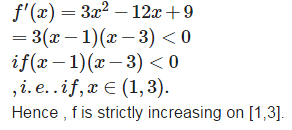
In case of strict decreasing functions, slope of tangent and hence derivative is
- a)Negative
- b)either negative or zero.
- c)Zero
- d)Positive
Correct answer is option 'A'. Can you explain this answer?
In case of strict decreasing functions, slope of tangent and hence derivative is
a)
Negative
b)
either negative or zero.
c)
Zero
d)
Positive

|
Avantika Joshi answered |
In the case of strictly decreasing functions, the slope of the tangent line is always negative. This implies that the derivative of a strictly decreasing function is always negative. The derivative represents the rate of change of the function, and if the function is strictly decreasing, the rate of change is negative.

Let f (x) = x3−6x2+9x+8, then f (x) is decreasing in- a)(−∞,1) ∪ (3,∞)
- b)[1, 3]
- c)[3,∞]
- d)(−∞,1)
Correct answer is option 'B'. Can you explain this answer?
Let f (x) = x3−6x2+9x+8, then f (x) is decreasing in
a)
(−∞,1) ∪ (3,∞)
b)
[1, 3]
c)
[3,∞]
d)
(−∞,1)
|
|
Pranjal Saini answered |
Understanding the Function f(x)
The function given is f(x) = x^3 - 6x^2 + 9x + 8. To determine where this function is decreasing, we need to analyze its first derivative.
Finding the First Derivative
- The first derivative f'(x) helps identify increasing and decreasing intervals.
- f'(x) = 3x^2 - 12x + 9.
Finding Critical Points
- Set the first derivative equal to zero to find critical points:
3x^2 - 12x + 9 = 0.
- Simplifying gives us:
x^2 - 4x + 3 = 0.
- Factoring results in:
(x - 1)(x - 3) = 0, leading to critical points at x = 1 and x = 3.
Test Intervals
Now we need to evaluate the sign of f'(x) in the intervals defined by these critical points:
- Interval (-∞, 1): Choose x = 0.
f'(0) = 3(0)^2 - 12(0) + 9 = 9 (positive).
- Interval (1, 3): Choose x = 2.
f'(2) = 3(2)^2 - 12(2) + 9 = -3 (negative).
- Interval (3, ∞): Choose x = 4.
f'(4) = 3(4)^2 - 12(4) + 9 = 9 (positive).
Conclusion
- f'(x) > 0 in (-∞, 1) and (3, ∞) (increasing).
- f'(x) < 0="" in="" (1,="" 3)="">
Thus, f(x) is decreasing in the interval [1, 3], which corresponds to option 'B'. 0="" in="" (1,="" 3)="" (decreasing).="" thus,="" f(x)="" is="" decreasing="" in="" the="" interval="" [1,="" 3],="" which="" corresponds="" to="" option="">
Thus, f(x) is decreasing in the interval [1, 3], which corresponds to option 'B'.>
The function given is f(x) = x^3 - 6x^2 + 9x + 8. To determine where this function is decreasing, we need to analyze its first derivative.
Finding the First Derivative
- The first derivative f'(x) helps identify increasing and decreasing intervals.
- f'(x) = 3x^2 - 12x + 9.
Finding Critical Points
- Set the first derivative equal to zero to find critical points:
3x^2 - 12x + 9 = 0.
- Simplifying gives us:
x^2 - 4x + 3 = 0.
- Factoring results in:
(x - 1)(x - 3) = 0, leading to critical points at x = 1 and x = 3.
Test Intervals
Now we need to evaluate the sign of f'(x) in the intervals defined by these critical points:
- Interval (-∞, 1): Choose x = 0.
f'(0) = 3(0)^2 - 12(0) + 9 = 9 (positive).
- Interval (1, 3): Choose x = 2.
f'(2) = 3(2)^2 - 12(2) + 9 = -3 (negative).
- Interval (3, ∞): Choose x = 4.
f'(4) = 3(4)^2 - 12(4) + 9 = 9 (positive).
Conclusion
- f'(x) > 0 in (-∞, 1) and (3, ∞) (increasing).
- f'(x) < 0="" in="" (1,="" 3)="">
Thus, f(x) is decreasing in the interval [1, 3], which corresponds to option 'B'. 0="" in="" (1,="" 3)="" (decreasing).="" thus,="" f(x)="" is="" decreasing="" in="" the="" interval="" [1,="" 3],="" which="" corresponds="" to="" option="">
Thus, f(x) is decreasing in the interval [1, 3], which corresponds to option 'B'.>
Let f (x) be differentiable in (0, 4) and f (2) = f (3) and S = {c : 2 < c < 3, f’ (c) = 0} then- a)S has exactly one point
- b)S = { }
- c)S has atleast one point
- d)none of these
Correct answer is option 'C'. Can you explain this answer?
Let f (x) be differentiable in (0, 4) and f (2) = f (3) and S = {c : 2 < c < 3, f’ (c) = 0} then
a)
S has exactly one point
b)
S = { }
c)
S has atleast one point
d)
none of these
|
|
Nandini Choudhury answered |
Conditions of Rolle’s Theorem are satisfied by f(x) in [2,3].Hence there exist atleast one real c in (2, 3) s.t. f ‘(c) = 0 . Therefore , the set S contains atleast one element
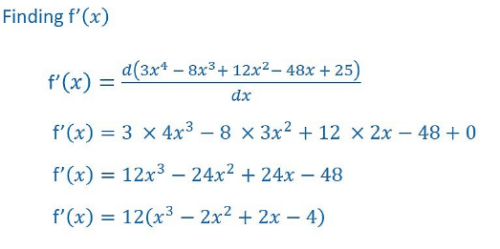

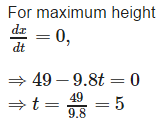
The function f (x) = x3 has a- a)point of inflexion at = 0
- b)local minima at x = 0
- c)local maxima at x = 0
- d)none of these
Correct answer is option 'A'. Can you explain this answer?
The function f (x) = x3 has a
a)
point of inflexion at = 0
b)
local minima at x = 0
c)
local maxima at x = 0
d)
none of these

|
Amrita Sarkar answered |
f ‘(0) = 0 , f ‘’ (0) = 0 and f ‘’’(0) = 6 . So, f has a point of inflexion at 0.
Find the approximate change in total surface area of a cube of side x metre caused by increase in side by 1%.- a)12 m2
- b)0.12x2 m2
- c)1.2x m2
- d)12x m2
Correct answer is option 'B'. Can you explain this answer?
Find the approximate change in total surface area of a cube of side x metre caused by increase in side by 1%.
a)
12 m2
b)
0.12x2 m2
c)
1.2x m2
d)
12x m2

|
Ayush Joshi answered |
Toolbox:
Let y=f(x)
Δx denote a small increment in x
Δy=f(x+Δx)−f(x)
dy=(dy/dx)Δx
Surface area of cube =6s^2
Step 1:
The side of the cube =x meters
Decrease in side =1%
= 0.01x
Increase in side =Δx
= −0.01x
Step 2:
Surface area of cube = 6s^2
= 6 * x^2
S = 6x^2
ds/dx = 12x [Differentiating with respect to x]
Approximate change in surface area of cube = ds/dx * Δx
=12x *(0.01x)
= 0.12x^2 m^2
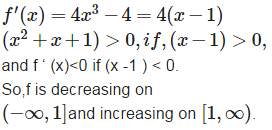
If the line y=x is a tangent to the parabola y=ax2+bx+c at the point (1,1) and the curve passes through (−1,0), then- a) a=b=−1, c=3
- b) a=b=1/2, c=0
- c) a=c=1/4, b=1/2
- d) a=0, b=c=1/2
Correct answer is option 'C'. Can you explain this answer?
If the line y=x is a tangent to the parabola y=ax2+bx+c at the point (1,1) and the curve passes through (−1,0), then
a)
a=b=−1, c=3
b)
a=b=1/2, c=0
c)
a=c=1/4, b=1/2
d)
a=0, b=c=1/2

|
Ankit Chaudhary answered |
Explanation:
Given Conditions:
- The line y = x is a tangent to the parabola y = ax^2 + bx + c at the point (1,1).
- The curve passes through (-1,0).
Using the tangent condition:
- Since the line y = x is a tangent to the parabola y = ax^2 + bx + c at the point (1,1), the slope of the tangent at this point should be equal to 1 (slope of the line y = x).
- The derivative of y = ax^2 + bx + c is y' = 2ax + b.
- At x = 1, the derivative should be equal to 1. So, 2a + b = 1.
Using the point condition:
- Since the curve passes through (-1,0), substituting x = -1 and y = 0 in the equation of the parabola gives 0 = a(-1)^2 + b(-1) + c.
- This simplifies to a - b + c = 0.
Solving the equations:
- From the tangent condition, we have 2a + b = 1.
- From the point condition, we have a - b + c = 0.
- Substituting a = c/4 into the equations above, we get a = c = 1/4 and b = 1/2.
Final Answer:
- Therefore, the correct values for a, b, and c are a = c = 1/4 and b = 1/2, which corresponds to option 'C'.
Given Conditions:
- The line y = x is a tangent to the parabola y = ax^2 + bx + c at the point (1,1).
- The curve passes through (-1,0).
Using the tangent condition:
- Since the line y = x is a tangent to the parabola y = ax^2 + bx + c at the point (1,1), the slope of the tangent at this point should be equal to 1 (slope of the line y = x).
- The derivative of y = ax^2 + bx + c is y' = 2ax + b.
- At x = 1, the derivative should be equal to 1. So, 2a + b = 1.
Using the point condition:
- Since the curve passes through (-1,0), substituting x = -1 and y = 0 in the equation of the parabola gives 0 = a(-1)^2 + b(-1) + c.
- This simplifies to a - b + c = 0.
Solving the equations:
- From the tangent condition, we have 2a + b = 1.
- From the point condition, we have a - b + c = 0.
- Substituting a = c/4 into the equations above, we get a = c = 1/4 and b = 1/2.
Final Answer:
- Therefore, the correct values for a, b, and c are a = c = 1/4 and b = 1/2, which corresponds to option 'C'.
The function f (x) = | x | has- a)only one minima
- b)no maxima or minima
- c)only one maxima
- d)none of these
Correct answer is option 'A'. Can you explain this answer?
The function f (x) = | x | has
a)
only one minima
b)
no maxima or minima
c)
only one maxima
d)
none of these

|
Nilesh Goyal answered |
The modulus function has V-shaped graph,which means that it has only one minima.
Given that f (x) = x1/x , x>0, has the maximum value at x = e,then- a)eπ=πe
- b)eπ<πe
- c)eπ>πe
- d)eπ⩽πe
Correct answer is option 'C'. Can you explain this answer?
Given that f (x) = x1/x , x>0, has the maximum value at x = e,then
a)
eπ=πe
b)
eπ<πe
c)
eπ>πe
d)
eπ⩽πe

|
Anirudh Malik answered |
Understanding the Function
The function f(x) = x^(1/x) is given, and we need to find its maximum value.
Finding the Maximum Value
To find the maximum, we take the natural logarithm of f(x):
- Let y = f(x) = x^(1/x)
- Then, ln(y) = (1/x) * ln(x)
Next, we differentiate ln(y) with respect to x and set the derivative to zero:
- d/dx[ln(y)] = d/dx[(1/x) * ln(x)]
- Using quotient rule and simplifying leads to critical points.
Setting the Derivative to Zero
After simplification, we find the critical points by solving:
- 1 - ln(x) = 0
- Hence, ln(x) = 1
- This gives us x = e.
Verifying Maximum at x = e
To confirm that x = e is a maximum, we can use the second derivative test or analyze the behavior of the function around e. The function f(x) increases until x = e and then decreases afterwards.
Conclusion
Since the maximum value of the function f(x) occurs at x = e, we conclude:
- The correct answer is c) e.
This shows that the maximum value of the function f(x) = x^(1/x) indeed occurs at x = e, making option 'C' the correct choice.
The function f(x) = x^(1/x) is given, and we need to find its maximum value.
Finding the Maximum Value
To find the maximum, we take the natural logarithm of f(x):
- Let y = f(x) = x^(1/x)
- Then, ln(y) = (1/x) * ln(x)
Next, we differentiate ln(y) with respect to x and set the derivative to zero:
- d/dx[ln(y)] = d/dx[(1/x) * ln(x)]
- Using quotient rule and simplifying leads to critical points.
Setting the Derivative to Zero
After simplification, we find the critical points by solving:
- 1 - ln(x) = 0
- Hence, ln(x) = 1
- This gives us x = e.
Verifying Maximum at x = e
To confirm that x = e is a maximum, we can use the second derivative test or analyze the behavior of the function around e. The function f(x) increases until x = e and then decreases afterwards.
Conclusion
Since the maximum value of the function f(x) occurs at x = e, we conclude:
- The correct answer is c) e.
This shows that the maximum value of the function f(x) = x^(1/x) indeed occurs at x = e, making option 'C' the correct choice.
The equation of the tangent to the curve y=(4−x2)2/3 at x = 2 is- a)x = 2
- b)x = – 2
- c)y = – 1.
- d)y = 2
Correct answer is option 'A'. Can you explain this answer?
The equation of the tangent to the curve y=(4−x2)2/3 at x = 2 is
a)
x = 2
b)
x = – 2
c)
y = – 1.
d)
y = 2

|
Sushant Khanna answered |
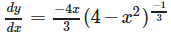 , which does not exist at x = 2 . However , we find that
  , at x = 2 . Hence , there is a vertical tangent to the given curve at x = 2 .The point on the curve corresponding to x = 2 is (2 , 0). Hence , the equation of the tangent at x = 2 is x = 2
The true set of real values of x for which the function, f(x) = x ln x – x + 1 is positive is- a) (1, ∞)
- b)(1/e, ∞)
- c)[e, ∞)
- d)(0, 1) and (1, ∞)
Correct answer is option 'D'. Can you explain this answer?
The true set of real values of x for which the function, f(x) = x ln x – x + 1 is positive is
a)
(1, ∞)
b)
(1/e, ∞)
c)
[e, ∞)
d)
(0, 1) and (1, ∞)
|
|
Anjali Sen answered |
The true set of real values of x for which the function f(x) = xln x is defined is x > 0. This is because the natural logarithm function ln x is only defined for positive real numbers.
Let f (x) = (x2−4)1/3, then f has a- a)local minima at x = 0
- b)local maxima at x = 0
- c)point of inflextion at x = 0
- d)none of these
Correct answer is option 'A'. Can you explain this answer?
Let f (x) = (x2−4)1/3, then f has a
a)
local minima at x = 0
b)
local maxima at x = 0
c)
point of inflextion at x = 0
d)
none of these

|
Anu Basu answered |
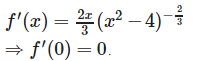
Also, for x < 0 (slightly) , f ‘(x) < 0 and for x > 0 (slightly) f ‘(x) >0. Hence f has a local minima at x = 0 .
The equation of the tangent to the curve y = e2x at the point (0, 1) is- a)1 – y = 2 x
- b)y – 1 = 2 x
- c)y + 1 = 2 x
- d)none of these
Correct answer is option 'B'. Can you explain this answer?
The equation of the tangent to the curve y = e2x at the point (0, 1) is
a)
1 – y = 2 x
b)
y – 1 = 2 x
c)
y + 1 = 2 x
d)
none of these
|
|
Sushant Khanna answered |
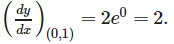
Hence equation of tangent to the given curve at (0 , 1) is :
(y−1) = 2(x−0),i.e..y−1 = 2x

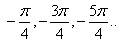
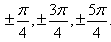


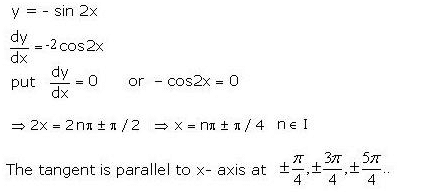
The normal at any point q to the curve x = a (cos q + q sin q), y = a (sin q – q cos q) is at distance from the origin that is equal to… .- a)a
- b)2a
- c)4a
- d)3a
Correct answer is option 'A'. Can you explain this answer?
The normal at any point q to the curve x = a (cos q + q sin q), y = a (sin q – q cos q) is at distance from the origin that is equal to… .
a)
a
b)
2a
c)
4a
d)
3a

|
Athul Yadav answered |
Clearly, dx/dy =tan q = slope of normal = −cotq
Equation of normal at θ' is y−a(sinq − qcosq) = −cotq(x−a(cosq + qsinq)
= ysinq − asin2q + aqcosqsinq
= −xcosq + acos2q + aqsinqcosq
= xcosq + ysinq = a
Equation of normal at θ' is y−a(sinq − qcosq) = −cotq(x−a(cosq + qsinq)
= ysinq − asin2q + aqcosqsinq
= −xcosq + acos2q + aqsinqcosq
= xcosq + ysinq = a
The points on the curve 4 y = |x2−4| at which tangents are parallel to x – axis, are- a)(4, 3) and (– 4, – 3)
- b)(0, 1) only
- c)(2, 0) and (– 2, 0)
- d)none of these
Correct answer is option 'B'. Can you explain this answer?
The points on the curve 4 y = |x2−4| at which tangents are parallel to x – axis, are
a)
(4, 3) and (– 4, – 3)
b)
(0, 1) only
c)
(2, 0) and (– 2, 0)
d)
none of these
|
|
Ameya Sengupta answered |
Given curve: 4y = |x-24|
To find the points on the curve at which tangents are parallel to the x-axis, we need to find the points where the slope of the tangent is zero (since the slope of the x-axis is zero).
First, let's find the derivative of the curve:
Differentiating both sides of the equation with respect to x, we get:
4(dy/dx) = d/dx |x-24|
To find the derivative of the absolute value function, we consider two cases: x-24 > 0 and x-24 <>
Case 1: x-24 > 0
In this case, the absolute value function simplifies to x-24. Taking the derivative, we get:
4(dy/dx) = d/dx (x-24)
4(dy/dx) = 1
Case 2: x-24 <>
In this case, the absolute value function simplifies to -(x-24). Taking the derivative, we get:
4(dy/dx) = d/dx (-(x-24))
4(dy/dx) = -1
Simplifying both cases, we get:
Case 1: dy/dx = 1/4
Case 2: dy/dx = -1/4
Now, let's find the points on the curve where the slope of the tangent is zero (parallel to the x-axis).
Setting dy/dx = 0, we get:
Case 1: 1/4 = 0 (No solution)
Case 2: -1/4 = 0 (No solution)
Therefore, there are no points on the curve where the tangents are parallel to the x-axis. Hence, the correct answer is option 'D' (none of these).
Note: It is important to carefully analyze the given curve and consider all possible cases when finding the points where tangents are parallel to a particular line. In this case, since the slope of the x-axis is zero, we need to find the points where the derivative is zero. However, after considering all cases, we find that there are no such points on the given curve.
To find the points on the curve at which tangents are parallel to the x-axis, we need to find the points where the slope of the tangent is zero (since the slope of the x-axis is zero).
First, let's find the derivative of the curve:
Differentiating both sides of the equation with respect to x, we get:
4(dy/dx) = d/dx |x-24|
To find the derivative of the absolute value function, we consider two cases: x-24 > 0 and x-24 <>
Case 1: x-24 > 0
In this case, the absolute value function simplifies to x-24. Taking the derivative, we get:
4(dy/dx) = d/dx (x-24)
4(dy/dx) = 1
Case 2: x-24 <>
In this case, the absolute value function simplifies to -(x-24). Taking the derivative, we get:
4(dy/dx) = d/dx (-(x-24))
4(dy/dx) = -1
Simplifying both cases, we get:
Case 1: dy/dx = 1/4
Case 2: dy/dx = -1/4
Now, let's find the points on the curve where the slope of the tangent is zero (parallel to the x-axis).
Setting dy/dx = 0, we get:
Case 1: 1/4 = 0 (No solution)
Case 2: -1/4 = 0 (No solution)
Therefore, there are no points on the curve where the tangents are parallel to the x-axis. Hence, the correct answer is option 'D' (none of these).
Note: It is important to carefully analyze the given curve and consider all possible cases when finding the points where tangents are parallel to a particular line. In this case, since the slope of the x-axis is zero, we need to find the points where the derivative is zero. However, after considering all cases, we find that there are no such points on the given curve.
The function f (x) = x2, for all real x, is- a)neither decreasing nor increasing
- b)Decreasing
- c)Increasing
- d)none of these
Correct answer is option 'A'. Can you explain this answer?
The function f (x) = x2, for all real x, is
a)
neither decreasing nor increasing
b)
Decreasing
c)
Increasing
d)
none of these

|
Pragati Patel answered |
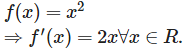
Since f ‘(x) = 2x > 0 for x > 0,and f ‘ (x) = 2x < 0 for x < 0 ,therefore on R , f is neither increasing nor decreasing. Infact , f is strict increasing on [0 , ∞) and strict decreasing on (- ∞,0].
If a differentiable function f (x) has a relative minimum at x = 0, then the function y = f (x) + a x + b has a relative minimum at x = 0 for- a)all b if a = 0
- b)all a > 0.
- c)all b > 0
- d)all a and all b
Correct answer is option 'A'. Can you explain this answer?
If a differentiable function f (x) has a relative minimum at x = 0, then the function y = f (x) + a x + b has a relative minimum at x = 0 for
a)
all b if a = 0
b)
all a > 0.
c)
all b > 0
d)
all a and all b

|
Manisha Choudhary answered |
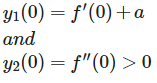
And y has a relative minimum at x = 0 if f ‘(0)+a = 0 . a =0.
Find the points of local maxima or minima for the function f(x) = x3.ex.- a)x=-3 is a point of local maxima
- b)x=-3 is a point of local minima
- c)x=0 is a point of local maxima
- d)x=0 is a point of local minima
Correct answer is option 'B'. Can you explain this answer?
Find the points of local maxima or minima for the function f(x) = x3.ex.
a)
x=-3 is a point of local maxima
b)
x=-3 is a point of local minima
c)
x=0 is a point of local maxima
d)
x=0 is a point of local minima
|
|
Gitanjali Tiwari answered |
Solution:
The given function is f(x) = x3.ex.
To find the points of local maxima or minima, we need to find the critical points of the function.
Critical points: The points where the derivative of the function is either zero or does not exist.
f'(x) = 3x2.ex + x3.ex
Let f'(x) = 0, then
3x2.ex + x3.ex = 0
x2(ex + x) = 0
x = 0 or x = -ex
Now, we need to check the nature of critical points using the second derivative test.
f''(x) = 6x.ex + 6x2.ex + 2x3.ex
At x = 0,
f''(0) = 0
Thus, x = 0 is not a point of local maxima or minima.
At x = -ex,
f''(-ex) = 6(-ex).ex + 6(-ex)2.ex + 2(-ex)3.ex
f''(-ex) = -2ex3 <>
Thus, x = -ex is a point of local maxima.
Hence, option B is the correct answer.
Note: The second derivative test is used to determine the nature of critical points. If f''(x) > 0, then the critical point is a point of local minima. If f''(x) < 0,="" then="" the="" critical="" point="" is="" a="" point="" of="" local="" maxima.="" if="" f''(x)="0," then="" the="" test="" is="" inconclusive.="" 0,="" then="" the="" critical="" point="" is="" a="" point="" of="" local="" maxima.="" if="" f''(x)="0," then="" the="" test="" is="">
The given function is f(x) = x3.ex.
To find the points of local maxima or minima, we need to find the critical points of the function.
Critical points: The points where the derivative of the function is either zero or does not exist.
f'(x) = 3x2.ex + x3.ex
Let f'(x) = 0, then
3x2.ex + x3.ex = 0
x2(ex + x) = 0
x = 0 or x = -ex
Now, we need to check the nature of critical points using the second derivative test.
f''(x) = 6x.ex + 6x2.ex + 2x3.ex
At x = 0,
f''(0) = 0
Thus, x = 0 is not a point of local maxima or minima.
At x = -ex,
f''(-ex) = 6(-ex).ex + 6(-ex)2.ex + 2(-ex)3.ex
f''(-ex) = -2ex3 <>
Thus, x = -ex is a point of local maxima.
Hence, option B is the correct answer.
Note: The second derivative test is used to determine the nature of critical points. If f''(x) > 0, then the critical point is a point of local minima. If f''(x) < 0,="" then="" the="" critical="" point="" is="" a="" point="" of="" local="" maxima.="" if="" f''(x)="0," then="" the="" test="" is="" inconclusive.="" 0,="" then="" the="" critical="" point="" is="" a="" point="" of="" local="" maxima.="" if="" f''(x)="0," then="" the="" test="" is="">



Chapter doubts & questions for Application of Derivatives - 3 Months Class 12 Board Preparation (Non-Medical) 2026 is part of JEE exam preparation. The chapters have been prepared according to the JEE exam syllabus. The Chapter doubts & questions, notes, tests & MCQs are made for JEE 2026 Exam. Find important definitions, questions, notes, meanings, examples, exercises, MCQs and online tests here.
Chapter doubts & questions of Application of Derivatives - 3 Months Class 12 Board Preparation (Non-Medical) in English & Hindi are available as part of JEE exam.
Download more important topics, notes, lectures and mock test series for JEE Exam by signing up for free.
3 Months Class 12 Board Preparation (Non-Medical)
222 videos|860 docs|277 tests
|
