


All Exams >
NEET >
30-Day Revision Course for NEET >
All Questions
All questions of Current Electricity for NEET Exam
A wire of resistance 12 Ωm-1 is bent to form a complete circle of radius 10 cm. The resistance between its two diametrically opposite point, A and B as shown in the figure, is [2009]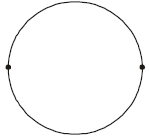
- a)3Ω
- b)6π Ω
- c)6Ω
- d)0. 6π Ω
Correct answer is option 'D'. Can you explain this answer?
A wire of resistance 12 Ωm-1 is bent to form a complete circle of radius 10 cm. The resistance between its two diametrically opposite point, A and B as shown in the figure, is [2009]
a)
3Ω
b)
6π Ω
c)
6Ω
d)
0. 6π Ω
|
|
Ram Mohith answered |
The two halves (or semicircles) are in parallel combination.
Length of each part is πr = π(0.1) m
Resistance of each part = 12(0.1π) = 1.2π
We know that when two equal resistance are kept in parallel the equivalent resistance will be half of any one resistance. So, the equivalent resistance between A and B is 0.6π
Length of each part is πr = π(0.1) m
Resistance of each part = 12(0.1π) = 1.2π
We know that when two equal resistance are kept in parallel the equivalent resistance will be half of any one resistance. So, the equivalent resistance between A and B is 0.6π

In a meter bridge experiment a balance point is obtained at a distance of 60 cm from the left end when unknown resistance R is in a left gap and 8 ohms resistor is connected in the right gap. When the position of R and 8 ohm resistor is interchanged the balance point will be at distance of- a)40 cm
- b)30 cm
- c)50 cm
- d)60 cm
Correct answer is option 'A'. Can you explain this answer?
In a meter bridge experiment a balance point is obtained at a distance of 60 cm from the left end when unknown resistance R is in a left gap and 8 ohms resistor is connected in the right gap. When the position of R and 8 ohm resistor is interchanged the balance point will be at distance of
a)
40 cm
b)
30 cm
c)
50 cm
d)
60 cm

|
Jyoti Sengupta answered |
60/40 = l/100-l, = R/8
so R=12
now changed position 8 is proportional to l and 12 to (100-l)
8/12 = l/100-l
l = 40ohm
Consider the following two statements:
(a) Kirchhoff's junction law follows from the conservation of charge.
(b) Kirchhoff's loop law follows from the conservation of energy.Which of the following is correct? [2010]- a)Both (a) and (b) are wrong
- b)(a) is correct and (b) is wrong
- c)(a) is wrong and (b) is correct
- d)Both (a) and (b) are correct
Correct answer is option 'D'. Can you explain this answer?
Consider the following two statements:
(a) Kirchhoff's junction law follows from the conservation of charge.
(b) Kirchhoff's loop law follows from the conservation of energy.
(a) Kirchhoff's junction law follows from the conservation of charge.
(b) Kirchhoff's loop law follows from the conservation of energy.
Which of the following is correct? [2010]
a)
Both (a) and (b) are wrong
b)
(a) is correct and (b) is wrong
c)
(a) is wrong and (b) is correct
d)
Both (a) and (b) are correct

|
Nayanika Reddy answered |
Junction law follows from conservation
of charge and loop law is the conservation
of energy
of charge and loop law is the conservation
of energy
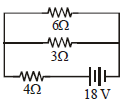
The total power dissipated in watts in the circuit shown here is [2007]
- a)40
- b)54
- c)4
- d)16
Correct answer is option 'B'. Can you explain this answer?
The total power dissipated in watts in the circuit shown here is [2007]
a)
40
b)
54
c)
4
d)
16

|
Ashwini Khanna answered |
The resistance of 6Ω and 3Ω are in parallel in the given circuit, their equivalent resistance is

In the circuit shown in the figure, if the potential at point A is taken to be zero, the potential at point B is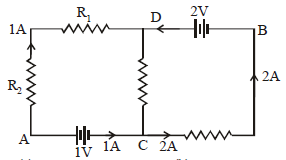
- a)–1V
- b)+ 2V
- c)–2V
- d)+ 1V
Correct answer is option 'D'. Can you explain this answer?
In the circuit shown in the figure, if the potential at point A is taken to be zero, the potential at point B is
a)
–1V
b)
+ 2V
c)
–2V
d)
+ 1V

|
Riya Banerjee answered |
Current from D to C = 1A
∴ VD – VC = 2 × 1 = 2V
VA = 0 ∴ VC = 1V, ∴ VD – VC = 2
⇒VD – 1 = 2 ∴ VD = 3V
∴ VD – VB = 2 ∴ 3 – VB = 2 ∴ VB = 1V
∴ VD – VC = 2 × 1 = 2V
VA = 0 ∴ VC = 1V, ∴ VD – VC = 2
⇒VD – 1 = 2 ∴ VD = 3V
∴ VD – VB = 2 ∴ 3 – VB = 2 ∴ VB = 1V
The Wheatstone bridge is balanced for four resistors R1,R2,R3 and R4 with a cell of emf 1.46 V. The cell is now replaced by another cell of emf 1.08 V. To obtain the balance again
- a)All the four resistance should be changed
- b)Both the resistance R1 and R4 should be changed
- c)No resistance needs to be changed
- d)Resistance R4 should be changed only
Correct answer is option 'C'. Can you explain this answer?
The Wheatstone bridge is balanced for four resistors R1,R2,R3 and R4 with a cell of emf 1.46 V. The cell is now replaced by another cell of emf 1.08 V. To obtain the balance again
a)
All the four resistance should be changed
b)
Both the resistance R1 and R4 should be changed
c)
No resistance needs to be changed
d)
Resistance R4 should be changed only

|
Neha Sharma answered |
The balance point of the Wheatstone’s bridge is determined by the ratio of the resistances. The change in the emf of the external battery will have no effect on the balance point.
Explanation:
- Initial Balanced Wheatstone Bridge: In the initial balanced Wheatstone bridge configuration, the emf of the cell is 1.46 V and all four resistors R1, R2, R3, and R4 are set to specific values to achieve balance.
- Replacement of Cell: When the cell is replaced by another cell with an emf of 1.08 V, the balance of the Wheatstone bridge is disrupted.
- Requirement for Rebalancing: In order to rebalance the Wheatstone bridge with the new cell of emf 1.08 V, no resistance needs to be changed.
- Reasoning: The balance of the Wheatstone bridge is determined by the ratio of the resistances in the bridge arms and not by the absolute values of the resistances. As long as the ratio of the resistances remains the same, the balance will be maintained regardless of the emf of the cell.
- Conclusion: Therefore, in this scenario, no resistance needs to be changed to obtain the balance again with the new cell of emf 1.08 V.


A ring is made of a wire having a resistance R0 = 12 Ω. Find the points A and B as shown in the figure, at which a current carrying conductor should be connected so that the resistance R of the sub-circuit between these points is equal to 8/3 Ω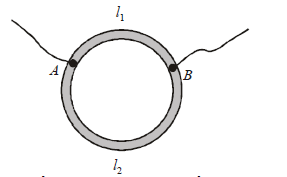
- a)

- b)

- c)

- d)

Correct answer is option 'D'. Can you explain this answer?
A ring is made of a wire having a resistance R0 = 12 Ω. Find the points A and B as shown in the figure, at which a current carrying conductor should be connected so that the resistance R of the sub-circuit between these points is equal to 8/3 Ω
a)
b)
c)
d)

|
EduRev JEE answered |
Let x is the resistance per unit length then
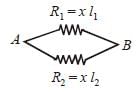
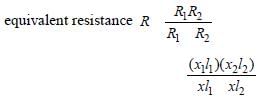
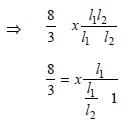
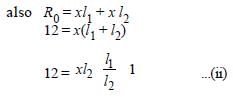
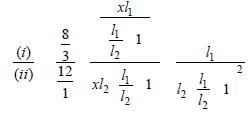
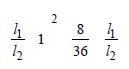
(y2 + 1 + 2y) × 8/36 y (where y l1/l2

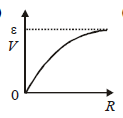
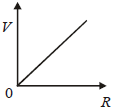

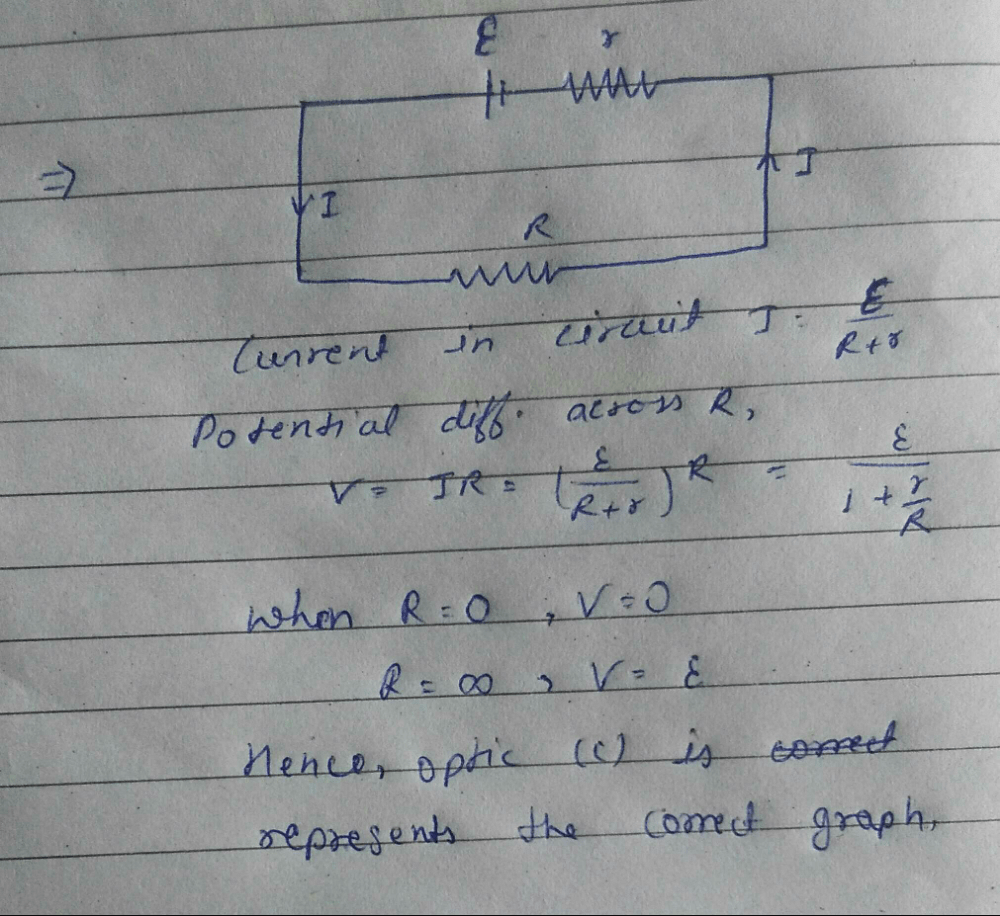
Potentiometer measures the potential difference more accurately than a voltmeter, because- a)It draws a heavy current from external circuit.
- b)It does not draw current from external circuit.
- c)it has a wire of low resistance.
- d)it has a wire of high resistance
Correct answer is option 'B'. Can you explain this answer?
Potentiometer measures the potential difference more accurately than a voltmeter, because
a)
It draws a heavy current from external circuit.
b)
It does not draw current from external circuit.
c)
it has a wire of low resistance.
d)
it has a wire of high resistance

|
Amar Pillai answered |
Explanation:Potentiometer measures the potential difference using null deflection method, where no current is drawn from the cell; whereas voltmeter needs a small current to show deflection. So, accurate measurement of p.d is done using a potentiometer.

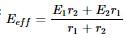
A voltmeter has a resistance of G ohm and range V volt. The value of resistance used in series to convert it into voltmeter of range nV volt is- a)nG
- b)(n−1)G
- c)G/n
- d)G/(n−1)
Correct answer is option 'B'. Can you explain this answer?
A voltmeter has a resistance of G ohm and range V volt. The value of resistance used in series to convert it into voltmeter of range nV volt is
a)
nG
b)
(n−1)G
c)
G/n
d)
G/(n−1)
|
|
Avantika Mehta answered |
Understanding Voltmeter Conversion
To convert a voltmeter of range V volts into a voltmeter of range nV volts, we need to consider the resistance of the voltmeter and the additional resistance required in series.
Principle of Operation
- A voltmeter measures the potential difference across its terminals.
- When converting to a higher range, we add a series resistance to ensure that the voltmeter can handle the increased voltage without damaging its internal components.
Given Parameters
- Resistance of the voltmeter = G ohm
- Original range of the voltmeter = V volts
- New desired range = nV volts
Calculating Series Resistance
1. Voltage Division: When a voltmeter with resistance G is connected in series with another resistance R, the voltage drop across the voltmeter is a fraction of the total voltage.
2. Using Voltage Ratios: The voltage across the voltmeter can be given by the ratio:
- V / (V + R) = G / (G + R)
3. Setting Up the Equation: For the new range of nV:
- nV / (nV + R) = G / (G + R)
4. Solving for R: Rearranging gives us:
- R = (n-1)G
This means the resistance required in series to achieve the desired range of nV volts is (n - 1)G ohms.
Conclusion
Thus, the correct answer for the resistance used in series to convert the voltmeter into one of range nV volts is option B: (n - 1)G. This ensures proper functioning and safety of the voltmeter under higher voltage conditions.
To convert a voltmeter of range V volts into a voltmeter of range nV volts, we need to consider the resistance of the voltmeter and the additional resistance required in series.
Principle of Operation
- A voltmeter measures the potential difference across its terminals.
- When converting to a higher range, we add a series resistance to ensure that the voltmeter can handle the increased voltage without damaging its internal components.
Given Parameters
- Resistance of the voltmeter = G ohm
- Original range of the voltmeter = V volts
- New desired range = nV volts
Calculating Series Resistance
1. Voltage Division: When a voltmeter with resistance G is connected in series with another resistance R, the voltage drop across the voltmeter is a fraction of the total voltage.
2. Using Voltage Ratios: The voltage across the voltmeter can be given by the ratio:
- V / (V + R) = G / (G + R)
3. Setting Up the Equation: For the new range of nV:
- nV / (nV + R) = G / (G + R)
4. Solving for R: Rearranging gives us:
- R = (n-1)G
This means the resistance required in series to achieve the desired range of nV volts is (n - 1)G ohms.
Conclusion
Thus, the correct answer for the resistance used in series to convert the voltmeter into one of range nV volts is option B: (n - 1)G. This ensures proper functioning and safety of the voltmeter under higher voltage conditions.
A piece of copper and another of germanium are cooled from room temperature to 80K. The resistance- a)of each of them decreases
- b)of each of them increases
- c)copper increases and that of germanium decreases
- d)copper decreases and that of germanium increases
Correct answer is option 'D'. Can you explain this answer?
A piece of copper and another of germanium are cooled from room temperature to 80K. The resistance
a)
of each of them decreases
b)
of each of them increases
c)
copper increases and that of germanium decreases
d)
copper decreases and that of germanium increases

|
Pranjal Pillai answered |
Explanation:Copper is a conductor and we know that for conductors, resistance is directly proprtional to temperature. Therefore on decreasing temperature resistance also decreases.Whereas, germanium is a semiconductor and for semiconductors, resistance is inversely proportional to temperature. So on decreasing temperature resistance increases.
In a metre bridge experiment, null point is obtained at 20 cm from one end of the wire when resistance X is balanced against another resistance Y. If X<Y, then where will be the new position of the null point from the same end, if one decides to balance a resistance of 4X against Y ?- a)50 cm
- b)80 cm
- c)40 cm
- d)70 cm
Correct answer is option 'A'. Can you explain this answer?
In a metre bridge experiment, null point is obtained at 20 cm from one end of the wire when resistance X is balanced against another resistance Y. If X<Y, then where will be the new position of the null point from the same end, if one decides to balance a resistance of 4X against Y ?
a)
50 cm
b)
80 cm
c)
40 cm
d)
70 cm
|
|
Pranab Kapoor answered |
Understanding the Metre Bridge Experiment
In a metre bridge experiment, the balance point (null point) indicates the equality of the ratios of resistances. Here’s a detailed explanation of how to determine the new null point when balancing different resistances.
Initial Setup
- A null point is found at 20 cm from one end of the wire when resistance X is balanced against resistance Y.
- This can be expressed as:
(X / Y) = (Length from one end / Length from the other end)
Thus, (X / Y) = (20 cm / 80 cm) = 1/4.
- Given that X < y,="" we="" can="" infer="" that="" x="">
New Resistance Balancing
- Now, we are tasked with balancing a resistance of 4X against Y.
- The new equation becomes (4X / Y) = (Length from one end / Length from the other end).
Calculating New Null Point
- From the previous relationship, we know that X = (1/4)Y, therefore:
4X = 4 * (1/4)Y = Y.
- This implies that when balancing 4X against Y, they are equal.
- Hence, the new null point would be halfway along the bridge length, which is at 50 cm from one end.
Conclusion
- Therefore, when balancing a resistance of 4X against Y, the new null point will be at 50 cm from the original end.
- Thus, the correct answer is option a) 50 cm.
In a metre bridge experiment, the balance point (null point) indicates the equality of the ratios of resistances. Here’s a detailed explanation of how to determine the new null point when balancing different resistances.
Initial Setup
- A null point is found at 20 cm from one end of the wire when resistance X is balanced against resistance Y.
- This can be expressed as:
(X / Y) = (Length from one end / Length from the other end)
Thus, (X / Y) = (20 cm / 80 cm) = 1/4.
- Given that X < y,="" we="" can="" infer="" that="" x="">
New Resistance Balancing
- Now, we are tasked with balancing a resistance of 4X against Y.
- The new equation becomes (4X / Y) = (Length from one end / Length from the other end).
Calculating New Null Point
- From the previous relationship, we know that X = (1/4)Y, therefore:
4X = 4 * (1/4)Y = Y.
- This implies that when balancing 4X against Y, they are equal.
- Hence, the new null point would be halfway along the bridge length, which is at 50 cm from one end.
Conclusion
- Therefore, when balancing a resistance of 4X against Y, the new null point will be at 50 cm from the original end.
- Thus, the correct answer is option a) 50 cm.
See the electric circuit shown in the figure.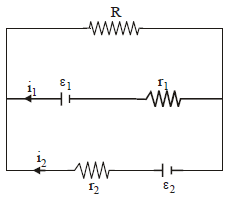 Which of the following equations is a correct equation for it? [2009]
- a)ε2 – i2 r2 – ε1 – i1 r1 = 0
- b)-ε2 – (i1 + i2) R+ i2 r2 = 0
- c)ε1 – (i1 + i2) R + i1 r1 = 0
- d)ε1 – (i1 + i2) R– i1 r1 = 0
Correct answer is option 'D'. Can you explain this answer?
See the electric circuit shown in the figure.
Which of the following equations is a correct equation for it? [2009]
a)
ε2 – i2 r2 – ε1 – i1 r1 = 0
b)
-ε2 – (i1 + i2) R+ i2 r2 = 0
c)
ε1 – (i1 + i2) R + i1 r1 = 0
d)
ε1 – (i1 + i2) R– i1 r1 = 0

|
Shanaya Rane answered |
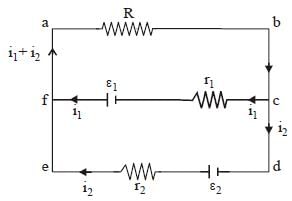
Applying Kirchhoff ’s rule in loop abcfa
ε1 – (i1 + i2) R – i1 r1 = 0.
ε1 – (i1 + i2) R – i1 r1 = 0.
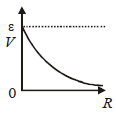
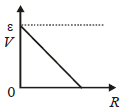
A student measures the terminal potentialdifference (V) of a cell (of emf E and internalresistance r) as a function of the current (I)flowing through it. The slope and intercept, ofthe graph between V and I, then, respectively,equal: [2009]- a)– r and E
- b)r and – E
- c)– E and r
- d)E and – r
Correct answer is option 'A'. Can you explain this answer?
A student measures the terminal potentialdifference (V) of a cell (of emf E and internalresistance r) as a function of the current (I)flowing through it. The slope and intercept, ofthe graph between V and I, then, respectively,equal: [2009]
a)
– r and E
b)
r and – E
c)
– E and r
d)
E and – r

|
Madhavan Patel answered |
The slope of the graph between V and I represents the internal resistance of the cell, r. This is because according to Ohm's Law, V = E - Ir, where E is the emf of the cell. Rearranging this equation, we get Ir = E - V, which shows that the current I is directly proportional to the difference between the emf and the terminal potential difference. Therefore, the slope of the graph is equal to the internal resistance, r.
The intercept of the graph represents the emf of the cell, E. This is because when the current I is zero, the equation V = E - Ir simplifies to V = E, meaning that the terminal potential difference is equal to the emf. Therefore, the intercept of the graph is equal to the emf, E.
The intercept of the graph represents the emf of the cell, E. This is because when the current I is zero, the equation V = E - Ir simplifies to V = E, meaning that the terminal potential difference is equal to the emf. Therefore, the intercept of the graph is equal to the emf, E.
A milli voltmeter of 25 milli volt range is to beconverted into an ammeter of 25 ampere range.The value (in ohm) of necessary shunt will be :[2012]- a)0.001
- b)0.01
- c)1
- d)0.05
Correct answer is option 'A'. Can you explain this answer?
A milli voltmeter of 25 milli volt range is to beconverted into an ammeter of 25 ampere range.The value (in ohm) of necessary shunt will be :[2012]
a)
0.001
b)
0.01
c)
1
d)
0.05

|
Rohan Unni answered |
Galvanometer is converted into ammeter,
by connected a shunt, in parallel with it.
by connected a shunt, in parallel with it.
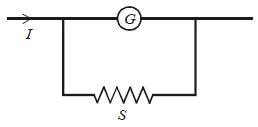
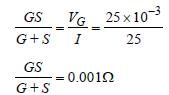
Here S << G so
S = 0.001 Ω
S = 0.001 Ω
A cell can be balanced against 110 cm and 100cm of potentiometer wire, respectively with andwithout being short circuited through aresistance of 10Ω. Its internal resistance is [2008]- a)1.0 ohm
- b)0.5 ohm
- c)2.0 ohm
- d)zero
Correct answer is option 'A'. Can you explain this answer?
A cell can be balanced against 110 cm and 100cm of potentiometer wire, respectively with andwithout being short circuited through aresistance of 10Ω. Its internal resistance is [2008]
a)
1.0 ohm
b)
0.5 ohm
c)
2.0 ohm
d)
zero

|
Krish Khanna answered |
Here  hence the lengths 110 cm
and 100 cm are interchanged.
Without being short-circuited through R,
only the battery E is balanced.
hence the lengths 110 cmand 100 cm are interchanged.
Without being short-circuited through R,
only the battery E is balanced.
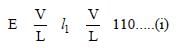
When R is connected across E, Ri, V/L, l2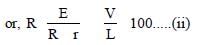
Dividing (i) by (ii), we get

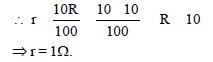
or, 100 R + 100 r = 110 R
or, 10 R = 100 r
or, 10 R = 100 r
Three resistances P, Q, R each of 2Ω and anunknown resistance S form the four arms of a Wheatstone bridge circuit. When a resistanceof 6Ω is connected in parallel to S the bridgegets balanced. What is the value of S? [2007]- a)3Ω
- b)6Ω
- c)1Ω
- d)2Ω
Correct answer is option 'A'. Can you explain this answer?
Three resistances P, Q, R each of 2Ω and anunknown resistance S form the four arms of a Wheatstone bridge circuit. When a resistanceof 6Ω is connected in parallel to S the bridgegets balanced. What is the value of S? [2007]
a)
3Ω
b)
6Ω
c)
1Ω
d)
2Ω

|
Moumita Khanna answered |
A balanced wheatstone bridge simply
requires
requires
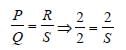
Therefore, S should be 2Ω.
A resistance of 6Ω is connected in parallel.
In parallel combination,
A resistance of 6Ω is connected in parallel.
In parallel combination,

The resistance of an ammeter is 13 Ω and itsscale is graduated for a current upto 100 amps.After an additional shunt has been connectedto this ammeter it becomes possible to measurecurrents upto 750 amperes by this meter. Thevalue of shunt-resistance is [2007]- a)2 Ω
- b)0.2 Ω
- c)2 k Ω
- d)20 Ω
Correct answer is option 'A'. Can you explain this answer?
The resistance of an ammeter is 13 Ω and itsscale is graduated for a current upto 100 amps.After an additional shunt has been connectedto this ammeter it becomes possible to measurecurrents upto 750 amperes by this meter. Thevalue of shunt-resistance is [2007]
a)
2 Ω
b)
0.2 Ω
c)
2 k Ω
d)
20 Ω

|
Vaibhav Basu answered |
We know
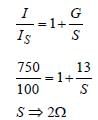
The ratio of the resistance of conductor at temperature 15°C to its resistance at temperature 37.5°C is 4:5 . The temperature coefficient of resistance of the conductor is -- a) 1/20 ºC-1
- b) 1/50 ºC-1
- c)1/80 ºC-1
- d) 1/75 ºC-1
Correct answer is option 'D'. Can you explain this answer?
The ratio of the resistance of conductor at temperature 15°C to its resistance at temperature 37.5°C is 4:5 . The temperature coefficient of resistance of the conductor is -
a)
1/20 ºC-1
b)
1/50 ºC-1
c)
1/80 ºC-1
d)
1/75 ºC-1

|
Rohan Pillai answered |
Understanding Resistance and Temperature Relationship
The resistance of a conductor changes with temperature, which can be described by the formula:
R(T) = R0(1 + α(T - T0))
Where:
- R(T) = Resistance at temperature T
- R0 = Resistance at a reference temperature T0
- α = Temperature coefficient of resistance
- T = New temperature
- T0 = Reference temperature
Given Data
- Resistance ratio at 15°C and 37.5°C is 4:5.
- Let R1 = Resistance at 15°C and R2 = Resistance at 37.5°C.
From the ratio, we can express it as:
R1/R2 = 4/5
This leads to:
R2 = (5/4) R1
Applying the Resistance Formula
Using the resistance formula for both temperatures:
R1 = R0(1 + α(15 - T0))
R2 = R0(1 + α(37.5 - T0))
Substituting R2 into the resistance ratio:
R0(1 + α(15 - T0)) / R0(1 + α(37.5 - T0)) = 4/5
This simplifies to:
(1 + α(15 - T0)) / (1 + α(37.5 - T0)) = 4/5
Solving for Temperature Coefficient (α)
Cross-multiplying gives:
5(1 + α(15 - T0)) = 4(1 + α(37.5 - T0))
Expanding both sides:
5 + 5α(15 - T0) = 4 + 4α(37.5 - T0)
Rearranging leads to:
α(5(15 - T0) - 4(37.5 - T0)) = -1
Solving for α leads us to find:
α = -1 / (5(15 - T0) - 4(37.5 - T0))
When T0 is taken as 0°C, we find:
α = -1/75 °C^-1
Conclusion
The temperature coefficient of resistance of the conductor is indeed -1/75 °C^-1, confirming that option 'D' is the correct answer.
The resistance of a conductor changes with temperature, which can be described by the formula:
R(T) = R0(1 + α(T - T0))
Where:
- R(T) = Resistance at temperature T
- R0 = Resistance at a reference temperature T0
- α = Temperature coefficient of resistance
- T = New temperature
- T0 = Reference temperature
Given Data
- Resistance ratio at 15°C and 37.5°C is 4:5.
- Let R1 = Resistance at 15°C and R2 = Resistance at 37.5°C.
From the ratio, we can express it as:
R1/R2 = 4/5
This leads to:
R2 = (5/4) R1
Applying the Resistance Formula
Using the resistance formula for both temperatures:
R1 = R0(1 + α(15 - T0))
R2 = R0(1 + α(37.5 - T0))
Substituting R2 into the resistance ratio:
R0(1 + α(15 - T0)) / R0(1 + α(37.5 - T0)) = 4/5
This simplifies to:
(1 + α(15 - T0)) / (1 + α(37.5 - T0)) = 4/5
Solving for Temperature Coefficient (α)
Cross-multiplying gives:
5(1 + α(15 - T0)) = 4(1 + α(37.5 - T0))
Expanding both sides:
5 + 5α(15 - T0) = 4 + 4α(37.5 - T0)
Rearranging leads to:
α(5(15 - T0) - 4(37.5 - T0)) = -1
Solving for α leads us to find:
α = -1 / (5(15 - T0) - 4(37.5 - T0))
When T0 is taken as 0°C, we find:
α = -1/75 °C^-1
Conclusion
The temperature coefficient of resistance of the conductor is indeed -1/75 °C^-1, confirming that option 'D' is the correct answer.

According to Kirchhoff’s Loop Rule
- a)The absolute sum of changes in potential around any closed loop must be same.
- b)The algebraic sum of changes in potential around any closed loop must be negative.
- c)The algebraic sum of changes in potential around any closed loop must be positive.
- d)The algebraic sum of changes in potential around any closed loop must be zero.
Correct answer is option 'D'. Can you explain this answer?
According to Kirchhoff’s Loop Rule
a)
The absolute sum of changes in potential around any closed loop must be same.
b)
The algebraic sum of changes in potential around any closed loop must be negative.
c)
The algebraic sum of changes in potential around any closed loop must be positive.
d)
The algebraic sum of changes in potential around any closed loop must be zero.

|
Neha Chauhan answered |
Kirchhoff’s loop rule is based on the principle of conservation of energy. The work done in transporting a charge in a closed loop is zero. The algebraic sum ( since potential differences can be both positive and negative) of potential differences around any closed loop is always zero.
A galvanometer of resistance 50 Ω is connectedto battery of 3V along with a resistance of 2950 Ωin series. A full scale deflection of 30 divisions isobtained in the galvanometer. In order to reducethis deflection to 20 divisions, the resistance inseries should be [2008]- a)5050 Ω
- b)5550 Ω
- c)6050 Ω
- d)4450 Ω
Correct answer is option 'D'. Can you explain this answer?
A galvanometer of resistance 50 Ω is connectedto battery of 3V along with a resistance of 2950 Ωin series. A full scale deflection of 30 divisions isobtained in the galvanometer. In order to reducethis deflection to 20 divisions, the resistance inseries should be [2008]
a)
5050 Ω
b)
5550 Ω
c)
6050 Ω
d)
4450 Ω

|
Nilanjan Chakraborty answered |
Total internal resistance = (50+2950)Ω
= 3000 Ω
Emf of the cell, ε = 3V
= 3000 Ω
Emf of the cell, ε = 3V
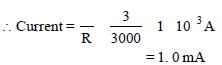
Current for full scale deflection of 30
divisions is 1.0 mA.
∴ Current for a deflection of 20 divisions
divisions is 1.0 mA.
∴ Current for a deflection of 20 divisions

Let the resistance be x Ω. Then
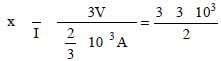
= 4500 Ω
But the resistance of the galvanometer
is 50Ω
∴ Resistance to be added
= (4500 –50) Ω= 4450 Ω
But the resistance of the galvanometer
is 50Ω
∴ Resistance to be added
= (4500 –50) Ω= 4450 Ω
In producing chlorine by electrolysis 100 kWpower at 125 V is being consumed. How muchchlorine per minute is liberated? (E.C.E. ofchlorine is 0.367×10⁻⁶ kg / C) [2010]- a)1.76 × 10⁻³ kg
- b)9.67 × 10. kg
- c)17.61 × 10⁻³ kg
- d)3.67 × 10⁻³ kg
Correct answer is option 'C'. Can you explain this answer?
In producing chlorine by electrolysis 100 kWpower at 125 V is being consumed. How muchchlorine per minute is liberated? (E.C.E. ofchlorine is 0.367×10⁻⁶ kg / C) [2010]
a)
1.76 × 10⁻³ kg
b)
9.67 × 10. kg
c)
17.61 × 10⁻³ kg
d)
3.67 × 10⁻³ kg

|
Srishti Chavan answered |
Calculation:
Given:
Power = 100 kW = 100,000 W
Voltage = 125 V
Charge of 1 mole of electrons (1 F) = 96500 C
E.C.E. of chlorine = 0.367 × 10⁻⁶ kg / C
Step 1: Calculate the charge consumed
Power (P) = Voltage (V) × Current (I)
Current (I) = P / V = 100,000 W / 125 V = 800 A
Step 2: Calculate the charge consumed per second
Charge (Q) = Current (I) × Time (t)
As power is given in kW and we need to find the amount per minute, convert time to seconds.
Time (t) = 1 minute = 60 seconds
Charge per second = 800 A × 60 s = 48,000 C
Step 3: Calculate the amount of chlorine liberated per second
Amount of chlorine liberated per second = E.C.E. of chlorine × Charge per second
= 0.367 × 10⁻⁶ kg / C × 48,000 C
= 17.616 × 10⁻³ kg
Step 4: Calculate the amount of chlorine liberated per minute
Amount of chlorine liberated per minute = Amount per second × 60
= 17.616 × 10⁻³ kg/s × 60 s
= 17.616 × 10⁻³ kg/min
= 17.61 × 10⁻³ kg/min
Therefore, the amount of chlorine liberated per minute is 17.61 × 10⁻³ kg, which is option C.
Given:
Power = 100 kW = 100,000 W
Voltage = 125 V
Charge of 1 mole of electrons (1 F) = 96500 C
E.C.E. of chlorine = 0.367 × 10⁻⁶ kg / C
Step 1: Calculate the charge consumed
Power (P) = Voltage (V) × Current (I)
Current (I) = P / V = 100,000 W / 125 V = 800 A
Step 2: Calculate the charge consumed per second
Charge (Q) = Current (I) × Time (t)
As power is given in kW and we need to find the amount per minute, convert time to seconds.
Time (t) = 1 minute = 60 seconds
Charge per second = 800 A × 60 s = 48,000 C
Step 3: Calculate the amount of chlorine liberated per second
Amount of chlorine liberated per second = E.C.E. of chlorine × Charge per second
= 0.367 × 10⁻⁶ kg / C × 48,000 C
= 17.616 × 10⁻³ kg
Step 4: Calculate the amount of chlorine liberated per minute
Amount of chlorine liberated per minute = Amount per second × 60
= 17.616 × 10⁻³ kg/s × 60 s
= 17.616 × 10⁻³ kg/min
= 17.61 × 10⁻³ kg/min
Therefore, the amount of chlorine liberated per minute is 17.61 × 10⁻³ kg, which is option C.
A steady current of 1.5 amp flows through acopper voltameter for 10 minutes. If the electrochemical equivalent of copper is30 × 10–5 g coulomb–1, the mass of copperdeposited on the electrode will be [2007]- a)0.50 g
- b)0.67 g
- c)0.27 g
- d)0.40 g.
Correct answer is option 'C'. Can you explain this answer?
A steady current of 1.5 amp flows through acopper voltameter for 10 minutes. If the electrochemical equivalent of copper is30 × 10–5 g coulomb–1, the mass of copperdeposited on the electrode will be [2007]
a)
0.50 g
b)
0.67 g
c)
0.27 g
d)
0.40 g.

|
Arya Khanna answered |
We have, m = ZIt
where, Z is the electrochemical equivalent
of copper.
⇒ m = 30 x10-5 x1.5 x10 x 60
= 0.27 gm.
where, Z is the electrochemical equivalent
of copper.
⇒ m = 30 x10-5 x1.5 x10 x 60
= 0.27 gm.
The thermo e.m.f E in volts of a certain thermocouple is found to vary with temperature difference θ in °C between the two junctions according to the relation The neutral temperature for the thermocouplewill be
- a)30° C
- b)450° C
- c)400 ° C
- d)225° C
Correct answer is option 'D'. Can you explain this answer?
The thermo e.m.f E in volts of a certain thermocouple is found to vary with temperature difference θ in °C between the two junctions according to the relation
The neutral temperature for the thermocouplewill be
a)
30° C
b)
450° C
c)
400 ° C
d)
225° C

|
Rajeev Sharma answered |

For neutral temperature, 
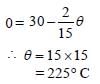
Hence, neutral temperature is 225°C.
The sensitivity of the potentiometer can be increased by:- a)increasing the length of potentiometer wire.
- b)increasing the e.m.f. of primary cell.
- c)decreasing the length of potentiometer wire.
- d)increasing the potential gradient.
Correct answer is option 'A'. Can you explain this answer?
The sensitivity of the potentiometer can be increased by:
a)
increasing the length of potentiometer wire.
b)
increasing the e.m.f. of primary cell.
c)
decreasing the length of potentiometer wire.
d)
increasing the potential gradient.

|
Anjali Reddy answered |
Explanation:A potentiometer is considered to be sensitive if the potential gradient dV/dl is low. Such a potentiometer can measure very small changes in potential difference. Increasing the length of the potentiometer wire decreases the potential gradient. Its sensitivity increases. Increasing potential gradient decreases the sensitivity. increasing the emf of the primary cell and by decreasing the length, potential gradient increases.
In a potentiometer experiment, for measuring internal resistance of a cell, the balance point has been obtained on the fourth wire. The balance point can be shifted to fifth wire by- a)increasing the current due to auxiliary battery
- b)Putting a shunt resistance in parallel with the cell.
- c)decreasing the current due to auxiliary battery
- d)putting a suitable resistance in series with the cell.
Correct answer is option 'C'. Can you explain this answer?
In a potentiometer experiment, for measuring internal resistance of a cell, the balance point has been obtained on the fourth wire. The balance point can be shifted to fifth wire by
a)
increasing the current due to auxiliary battery
b)
Putting a shunt resistance in parallel with the cell.
c)
decreasing the current due to auxiliary battery
d)
putting a suitable resistance in series with the cell.
|
|
Pranjal Pillai answered |
Explanation:If the current due to the auxillary battery is decreased, the potential gradient will be decreases, so the balancing length increases.Thus null point will move to fifth wire.
If the length of the filament of a heater is reduced by 10% the power of the heater will- a)increase by about 11%
- b)increase by about 19%
- c)decrease by about 29%
- d)Increase by about 9%
Correct answer is option 'A'. Can you explain this answer?
If the length of the filament of a heater is reduced by 10% the power of the heater will
a)
increase by about 11%
b)
increase by about 19%
c)
decrease by about 29%
d)
Increase by about 9%

|
Top Rankers answered |
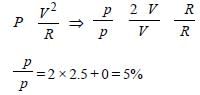
Power P= V2/R
If length is reduced by 10% then, new resistance of filament will be R′.
R′ = R−10% of R
R′ = 0.9R
Now new power of heater is P2
P2 = V2/R′ = V2/0.9R = 1.1 P
% increase powe r = 11%
If length is reduced by 10% then, new resistance of filament will be R′.
R′ = R−10% of R
R′ = 0.9R
Now new power of heater is P2
P2 = V2/R′ = V2/0.9R = 1.1 P
% increase powe r = 11%
The rate of increase of thermo–e.m.f. withtemperature at the neutral temperature of athermocouple [2011]- a)is positive
- b)is zero
- c)depends upon the choice of the twomaterials of the thermocouple
- d)is negative
Correct answer is option 'B'. Can you explain this answer?
The rate of increase of thermo–e.m.f. withtemperature at the neutral temperature of athermocouple [2011]
a)
is positive
b)
is zero
c)
depends upon the choice of the twomaterials of the thermocouple
d)
is negative

|
Jatin Chakraborty answered |
We have,
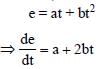
At neutral temperature,

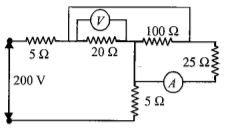
In the figure, voltmeter and ammeter shown are ideal. Then voltmeter and ammeter readings, respectively, are
- a)125 V,3 A
- b)100 V,4 A
- c)120 V,4 A
- d)120 V,3 A
Correct answer is option 'B'. Can you explain this answer?
In the figure, voltmeter and ammeter shown are ideal. Then voltmeter and ammeter readings, respectively, are
a)
125 V,3 A
b)
100 V,4 A
c)
120 V,4 A
d)
120 V,3 A

|
Ambition Institute answered |
Resistors 20Ω,100Ω and 25Ω will be in parallel. Their equivalent is 10Ω.
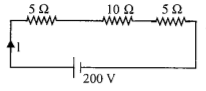

p.d. across 10Ω,10I = 10 × 10 = 100 V
This will be the voltmeter reading. Also, this will be the p.d. across each of 20Ω,100Ω and 25Ω resistors.
Ammeter reading = current through 25Ω=100/25=4 A.
p.d. across 10Ω,10I = 10 × 10 = 100 V
This will be the voltmeter reading. Also, this will be the p.d. across each of 20Ω,100Ω and 25Ω resistors.
Ammeter reading = current through 25Ω=100/25=4 A.
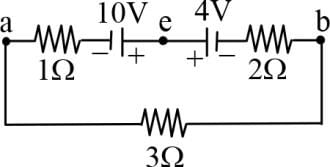


Two rods are joined end to end, as shown. Both have a cross-sectional area of 0.01 cm2. Each is 1 meter long. One rod is of copper with a resistivity of 1.7 × 10⁻⁶ ohm-centimeter, the other is of iron with a resistivity of 10–5 ohmcentimeter. [NEET Kar. 2013]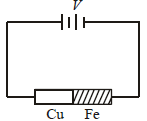
How much voltage is required to produce a current of 1 ampere in the rods?- a)0.117 V
- b)0.00145 V
- c)0.0145 V
- d)1.7 × 10⁻⁶ V
Correct answer is option 'A'. Can you explain this answer?
Two rods are joined end to end, as shown. Both have a cross-sectional area of 0.01 cm2. Each is 1 meter long. One rod is of copper with a resistivity of 1.7 × 10⁻⁶ ohm-centimeter, the other is of iron with a resistivity of 10–5 ohmcentimeter. [NEET Kar. 2013]
How much voltage is required to produce a current of 1 ampere in the rods?
a)
0.117 V
b)
0.00145 V
c)
0.0145 V
d)
1.7 × 10⁻⁶ V

|
Sarthak Saini answered |
Copper rod and iron rod are joined in series.
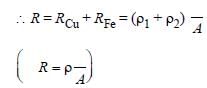
From ohm’s law V = RI
= (1.7 × 10–6 × 10–2 + 10–5 × 10⁻²) ÷ 0.01 × 10⁻⁴ volt
= 0.117 volt ( I = 1A)
= 0.117 volt ( I = 1A)
The internal resistance of a 2.1 V cell which givesa current of 0.2 A through a resistance of 10 Ω is[NEET 2013]- a)0.5 Ω
- b)0.8 Ω
- c)1.0 Ω
- d)0.2 Ω
Correct answer is option 'A'. Can you explain this answer?
The internal resistance of a 2.1 V cell which givesa current of 0.2 A through a resistance of 10 Ω is[NEET 2013]
a)
0.5 Ω
b)
0.8 Ω
c)
1.0 Ω
d)
0.2 Ω

|
Abhiram Nair answered |
Given : emf ε = 2.1 V
I = 0.2 A, R = 10Ω
Internal resistance r = ?
From formula.
ε – Ir = V = IR
2.1 – 0.2r = 0.2 × 10
2.1 – 0.2 r = 2 or 0.2 r = 0.1
I = 0.2 A, R = 10Ω
Internal resistance r = ?
From formula.
ε – Ir = V = IR
2.1 – 0.2r = 0.2 × 10
2.1 – 0.2 r = 2 or 0.2 r = 0.1
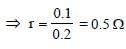
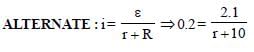
⇒ 2.1 = 0.2r +2 ⇒ r = 1/2 = 0.5Ω
A wire of a certain material is stretched slowlyby ten per cent. Its new resistance and specificresistance become respectively: [2008]- a)1.2 times, 1.3 times
- b)1.21 times, same
- c)both remain the same
- d)1.1 times, 1.1 times
Correct answer is option 'B'. Can you explain this answer?
A wire of a certain material is stretched slowlyby ten per cent. Its new resistance and specificresistance become respectively: [2008]
a)
1.2 times, 1.3 times
b)
1.21 times, same
c)
both remain the same
d)
1.1 times, 1.1 times

|
Dipanjan Mehta answered |
Resistance of a wire is given by R l/a
If the length is increased by 10% then new
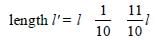
In that case, area of cross-section of wire
would decrease by 10%
∴ New area of cross-section
would decrease by 10%
∴ New area of cross-section
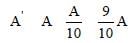
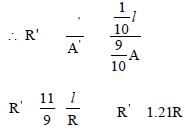
Thus the new resistance increases by 1.21
times. The specific resistance (resistivity)
remains unchanged as it depends on the
nature of the material of the wire.
times. The specific resistance (resistivity)
remains unchanged as it depends on the
nature of the material of the wire.

A 12 cm wire is given a shape of a right angled triangle ABC having sides 3 cm, 4 cm and 5 cm as shown in the figure. The resistance between two ends (AB, BC, CA) of the respective sides are measured one by one by a multi-meter. The resistances will be in the ratio of [NEET Kar. 2013]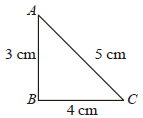
- a)3 : 4 : 5
- b)9 : 16 : 25
- c)27 : 32 : 35
- d)21 : 24 : 25
Correct answer is option 'C'. Can you explain this answer?
A 12 cm wire is given a shape of a right angled triangle ABC having sides 3 cm, 4 cm and 5 cm as shown in the figure. The resistance between two ends (AB, BC, CA) of the respective sides are measured one by one by a multi-meter. The resistances will be in the ratio of [NEET Kar. 2013]
a)
3 : 4 : 5
b)
9 : 16 : 25
c)
27 : 32 : 35
d)
21 : 24 : 25
|
|
Dipanjan Mehta answered |
Resistance is directly proportional to length
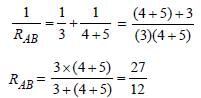
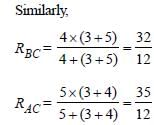
∴ RAB : RBC : RAC = 27 : 32 : 35
Ten identical cells connected in series areneeded to heat a wire of length one meter andradius ‘r’ by 10ºC in time ‘t’. How many cells willbe required to heat the wire of length two meterof the same radius by the same temperature intime ‘t’? [NEET Kar. 2013]- a)10
- b)20
- c)30
- d)40
Correct answer is option 'B'. Can you explain this answer?
Ten identical cells connected in series areneeded to heat a wire of length one meter andradius ‘r’ by 10ºC in time ‘t’. How many cells willbe required to heat the wire of length two meterof the same radius by the same temperature intime ‘t’? [NEET Kar. 2013]
a)
10
b)
20
c)
30
d)
40
|
|
Nilanjan Chakraborty answered |
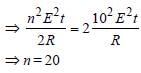
Resistance is directly proportionl to length
of the wire. As length is doubled so mass is
doubled and resistance is doubled.
We have
of the wire. As length is doubled so mass is
doubled and resistance is doubled.
We have

If power dissipated in the 9-Ω resistor in the circuit shown is 36 watt, the potential difference across the 2-Ω resistor is [2011]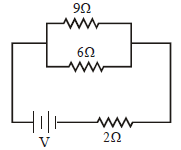
- a)4 volt
- b)8 volt
- c)10 volt
- d)2 volt
Correct answer is option 'C'. Can you explain this answer?
If power dissipated in the 9-Ω resistor in the circuit shown is 36 watt, the potential difference across the 2-Ω resistor is [2011]
a)
4 volt
b)
8 volt
c)
10 volt
d)
2 volt

|
Anand Jain answered |
We have,
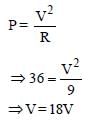
Current passing through the 9Ω resistor is
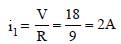
The 9Ω and 6Ω resistors are in parallel,
therefore
therefore

where i is the current delivered by the
battery.
battery.
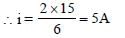
Thus, potential difference across 2Ω
resistor is
V = iR
= 5 × 2
= 10V
resistor is
V = iR
= 5 × 2
= 10V
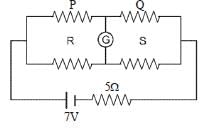
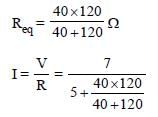
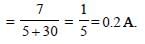
The resistance of the four arms P, Q, R and S in a Wheatstone’s bridge are 10 ohm, 30 ohm, 30 ohm and 90 ohm, respectively. The e.m.f. and internal resistance of the cell are 7 volt and 5 ohmrespectively. If the galvanometer resistance is50 ohm, the current drawn from the cell will be [NEET 2013]- a)0.2 A
- b)0.1 A
- c)2. 0 A
- d)1. 0 A
Correct answer is option 'A'. Can you explain this answer?
The resistance of the four arms P, Q, R and S in a Wheatstone’s bridge are 10 ohm, 30 ohm, 30 ohm and 90 ohm, respectively. The e.m.f. and internal resistance of the cell are 7 volt and 5 ohmrespectively. If the galvanometer resistance is50 ohm, the current drawn from the cell will be [NEET 2013]
a)
0.2 A
b)
0.1 A
c)
2. 0 A
d)
1. 0 A

|
Maheshwar Saini answered |
Given : V = 7 V
r = 5Ω
r = 5Ω
A current of 3 amp flows through the 2Ω resistor shown in the circuit. The power dissipated in the 5-Ω resistor is: [2008]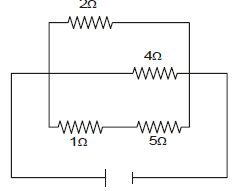
- a)4 watt
- b)2 watt
- c)1 watt
- d)5 watt
Correct answer is option 'D'. Can you explain this answer?
A current of 3 amp flows through the 2Ω resistor shown in the circuit. The power dissipated in the 5-Ω resistor is: [2008]
a)
4 watt
b)
2 watt
c)
1 watt
d)
5 watt
|
|
Rajeev Sharma answered |
Clearly, 2Ω, 4Ω and ( 1 + 5) Ωresistors are
in parallel. Hence, potential difference is
same across each of them.
∴ I1 × 2 = I2 × 4 = I3 × 6
in parallel. Hence, potential difference is
same across each of them.
∴ I1 × 2 = I2 × 4 = I3 × 6
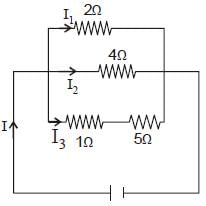
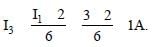
Given I1 = 3A ∴ I1 × 2 = I3 × 6
Given I1 = 3A.
∴ I1 × 2 = I3 × 6 provides
Given I1 = 3A.
∴ I1 × 2 = I3 × 6 provides
Now, the potential across the 5Ω resistor is
V = I3 × 5 = 1 × 5 = 5V.
∴ the power dissipated in the 5Ωresistor
V = I3 × 5 = 1 × 5 = 5V.
∴ the power dissipated in the 5Ωresistor

In the circuit shown, if a conducting wire is connected between points A and B, the current in this wire will [2006]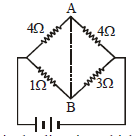
- a)flow in the direction which will be decidedby the value of V
- b)be zero
- c)flow from B to A
- d)flow from A to B
Correct answer is option 'C'. Can you explain this answer?
In the circuit shown, if a conducting wire is connected between points A and B, the current in this wire will [2006]
a)
flow in the direction which will be decidedby the value of V
b)
be zero
c)
flow from B to A
d)
flow from A to B

|
Kajal Bose answered |
Current will flow from B to A
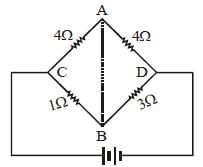
Potential drop over the resistance CA will be
more due to higher value of resistance. So
potential at A will be less as compared with at
B. Hence, current will flow from B to A.
more due to higher value of resistance. So
potential at A will be less as compared with at
B. Hence, current will flow from B to A.
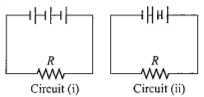
Three identical cells, each having an e.m.f. of 1.5 V and a constant internal resistance of 2.0Ω, are connected in series with a 4.0Ω resistor R, first as in circuit (i), and secondly as in circuit (ii).
What is the ratio 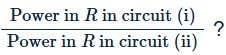
- a)9.0
- b)7.2
- c)1.8
- d)3.0
Correct answer is option 'A'. Can you explain this answer?
Three identical cells, each having an e.m.f. of 1.5 V and a constant internal resistance of 2.0Ω, are connected in series with a 4.0Ω resistor R, first as in circuit (i), and secondly as in circuit (ii).
What is the ratio
What is the ratio
a)
9.0
b)
7.2
c)
1.8
d)
3.0

|
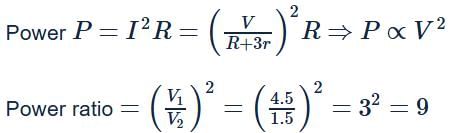
Mohit Rajpoot answered |
The power dissipated in the circuit shown in the figure is 30 Watts. The value of R is: [2012M]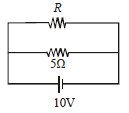
- a)20 Ω
- b)15 Ω
- c)10 Ω
- d)30 Ω
Correct answer is option 'C'. Can you explain this answer?
The power dissipated in the circuit shown in the figure is 30 Watts. The value of R is: [2012M]
a)
20 Ω
b)
15 Ω
c)
10 Ω
d)
30 Ω
|
|
Arya Khanna answered |
The power dissipated in the circuit

v = 10 volt
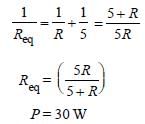
Substituting the values in equation (i)

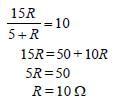
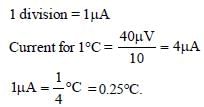
A thermocouple of negligible resistanceproduces an e.m.f. of 40 μV/°C in the linear rangeof temperature. A galvanometer of resistance 10ohm whose sensitivity is 1μA/div, is employedwith the termocouple. The smallest value oftemperature difference that can be detected bythe system will be [2011M]- a)0.5°C
- b)1°C
- c)0.1°C
- d)0.25°C
Correct answer is option 'D'. Can you explain this answer?
A thermocouple of negligible resistanceproduces an e.m.f. of 40 μV/°C in the linear rangeof temperature. A galvanometer of resistance 10ohm whose sensitivity is 1μA/div, is employedwith the termocouple. The smallest value oftemperature difference that can be detected bythe system will be [2011M]
a)
0.5°C
b)
1°C
c)
0.1°C
d)
0.25°C
|
|
Nayanika Reddy answered |
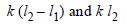
A potentiometer circuit is set up as shown. The potential gradient, across the potentiometer wire, is k volt/cm and the ammeter, present in the circuit, reads 1.0 A when two way key is switched off. The balance points, when the key between the terminals (i) 1 and 2 (ii) 1 and 3, is plugged in, are found to be at lengths ℓ1 cm and ℓ2 cm respectively. The magnitudes, of the resistors R and X, in ohms, are then, equal, respectively, to [2010]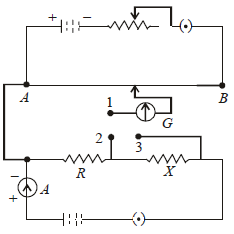
- a)
- b)

- c)

- d)

Correct answer is option 'B'. Can you explain this answer?
A potentiometer circuit is set up as shown. The potential gradient, across the potentiometer wire, is k volt/cm and the ammeter, present in the circuit, reads 1.0 A when two way key is switched off. The balance points, when the key between the terminals (i) 1 and 2 (ii) 1 and 3, is plugged in, are found to be at lengths ℓ1 cm and ℓ2 cm respectively. The magnitudes, of the resistors R and X, in ohms, are then, equal, respectively, to [2010]
a)
b)
c)
d)
|
|
Rohan Unni answered |
(i) When key between the terminals 1
and 2 is plugged in,
P.D. across R = IR = k l1
⇒ R = k l1 as I = 1A
(ii) When key between terminals 1 and 3 is
plugged in,
P.D. across (X + R) = I(X + R) = k l2
⇒ X + R = k l2
∴ X = k (l2 – l1)
∴ R = kl1 and X = k (l2 – l1)
and 2 is plugged in,
P.D. across R = IR = k l1
⇒ R = k l1 as I = 1A
(ii) When key between terminals 1 and 3 is
plugged in,
P.D. across (X + R) = I(X + R) = k l2
⇒ X + R = k l2
∴ X = k (l2 – l1)
∴ R = kl1 and X = k (l2 – l1)
A wire of resistance 4 Ω is stretched to twice itsoriginal length. The resistance of stretched wirewould be [NEET 2013]- a)4 Ω
- b)8 Ω
- c)16 Ω
- d)2 Ω
Correct answer is option 'C'. Can you explain this answer?
A wire of resistance 4 Ω is stretched to twice itsoriginal length. The resistance of stretched wirewould be [NEET 2013]
a)
4 Ω
b)
8 Ω
c)
16 Ω
d)
2 Ω
|
|
Anand Jain answered |
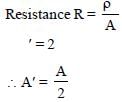
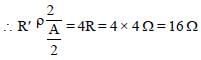
Therefore the resistance of new wire
becomes 16 Ω
becomes 16 Ω
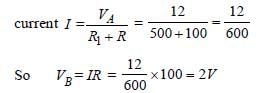
In the circuit shown the cells A and B have negligible resistances. For VA = 12V, R1 = 500Ω and R = 100Ω the galvanometer (G) shows no deflection. The value of VB is : [2012]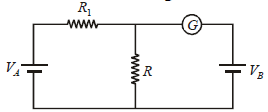
- a)4 V
- b)2 V
- c)12 V
- d)6 V
Correct answer is option 'B'. Can you explain this answer?
In the circuit shown the cells A and B have negligible resistances. For VA = 12V, R1 = 500Ω and R = 100Ω the galvanometer (G) shows no deflection. The value of VB is : [2012]
a)
4 V
b)
2 V
c)
12 V
d)
6 V

|
Soumya Ahuja answered |
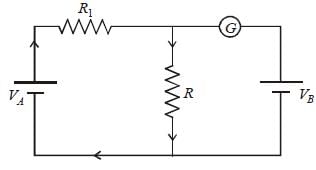
Since deflection in galvanometer is zero so
current will flow as shown in the above
diagram.
current will flow as shown in the above
diagram.
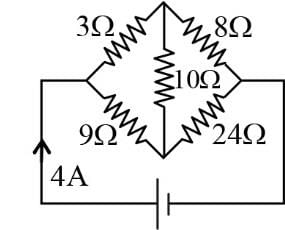
In the circuit shown, if the 10 Ω resistance is replaced by 20 Ω, then the amount of current drawn from the battery will be
- a)10 A
- b)4 A
- c)8 A
- d)2 A
Correct answer is option 'B'. Can you explain this answer?
In the circuit shown, if the 10 Ω resistance is replaced by 20 Ω, then the amount of current drawn from the battery will be
a)
10 A
b)
4 A
c)
8 A
d)
2 A

|
Lead Academy answered |
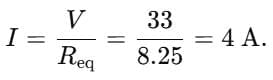
The network is a Wheatstone bridge. It’s balanced because
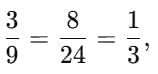
so the potential at the top and bottom junctions is the same. Hence no current flows through the middle resistor, whatever its value (10 Ω or 20 Ω).
So the equivalent seen by the battery is just the two series paths in parallel:
With the original current 4 A, the battery voltage is

Replacing 10 Ω with 20 Ω doesn’t change Req, so the current drawn remains
Chapter doubts & questions for Current Electricity - 30-Day Revision Course for NEET 2026 is part of NEET exam preparation. The chapters have been prepared according to the NEET exam syllabus. The Chapter doubts & questions, notes, tests & MCQs are made for NEET 2026 Exam. Find important definitions, questions, notes, meanings, examples, exercises, MCQs and online tests here.
Chapter doubts & questions of Current Electricity - 30-Day Revision Course for NEET in English & Hindi are available as part of NEET exam.
Download more important topics, notes, lectures and mock test series for NEET Exam by signing up for free.
30-Day Revision Course for NEET
85 videos|301 docs|171 tests
|
