


All Exams >
Civil Engineering (CE) >
RRB JE Mock Test Series for Civil Engineering (CE) 2025 >
All Questions
All questions of Pipes & Cistern for Civil Engineering (CE) Exam
A pipe can fill a tank in 20 minutes but due to a leak develop at the bottom of the tank, 1/5 of the water filled by the pipe leaks out. Find the time in which the tank is filled.- a)20 min
- b)25 min
- c)30 min
- d)can’t be determined
- e)None of these
Correct answer is option 'B'. Can you explain this answer?
A pipe can fill a tank in 20 minutes but due to a leak develop at the bottom of the tank, 1/5 of the water filled by the pipe leaks out. Find the time in which the tank is filled.
a)
20 min
b)
25 min
c)
30 min
d)
can’t be determined
e)
None of these

|
Nancy Verma answered |
Suppose in 20 min ----x is filled
now with leak 20min ---- (x-x/5) =4x/5 is filled
so full i.e. x will be filled in x=20*5/4= 25min
now with leak 20min ---- (x-x/5) =4x/5 is filled
so full i.e. x will be filled in x=20*5/4= 25min

On pipe P is 4 times faster than pipe Q and takes 45 minutes less than pipe Q. In what time the cistern is full if both the pipes are opened together?- a)8 minutes
- b)10 minutes
- c)12 minutes
- d)14 minutes
- e)None of these
Correct answer is option 'C'. Can you explain this answer?
On pipe P is 4 times faster than pipe Q and takes 45 minutes less than pipe Q. In what time the cistern is full if both the pipes are opened together?
a)
8 minutes
b)
10 minutes
c)
12 minutes
d)
14 minutes
e)
None of these

|
Cstoppers Instructors answered |
Let P takes x minutes to fill the tank alone, then Q will take 4x minutes to fill the tank
4x – x = 45, x = 15
So P will take 15 minutes and Q will take 60 minutes to fill the tank. Both will fill the tank in
(60*15)/(75) = 12 minutes
4x – x = 45, x = 15
So P will take 15 minutes and Q will take 60 minutes to fill the tank. Both will fill the tank in
(60*15)/(75) = 12 minutes
Two pipes A and B can fill a tank in 12 hours and 15 hours respectively. If they are opened on alternate hours with pipe A opened first, then in how many hours the tank will be full?- a)13 hrs
- b)14 1/2 hrs
- c)12 hrs
- d)12 1/2 hrs
- e)10 2/3 hrs
Correct answer is option 'D'. Can you explain this answer?
Two pipes A and B can fill a tank in 12 hours and 15 hours respectively. If they are opened on alternate hours with pipe A opened first, then in how many hours the tank will be full?
a)
13 hrs
b)
14 1/2 hrs
c)
12 hrs
d)
12 1/2 hrs
e)
10 2/3 hrs

|
Bank Exams India answered |
A = 12 hours, B = 15 hours
Total work = LCM(12,15) = 60
So efficiency of A = 60/12 = 5, efficiency of B = 60/15 = 4
2 hrs work of (A+B) = 5+4 = 9
2*6(12) hours work of (A+B) = 9*6 = 54
So remaining work = 60-54 = 6
Now A’s turn at 13th hour, he will do remaining work(6) in 6/12 hr
So total 12 1/2 hrs
Total work = LCM(12,15) = 60
So efficiency of A = 60/12 = 5, efficiency of B = 60/15 = 4
2 hrs work of (A+B) = 5+4 = 9
2*6(12) hours work of (A+B) = 9*6 = 54
So remaining work = 60-54 = 6
Now A’s turn at 13th hour, he will do remaining work(6) in 6/12 hr
So total 12 1/2 hrs
In what time would a cistern be filled by three pipes whose diameters are 1cm, 2 cm and 3 cm running together, when the largest pipe alone can fill the tank in 21 minutes? The amount of water flowing through the pipe is directly proportional to the square of its diameter.- a)10.5 minutes
- b)11.5 minutes
- c)12.5 minutes
- d)13.5 minutes
- e)None of these
Correct answer is option 'D'. Can you explain this answer?
In what time would a cistern be filled by three pipes whose diameters are 1cm, 2 cm and 3 cm running together, when the largest pipe alone can fill the tank in 21 minutes? The amount of water flowing through the pipe is directly proportional to the square of its diameter.
a)
10.5 minutes
b)
11.5 minutes
c)
12.5 minutes
d)
13.5 minutes
e)
None of these

|
Divey Sethi answered |
More the diameter more will be the water flowing through it and less will be the time taken.
Means bigger pipe will take less time to fill the tank
So, for 1 cm time, (12)/(32) = 21/t, we get t = 189
For 2 cm time, (22)/(32) = 21/t. We get t = 189/4
So total time = 1/21 + 1/189 + 4/189 = 2/27
So total time = 13.5 minutes
Means bigger pipe will take less time to fill the tank
So, for 1 cm time, (12)/(32) = 21/t, we get t = 189
For 2 cm time, (22)/(32) = 21/t. We get t = 189/4
So total time = 1/21 + 1/189 + 4/189 = 2/27
So total time = 13.5 minutes
A cistern can be filled by a pipe in 6 hours. A leak is developed at the bottom due to which it takes 2 hours more to fill the cistern. Find the time taken by the leak to empty the cistern when the cistern is full.- a)20hr
- b)22hr
- c)24hr
- d)26hr
- e)None of these
Correct answer is option 'C'. Can you explain this answer?
A cistern can be filled by a pipe in 6 hours. A leak is developed at the bottom due to which it takes 2 hours more to fill the cistern. Find the time taken by the leak to empty the cistern when the cistern is full.
a)
20hr
b)
22hr
c)
24hr
d)
26hr
e)
None of these

|
Kavya Saxena answered |
1/6 – 1/T = 1/8, solve for T
Pipe A fills a tank in 30 minutes. Pipe B can fill the same tank 5 times as fast as pipe A. If both the pipes were kept open when the tank is empty, how much time will it take for the tank to overflow?- a)3 minutes
- b)2 minutes
- c)5 minutes
- d)4 minutes
- e)None of the Above
Correct answer is option 'E'. Can you explain this answer?
Pipe A fills a tank in 30 minutes. Pipe B can fill the same tank 5 times as fast as pipe A. If both the pipes were kept open when the tank is empty, how much time will it take for the tank to overflow?
a)
3 minutes
b)
2 minutes
c)
5 minutes
d)
4 minutes
e)
None of the Above

|
Nikita Singh answered |
Total Capacity = 90L.
Tank filled in 1 minute by A = 3L
Tank filled in 1 minute by B = 15L
The capacity of the tank filled with both A and B in 1 minute = 18L.
overflow = 90/18 = 5 minutes.
Tank filled in 1 minute by A = 3L
Tank filled in 1 minute by B = 15L
The capacity of the tank filled with both A and B in 1 minute = 18L.
overflow = 90/18 = 5 minutes.
There are 4 filling pipes and 3 emptying pipes capable of filling and emptying in 12 minutes and 15 minutes respectively. If all the pipes are opened together and as a result they fill 10 litres of water per minute. Find the capacity of the tank.- a)65ltr
- b)70ltr
- c)75ltr
- d)80ltr
- e)None of these
Correct answer is option 'C'. Can you explain this answer?
There are 4 filling pipes and 3 emptying pipes capable of filling and emptying in 12 minutes and 15 minutes respectively. If all the pipes are opened together and as a result they fill 10 litres of water per minute. Find the capacity of the tank.
a)
65ltr
b)
70ltr
c)
75ltr
d)
80ltr
e)
None of these
|
|
Cstoppers Instructors answered |
(4/12 – 3/15)*t = 1
t = 15/2 minute – in this time the tank will be filled. So the capacity = (15/2)*10 = 75 litre
t = 15/2 minute – in this time the tank will be filled. So the capacity = (15/2)*10 = 75 litre
A Tank is already filled up to X% of its capacity. An Inlet pipe can fill Full Tank in 30 minutes and an Outlet pipe can empty Full Tank in 20 Minutes. Now both pipes are opened then the Tank is emptied in 24 Minutes. Then initially up to what % of its capacity is Tank filled?- a)40%
- b)48%
- c)50%
- d)60%
- e)Cannot be determined
Correct answer is option 'A'. Can you explain this answer?
A Tank is already filled up to X% of its capacity. An Inlet pipe can fill Full Tank in 30 minutes and an Outlet pipe can empty Full Tank in 20 Minutes. Now both pipes are opened then the Tank is emptied in 24 Minutes. Then initially up to what % of its capacity is Tank filled?
a)
40%
b)
48%
c)
50%
d)
60%
e)
Cannot be determined

|
Aisha Gupta answered |
1/30 – 1/20 = -1/60
Full Tank can be emptied 60 Minutes
In 24 minutes 40% of Tank can be emptied.
Full Tank can be emptied 60 Minutes
In 24 minutes 40% of Tank can be emptied.
One pipe fill 1/4 of the tank in 4 minutes and another pipe fills 1/5 of the tank in 4 minutes. Find the time taken by both pipe together to fill half the tank?- a)40/9 minutes
- b)50/9 minutes
- c)44/9 minutes
- d)53/9 minutes
- e)None of these
Correct answer is option 'A'. Can you explain this answer?
One pipe fill 1/4 of the tank in 4 minutes and another pipe fills 1/5 of the tank in 4 minutes. Find the time taken by both pipe together to fill half the tank?
a)
40/9 minutes
b)
50/9 minutes
c)
44/9 minutes
d)
53/9 minutes
e)
None of these

|
Chirag Makkar answered |
First pipe will take 16 minutes to fill the tank alone. Similarly second pipe will take 20 minutes to fill the tank alone. Let T is the time in which both the pipes will fill half the tank
(1/16 + 1/20)*T = 1/2, we get T = 40/9 minutes
(1/16 + 1/20)*T = 1/2, we get T = 40/9 minutes
Three pipes A, B, and C can fill the tank in 10 hours, 20 hours and 40 hours respectively. In the beginning all of them are opened simultaneously. After 2 hours, tap C is closed and A and B are kept running. After the 4th hour, tap B is also closed. The remaining work is done by tap A alone. What is the percentage of the work done by tap A alone?- a)30 %
- b)35 %
- c)45 %
- d)50 %
- e)None of the Above
Correct answer is option 'B'. Can you explain this answer?
Three pipes A, B, and C can fill the tank in 10 hours, 20 hours and 40 hours respectively. In the beginning all of them are opened simultaneously. After 2 hours, tap C is closed and A and B are kept running. After the 4th hour, tap B is also closed. The remaining work is done by tap A alone. What is the percentage of the work done by tap A alone?
a)
30 %
b)
35 %
c)
45 %
d)
50 %
e)
None of the Above

|
Future Foundation Institute answered |
Pipe A’s work in % = 100/10 = 10%
Pipe B’s work in % = 100/20 = 5%
Pipe C’s work in % = 100/40 = 2.5%
All of them are opened for 2 hours + after 2 hours, tap C is closed + After the 4th hour, tap B is also closed = 100
⇒ (10+5+2.5)*2 + (10+5)*2 + X = 100
⇒ 35 + 30 + work by tap A alone = 100
⇒ work by tap A alone = 100-65 = 35%
Pipe B’s work in % = 100/20 = 5%
Pipe C’s work in % = 100/40 = 2.5%
All of them are opened for 2 hours + after 2 hours, tap C is closed + After the 4th hour, tap B is also closed = 100
⇒ (10+5+2.5)*2 + (10+5)*2 + X = 100
⇒ 35 + 30 + work by tap A alone = 100
⇒ work by tap A alone = 100-65 = 35%
A tank is normally filled in 6 hours but takes two hours longer to fill because of a leak in the bottom of the tank. If the tank is full the leak will empty it in how many hours?- a)16 hours
- b)18 hours
- c)17 hours
- d)24 hours
- e)None of the Above
Correct answer is option 'D'. Can you explain this answer?
A tank is normally filled in 6 hours but takes two hours longer to fill because of a leak in the bottom of the tank. If the tank is full the leak will empty it in how many hours?
a)
16 hours
b)
18 hours
c)
17 hours
d)
24 hours
e)
None of the Above
|
|
Bank Exams India answered |
Work done by leak in 1 hr=(1/6-1/8)=1/24
Leak will empty the tank in 24 hours
Leak will empty the tank in 24 hours
Two Inlet Pipes A and B together can fill a Tank in ‘X’ minutes. If A and B take 81 minutes and 49 minutes more than ‘X’ minutes respectively, to fill the Tank. Then They can fill the 5/7 of that Tank in how many minutes?- a)45 Minutes
- b)49 Minutes
- c)63 Minutes
- d)81 Minutes
- e)None
Correct answer is option 'A'. Can you explain this answer?
Two Inlet Pipes A and B together can fill a Tank in ‘X’ minutes. If A and B take 81 minutes and 49 minutes more than ‘X’ minutes respectively, to fill the Tank. Then They can fill the 5/7 of that Tank in how many minutes?
a)
45 Minutes
b)
49 Minutes
c)
63 Minutes
d)
81 Minutes
e)
None
|
|
Future Foundation Institute answered |
Time taken by two pipes to fill full Tank is = √ab min = 63 min
5/7 Tank = 63*5/7 = 45 min
5/7 Tank = 63*5/7 = 45 min
A cistern is filled by 3 pipes A, B and C with uniform flow. The second pipe B takes3/2 times the time taken by A to fill the tank, while C takes twice the time taken by B to fill the tank. If all the three pipes can fill the tank in 7 hours, find the time required by pipe A alone to fill the tank.- a)10hrs
- b)12hrs
- c)14hrs
- d)15hrs
- e)None of these
Correct answer is option 'C'. Can you explain this answer?
A cistern is filled by 3 pipes A, B and C with uniform flow. The second pipe B takes3/2 times the time taken by A to fill the tank, while C takes twice the time taken by B to fill the tank. If all the three pipes can fill the tank in 7 hours, find the time required by pipe A alone to fill the tank.
a)
10hrs
b)
12hrs
c)
14hrs
d)
15hrs
e)
None of these

|
Preeti Khanna answered |
1/x + 1/ (3/2x) + ½(3x/2) = 1/7
6/3x = 1/7
3x/6 = 7
3x=42
X=14
6/3x = 1/7
3x/6 = 7
3x=42
X=14
A bathing tub can be filled by a cold pipe in 15 minutes and by a hot pipe in 10 minutes. Ramesh opened both the tap and leaves the bathroom and returns at the time when the tub should be full. He observed that a waste pipe is opened at the bottom, he now closes it. Now the tub will take more 5 minutes to fill the tank, find the time in which the leak can empty the tank.- a)36/5 min
- b)33/5 min
- c)37/5 min
- d)can’t be determined
- e)None of these
Correct answer is option 'A'. Can you explain this answer?
A bathing tub can be filled by a cold pipe in 15 minutes and by a hot pipe in 10 minutes. Ramesh opened both the tap and leaves the bathroom and returns at the time when the tub should be full. He observed that a waste pipe is opened at the bottom, he now closes it. Now the tub will take more 5 minutes to fill the tank, find the time in which the leak can empty the tank.
a)
36/5 min
b)
33/5 min
c)
37/5 min
d)
can’t be determined
e)
None of these
|
|
Divey Sethi answered |
(1/15 + 1/10 – 1/x)*6 + (1/15 + 1/10)*5 = 1
x = 36/5
x = 36/5
A pipe can fill a tank in 12 minutes and another pipe can fill it in 15 minutes, but a third pipe can empty it in 6 minutes. The first two pipes are kept open for 5 min in the beginning and then third pipe is also opened. Time taken to empty the water tank is?- a)30 mins
- b)25 mins
- c)45 mins
- d)50 mins
- e)None of the Above
Correct answer is option 'C'. Can you explain this answer?
A pipe can fill a tank in 12 minutes and another pipe can fill it in 15 minutes, but a third pipe can empty it in 6 minutes. The first two pipes are kept open for 5 min in the beginning and then third pipe is also opened. Time taken to empty the water tank is?
a)
30 mins
b)
25 mins
c)
45 mins
d)
50 mins
e)
None of the Above
|
|
Kavya Saxena answered |
x/6 – (x+5)/12 – (x+5)/15 = 0
x = 45 mins
x = 45 mins
In what time a cistern is filled by three pipes of diameter 2cm, 4cm and 6cm respectively. If the time taken by largest pipe to fill the tank is 40 minutes. Amount of water flowing through the pipe is proportional to the diameter of the pipe- a)25.5/7 min
- b)25.3/7 min
- c)23.5/7 min
- d)23.4/7 min
- e)None of these
Correct answer is option 'A'. Can you explain this answer?
In what time a cistern is filled by three pipes of diameter 2cm, 4cm and 6cm respectively. If the time taken by largest pipe to fill the tank is 40 minutes. Amount of water flowing through the pipe is proportional to the diameter of the pipe
a)
25.5/7 min
b)
25.3/7 min
c)
23.5/7 min
d)
23.4/7 min
e)
None of these
|
|
Divey Sethi answered |
Larger the cross-section area less will be time taken by pipe to fill the tank. 36/16 = T/40, T = 90min (for 4 cm pipe)
similarly for 2 cm pipe time taken will be = 360min
Total time = (1/360 + 1/90 + 1/40) = 1/p, so we get P = 25.5/7 minutes
similarly for 2 cm pipe time taken will be = 360min
Total time = (1/360 + 1/90 + 1/40) = 1/p, so we get P = 25.5/7 minutes
Two pipes A and B can fill a tank in 20 and 30 minutes respectively. Both the pipes are opened together but after 5 minutes pipe B is closed. What is the total time required to fill the tank- a)16.1/3 min
- b)16.2/3 min
- c)17.2/3 min
- d)18.2/3 min
- e)None of these
Correct answer is option 'B'. Can you explain this answer?
Two pipes A and B can fill a tank in 20 and 30 minutes respectively. Both the pipes are opened together but after 5 minutes pipe B is closed. What is the total time required to fill the tank
a)
16.1/3 min
b)
16.2/3 min
c)
17.2/3 min
d)
18.2/3 min
e)
None of these
|
|
Future Foundation Institute answered |
(1/20 + 1/30)*5 + (1/20)*T = 1
total time = T + 5 min
total time = T + 5 min
Two pipes M and N can fill a tank in 30 and 45 minutes respectively. If both the pipes were open for few minutes after N was closed and the tank was full in 25 minutes, find the time for pipe N was open.- a)8.16m
- b)7.5min
- c)5min
- d)10.2m
- e)None of these
Correct answer is option 'B'. Can you explain this answer?
Two pipes M and N can fill a tank in 30 and 45 minutes respectively. If both the pipes were open for few minutes after N was closed and the tank was full in 25 minutes, find the time for pipe N was open.
a)
8.16m
b)
7.5min
c)
5min
d)
10.2m
e)
None of these
|
|
Preeti Khanna answered |
X(1/30+1/45) + 1/30(25-x) = 1
x/45+25/30 =1
x/45 = 5/30 =1/6
x=45/6
x=7.5m
x/45+25/30 =1
x/45 = 5/30 =1/6
x=45/6
x=7.5m
Three pipes A, B and C is attached to a cistern. A can fill it in 20 minutes and B can fill it in 30 minutes. C is a waste pipe. After opening both the pipes A and B, Riya leaves the cistern to fill and returns when the cistern is supposed to be filled. But she found that waste pipe C had been left open, she closes it and now the cistern takes 5 minutes more to fill. In how much time the pipe C can empty the full cistern?- a)26.8 minutes
- b)25.8 minutes
- c)27.8 minutes
- d)28.8 minutes
- e)None of these
Correct answer is option 'D'. Can you explain this answer?
Three pipes A, B and C is attached to a cistern. A can fill it in 20 minutes and B can fill it in 30 minutes. C is a waste pipe. After opening both the pipes A and B, Riya leaves the cistern to fill and returns when the cistern is supposed to be filled. But she found that waste pipe C had been left open, she closes it and now the cistern takes 5 minutes more to fill. In how much time the pipe C can empty the full cistern?
a)
26.8 minutes
b)
25.8 minutes
c)
27.8 minutes
d)
28.8 minutes
e)
None of these
|
|
Preeti Khanna answered |
The tank supposed to be filled in (30*20)/50 = 12 minutes
so, (1/20 + 1/30)*12 – 12/C + (1/20 + 1/30)*5 = 1 (A and B work for 12 minutes and also C work for 12 minutes and then A and B takes 5 more minutes to fill the tank)
solve for C, we will get C = 144/5 = 28.8
so, (1/20 + 1/30)*12 – 12/C + (1/20 + 1/30)*5 = 1 (A and B work for 12 minutes and also C work for 12 minutes and then A and B takes 5 more minutes to fill the tank)
solve for C, we will get C = 144/5 = 28.8
Two pipes P and Q can fill a cistern in 10 hours and 20 hours respectively. If they are opened simultaneously. Sometimes later, tap Q was closed, then it takes total 8 hours to fill up the whole tank. After how many hours Q was closed?- a)4 hours
- b)5 hours
- c)2 hours
- d)6 hours
- e)None of the Above
Correct answer is option 'A'. Can you explain this answer?
Two pipes P and Q can fill a cistern in 10 hours and 20 hours respectively. If they are opened simultaneously. Sometimes later, tap Q was closed, then it takes total 8 hours to fill up the whole tank. After how many hours Q was closed?
a)
4 hours
b)
5 hours
c)
2 hours
d)
6 hours
e)
None of the Above

|
Vikas Singh answered |
Assume that the total volume of the cistern is 200L.
so, P fills 20L/hr and Q fills 10L/hr, and they both simultaneously fill 30L/hr
now, let Q was closed after x hrs and then rest was filled by P.
30x + 20(8-x)= 200
10x = 40 => x = 4 hrs
hence Q was closed after 4 hrs
so, P fills 20L/hr and Q fills 10L/hr, and they both simultaneously fill 30L/hr
now, let Q was closed after x hrs and then rest was filled by P.
30x + 20(8-x)= 200
10x = 40 => x = 4 hrs
hence Q was closed after 4 hrs
Two taps can separately fill the tank in 10m and 15min respectively. They fill the tank in 12 minutes when a third pipe which empties the tank is also opened. What is the time taken by the third pipe to empty the whole tank?- a)14 minutes
- b)15 minutes
- c)12 minutes
- d)20 minutes
- e)16 minutes
Correct answer is option 'C'. Can you explain this answer?
Two taps can separately fill the tank in 10m and 15min respectively. They fill the tank in 12 minutes when a third pipe which empties the tank is also opened. What is the time taken by the third pipe to empty the whole tank?
a)
14 minutes
b)
15 minutes
c)
12 minutes
d)
20 minutes
e)
16 minutes

|
Target Study Academy answered |
1/10 + 1/15 – 1/x = 1/12
Solve, x = 12
Solve, x = 12
Three pipes, A, B and C are opened to fill a tank such that A and B cam fill the tank alone in 36 min. and 45 min. respectively and C can empty it in 30 min. After 6 minutes the emptying pipe is closed. In how many minutes the tank will be full in this way?- a)20
- b)25
- c)18
- d)24
- e)30
Correct answer is option 'D'. Can you explain this answer?
Three pipes, A, B and C are opened to fill a tank such that A and B cam fill the tank alone in 36 min. and 45 min. respectively and C can empty it in 30 min. After 6 minutes the emptying pipe is closed. In how many minutes the tank will be full in this way?
a)
20
b)
25
c)
18
d)
24
e)
30
|
|
Preeti Khanna answered |
Let the tank full in x minutes, then A and B opened for x minutes and C for 6 minutes.
(1/36 + 1/45)*x – (1/30)*6 = 1
(1/20)*x = 6/5
Solve, x = 24
(1/36 + 1/45)*x – (1/30)*6 = 1
(1/20)*x = 6/5
Solve, x = 24
A Tank is filled with the mixture of Milk and Water in the ratio of 3:2 up to 2/5 of its capacity. The tank has two inlet pipes i.e., Milk and Water inlets. Milk and Water pipe can fill an empty tank in 12 and 18 hours respectively. Now both pipes are opened simultaneously and closed after the Tank is completely filled, then what is the ratio of Milk and Water in the full Tank if it can accommodate 250Litre?- a)1:1
- b)2:3
- c)3:2
- d)5:4
- e)None
Correct answer is option 'C'. Can you explain this answer?
A Tank is filled with the mixture of Milk and Water in the ratio of 3:2 up to 2/5 of its capacity. The tank has two inlet pipes i.e., Milk and Water inlets. Milk and Water pipe can fill an empty tank in 12 and 18 hours respectively. Now both pipes are opened simultaneously and closed after the Tank is completely filled, then what is the ratio of Milk and Water in the full Tank if it can accommodate 250Litre?
a)
1:1
b)
2:3
c)
3:2
d)
5:4
e)
None

|
Machine Experts answered |
Initial Milk = 2/5*250*3/5 = 60 L
Water = 2/5*250*2/5 = 40 L
Rest of Tank =150 L
Pipes are opened then can fill rest of tank in 108/25 hours
H/W = constant
then (108/25)/12/x = (108/25)/18(150-x)
X = 90 = Milk, Water = 60
Final ratio = 3:2
Water = 2/5*250*2/5 = 40 L
Rest of Tank =150 L
Pipes are opened then can fill rest of tank in 108/25 hours
H/W = constant
then (108/25)/12/x = (108/25)/18(150-x)
X = 90 = Milk, Water = 60
Final ratio = 3:2
Two pipes P and Q can fill a tank in 10 min and 12 min respectively and a waste pipe can carry off 12 litres of water per minute. If all the pipes are opened when the tank is full and it takes one hour to empty the tank. Find the capacity of the tank.- a)30
- b)45
- c)60
- d)75
- e)None of these
Correct answer is option 'C'. Can you explain this answer?
Two pipes P and Q can fill a tank in 10 min and 12 min respectively and a waste pipe can carry off 12 litres of water per minute. If all the pipes are opened when the tank is full and it takes one hour to empty the tank. Find the capacity of the tank.
a)
30
b)
45
c)
60
d)
75
e)
None of these
|
|
Aarav Sharma answered |
Problem:
Two pipes P and Q can fill a tank in 10 min and 12 min respectively and a waste pipe can carry off 12 litres of water per minute. If all the pipes are opened when the tank is full and it takes one hour to empty the tank. Find the capacity of the tank.
Solution:
Let the capacity of the tank be 'x' litres.
Given, Pipe P can fill the tank in 10 minutes. So, the amount of water it can fill in 1 minute is x/10 litres.
Similarly, Pipe Q can fill the tank in 12 minutes. So, the amount of water it can fill in 1 minute is x/12 litres.
The waste pipe can carry off 12 litres of water per minute. So, the net amount of water filled in 1 minute when all pipes are opened is (x/10 + x/12 - 12) litres.
It takes 1 hour to empty the tank. So, the amount of water emptied in 1 minute is x/60 litres.
Therefore, the net amount of water filled in 1 minute is equal to the amount of water emptied in 1 minute. Hence, we can write the equation as follows:
x/10 + x/12 - 12 = x/60
Solving this equation, we get x = 60 litres.
Answer:
The capacity of the tank is 60 litres. Therefore, the correct answer is option (c).
Two pipes P and Q can fill a tank in 10 min and 12 min respectively and a waste pipe can carry off 12 litres of water per minute. If all the pipes are opened when the tank is full and it takes one hour to empty the tank. Find the capacity of the tank.
Solution:
Let the capacity of the tank be 'x' litres.
Given, Pipe P can fill the tank in 10 minutes. So, the amount of water it can fill in 1 minute is x/10 litres.
Similarly, Pipe Q can fill the tank in 12 minutes. So, the amount of water it can fill in 1 minute is x/12 litres.
The waste pipe can carry off 12 litres of water per minute. So, the net amount of water filled in 1 minute when all pipes are opened is (x/10 + x/12 - 12) litres.
It takes 1 hour to empty the tank. So, the amount of water emptied in 1 minute is x/60 litres.
Therefore, the net amount of water filled in 1 minute is equal to the amount of water emptied in 1 minute. Hence, we can write the equation as follows:
x/10 + x/12 - 12 = x/60
Solving this equation, we get x = 60 litres.
Answer:
The capacity of the tank is 60 litres. Therefore, the correct answer is option (c).
A Cistern has an inlet pipe and outlet pipe. The inlet pipe fills the cistern completely in 1 hour 20 minutes when the outlet pipe is plugged. The outlet pipe empties the tank completely in 4 hours when the inlet pipe is plugged. If both pipes are opened simultaneously at a time when the tank was one-third filled, when will the tank fill thereafter?- a)3 hours
- b)2 hours
- c)5 hours
- d)4 hours
- e)None of the Above
Correct answer is option 'B'. Can you explain this answer?
A Cistern has an inlet pipe and outlet pipe. The inlet pipe fills the cistern completely in 1 hour 20 minutes when the outlet pipe is plugged. The outlet pipe empties the tank completely in 4 hours when the inlet pipe is plugged. If both pipes are opened simultaneously at a time when the tank was one-third filled, when will the tank fill thereafter?
a)
3 hours
b)
2 hours
c)
5 hours
d)
4 hours
e)
None of the Above
|
|
Bank Exams India answered |
Inlet pipe Efficiency = 100/(8/6) = 75%
Outlet pipe Efficiency = 100/(4) = 25%
Net Efficiency = 75 – 25 = 50%(1/3)filled
2/3 filled = 100%
Required time = 100/50 = 2 hours
Outlet pipe Efficiency = 100/(4) = 25%
Net Efficiency = 75 – 25 = 50%(1/3)filled
2/3 filled = 100%
Required time = 100/50 = 2 hours
Three pipes P, Q and R connected to a Cistern. The first pipe (i.e) P can fill 1/2 part of the tank in one hour, second pipe, Q can fill 1/3 part of the cistern in one hour. R is connected to empty the cistern. After opening all the three pipes 7/12 part of the cistern. Then how much time required to empty the cistern completely?- a)2 hours
- b)3 hours
- c)4 hours
- d)5 hours
- e)None of the Above
Correct answer is option 'C'. Can you explain this answer?
Three pipes P, Q and R connected to a Cistern. The first pipe (i.e) P can fill 1/2 part of the tank in one hour, second pipe, Q can fill 1/3 part of the cistern in one hour. R is connected to empty the cistern. After opening all the three pipes 7/12 part of the cistern. Then how much time required to empty the cistern completely?
a)
2 hours
b)
3 hours
c)
4 hours
d)
5 hours
e)
None of the Above
|
|
Target Study Academy answered |
In 1 hour, P can fill = 1/2 Part
Time taken to fill the Cistern by Pipe P = 2 hours
In 1 hour, Q can fill = 1/3 Part
Time taken to fill the Cistern by Pipe P = 3 hours
[1/2 + 1/3 – 1/R] = 7/12
1/R = 1/4
Time required to empty the Cistern = 4 hours
Time taken to fill the Cistern by Pipe P = 2 hours
In 1 hour, Q can fill = 1/3 Part
Time taken to fill the Cistern by Pipe P = 3 hours
[1/2 + 1/3 – 1/R] = 7/12
1/R = 1/4
Time required to empty the Cistern = 4 hours
A pipe can fill a tank in 20 minutes and another pipe can fill the tank in 40 minutes. There is a waste pipe which can empty the tank in 15 minutes. First two pipes are opened for 5 minutes and then the third pipe is also opened. In what time the cistern is emptied after the third pipe also opened- a)60
- b)75
- c)80
- d)90
- e)None of these
Correct answer is option 'B'. Can you explain this answer?
A pipe can fill a tank in 20 minutes and another pipe can fill the tank in 40 minutes. There is a waste pipe which can empty the tank in 15 minutes. First two pipes are opened for 5 minutes and then the third pipe is also opened. In what time the cistern is emptied after the third pipe also opened
a)
60
b)
75
c)
80
d)
90
e)
None of these
|
|
Alok Verma answered |
(1/20 + 1/40)*5 + (1/20 + 1/40 – 1/15)*T = 1
An inlet pipe can fill a tank in 4 hours and an outlet pipe can empty a tank in 3/7 of a tank in 3h. Find the time taken to fill the tank if they start working alternately.
- a)125/8 hours
- b)127/7 hours
- c)121/9 hours
- d)129/8 hours
- e)None
Correct answer is option 'B'. Can you explain this answer?
An inlet pipe can fill a tank in 4 hours and an outlet pipe can empty a tank in 3/7 of a tank in 3h. Find the time taken to fill the tank if they start working alternately.
a)
125/8 hours
b)
127/7 hours
c)
121/9 hours
d)
129/8 hours
e)
None
|
|
Nikita Singh answered |
Given:
Time taken by inlet pipe to fill the tank = 4 hours
Time taken by outlet pipe to empty 3/7 of a tank = 3 hours
Formula used:
Efficiency = Total work/Time taken
Calculation:
LCM of 4 and 7 = 28 = Total work
Efficiency of inlet pipe = 28/4 = 7 work
Efficiency of outlet pipe = 28/7 = 4 work
Work done in 2 hours = (7 – 4) = 3 work
Time taken to do 27 work = (2/3) × 27 hours
⇒ 18 hours
Time taken more to complete remaining 1 work = 1/7 hour
Total time taken = 18 + (1/7) hours
⇒ 127/7 hours
∴ The total time taken to fill the tank is 127/7 hours
Three pipes P, Q and R can fill a Cistern in 6 hours. After working at it together for 2 hours, R is closed and P and Q can fill the remaining part in 7 hours. The number of hours taken by R alone to fill the Cistern is- a)14 hours
- b)12 hours
- c)15 hours
- d)18 hours
- e)None of the Above
Correct answer is option 'A'. Can you explain this answer?
Three pipes P, Q and R can fill a Cistern in 6 hours. After working at it together for 2 hours, R is closed and P and Q can fill the remaining part in 7 hours. The number of hours taken by R alone to fill the Cistern is
a)
14 hours
b)
12 hours
c)
15 hours
d)
18 hours
e)
None of the Above
|
|
Divey Sethi answered |
Part filled in 2 hours = 2/6 = 1/3
Remaining Part = (1-1/3) = 2/3
(P + Q)’s 7 hour work = 2/3
(P + Q)’s 1 hour work = 2/21
R’s 1 hour work = (P + Q + R) 1 hour work – (P + Q) 1 hour work
= (1/6 – 2/21) = 1/14 = 14 hours
Remaining Part = (1-1/3) = 2/3
(P + Q)’s 7 hour work = 2/3
(P + Q)’s 1 hour work = 2/21
R’s 1 hour work = (P + Q + R) 1 hour work – (P + Q) 1 hour work
= (1/6 – 2/21) = 1/14 = 14 hours
Pipes P and Q can fill the tank in 24 minutes and 32 minutes respectively. Both piped are opened together. To have the tank full in 18 minutes, after how many minutes the pipe P must be closed?- a)22 minutes
- b)21 minutes
- c)15 minutes
- d)12.5 minutes
- e)10.5 minutes
Correct answer is option 'E'. Can you explain this answer?
Pipes P and Q can fill the tank in 24 minutes and 32 minutes respectively. Both piped are opened together. To have the tank full in 18 minutes, after how many minutes the pipe P must be closed?
a)
22 minutes
b)
21 minutes
c)
15 minutes
d)
12.5 minutes
e)
10.5 minutes
|
|
Aisha Gupta answered |
P is to be closed before 18 minutes, let it is closed after x minutes, then Q worked for all 18 minutes. So,
(1/24)*x + (1/32)*18 = 1
Solve, x = 10.5
(1/24)*x + (1/32)*18 = 1
Solve, x = 10.5
A leak in the bottom of a tank can empty the full tank in 7 hours. An inlet pipe fills water at the rate of 2 litres a minute. When the tank is full the inlet is opened and due to the leak the tank is empty in 8 hours. The capacity of the tank in litres is- a)3450 litres
- b)5460 litres
- c)7620 litres
- d)6720 litres
- e)None of these
Correct answer is option 'D'. Can you explain this answer?
A leak in the bottom of a tank can empty the full tank in 7 hours. An inlet pipe fills water at the rate of 2 litres a minute. When the tank is full the inlet is opened and due to the leak the tank is empty in 8 hours. The capacity of the tank in litres is
a)
3450 litres
b)
5460 litres
c)
7620 litres
d)
6720 litres
e)
None of these
|
|
Preeti Khanna answered |
In 1 hr = 1/7 – 1/8 = 8-7/56 = 1/56
In 1 min = 1/(56*60) = 1/3360
Inlet pipe fill water at the rate of 2 liters a minute = 2*3360 = 6720litres
In 1 min = 1/(56*60) = 1/3360
Inlet pipe fill water at the rate of 2 liters a minute = 2*3360 = 6720litres
A full tank gets emptied in 8 minutes due to the presence of a leak in it. On opening a tap which can fill the tank at the rate of 9 L/min, the tank get emptied in 12 min. Find the capacity of a tank?- a)120 L
- b)240 L
- c)216 L
- d)224 L
- e)None of the Above
Correct answer is option 'C'. Can you explain this answer?
A full tank gets emptied in 8 minutes due to the presence of a leak in it. On opening a tap which can fill the tank at the rate of 9 L/min, the tank get emptied in 12 min. Find the capacity of a tank?
a)
120 L
b)
240 L
c)
216 L
d)
224 L
e)
None of the Above

|
KS Coaching Center answered |
a = 8; b = 9; C = 12
Capacity of a tank = a*b*c/c-a = 8*9*12/4 = 216 Litre.
Capacity of a tank = a*b*c/c-a = 8*9*12/4 = 216 Litre.
Two pipes A and B can fill a tank in 10 hours and 15 hours respectively while a third pipe C can empty the full tank in 20 hours. All the pipes are opened for 5 hours and then C is closed. Find the time in which the tank is full?- a)5.5 hrs
- b)6.5 hrs
- c)7.5 hrs
- d)8.5 hrs
- e)None of these
Correct answer is option 'C'. Can you explain this answer?
Two pipes A and B can fill a tank in 10 hours and 15 hours respectively while a third pipe C can empty the full tank in 20 hours. All the pipes are opened for 5 hours and then C is closed. Find the time in which the tank is full?
a)
5.5 hrs
b)
6.5 hrs
c)
7.5 hrs
d)
8.5 hrs
e)
None of these

|
Faizan Khan answered |
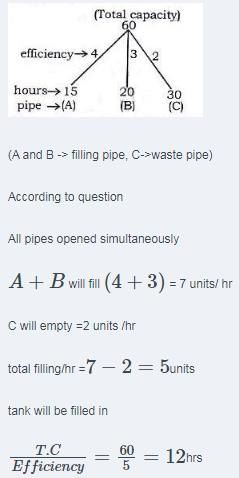
A large cistern can be filled by two pipes P and Q in 15 minutes and 20 minutes respectively. How many minutes will it take to fill the Cistern from an empty state if Q is used for half the time and P and Q fill it together for the other half?- a)12 minutes
- b)17 minutes
- c)18 minutes
- d)19 minutes
- e)None of the Above
Correct answer is option 'A'. Can you explain this answer?
A large cistern can be filled by two pipes P and Q in 15 minutes and 20 minutes respectively. How many minutes will it take to fill the Cistern from an empty state if Q is used for half the time and P and Q fill it together for the other half?
a)
12 minutes
b)
17 minutes
c)
18 minutes
d)
19 minutes
e)
None of the Above
|
|
Kavya Saxena answered |
Part filled by P and Q = 1/15 + 1/20 = 7/60
Part filled by Q = 1/20
x/2(7/60 + 1/20) = 12 minutes
Part filled by Q = 1/20
x/2(7/60 + 1/20) = 12 minutes
Pipe A and B can fill a Tank alone in 48 Hours and 24 Hours respectively. Another Pipe C can empty the same Tank alone in 36 Hours. In an empty Tank for the First hour, Pipe A is opened alone, Second Hour pipe B is opened alone, Third Hour pipe C is opened alone. This process is continued until the Tank is filled. Then Pipe B is opened for How many Hours?- a)28 Hours
- b)28 Hours 10 Min
- c)29 Hours
- d)29 Hours 10 Min
- e)None
Correct answer is option 'B'. Can you explain this answer?
Pipe A and B can fill a Tank alone in 48 Hours and 24 Hours respectively. Another Pipe C can empty the same Tank alone in 36 Hours. In an empty Tank for the First hour, Pipe A is opened alone, Second Hour pipe B is opened alone, Third Hour pipe C is opened alone. This process is continued until the Tank is filled. Then Pipe B is opened for How many Hours?
a)
28 Hours
b)
28 Hours 10 Min
c)
29 Hours
d)
29 Hours 10 Min
e)
None
|
|
Cstoppers Instructors answered |
3 Hours work = (1/48+1/24-1/36) = 5/144 28* 3hours = 140/144
remaining part = 4/144 = 1/36
Now it’s A turn = 1/36-1/48
= 1/144 left
Now it’s B turn = 1/144*24 = 1/6 hour = 10 min
Total B = 28 Hours + 10 Min
remaining part = 4/144 = 1/36
Now it’s A turn = 1/36-1/48
= 1/144 left
Now it’s B turn = 1/144*24 = 1/6 hour = 10 min
Total B = 28 Hours + 10 Min
If a pipe A can fill a tank 3 times faster than pipe B. If both the pipes can fill the tank in 32 minutes, then the slower pipe alone will be able to fill the tank in?- a)128 minutes
- b)124 minutes
- c)154 minutes
- d)168 minutes
- e)None of the Above
Correct answer is option 'A'. Can you explain this answer?
If a pipe A can fill a tank 3 times faster than pipe B. If both the pipes can fill the tank in 32 minutes, then the slower pipe alone will be able to fill the tank in?
a)
128 minutes
b)
124 minutes
c)
154 minutes
d)
168 minutes
e)
None of the Above
|
|
KS Coaching Center answered |
Time is taken by pipe A = x
Time is taken by pipe B = x/3
1/x + 3/x = 1/32
x = 128 minutes
Time is taken by pipe B = x/3
1/x + 3/x = 1/32
x = 128 minutes
Three taps P, Q and R can fill a tank in 12, 15 and 20 hours respectively. If P is open all the time and Q, R are open for one hour each alternatively, the tank will be full in- a)3 hours
- b)2 hours
- c)7 hours
- d)4 hours
- e)None of the Above
Correct answer is option 'C'. Can you explain this answer?
Three taps P, Q and R can fill a tank in 12, 15 and 20 hours respectively. If P is open all the time and Q, R are open for one hour each alternatively, the tank will be full in
a)
3 hours
b)
2 hours
c)
7 hours
d)
4 hours
e)
None of the Above
|
|
Aisha Gupta answered |
(P + Q)’s 1 hour work = 1/12 + 1/15 = 3/20
(P + R)’s 1 hour work = 1/12 + 1/20 = 2/15
For 2 hrs = (3/20 + 2/15) = 17/60
For 6 hrs = (3*17/60) = 17/20
Remaining Part = 1 – 17/20 = 3/20 filled by P and Q in 1 hour
(P + R)’s 1 hour work = 1/12 + 1/20 = 2/15
For 2 hrs = (3/20 + 2/15) = 17/60
For 6 hrs = (3*17/60) = 17/20
Remaining Part = 1 – 17/20 = 3/20 filled by P and Q in 1 hour
Pipes A and B can fill a tank in 5 and 3 hrs respectively. Pipe C can empty empty it in 15 h. The tank is half full. All the three pipes are in operation simultaneously. After how much time the tank will be full ?- a)1(7/15)hrs
- b)2(1/11)hrs
- c)1(1/14)hrs
- d)2(3/11)hrs
- e)None of these
Correct answer is option 'C'. Can you explain this answer?
Pipes A and B can fill a tank in 5 and 3 hrs respectively. Pipe C can empty empty it in 15 h. The tank is half full. All the three pipes are in operation simultaneously. After how much time the tank will be full ?
a)
1(7/15)hrs
b)
2(1/11)hrs
c)
1(1/14)hrs
d)
2(3/11)hrs
e)
None of these
|
|
Nikita Singh answered |
In 1 hr = 1/5+1/3 – 1/15 = 3+5-1/15 = 7/15
½ tank filled by 3 pipes = 15/7*1/2 = 15/14 =1(1/14)
½ tank filled by 3 pipes = 15/7*1/2 = 15/14 =1(1/14)
Two pipes P and Q can fill a tank in 6 hours and 8 hours respectively. If they are opened on alternate hours and if pipe P is opened first, in how many hours, the tank shall be full ?- a)10 hrs
- b)9.30hrs
- c)6.45hrs
- d)10.30hrs
- e)None of these
Correct answer is option 'C'. Can you explain this answer?
Two pipes P and Q can fill a tank in 6 hours and 8 hours respectively. If they are opened on alternate hours and if pipe P is opened first, in how many hours, the tank shall be full ?
a)
10 hrs
b)
9.30hrs
c)
6.45hrs
d)
10.30hrs
e)
None of these
|
|
Nikita Singh answered |
1/6+ 1/8 = 8+6/48 = 14/48 = 7/24…………in 2 hr
= 21/24…………6hrs
P ⇒ 6* 3/24 ⇒ 3/4 = 45min
Total = 6hrs 45min
= 21/24…………6hrs
P ⇒ 6* 3/24 ⇒ 3/4 = 45min
Total = 6hrs 45min
A tap can fill a tank in 12 minutes and another tap can empty the tank in 6 minutes.If the tank is already full and then both the taps are opened the tank will be- a)Filled in 6 minutes
- b)Emptied in 6 minutes
- c)Filled in 8 minutes
- d)Emptied in 12 minutes
- e)None of these
Correct answer is option 'D'. Can you explain this answer?
A tap can fill a tank in 12 minutes and another tap can empty the tank in 6 minutes.If the tank is already full and then both the taps are opened the tank will be
a)
Filled in 6 minutes
b)
Emptied in 6 minutes
c)
Filled in 8 minutes
d)
Emptied in 12 minutes
e)
None of these

|
Yash Patel answered |
1/12 – 1/6 = 1-2/12 = -1/12
Pipe A is 4 times as fast as B in filling a tank. If A takes 20 minutes to fill a tank, then what is the time taken by both the pipe A and B to fill the tank?- a)12
- b)16
- c)18
- d)20
- e)None of these
Correct answer is option 'B'. Can you explain this answer?
Pipe A is 4 times as fast as B in filling a tank. If A takes 20 minutes to fill a tank, then what is the time taken by both the pipe A and B to fill the tank?
a)
12
b)
16
c)
18
d)
20
e)
None of these
|
|
Future Foundation Institute answered |
A takes 20 minutes and it is 4 times faster than B, it means B will take 80 minutes to fill the tank.
(1/20 + 1/80)*t = 1. We get t = 16
(1/20 + 1/80)*t = 1. We get t = 16
Pipes A and B can fill a cistern in 15 hours together. But if these pipes operate separately A takes 40 hours less than B to fill the tank. In how many hours the pipe A will fill the cistern working alone?- a)60
- b)20
- c)40
- d)15
- e)25
Correct answer is option 'B'. Can you explain this answer?
Pipes A and B can fill a cistern in 15 hours together. But if these pipes operate separately A takes 40 hours less than B to fill the tank. In how many hours the pipe A will fill the cistern working alone?
a)
60
b)
20
c)
40
d)
15
e)
25
|
|
Future Foundation Institute answered |
Let A takes x hours, then B = (x+40) hours
1/x + 1/(x+40) = 1/15
Solve, x = 20
1/x + 1/(x+40) = 1/15
Solve, x = 20
A pipe can empty a tank in 60 minutes alone. Another pipe whose diameter is twice the diameter of first pipe is also opened. Now find the time in which both pipe will empty the tank together.- a)8 min
- b)10 min
- c)12 min
- d)14 min
- e)None of these
Correct answer is option 'C'. Can you explain this answer?
A pipe can empty a tank in 60 minutes alone. Another pipe whose diameter is twice the diameter of first pipe is also opened. Now find the time in which both pipe will empty the tank together.
a)
8 min
b)
10 min
c)
12 min
d)
14 min
e)
None of these
|
|
Aarav Sharma answered |
Let's assume that the capacity of the tank is 1 unit.
First, we need to find the rates at which each pipe can empty the tank.
The first pipe can empty the tank in 60 minutes, so its rate is 1/60 units per minute.
The second pipe has a diameter twice that of the first pipe. Since the rate of flow is directly proportional to the square of the diameter, the second pipe will have a rate four times that of the first pipe.
So, the rate of the second pipe is 4/60 = 1/15 units per minute.
Now, we need to find the combined rate at which both pipes can empty the tank.
To find the combined rate, we add the rates of both pipes:
Combined rate = 1/60 + 1/15
= (1 + 4)/60
= 5/60
= 1/12 units per minute
Now, let's calculate the time it will take for both pipes to empty the tank together.
Since the combined rate is 1/12 units per minute, it will take 12 minutes to empty 1 unit.
However, we assumed the capacity of the tank is 1 unit, so the time it will take to empty the tank is also 12 minutes.
Therefore, the correct answer is option 'C', 12 minutes.
First, we need to find the rates at which each pipe can empty the tank.
The first pipe can empty the tank in 60 minutes, so its rate is 1/60 units per minute.
The second pipe has a diameter twice that of the first pipe. Since the rate of flow is directly proportional to the square of the diameter, the second pipe will have a rate four times that of the first pipe.
So, the rate of the second pipe is 4/60 = 1/15 units per minute.
Now, we need to find the combined rate at which both pipes can empty the tank.
To find the combined rate, we add the rates of both pipes:
Combined rate = 1/60 + 1/15
= (1 + 4)/60
= 5/60
= 1/12 units per minute
Now, let's calculate the time it will take for both pipes to empty the tank together.
Since the combined rate is 1/12 units per minute, it will take 12 minutes to empty 1 unit.
However, we assumed the capacity of the tank is 1 unit, so the time it will take to empty the tank is also 12 minutes.
Therefore, the correct answer is option 'C', 12 minutes.
Bucket A has thrice the capacity as bucket B. It takes 20 turns for bucket P to fill the empty drum. How many turns it will take for both the buckets A and B having each turn together to fill the empty drum- a)12
- b)10
- c)15
- d)16
- e)None of these
Correct answer is option 'C'. Can you explain this answer?
Bucket A has thrice the capacity as bucket B. It takes 20 turns for bucket P to fill the empty drum. How many turns it will take for both the buckets A and B having each turn together to fill the empty drum
a)
12
b)
10
c)
15
d)
16
e)
None of these
|
|
Yash Patel answered |
A = 3B
A = 60, B = 20
No of turns = xy/x+y
No of turns = 60*20/20+60 = 1200/80 = 15 turns
A = 60, B = 20
No of turns = xy/x+y
No of turns = 60*20/20+60 = 1200/80 = 15 turns
Pipe A can fill a Tank in 18 Hours, Pipe B can empty a Tank in 12 Hours, Pipe C can fill Tank in 6 Hours. The Tank is already filled up to 1/6 of its capacity. Now Pipe A is opened in the First Hour alone, Pipe B is opened in the Second Hour alone and Pipe C is opened in the Third Hour alone. This cycle is repeated until the Tank gets filled. Then in How many Hours does the rest of Tank gets filled?- a)15 Hours
- b)18 Hours
- c)20 Hours
- d)24 Hours
- e)None
Correct answer is option 'B'. Can you explain this answer?
Pipe A can fill a Tank in 18 Hours, Pipe B can empty a Tank in 12 Hours, Pipe C can fill Tank in 6 Hours. The Tank is already filled up to 1/6 of its capacity. Now Pipe A is opened in the First Hour alone, Pipe B is opened in the Second Hour alone and Pipe C is opened in the Third Hour alone. This cycle is repeated until the Tank gets filled. Then in How many Hours does the rest of Tank gets filled?
a)
15 Hours
b)
18 Hours
c)
20 Hours
d)
24 Hours
e)
None
|
|
Kavya Saxena answered |
In First Hour Tank filled = 1/6+1/18
Second Hour = 1/6+1/18-1/12
Third Hour = 1/6+1/18-1/12+1/6 = 11/36 is filled 25/36 is left
From then 3 hours work = 1/18-1/12+1/6 = 5/36
5*3 Hours = 5*5/36 = 25/36
Total = 5*3+3 = 18 Hours
Second Hour = 1/6+1/18-1/12
Third Hour = 1/6+1/18-1/12+1/6 = 11/36 is filled 25/36 is left
From then 3 hours work = 1/18-1/12+1/6 = 5/36
5*3 Hours = 5*5/36 = 25/36
Total = 5*3+3 = 18 Hours
Two pipes P and Q can fill a cistern in 12 hours and 4 hours respectively. If they are opened on alternate hours and if pipe A is opened first, in how many hours will the tank be full?- a)4 hours
- b)5 hours
- c)2 hours
- d)6 hours
- e)None of the Above
Correct answer is option 'D'. Can you explain this answer?
Two pipes P and Q can fill a cistern in 12 hours and 4 hours respectively. If they are opened on alternate hours and if pipe A is opened first, in how many hours will the tank be full?
a)
4 hours
b)
5 hours
c)
2 hours
d)
6 hours
e)
None of the Above
|
|
Kavya Saxena answered |
Pipe P can fill = 1/12
Pipe Q can fill = 1/4
For every two hour, 1/12 + 1/4 = 1/3 Part filled
Total = 6 hours
Pipe Q can fill = 1/4
For every two hour, 1/12 + 1/4 = 1/3 Part filled
Total = 6 hours
A dam has four inlets – A, B, C and D. The dam can be filled in 12 minutes through the first three inlets and it can be filled in 15 minutes through the second, the third and fourth inlet also it can be filled through the first and the fourth inlet in 20 minutes. How much time required to fill up the dam by all the four inlets?- a)10 mins
- b)15 mins
- c)20 mins
- d)25 mins
- e)None of the Above
Correct answer is option 'A'. Can you explain this answer?
A dam has four inlets – A, B, C and D. The dam can be filled in 12 minutes through the first three inlets and it can be filled in 15 minutes through the second, the third and fourth inlet also it can be filled through the first and the fourth inlet in 20 minutes. How much time required to fill up the dam by all the four inlets?
a)
10 mins
b)
15 mins
c)
20 mins
d)
25 mins
e)
None of the Above
|
|
Alok Verma answered |
(1/A + 1/B + 1/C) = 1/12 …(i)
(1/B + 1/C + 1/D) = 1/15 …(ii)
(1/A + 1/D) = 1/20 …(iii)
From eqn (i) and (ii)
(1/A – 1/D) = 1/60…(iv)
From eqn (iii) and (iv)
A=30 D=60.
Let the time taken to full the tank = T
T(1/A + 1/B +1/C +1/D)= 1
T(1/30 + 1/15) = 1
T = 10 mins
(1/B + 1/C + 1/D) = 1/15 …(ii)
(1/A + 1/D) = 1/20 …(iii)
From eqn (i) and (ii)
(1/A – 1/D) = 1/60…(iv)
From eqn (iii) and (iv)
A=30 D=60.
Let the time taken to full the tank = T
T(1/A + 1/B +1/C +1/D)= 1
T(1/30 + 1/15) = 1
T = 10 mins
In a tank there is a pipe which can be used for filling the tank as well as for emptying it. The capacity of the tank is 1200 m³. The emptying of the tank is 10 m³ per minute higher than its filling capacity and the pump needs 6 minutes lesser to empty the tank than it needs to fill it. What is the filling capacity of the pipe?- a)20 m³ / min.
- b)40 m³ / min.
- c)50 m³ / min.
- d)60 m³ / min.
- e)None of the Above
Correct answer is option 'B'. Can you explain this answer?
In a tank there is a pipe which can be used for filling the tank as well as for emptying it. The capacity of the tank is 1200 m³. The emptying of the tank is 10 m³ per minute higher than its filling capacity and the pump needs 6 minutes lesser to empty the tank than it needs to fill it. What is the filling capacity of the pipe?
a)
20 m³ / min.
b)
40 m³ / min.
c)
50 m³ / min.
d)
60 m³ / min.
e)
None of the Above
|
|
Anaya Patel answered |
1200/x – 1200/(x+10) = 6
200/x – 200/(x+10) = 6
x2 + 10x – 2000 = 0
x = 40
200/x – 200/(x+10) = 6
x2 + 10x – 2000 = 0
x = 40
A Cistern has an inlet pipe and outlet pipe. The inlet pipe fills the cistern completely in 1 hour 20 minutes when the outlet pipe is plugged. The outlet pipe empties the tank completely in 6 hours when the inlet pipe is plugged. If there is a leakage also which is capable of draining out the water from the tank at half of the rate of the outlet pipe, then what is the time taken to fill the empty tank when both the pipes are opened?- a)3 hours
- b)2 hours
- c)5 hours
- d)4 hours
- e)None of the Above
Correct answer is option 'B'. Can you explain this answer?
A Cistern has an inlet pipe and outlet pipe. The inlet pipe fills the cistern completely in 1 hour 20 minutes when the outlet pipe is plugged. The outlet pipe empties the tank completely in 6 hours when the inlet pipe is plugged. If there is a leakage also which is capable of draining out the water from the tank at half of the rate of the outlet pipe, then what is the time taken to fill the empty tank when both the pipes are opened?
a)
3 hours
b)
2 hours
c)
5 hours
d)
4 hours
e)
None of the Above
|
|
Aryan Khanna answered |
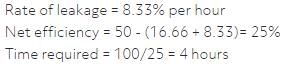
Twelve pipes are connected to a Cistern. Some of them are inlet pipes and the others are outlet pipes. Each of the inlet pipes can fill the tank in 8 hours and each of the outlet pipes can empty the cistern completely in 6 hours. If all the pipes are kept open, the empty tank gets filled in 24 hours. How many inlet pipes are there?- a)6
- b)8
- c)7
- d)4
- e)None of the Above
Correct answer is option 'C'. Can you explain this answer?
Twelve pipes are connected to a Cistern. Some of them are inlet pipes and the others are outlet pipes. Each of the inlet pipes can fill the tank in 8 hours and each of the outlet pipes can empty the cistern completely in 6 hours. If all the pipes are kept open, the empty tank gets filled in 24 hours. How many inlet pipes are there?
a)
6
b)
8
c)
7
d)
4
e)
None of the Above
|
|
Kavya Saxena answered |
(x/8)-[(12-x)/6] = 1/24
x = 7
x = 7
Chapter doubts & questions for Pipes & Cistern - RRB JE Mock Test Series for Civil Engineering (CE) 2025 2025 is part of Civil Engineering (CE) exam preparation. The chapters have been prepared according to the Civil Engineering (CE) exam syllabus. The Chapter doubts & questions, notes, tests & MCQs are made for Civil Engineering (CE) 2025 Exam. Find important definitions, questions, notes, meanings, examples, exercises, MCQs and online tests here.
Chapter doubts & questions of Pipes & Cistern - RRB JE Mock Test Series for Civil Engineering (CE) 2025 in English & Hindi are available as part of Civil Engineering (CE) exam.
Download more important topics, notes, lectures and mock test series for Civil Engineering (CE) Exam by signing up for free.


Signup to see your scores go up within 7 days!
Study with 1000+ FREE Docs, Videos & Tests
10M+ students study on EduRev
|
© EduRev
|
Education Revolution
|


|








Signup to see your scores
go up
within 7 days!
within 7 days!
Takes less than 10 seconds to signup