


NEET Exam > NEET Questions > The fundamental frequency of a closed pipe is... Start Learning for Free
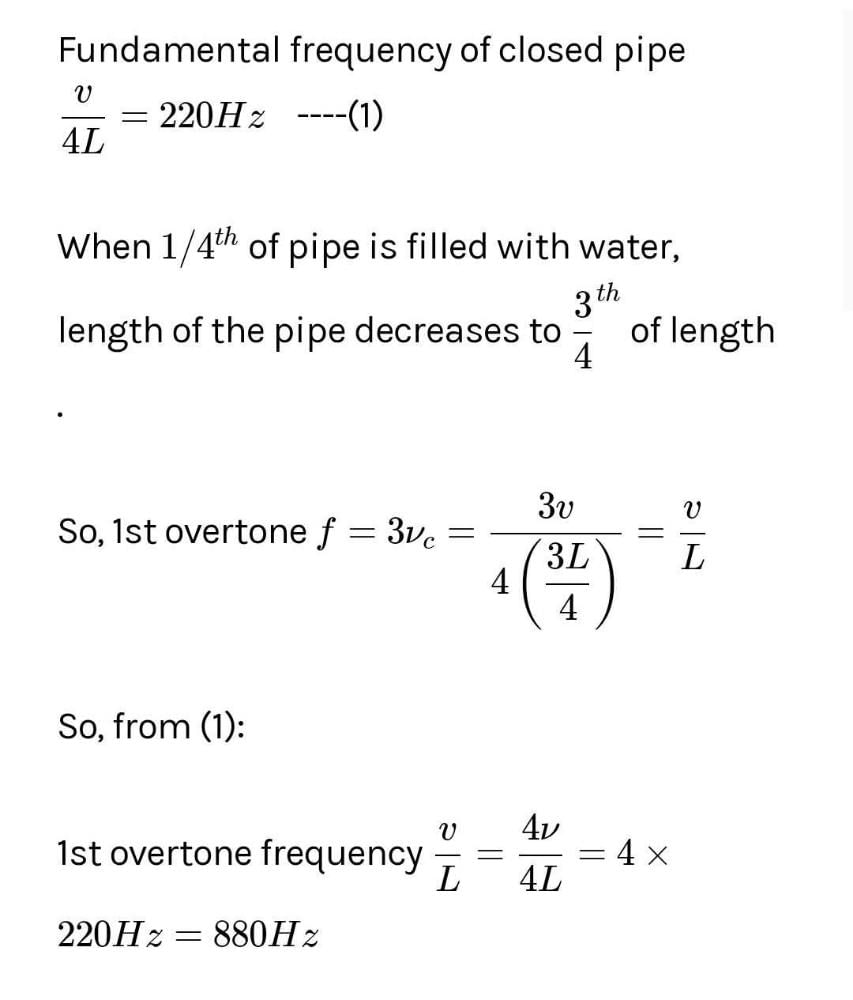
The fundamental frequency of a closed pipe is 220 Hz. If 1/4 of the pipe is filled with water, the frequency of the 1st overtone of the pipe now is
- a)220 Hz
- b)440 Hz
- c)880 Hz
- d)1760 Hz
Correct answer is option 'C'. Can you explain this answer?

Most Upvoted Answer
The fundamental frequency of a closed pipe is 220 Hz. If 1/4 of the pi...
The fundamental frequency of a closed pipe is determined by the length of the pipe. In a closed pipe, the sound wave undergoes a complete reflection at the closed end and a partial reflection at the open end. This causes a standing wave pattern to form inside the pipe.
If the entire pipe is filled with water, the effective length of the pipe increases due to the reflection of the sound wave at the water surface. This results in a decrease in the fundamental frequency.
Given that the fundamental frequency of the closed pipe is 220 Hz, we can determine the length of the pipe using the formula:
λ = 4L
where λ is the wavelength and L is the length of the pipe.
Since the pipe is closed, the fundamental frequency corresponds to the first harmonic, where the wavelength is twice the length of the pipe:
λ1 = 2L
Substituting the given value of the fundamental frequency:
220 = v/λ1
where v is the speed of sound.
We can rearrange the equation to solve for the length of the pipe:
L = v/(2 * 220)
If 1/4 of the pipe is filled with water, the effective length of the pipe becomes 3/4 of the original length. Therefore, the new length of the pipe is:
L' = (3/4) * L
The new fundamental frequency, f', can be determined using the formula:
f' = v/λ'
where λ' is the new wavelength.
Since the pipe is closed, the new fundamental frequency corresponds to the first harmonic, where the new wavelength is twice the new length of the pipe:
λ'1 = 2 * L'
Substituting the values:
f' = v/λ'1
= v/(2 * L')
Substituting the expression for L':
f' = v/(2 * (3/4) * L)
= (4/6) * (v/2L)
= (2/3) * f
where f is the original fundamental frequency.
Given that f = 220 Hz, the new fundamental frequency is:
f' = (2/3) * 220
= 440 Hz
Therefore, the frequency of the first overtone of the pipe, which is twice the fundamental frequency, is:
2 * f' = 2 * 440 Hz
= 880 Hz
Hence, the correct answer is option C) 880 Hz.
If the entire pipe is filled with water, the effective length of the pipe increases due to the reflection of the sound wave at the water surface. This results in a decrease in the fundamental frequency.
Given that the fundamental frequency of the closed pipe is 220 Hz, we can determine the length of the pipe using the formula:
λ = 4L
where λ is the wavelength and L is the length of the pipe.
Since the pipe is closed, the fundamental frequency corresponds to the first harmonic, where the wavelength is twice the length of the pipe:
λ1 = 2L
Substituting the given value of the fundamental frequency:
220 = v/λ1
where v is the speed of sound.
We can rearrange the equation to solve for the length of the pipe:
L = v/(2 * 220)
If 1/4 of the pipe is filled with water, the effective length of the pipe becomes 3/4 of the original length. Therefore, the new length of the pipe is:
L' = (3/4) * L
The new fundamental frequency, f', can be determined using the formula:
f' = v/λ'
where λ' is the new wavelength.
Since the pipe is closed, the new fundamental frequency corresponds to the first harmonic, where the new wavelength is twice the new length of the pipe:
λ'1 = 2 * L'
Substituting the values:
f' = v/λ'1
= v/(2 * L')
Substituting the expression for L':
f' = v/(2 * (3/4) * L)
= (4/6) * (v/2L)
= (2/3) * f
where f is the original fundamental frequency.
Given that f = 220 Hz, the new fundamental frequency is:
f' = (2/3) * 220
= 440 Hz
Therefore, the frequency of the first overtone of the pipe, which is twice the fundamental frequency, is:
2 * f' = 2 * 440 Hz
= 880 Hz
Hence, the correct answer is option C) 880 Hz.
Free Test
FREE
| Start Free Test |
Community Answer
The fundamental frequency of a closed pipe is 220 Hz. If 1/4 of the pi...
 | Explore Courses for NEET exam |  |
Top Courses for NEETView all





Top Courses for NEET
Question Description
The fundamental frequency of a closed pipe is 220 Hz. If 1/4 of the pipe is filled with water, the frequency of the 1st overtone of the pipe now isa)220 Hzb)440 Hzc)880 Hzd)1760 HzCorrect answer is option 'C'. Can you explain this answer? for NEET 2026 is part of NEET preparation. The Question and answers have been prepared according to the NEET exam syllabus. Information about The fundamental frequency of a closed pipe is 220 Hz. If 1/4 of the pipe is filled with water, the frequency of the 1st overtone of the pipe now isa)220 Hzb)440 Hzc)880 Hzd)1760 HzCorrect answer is option 'C'. Can you explain this answer? covers all topics & solutions for NEET 2026 Exam. Find important definitions, questions, meanings, examples, exercises and tests below for The fundamental frequency of a closed pipe is 220 Hz. If 1/4 of the pipe is filled with water, the frequency of the 1st overtone of the pipe now isa)220 Hzb)440 Hzc)880 Hzd)1760 HzCorrect answer is option 'C'. Can you explain this answer?.
The fundamental frequency of a closed pipe is 220 Hz. If 1/4 of the pipe is filled with water, the frequency of the 1st overtone of the pipe now isa)220 Hzb)440 Hzc)880 Hzd)1760 HzCorrect answer is option 'C'. Can you explain this answer? for NEET 2026 is part of NEET preparation. The Question and answers have been prepared according to the NEET exam syllabus. Information about The fundamental frequency of a closed pipe is 220 Hz. If 1/4 of the pipe is filled with water, the frequency of the 1st overtone of the pipe now isa)220 Hzb)440 Hzc)880 Hzd)1760 HzCorrect answer is option 'C'. Can you explain this answer? covers all topics & solutions for NEET 2026 Exam. Find important definitions, questions, meanings, examples, exercises and tests below for The fundamental frequency of a closed pipe is 220 Hz. If 1/4 of the pipe is filled with water, the frequency of the 1st overtone of the pipe now isa)220 Hzb)440 Hzc)880 Hzd)1760 HzCorrect answer is option 'C'. Can you explain this answer?.
Solutions for The fundamental frequency of a closed pipe is 220 Hz. If 1/4 of the pipe is filled with water, the frequency of the 1st overtone of the pipe now isa)220 Hzb)440 Hzc)880 Hzd)1760 HzCorrect answer is option 'C'. Can you explain this answer? in English & in Hindi are available as part of our courses for NEET. Download more important topics, notes, lectures and mock test series for NEET Exam by signing up for free.
Here you can find the meaning of The fundamental frequency of a closed pipe is 220 Hz. If 1/4 of the pipe is filled with water, the frequency of the 1st overtone of the pipe now isa)220 Hzb)440 Hzc)880 Hzd)1760 HzCorrect answer is option 'C'. Can you explain this answer? defined & explained in the simplest way possible. Besides giving the explanation of The fundamental frequency of a closed pipe is 220 Hz. If 1/4 of the pipe is filled with water, the frequency of the 1st overtone of the pipe now isa)220 Hzb)440 Hzc)880 Hzd)1760 HzCorrect answer is option 'C'. Can you explain this answer?, a detailed solution for The fundamental frequency of a closed pipe is 220 Hz. If 1/4 of the pipe is filled with water, the frequency of the 1st overtone of the pipe now isa)220 Hzb)440 Hzc)880 Hzd)1760 HzCorrect answer is option 'C'. Can you explain this answer? has been provided alongside types of The fundamental frequency of a closed pipe is 220 Hz. If 1/4 of the pipe is filled with water, the frequency of the 1st overtone of the pipe now isa)220 Hzb)440 Hzc)880 Hzd)1760 HzCorrect answer is option 'C'. Can you explain this answer? theory, EduRev gives you an ample number of questions to practice The fundamental frequency of a closed pipe is 220 Hz. If 1/4 of the pipe is filled with water, the frequency of the 1st overtone of the pipe now isa)220 Hzb)440 Hzc)880 Hzd)1760 HzCorrect answer is option 'C'. Can you explain this answer? tests, examples and also practice NEET tests.
| Explore Courses for NEET exam | |
Top Courses for NEET
Explore Courses
Signup for Free!
Signup to see your scores go up within 7 days! Learn & Practice with 1000+ FREE Notes, Videos & Tests.


