


All Exams >
OPSC OCS (Odisha) >
6 Months Preparation Course for OPSC >
All Questions
All questions of The Sangam Age for OPSC OCS (Odisha) Exam
Which one of the following Sangam towns was famous for its pearls and muslins, the latter being as thin as the skin of the snake?- a)Uraiyur
- b)Muziris
- c)Arikamedu
- d)Puhar
Correct answer is option 'A'. Can you explain this answer?
Which one of the following Sangam towns was famous for its pearls and muslins, the latter being as thin as the skin of the snake?
a)
Uraiyur
b)
Muziris
c)
Arikamedu
d)
Puhar

|
Yashvi Desai answered |
Sangam town famous for pearls and muslins
The Sangam period refers to the time between 3rd century BCE to 3rd century CE in South India. During this period, many towns emerged as centers of trade and commerce. One such town was Uraiyur, which was famous for its pearls and muslins.
Uraiyur
Uraiyur was an ancient town located near present-day Tiruchirapalli in Tamil Nadu. It was the capital of the early Chola dynasty and was an important center of trade and commerce during the Sangam period.
Pearls
Uraiyur was famous for its pearls, which were obtained from the nearby pearl banks in the Bay of Bengal. The pearls were highly valued and were used as currency in trade.
Muslins
Uraiyur was also famous for its muslins, which were as thin as the skin of a snake. Muslin is a cotton fabric that originated in the Indian subcontinent and was highly valued in ancient times. The muslins produced in Uraiyur were known for their fine quality and were in great demand in foreign markets.
Conclusion
In conclusion, Uraiyur was a prominent Sangam town that was famous for its pearls and muslins. The town was an important center of trade and commerce during the Sangam period and played a significant role in the economic and cultural development of South India.
The Sangam period refers to the time between 3rd century BCE to 3rd century CE in South India. During this period, many towns emerged as centers of trade and commerce. One such town was Uraiyur, which was famous for its pearls and muslins.
Uraiyur
Uraiyur was an ancient town located near present-day Tiruchirapalli in Tamil Nadu. It was the capital of the early Chola dynasty and was an important center of trade and commerce during the Sangam period.
Pearls
Uraiyur was famous for its pearls, which were obtained from the nearby pearl banks in the Bay of Bengal. The pearls were highly valued and were used as currency in trade.
Muslins
Uraiyur was also famous for its muslins, which were as thin as the skin of a snake. Muslin is a cotton fabric that originated in the Indian subcontinent and was highly valued in ancient times. The muslins produced in Uraiyur were known for their fine quality and were in great demand in foreign markets.
Conclusion
In conclusion, Uraiyur was a prominent Sangam town that was famous for its pearls and muslins. The town was an important center of trade and commerce during the Sangam period and played a significant role in the economic and cultural development of South India.

Assertion A : Merchants sold their goods by openly announcing the profit they were aiming at.
Reason R: Merchants functioned often in a body, which was known as ‘Vanikachattu’
- a)If both A and R are true and R is the correct explanation of A.
- b)If both A and R are true but R is not the correct explanation of A.
- c)If A is true and R is false.
- d)If A is false and R is true.
- e)If both A and R are false.
Correct answer is option 'B'. Can you explain this answer?
Assertion A : Merchants sold their goods by openly announcing the profit they were aiming at.
Reason R: Merchants functioned often in a body, which was known as ‘Vanikachattu’
a)
If both A and R are true and R is the correct explanation of A.
b)
If both A and R are true but R is not the correct explanation of A.
c)
If A is true and R is false.
d)
If A is false and R is true.
e)
If both A and R are false.

|
Aniket Nair answered |
Assertion and Reasoning questions are designed to test the candidate's understanding of the subject matter. In this question, the assertion is about the selling methods of merchants and the reason provided is about the functioning of merchants in a group. Let's analyze the given assertion and reasoning:
Assertion A: Merchants sold their goods by openly announcing the profit they were aiming at.
This assertion is related to the selling methods of merchants. It implies that merchants were transparent about the profit they aimed to make from the sale of their goods. This assertion is true and is supported by historical evidence.
Reason R: Merchants functioned often in a body, which was known as Vanikachattu.
This reasoning is related to the functioning of merchants. It implies that merchants often worked in groups called Vanikachattu. This reasoning is also true and is supported by historical evidence.
Now, let's analyze whether the reasoning explains the assertion or not.
If both A and R are true but R is not the correct explanation of A.
This option is the correct answer. The reasoning provided in R is not directly related to the assertion in A. While it is true that merchants often functioned in groups, it does not directly explain why they openly announced the profit they aimed to make. Therefore, option B is the correct answer.
To summarize, Assertion and Reasoning questions require careful analysis of both the statements. In this case, the assertion and reasoning are both true, but the reasoning does not directly explain the assertion. Candidates should be cautious while attempting such questions and analyze the statements logically.
Assertion A: Merchants sold their goods by openly announcing the profit they were aiming at.
This assertion is related to the selling methods of merchants. It implies that merchants were transparent about the profit they aimed to make from the sale of their goods. This assertion is true and is supported by historical evidence.
Reason R: Merchants functioned often in a body, which was known as Vanikachattu.
This reasoning is related to the functioning of merchants. It implies that merchants often worked in groups called Vanikachattu. This reasoning is also true and is supported by historical evidence.
Now, let's analyze whether the reasoning explains the assertion or not.
If both A and R are true but R is not the correct explanation of A.
This option is the correct answer. The reasoning provided in R is not directly related to the assertion in A. While it is true that merchants often functioned in groups, it does not directly explain why they openly announced the profit they aimed to make. Therefore, option B is the correct answer.
To summarize, Assertion and Reasoning questions require careful analysis of both the statements. In this case, the assertion and reasoning are both true, but the reasoning does not directly explain the assertion. Candidates should be cautious while attempting such questions and analyze the statements logically.
What was known as ‘Yavanapriya’?- a)Pepper
- b)Ginger
- c)Cotton
- d)Silk
Correct answer is option 'A'. Can you explain this answer?
What was known as ‘Yavanapriya’?
a)
Pepper
b)
Ginger
c)
Cotton
d)
Silk

|
Ashish Majumdar answered |
Literellay it means Pepper. During olden days there was trade between Rome and India. Romans are called Yavans. Trade was thriving between India and Rome. Rome used to Import Pepper and export Precious metals. They liked Pepper and hence the name given to Pepper is Yavanapriya..
Korkai was the coastal capital of the - a)Cholas
- b)Cheras
- c)Pandyas
- d)Pallavas
Correct answer is option 'C'. Can you explain this answer?
Korkai was the coastal capital of the
a)
Cholas
b)
Cheras
c)
Pandyas
d)
Pallavas

|
Ansh Awasthi answered |
It was called pandya-kavada in the kapatapuram in kalithogai. It is situated about 3km north of the Thamirabarani and about 6km from the shore of Bay of Bengal.
While Pandyan king is mentioned in the ‘Silappadikaram’?- a)Senguttuvan
- b)Karikala
- c)Nedunjeliyan
- d)Elara
Correct answer is option 'C'. Can you explain this answer?
While Pandyan king is mentioned in the ‘Silappadikaram’?
a)
Senguttuvan
b)
Karikala
c)
Nedunjeliyan
d)
Elara

|
Mrinalini Kumar answered |
Pandyan King mentioned in Silappadikaram is Nedunjeliyan.
Explanation:
Silappadikaram is one of the five great epics of Tamil literature. It was written by Ilango Adigal during the Sangam period. The story revolves around the characters Kannagi, Kovalan, and Madhavi.
The Pandyan king who is mentioned in Silappadikaram is Nedunjeliyan. He was the ruler of Madurai during the Sangam period. He is known for his patronage of Tamil literature and art.
Some of the notable achievements of Nedunjeliyan are:
• Conquered the Chera and Chola kingdoms and expanded the Pandyan Empire.
• Built the Nedunchezhian palace in Madurai, which was known for its grandeur and beauty.
• Commissioned the Manimekalai, a Tamil epic poem, which was a sequel to Silappadikaram.
• Developed the port city of Korkai, which was an important center for trade and commerce.
Nedunjeliyan was a patron of Tamil literature and is known to have supported poets and writers. He also encouraged the translation of Sanskrit works into Tamil.
In Silappadikaram, Nedunjeliyan is mentioned in various contexts. He is mentioned as a powerful king who is feared by his enemies. He is also portrayed as a just ruler who punishes the wrongdoers and protects the weak. Overall, Nedunjeliyan is depicted as a great king who is respected by his subjects and admired by his contemporaries.
Explanation:
Silappadikaram is one of the five great epics of Tamil literature. It was written by Ilango Adigal during the Sangam period. The story revolves around the characters Kannagi, Kovalan, and Madhavi.
The Pandyan king who is mentioned in Silappadikaram is Nedunjeliyan. He was the ruler of Madurai during the Sangam period. He is known for his patronage of Tamil literature and art.
Some of the notable achievements of Nedunjeliyan are:
• Conquered the Chera and Chola kingdoms and expanded the Pandyan Empire.
• Built the Nedunchezhian palace in Madurai, which was known for its grandeur and beauty.
• Commissioned the Manimekalai, a Tamil epic poem, which was a sequel to Silappadikaram.
• Developed the port city of Korkai, which was an important center for trade and commerce.
Nedunjeliyan was a patron of Tamil literature and is known to have supported poets and writers. He also encouraged the translation of Sanskrit works into Tamil.
In Silappadikaram, Nedunjeliyan is mentioned in various contexts. He is mentioned as a powerful king who is feared by his enemies. He is also portrayed as a just ruler who punishes the wrongdoers and protects the weak. Overall, Nedunjeliyan is depicted as a great king who is respected by his subjects and admired by his contemporaries.
Which of the following Tamil works highlight the importance of Jaina philosophy?- a)Jivak-Chintamani
- b)Silappadikaram
- c)Manimekalai
- d)Pattupattu
Correct answer is option 'A'. Can you explain this answer?
Which of the following Tamil works highlight the importance of Jaina philosophy?
a)
Jivak-Chintamani
b)
Silappadikaram
c)
Manimekalai
d)
Pattupattu

|
Rishabh Choudhary answered |
The Tamil work that highlights the importance of Jaina philosophy is Jivak-Chintamani. Let's understand why:
Jivak-Chintamani:
- Jivak-Chintamani is a Tamil work that was written by Tirutakkatevar, a Jain monk.
- It is an epic poem that consists of 3,000 verses and was written in the 14th century CE.
- The poem is a philosophical treatise that talks about the Jain doctrine of karma, the cycle of birth and death, and the importance of practicing non-violence and asceticism.
- The work also highlights the Jain concept of the three jewels, which are right faith, right knowledge, and right conduct.
- The poem is considered to be an important work in the Jain tradition and is often recited during religious ceremonies.
Silappadikaram, Manimekalai, and Pattupattu:
- Silappadikaram, Manimekalai, and Pattupattu are other Tamil works that are considered to be classics of Tamil literature.
- However, these works do not specifically highlight the importance of Jaina philosophy.
- Silappadikaram is a story of a courtesan named Kannagi who seeks justice for her husband's wrongful execution. The work explores themes of love, justice, and morality.
- Manimekalai is a Buddhist work that tells the story of a young woman named Manimekalai who becomes a Buddhist nun and learns about the Buddhist concept of enlightenment.
- Pattupattu is a collection of ten Tamil poems that were written by various authors. The poems explore themes of love, war, and nature.
In conclusion, Jivak-Chintamani is the Tamil work that specifically highlights the importance of Jaina philosophy, while Silappadikaram, Manimekalai, and Pattupattu explore other themes.
Jivak-Chintamani:
- Jivak-Chintamani is a Tamil work that was written by Tirutakkatevar, a Jain monk.
- It is an epic poem that consists of 3,000 verses and was written in the 14th century CE.
- The poem is a philosophical treatise that talks about the Jain doctrine of karma, the cycle of birth and death, and the importance of practicing non-violence and asceticism.
- The work also highlights the Jain concept of the three jewels, which are right faith, right knowledge, and right conduct.
- The poem is considered to be an important work in the Jain tradition and is often recited during religious ceremonies.
Silappadikaram, Manimekalai, and Pattupattu:
- Silappadikaram, Manimekalai, and Pattupattu are other Tamil works that are considered to be classics of Tamil literature.
- However, these works do not specifically highlight the importance of Jaina philosophy.
- Silappadikaram is a story of a courtesan named Kannagi who seeks justice for her husband's wrongful execution. The work explores themes of love, justice, and morality.
- Manimekalai is a Buddhist work that tells the story of a young woman named Manimekalai who becomes a Buddhist nun and learns about the Buddhist concept of enlightenment.
- Pattupattu is a collection of ten Tamil poems that were written by various authors. The poems explore themes of love, war, and nature.
In conclusion, Jivak-Chintamani is the Tamil work that specifically highlights the importance of Jaina philosophy, while Silappadikaram, Manimekalai, and Pattupattu explore other themes.
Which statement on Sangam history is incorrect?- a)Vishnu worship with Tulsi was popular among the Sangam people.
- b)The Sangam people did not worship Siva, Balaram and Krishna.
- c)Vedic religion of sacrifice was followed by the Sangam kings.
- d)Buddhism and Jainism found a footing in the land of Sangam people.
Correct answer is option 'B'. Can you explain this answer?
Which statement on Sangam history is incorrect?
a)
Vishnu worship with Tulsi was popular among the Sangam people.
b)
The Sangam people did not worship Siva, Balaram and Krishna.
c)
Vedic religion of sacrifice was followed by the Sangam kings.
d)
Buddhism and Jainism found a footing in the land of Sangam people.
|
|
Uday Menon answered |
Incorrect Statement on Sangam History
The incorrect statement on Sangam history is option 'B' - The Sangam people did not worship Siva, Balaram, and Krishna.
Explanation
The Sangam period was an ancient period of Tamil Nadu's history that lasted from 300 BCE to 300 CE. It was characterized by the development of Tamil literature, trade, and culture. The Sangam literature provides valuable insights into the religious beliefs and practices of the people of that period.
Vishnu Worship with Tulsi was Popular among the Sangam People
Vishnu worship with Tulsi was popular among the Sangam people. The Tamil literature of the Sangam period refers to Vishnu's worship with Tulsi leaves. The Sangam literature also mentions Vishnu's ten Avatars, including Rama and Krishna.
Vedic Religion of Sacrifice was Followed by the Sangam Kings
The Sangam kings followed the Vedic religion of sacrifice. The Sangam literature mentions the performance of Yajnas or sacrifices by the kings to appease the gods.
Buddhism and Jainism Found a Foothold in the Land of Sangam People
Buddhism and Jainism found a foothold in the land of Sangam people. The Sangam literature mentions the presence of Buddhist and Jain monks and their teachings in Tamil Nadu during that period.
Conclusion
In conclusion, option 'B' is incorrect because the Sangam people did worship Siva, Balaram, and Krishna, as mentioned in the Sangam literature. However, the worship of Vishnu with Tulsi was more popular among them.
The incorrect statement on Sangam history is option 'B' - The Sangam people did not worship Siva, Balaram, and Krishna.
Explanation
The Sangam period was an ancient period of Tamil Nadu's history that lasted from 300 BCE to 300 CE. It was characterized by the development of Tamil literature, trade, and culture. The Sangam literature provides valuable insights into the religious beliefs and practices of the people of that period.
Vishnu Worship with Tulsi was Popular among the Sangam People
Vishnu worship with Tulsi was popular among the Sangam people. The Tamil literature of the Sangam period refers to Vishnu's worship with Tulsi leaves. The Sangam literature also mentions Vishnu's ten Avatars, including Rama and Krishna.
Vedic Religion of Sacrifice was Followed by the Sangam Kings
The Sangam kings followed the Vedic religion of sacrifice. The Sangam literature mentions the performance of Yajnas or sacrifices by the kings to appease the gods.
Buddhism and Jainism Found a Foothold in the Land of Sangam People
Buddhism and Jainism found a foothold in the land of Sangam people. The Sangam literature mentions the presence of Buddhist and Jain monks and their teachings in Tamil Nadu during that period.
Conclusion
In conclusion, option 'B' is incorrect because the Sangam people did worship Siva, Balaram, and Krishna, as mentioned in the Sangam literature. However, the worship of Vishnu with Tulsi was more popular among them.
Which South Indian dynasty during the Sangam Age was famous for their trade with the Romans and had the emblem of "bow and arrow"?- a)Cholas
- b)Pandyas
- c)Pallavas
- d)Cheras
Correct answer is option 'D'. Can you explain this answer?
Which South Indian dynasty during the Sangam Age was famous for their trade with the Romans and had the emblem of "bow and arrow"?
a)
Cholas
b)
Pandyas
c)
Pallavas
d)
Cheras

|
Nishanth Jain answered |
Introduction
The Sangam Age, which flourished in South India from approximately 300 BCE to 300 CE, was a significant period marked by the rise of powerful dynasties and extensive trade networks. Among these, the Cheras stood out for their robust trade relations with the Romans.
Cheras and Their Trade Relations
- The Chera dynasty, located in present-day Kerala and parts of Tamil Nadu, was known for its maritime trade.
- They exported spices, ivory, and textiles, which were highly sought after by Roman traders.
- Their ports, such as Muziris, served as crucial hubs in the trade routes connecting India with the Roman Empire.
Emblem of Bow and Arrow
- The emblem of the Cheras was the “bow and arrow,” symbolizing strength and valor.
- This emblem is frequently found in their inscriptions and literature, indicating its importance in representing the dynasty's identity.
Significance of Trade
- The Cheras played a vital role in the economic landscape of the Sangam period, facilitating cultural exchanges and the spread of ideas.
- The influx of Roman gold into South India due to this trade contributed significantly to the prosperity of the Chera kingdom.
Conclusion
In summary, the Chera dynasty during the Sangam Age was notable for its extensive trade with the Romans, characterized by their emblem of the bow and arrow. Their strategic location and maritime prowess allowed them to become key players in the ancient trade networks, marking a significant chapter in South Indian history.
The Sangam Age, which flourished in South India from approximately 300 BCE to 300 CE, was a significant period marked by the rise of powerful dynasties and extensive trade networks. Among these, the Cheras stood out for their robust trade relations with the Romans.
Cheras and Their Trade Relations
- The Chera dynasty, located in present-day Kerala and parts of Tamil Nadu, was known for its maritime trade.
- They exported spices, ivory, and textiles, which were highly sought after by Roman traders.
- Their ports, such as Muziris, served as crucial hubs in the trade routes connecting India with the Roman Empire.
Emblem of Bow and Arrow
- The emblem of the Cheras was the “bow and arrow,” symbolizing strength and valor.
- This emblem is frequently found in their inscriptions and literature, indicating its importance in representing the dynasty's identity.
Significance of Trade
- The Cheras played a vital role in the economic landscape of the Sangam period, facilitating cultural exchanges and the spread of ideas.
- The influx of Roman gold into South India due to this trade contributed significantly to the prosperity of the Chera kingdom.
Conclusion
In summary, the Chera dynasty during the Sangam Age was notable for its extensive trade with the Romans, characterized by their emblem of the bow and arrow. Their strategic location and maritime prowess allowed them to become key players in the ancient trade networks, marking a significant chapter in South Indian history.
Which Tamil work throws light on India’s flourishing trade with the Roman Empire?- a)Ettutogai
- b)Pattupattu
- c)Manimekali
- d)Silappadikaram
Correct answer is option 'D'. Can you explain this answer?
Which Tamil work throws light on India’s flourishing trade with the Roman Empire?
a)
Ettutogai
b)
Pattupattu
c)
Manimekali
d)
Silappadikaram
|
|
Keerthana Khanna answered |
Explanation:
The Tamil work that throws light on India's flourishing trade with the Roman Empire is Silappadikaram.
Background:
Silappadikaram is one of the five great epics of Tamil literature. It was written by the Tamil poet Ilango Adigal in the 5th century CE. The work is divided into three books and tells the story of the lives of Kannagi and Kovalan. The epic also provides a wealth of information on the economic and social conditions of ancient Tamil Nadu.
Flourishing Trade:
Silappadikaram describes the flourishing trade between ancient India and the Roman Empire. The Chera king, Senguttuvan, is said to have sent an embassy to the Roman Emperor Augustus, bearing gifts of pearls, ivory, and peacocks. The embassy is said to have returned with Roman wine, gold, and a giraffe. This shows the extent of trade and diplomatic relations between ancient India and the Roman Empire.
The epic also describes the port city of Puhar (now known as Kaveripattinam) as a major hub of international trade. Merchants from various parts of the world, including the Roman Empire, China, and Southeast Asia, are said to have visited the city for trade. The city had a bustling market and was known for its textiles, pearls, and precious stones.
Conclusion:
In conclusion, Silappadikaram is an important source of information on the economic and social conditions of ancient Tamil Nadu. It provides valuable insights into the flourishing trade between ancient India and the Roman Empire and highlights the importance of the port city of Puhar in facilitating this trade.
The Tamil work that throws light on India's flourishing trade with the Roman Empire is Silappadikaram.
Background:
Silappadikaram is one of the five great epics of Tamil literature. It was written by the Tamil poet Ilango Adigal in the 5th century CE. The work is divided into three books and tells the story of the lives of Kannagi and Kovalan. The epic also provides a wealth of information on the economic and social conditions of ancient Tamil Nadu.
Flourishing Trade:
Silappadikaram describes the flourishing trade between ancient India and the Roman Empire. The Chera king, Senguttuvan, is said to have sent an embassy to the Roman Emperor Augustus, bearing gifts of pearls, ivory, and peacocks. The embassy is said to have returned with Roman wine, gold, and a giraffe. This shows the extent of trade and diplomatic relations between ancient India and the Roman Empire.
The epic also describes the port city of Puhar (now known as Kaveripattinam) as a major hub of international trade. Merchants from various parts of the world, including the Roman Empire, China, and Southeast Asia, are said to have visited the city for trade. The city had a bustling market and was known for its textiles, pearls, and precious stones.
Conclusion:
In conclusion, Silappadikaram is an important source of information on the economic and social conditions of ancient Tamil Nadu. It provides valuable insights into the flourishing trade between ancient India and the Roman Empire and highlights the importance of the port city of Puhar in facilitating this trade.
Consider the following statements regarding the Sangam period:1. The primary deity of the Sangam period was Murugan, who was worshipped in six abodes known as Arupadai Veedu.2. Tolkappiyam refers to four castes, including the vanigar, who were primarily engaged in agriculture.3. The chief source of state income was the revenue generated from foreign trade during the Sangam period.Which of the statements given above is/are correct?- a)1 Only
- b)1 and 2 Only
- c)1 and 3 Only
- d)1, 2 and 3
Correct answer is option 'A'. Can you explain this answer?
Consider the following statements regarding the Sangam period:
1. The primary deity of the Sangam period was Murugan, who was worshipped in six abodes known as Arupadai Veedu.
2. Tolkappiyam refers to four castes, including the vanigar, who were primarily engaged in agriculture.
3. The chief source of state income was the revenue generated from foreign trade during the Sangam period.
Which of the statements given above is/are correct?
a)
1 Only
b)
1 and 2 Only
c)
1 and 3 Only
d)
1, 2 and 3

|
Goel UPSC Coaching Center answered |
- Statement 1 is correct. Murugan was indeed the primary deity of the Sangam period and was worshipped in six abodes, known as Arupadai Veedu. This reflects the significant cultural and religious role Murugan played during this period.
- Statement 2 is incorrect. Tolkappiyam mentions four castes, among which the vanigar were engaged in trade and commerce, not agriculture. The vellalar were the ones primarily involved in agriculture. This misstatement about the role of vanigar makes this statement false.
- Statement 3 is incorrect. The chief source of state income during the Sangam period was land revenue, not foreign trade. Although customs duties on foreign trade contributed to the state’s income, the primary source was indeed land revenue, complemented by the booty captured in wars.
Thus, only Statement 1 is correct. Therefore, the correct answer is Option A: 1 Only.
Consider the following pairs:1. Cheras - Vanji2. Cholas - Korkai3. Pandyas - Madurai4. Cholas - Tiger (Emblem)How many pairs given above are correctly matched?- a)Only one pair
- b)Only two pairs
- c)Only three pairs
- d)All four pairs
Correct answer is option 'C'. Can you explain this answer?
Consider the following pairs:
1. Cheras - Vanji
2. Cholas - Korkai
3. Pandyas - Madurai
4. Cholas - Tiger (Emblem)
How many pairs given above are correctly matched?
a)
Only one pair
b)
Only two pairs
c)
Only three pairs
d)
All four pairs

|
Devanshi Choudhury answered |
Understanding the Pairs
To evaluate the correctness of the pairs provided, we need to analyze the historical and cultural significance of each match.
1. Cheras - Vanji
- The Cheras were an ancient dynasty in South India, and Vanji (modern-day Vanchi) is often associated with them as a significant trading port.
- Correct Match: Yes
2. Cholas - Korkai
- Korkai was a major port associated with the Pandya dynasty, not the Cholas.
- Correct Match: No
3. Pandyas - Madurai
- Madurai was the capital city of the Pandya dynasty and a center of their culture and trade.
- Correct Match: Yes
4. Cholas - Tiger (Emblem)
- The Chola dynasty is indeed known for the tiger as part of their royal insignia, symbolizing power and bravery.
- Correct Match: Yes
Summary of Correct Matches
- Correct Matches:
- Cheras - Vanji (Yes)
- Cholas - Korkai (No)
- Pandyas - Madurai (Yes)
- Cholas - Tiger (Emblem) (Yes)
Conclusion
Out of the four pairs, three are correctly matched:
1. Cheras - Vanji
2. Pandyas - Madurai
3. Cholas - Tiger (Emblem)
Thus, the correct answer is option 'C', which states that only three pairs are correctly matched.
To evaluate the correctness of the pairs provided, we need to analyze the historical and cultural significance of each match.
1. Cheras - Vanji
- The Cheras were an ancient dynasty in South India, and Vanji (modern-day Vanchi) is often associated with them as a significant trading port.
- Correct Match: Yes
2. Cholas - Korkai
- Korkai was a major port associated with the Pandya dynasty, not the Cholas.
- Correct Match: No
3. Pandyas - Madurai
- Madurai was the capital city of the Pandya dynasty and a center of their culture and trade.
- Correct Match: Yes
4. Cholas - Tiger (Emblem)
- The Chola dynasty is indeed known for the tiger as part of their royal insignia, symbolizing power and bravery.
- Correct Match: Yes
Summary of Correct Matches
- Correct Matches:
- Cheras - Vanji (Yes)
- Cholas - Korkai (No)
- Pandyas - Madurai (Yes)
- Cholas - Tiger (Emblem) (Yes)
Conclusion
Out of the four pairs, three are correctly matched:
1. Cheras - Vanji
2. Pandyas - Madurai
3. Cholas - Tiger (Emblem)
Thus, the correct answer is option 'C', which states that only three pairs are correctly matched.
Consider the following statements regarding the political history of the Sangam period:1. The Cheras controlled the region which included the central and northern parts of Kerala and the Kongu region of Tamil Nadu, with their capital at Vanji.2. The Cholas, known for their naval prowess, had their main capital at Korkai, and their emblem was the "Fish".3. The Pandyas were renowned for their pearl fisheries and chank diving at Korkai, and they adopted the Vedic religion of sacrifice.Which of the statements given above is/are correct?- a)1 Only
- b)1 and 2 Only
- c)1 and 3 Only
- d)1, 2 and 3
Correct answer is option 'C'. Can you explain this answer?
Consider the following statements regarding the political history of the Sangam period:
1. The Cheras controlled the region which included the central and northern parts of Kerala and the Kongu region of Tamil Nadu, with their capital at Vanji.
2. The Cholas, known for their naval prowess, had their main capital at Korkai, and their emblem was the "Fish".
3. The Pandyas were renowned for their pearl fisheries and chank diving at Korkai, and they adopted the Vedic religion of sacrifice.
Which of the statements given above is/are correct?
a)
1 Only
b)
1 and 2 Only
c)
1 and 3 Only
d)
1, 2 and 3

|
Divey Sethi answered |
- Statement 1 is correct. The Cheras indeed controlled the central and northern parts of Kerala and the Kongu region of Tamil Nadu, with Vanji as their capital. Their emblem was the "bow and arrow". They played a significant role in trade, particularly with the Romans.
- Statement 2 is incorrect. The Cholas had their capital at Uraiyur (near Tiruchirapalli), and Puhar (Kaviripattinam) was also a significant port and alternative royal residence. Their emblem was the "Tiger", not the "Fish", which was associated with the Pandyas. Korkai was the main port of the Pandyas.
- Statement 3 is correct. The Pandyas were indeed famous for their pearl fisheries and chank diving at Korkai, which was a significant port. They adopted the Vedic religion of sacrifice and patronized Brahmin priests, a notable feature of their rule.
Thus, statements 1 and 3 are correct, making the correct option Option C: 1 and 3 Only.
What was the script used in the earliest Tamil inscriptions? - a)Dravidian
- b)Pictographic
- c)Brahmi
- d)Kharosthi
Correct answer is option 'C'. Can you explain this answer?
What was the script used in the earliest Tamil inscriptions?
a)
Dravidian
b)
Pictographic
c)
Brahmi
d)
Kharosthi

|
Anjali Kaur answered |
< b="">The script used in the earliest Tamil inscriptions was Brahmi.<>
The Brahmi script is one of the oldest writing systems in the Indian subcontinent and was used to write various ancient Indian languages including Tamil. It originated during the Mauryan period in the 3rd century BCE and spread across different regions, including South India.
< b="">Origin and Development of Brahmi Script<>
The Brahmi script is believed to have evolved from the Aramaic script and was developed by the ancient Indian scholars. It was initially used to write Prakrit, the popular language of the time. Over time, it was adapted to write various regional languages, including Tamil.
< b="">Adaptation of Brahmi for Tamil<>
When the Brahmi script was adapted for Tamil, some modifications were made to accommodate the unique phonetic sounds of the language. Tamil has a distinct set of consonants and vowels, and the Brahmi script was adapted to represent these sounds accurately.
< b="">Earliest Tamil Inscriptions<>
The earliest Tamil inscriptions are found in the caves and rock-cut temples of Tamil Nadu. These inscriptions date back to the 2nd century BCE and provide valuable insights into the ancient Tamil society, culture, and political history. The inscriptions are mainly written in the Brahmi script.
< b="">Significance of Brahmi Script in Tamil Inscriptions<>
The use of the Brahmi script in the earliest Tamil inscriptions is of great significance as it signifies the influence of the script in the region during that time. It also indicates the existence of a written tradition in Tamil Nadu, highlighting the importance of literacy and documentation in ancient Tamil society.
< b="">Conclusion<>
In conclusion, the script used in the earliest Tamil inscriptions was the Brahmi script. It was adapted to accurately represent the phonetic sounds of the Tamil language. These inscriptions provide valuable information about the ancient Tamil society and highlight the significance of literacy and documentation in that era.
The Brahmi script is one of the oldest writing systems in the Indian subcontinent and was used to write various ancient Indian languages including Tamil. It originated during the Mauryan period in the 3rd century BCE and spread across different regions, including South India.
< b="">Origin and Development of Brahmi Script<>
The Brahmi script is believed to have evolved from the Aramaic script and was developed by the ancient Indian scholars. It was initially used to write Prakrit, the popular language of the time. Over time, it was adapted to write various regional languages, including Tamil.
< b="">Adaptation of Brahmi for Tamil<>
When the Brahmi script was adapted for Tamil, some modifications were made to accommodate the unique phonetic sounds of the language. Tamil has a distinct set of consonants and vowels, and the Brahmi script was adapted to represent these sounds accurately.
< b="">Earliest Tamil Inscriptions<>
The earliest Tamil inscriptions are found in the caves and rock-cut temples of Tamil Nadu. These inscriptions date back to the 2nd century BCE and provide valuable insights into the ancient Tamil society, culture, and political history. The inscriptions are mainly written in the Brahmi script.
< b="">Significance of Brahmi Script in Tamil Inscriptions<>
The use of the Brahmi script in the earliest Tamil inscriptions is of great significance as it signifies the influence of the script in the region during that time. It also indicates the existence of a written tradition in Tamil Nadu, highlighting the importance of literacy and documentation in ancient Tamil society.
< b="">Conclusion<>
In conclusion, the script used in the earliest Tamil inscriptions was the Brahmi script. It was adapted to accurately represent the phonetic sounds of the Tamil language. These inscriptions provide valuable information about the ancient Tamil society and highlight the significance of literacy and documentation in that era.
The first historical reference to Tamils or Pandyas occurs in the work inscriptions of - a)Megasthenes
- b)Periplus
- c) Kautilya
- d)Ashoka
Correct answer is option 'A'. Can you explain this answer?
The first historical reference to Tamils or Pandyas occurs in the work inscriptions of
a)
Megasthenes
b)
Periplus
c)
Kautilya
d)
Ashoka
|
|
Krithika Shah answered |
The Greek envoy, Megasthenes, mentions Madurai in his account of India in around 300 BC. It was in the period of the Roman empire, under the Pandya dynasty, that the city assumed its great importance, even sending embassies to Rome. Home to the ancient 'Tamil Sangam', (Academy of Tamil Learning), it became as important for its scholarship as for its religious heritage. One of the great Tamil literary epics 'Silappadikaram' was written here in the Roman period.
The external trade of the Sangam people was carried on mainly with the - a)Romans
- b)Chinese
- c)Arabs
- d)South East Asian People
Correct answer is option 'A'. Can you explain this answer?
The external trade of the Sangam people was carried on mainly with the
a)
Romans
b)
Chinese
c)
Arabs
d)
South East Asian People
|
|
Rhea Reddy answered |
The Romans began to arrive in the Tamil country 1st and 2nd century AD. The Pandyan kingdom was the first to get the benefit of the Roman trade. The Romans had employed the Tarn ii merchants to buy and sell goods in the local market. They had also served in the Pandyan army. In the First and Second centuries A,D,, both the Greeks and Romans expanded their trade in the Tamil country. After that period, there was a gradual decline in the overseas trade. The confusion in the Roman Empire and the collapse of the Sangam age in the Third century A.D. put an end to the Greek and Roman contacts with the Tamil country.
The cause of conflict between the Cheras, Cholas and Pandyas during the Sangam age was:- a)The desire to control the fertile deltas.
- b)The desire to control coastal region.
- c)The need for a access to important trading and urban centres.
- d)None of these.
Correct answer is option 'A'. Can you explain this answer?
The cause of conflict between the Cheras, Cholas and Pandyas during the Sangam age was:
a)
The desire to control the fertile deltas.
b)
The desire to control coastal region.
c)
The need for a access to important trading and urban centres.
d)
None of these.
|
|
Aruna Singh answered |
The correct answer is: a) The desire to control the fertile deltas.
During the Sangam age in ancient India, the Cheras, Cholas, and Pandyas were three major kingdoms that were in frequent conflict with each other. One of the main causes of this conflict was the desire to control the fertile deltas of the Kaveri, Cauvery, and Godavari rivers, which were highly productive agricultural regions. These deltas provided a source of wealth and power for the kingdoms that controlled them, and each of the Cheras, Cholas, and Pandyas sought to gain and maintain control over these regions. The conflicts between these kingdoms were often fierce and resulted in a number of battles and wars, with each kingdom attempting to expand its territory and influence.
Who was the chief deity of the Sangam age?- a)Murugan
- b)Siva
- c)Indra
- d)Vishnu.
Correct answer is option 'A'. Can you explain this answer?
Who was the chief deity of the Sangam age?
a)
Murugan
b)
Siva
c)
Indra
d)
Vishnu.
|
|
Garima Tiwari answered |
The chief deity of the Sangam age was Murugan. Murugan is a popular deity in the Tamil tradition and is considered as the son of Lord Shiva and Goddess Parvati. He is also known by various names such as Kartikeya, Skanda, and Subramanya.
During the Sangam age, which is believed to have lasted from 300 BCE to 300 CE, the Tamil society was highly influenced by religion and spirituality. The Sangam literature, which consists of various poems and literary works, provides insights into the religious and cultural practices of that time.
Explanation:
1. Sangam Age:
- The Sangam Age refers to the period of ancient Tamil history when the Sangam literature was produced.
- It is considered as a golden age of Tamil literature and is divided into three periods known as Sangam eras.
2. Sangam Literature:
- The Sangam literature consists of poems and literary works composed by Tamil poets during the Sangam Age.
- These poems provide valuable information about the social, political, and cultural aspects of the time.
3. Deities in Sangam Age:
- The Sangam literature mentions various deities worshipped during that time.
- Among them, Murugan was considered as the chief deity and held great significance in the Tamil tradition.
4. Murugan as the Chief Deity:
- Murugan was highly revered as the god of war, victory, and valor.
- He was often depicted as a young and handsome warrior with six faces and twelve arms, riding a peacock.
- Murugan was believed to protect the Tamil land and its people from enemies and evil forces.
5. Worship and Festivals:
- The worship of Murugan involved elaborate rituals and ceremonies.
- Temples dedicated to Murugan were built, and regular offerings and prayers were made.
- Festivals like Thaipusam, which is still celebrated today, were dedicated to Murugan and involved devotees piercing their bodies with hooks or spears as acts of penance and devotion.
Conclusion:
Murugan, also known as Kartikeya or Skanda, was the chief deity of the Sangam Age. His worship and significance can be seen in the Sangam literature and the religious practices of that time. He was revered as the god of war and protection, and his temples and festivals played an important role in the religious and cultural life of the Tamil people during the Sangam Age.
During the Sangam age, which is believed to have lasted from 300 BCE to 300 CE, the Tamil society was highly influenced by religion and spirituality. The Sangam literature, which consists of various poems and literary works, provides insights into the religious and cultural practices of that time.
Explanation:
1. Sangam Age:
- The Sangam Age refers to the period of ancient Tamil history when the Sangam literature was produced.
- It is considered as a golden age of Tamil literature and is divided into three periods known as Sangam eras.
2. Sangam Literature:
- The Sangam literature consists of poems and literary works composed by Tamil poets during the Sangam Age.
- These poems provide valuable information about the social, political, and cultural aspects of the time.
3. Deities in Sangam Age:
- The Sangam literature mentions various deities worshipped during that time.
- Among them, Murugan was considered as the chief deity and held great significance in the Tamil tradition.
4. Murugan as the Chief Deity:
- Murugan was highly revered as the god of war, victory, and valor.
- He was often depicted as a young and handsome warrior with six faces and twelve arms, riding a peacock.
- Murugan was believed to protect the Tamil land and its people from enemies and evil forces.
5. Worship and Festivals:
- The worship of Murugan involved elaborate rituals and ceremonies.
- Temples dedicated to Murugan were built, and regular offerings and prayers were made.
- Festivals like Thaipusam, which is still celebrated today, were dedicated to Murugan and involved devotees piercing their bodies with hooks or spears as acts of penance and devotion.
Conclusion:
Murugan, also known as Kartikeya or Skanda, was the chief deity of the Sangam Age. His worship and significance can be seen in the Sangam literature and the religious practices of that time. He was revered as the god of war and protection, and his temples and festivals played an important role in the religious and cultural life of the Tamil people during the Sangam Age.
What was the inland capital of the Sangam Cholas?- a)Tanjore
- b)Kaveripattanam
- c)Tricharapalli
- d)Uraiyur
Correct answer is option 'D'. Can you explain this answer?
What was the inland capital of the Sangam Cholas?
a)
Tanjore
b)
Kaveripattanam
c)
Tricharapalli
d)
Uraiyur
|
|
Bhavana Sen answered |
Inland Capital of the Sangam Cholas
The Sangam Cholas were a dynasty that ruled over parts of southern India from the 3rd century BCE to the 4th century CE. They were known for their patronage of literature, art, and architecture. The inland capital of the Sangam Cholas was Uraiyur.
Uraiyur as the Capital
Uraiyur was located on the banks of the Kaveri River in present-day Tamil Nadu. It was an important center of trade and commerce, as well as a hub of political and cultural activity. The Sangam literature refers to Uraiyur as the capital of the Cholas.
Uraiyur's Significance
Uraiyur was an important city during the Sangam period, and it played a key role in the growth and development of the Chola dynasty. It was a center of learning and scholarship, and it was home to many poets, scholars, and artists. Uraiyur was also a center of trade and commerce, and it was known for its textiles, pottery, and metalwork.
Conclusion
In conclusion, Uraiyur was the inland capital of the Sangam Cholas. It was an important city during the Sangam period, and it played a key role in the growth and development of the Chola dynasty. Uraiyur was a center of learning and scholarship, as well as a hub of political and cultural activity. It was an important center of trade and commerce, and it was known for its textiles, pottery, and metalwork.
The Sangam Cholas were a dynasty that ruled over parts of southern India from the 3rd century BCE to the 4th century CE. They were known for their patronage of literature, art, and architecture. The inland capital of the Sangam Cholas was Uraiyur.
Uraiyur as the Capital
Uraiyur was located on the banks of the Kaveri River in present-day Tamil Nadu. It was an important center of trade and commerce, as well as a hub of political and cultural activity. The Sangam literature refers to Uraiyur as the capital of the Cholas.
Uraiyur's Significance
Uraiyur was an important city during the Sangam period, and it played a key role in the growth and development of the Chola dynasty. It was a center of learning and scholarship, and it was home to many poets, scholars, and artists. Uraiyur was also a center of trade and commerce, and it was known for its textiles, pottery, and metalwork.
Conclusion
In conclusion, Uraiyur was the inland capital of the Sangam Cholas. It was an important city during the Sangam period, and it played a key role in the growth and development of the Chola dynasty. Uraiyur was a center of learning and scholarship, as well as a hub of political and cultural activity. It was an important center of trade and commerce, and it was known for its textiles, pottery, and metalwork.
Uraiyur during the Sangam period was famous for- a)Leather goods
- b)Pearls and muslin
- c)Gold
- d)Ivory
Correct answer is option 'B'. Can you explain this answer?
Uraiyur during the Sangam period was famous for
a)
Leather goods
b)
Pearls and muslin
c)
Gold
d)
Ivory

|
Rishabh Singh answered |
During the Sangam period, Uraiyur was a bustling trade center and was famous for its production of pearls and muslin. This answer can be explained in detail as follows:
Trade in Uraiyur during the Sangam period:
Uraiyur, also known as Puhar, was a major port city located on the banks of the river Kaveri in present-day Tamil Nadu. It was one of the prominent trading centers during the Sangam period, which spanned from 3rd century BCE to 3rd century CE. The city served as a hub for maritime trade, attracting merchants from various parts of the world.
Importance of pearls:
Pearls were highly valued during the Sangam period and were considered a symbol of wealth and luxury. Uraiyur had access to the rich pearl beds of the Gulf of Mannar, which made it a significant center for pearl trade. The city's strategic location on the coast facilitated the collection and distribution of pearls to other regions.
Production of muslin:
Muslin, a fine and delicate cotton fabric, was another important commodity produced in Uraiyur during the Sangam period. The city was renowned for its skilled weavers who produced high-quality muslin fabric. Muslin was highly sought after in the ancient world for its softness, lightness, and breathability. It was used to make garments, curtains, and other luxury items.
Reasons for Uraiyur's specialization in pearls and muslin:
1. Geographic Advantage: Uraiyur's proximity to the Gulf of Mannar gave it easy access to the pearl beds, allowing for efficient collection and trade of pearls. The city's location on the coast also facilitated the import of raw materials required for muslin production, such as cotton.
2. Skilled Artisans: Uraiyur had a large population of skilled craftsmen, including weavers and jewelers. These artisans had honed their craft over generations, leading to the production of high-quality pearls and muslin.
3. Demand and Trade Networks: The demand for pearls and muslin was high not only within the Indian subcontinent but also in the international trade networks. Uraiyur's position as a prominent port city allowed it to establish extensive trade links with other regions, enabling the export of pearls and muslin to distant markets.
In conclusion, Uraiyur's fame during the Sangam period for its production of pearls and muslin can be attributed to its geographic advantage, skilled artisans, and the high demand for these luxury goods in both regional and international trade networks.
Trade in Uraiyur during the Sangam period:
Uraiyur, also known as Puhar, was a major port city located on the banks of the river Kaveri in present-day Tamil Nadu. It was one of the prominent trading centers during the Sangam period, which spanned from 3rd century BCE to 3rd century CE. The city served as a hub for maritime trade, attracting merchants from various parts of the world.
Importance of pearls:
Pearls were highly valued during the Sangam period and were considered a symbol of wealth and luxury. Uraiyur had access to the rich pearl beds of the Gulf of Mannar, which made it a significant center for pearl trade. The city's strategic location on the coast facilitated the collection and distribution of pearls to other regions.
Production of muslin:
Muslin, a fine and delicate cotton fabric, was another important commodity produced in Uraiyur during the Sangam period. The city was renowned for its skilled weavers who produced high-quality muslin fabric. Muslin was highly sought after in the ancient world for its softness, lightness, and breathability. It was used to make garments, curtains, and other luxury items.
Reasons for Uraiyur's specialization in pearls and muslin:
1. Geographic Advantage: Uraiyur's proximity to the Gulf of Mannar gave it easy access to the pearl beds, allowing for efficient collection and trade of pearls. The city's location on the coast also facilitated the import of raw materials required for muslin production, such as cotton.
2. Skilled Artisans: Uraiyur had a large population of skilled craftsmen, including weavers and jewelers. These artisans had honed their craft over generations, leading to the production of high-quality pearls and muslin.
3. Demand and Trade Networks: The demand for pearls and muslin was high not only within the Indian subcontinent but also in the international trade networks. Uraiyur's position as a prominent port city allowed it to establish extensive trade links with other regions, enabling the export of pearls and muslin to distant markets.
In conclusion, Uraiyur's fame during the Sangam period for its production of pearls and muslin can be attributed to its geographic advantage, skilled artisans, and the high demand for these luxury goods in both regional and international trade networks.
After the death of which one of the following Roman kings, the trade was conducted more by barter than by coins on account of the financial difficulties of the Roman empire?- a)Pius
- b)Augustus
- c)Nero
- d)Claudium
Correct answer is option 'C'. Can you explain this answer?
After the death of which one of the following Roman kings, the trade was conducted more by barter than by coins on account of the financial difficulties of the Roman empire?
a)
Pius
b)
Augustus
c)
Nero
d)
Claudium
|
|
Chirag Chawla answered |
Nero was the fifth emperor of Rome. He was adopted by the Roman emperor Claudius at the age of thirteen, and succeeded him to the throne. Nero seems to have been popular with his Praetorian guards, and with lower-class commoners in Rome and the provinces, but was deeply resented by the Roman aristocracy.
What was the royal emblem for the Cheras?- a)Bow
- b)Elephant
- c)Lion
- d) Horse
Correct answer is option 'A'. Can you explain this answer?
What was the royal emblem for the Cheras?
a)
Bow
b)
Elephant
c)
Lion
d)
Horse
|
|
Aruna Singh answered |
The royal emblem for the Cheras was a bow. The Cheras were an ancient Tamil dynasty that ruled over parts of present-day Kerala and Tamil Nadu in southern India. The bow was the symbol of the Chera kings and was depicted on their coins, inscriptions, and other royal insignia. The bow was a powerful and revered weapon in ancient India and was associated with the god Shiva, who was believed to have used it to defeat demons and protect the world from chaos. The Cheras used the bow as their royal emblem to symbolize their power and authority as rulers of their kingdom.
Which of the following works from the Sangam age is regarded as the most significant masterpiece of ancient Tamil literature?- a)Ettutogai
- b)Pattupattu
- c)Tolkappiyam
- d)Padienenkilkanakku
Correct answer is option 'A'. Can you explain this answer?
Which of the following works from the Sangam age is regarded as the most significant masterpiece of ancient Tamil literature?
a)
Ettutogai
b)
Pattupattu
c)
Tolkappiyam
d)
Padienenkilkanakku

|
Deepika Gupta answered |
Significance of the Sangam Age
The Sangam age, spanning from approximately 300 BCE to 300 CE, is a pivotal period in ancient Tamil literature, renowned for its rich cultural and literary contributions.
Overview of the Ettutogai
- Definition: Ettutokai, meaning "Eight Anthologies," is a collection of eight classical Tamil poetic works.
- Literary Importance: It encompasses various themes, including love, valor, and the beauty of nature, reflecting the complexities of human emotions and societal values.
Masterpiece of Ancient Tamil Literature
- Culmination of Talent: The Ettutogai represents the zenith of Tamil literary tradition, showcasing the skill of multiple poets and their unique styles.
- Cultural Reflection: It provides deep insight into the social, political, and economic life of the Tamil people during the Sangam period.
Comparison with Other Works
- Pattupattu: While also significant, it is more of a narrative collection rather than an anthology, focusing on the heroic exploits of kings and warriors.
- Tolkappiyam: Primarily a treatise on grammar and poetics, it lays the foundation for Tamil literary studies but does not embody the poetic diversity found in the Ettutogai.
- Padinenkilkanakku: This work is a collection of didactic poems, emphasizing moral and ethical values, but lacks the overarching narrative depth of the Ettutogai.
Conclusion
The Ettutogai stands out as the most significant masterpiece of ancient Tamil literature due to its comprehensive representation of Tamil poetic forms, themes, and cultural ethos, making it a cornerstone of Tamil literary heritage.
The Sangam age, spanning from approximately 300 BCE to 300 CE, is a pivotal period in ancient Tamil literature, renowned for its rich cultural and literary contributions.
Overview of the Ettutogai
- Definition: Ettutokai, meaning "Eight Anthologies," is a collection of eight classical Tamil poetic works.
- Literary Importance: It encompasses various themes, including love, valor, and the beauty of nature, reflecting the complexities of human emotions and societal values.
Masterpiece of Ancient Tamil Literature
- Culmination of Talent: The Ettutogai represents the zenith of Tamil literary tradition, showcasing the skill of multiple poets and their unique styles.
- Cultural Reflection: It provides deep insight into the social, political, and economic life of the Tamil people during the Sangam period.
Comparison with Other Works
- Pattupattu: While also significant, it is more of a narrative collection rather than an anthology, focusing on the heroic exploits of kings and warriors.
- Tolkappiyam: Primarily a treatise on grammar and poetics, it lays the foundation for Tamil literary studies but does not embody the poetic diversity found in the Ettutogai.
- Padinenkilkanakku: This work is a collection of didactic poems, emphasizing moral and ethical values, but lacks the overarching narrative depth of the Ettutogai.
Conclusion
The Ettutogai stands out as the most significant masterpiece of ancient Tamil literature due to its comprehensive representation of Tamil poetic forms, themes, and cultural ethos, making it a cornerstone of Tamil literary heritage.
Consider the following statements:Statement-I:
The Sangam Period in South India is named after the Sangam academies that flourished under the royal patronage of the Pandya kings of Madurai.Statement-II:
The Sangam literature includes works like Tolkappiyam, Ettutogai, Pattuppattu, Pathinenkilkanakku, Silappathikaram, and Manimegalai, providing valuable insights into the history and society of that time.Which one of the following is correct in respect of the above statements?- a)Both Statement-I and Statement-II are correct and Statement-II explains Statement-I
- b)Both Statement-I and Statement-II are correct, but Statement-II does not explain Statement-I
- c)Statement-I is correct, but Statement-II is incorrect
- d)Statement-I is incorrect, but Statement-II is correct
Correct answer is option 'B'. Can you explain this answer?
Consider the following statements:
Statement-I:
The Sangam Period in South India is named after the Sangam academies that flourished under the royal patronage of the Pandya kings of Madurai.
The Sangam Period in South India is named after the Sangam academies that flourished under the royal patronage of the Pandya kings of Madurai.
Statement-II:
The Sangam literature includes works like Tolkappiyam, Ettutogai, Pattuppattu, Pathinenkilkanakku, Silappathikaram, and Manimegalai, providing valuable insights into the history and society of that time.
The Sangam literature includes works like Tolkappiyam, Ettutogai, Pattuppattu, Pathinenkilkanakku, Silappathikaram, and Manimegalai, providing valuable insights into the history and society of that time.
Which one of the following is correct in respect of the above statements?
a)
Both Statement-I and Statement-II are correct and Statement-II explains Statement-I
b)
Both Statement-I and Statement-II are correct, but Statement-II does not explain Statement-I
c)
Statement-I is correct, but Statement-II is incorrect
d)
Statement-I is incorrect, but Statement-II is correct

|
Innovative Classes answered |
- Statement I is correct. The Sangam Period in South India is indeed named after the Sangam academies, which were scholarly assemblies supported under the royal patronage of the Pandya kings in Madurai. These academies were central to the literary and cultural developments of the time.
- Statement II is also correct. Sangam literature includes works like the Tolkappiyam (an early work on Tamil grammar and poetics), Ettutogai and Pattuppattu (anthologies of poems), Pathinenkilkanakku (collection of didactic texts), Silappathikaram (an epic story of a loyal wife), and Manimegalai (the story of Manimegalai and her conversion to Buddhism). These works provide a wealth of information on the history, culture, and society of the Sangam era, including details on the daily life, economic activities, and social structures.
While both statements are correct, Statement II does not explain Statement I; it merely details the literary compositions of the Sangam period, which, while contributing to our understanding of the time, do not directly explain the function or origin of the Sangam academies themselves. Thus, the correct answer is option B.
Consider the following statements regarding the Sangam Period in South India:1. Tolkappiyam, a work from the Sangam literature, primarily focuses on Tamil grammar and also provides insights into the socio-political conditions of the time.2. The Second Sangam was held at Madurai, and the literary work Tolkappiyam is the only surviving text from this Sangam.3. The Sangam literature includes two epics, Silappathikaram and Manimegalai, which are known for detailing the trade relations between South India and the West.Which of the statements given above is/are correct?- a)1 Only
- b)1 and 2 Only
- c)1 and 3 Only
- d)1, 2 and 3
Correct answer is option 'A'. Can you explain this answer?
Consider the following statements regarding the Sangam Period in South India:
1. Tolkappiyam, a work from the Sangam literature, primarily focuses on Tamil grammar and also provides insights into the socio-political conditions of the time.
2. The Second Sangam was held at Madurai, and the literary work Tolkappiyam is the only surviving text from this Sangam.
3. The Sangam literature includes two epics, Silappathikaram and Manimegalai, which are known for detailing the trade relations between South India and the West.
Which of the statements given above is/are correct?
a)
1 Only
b)
1 and 2 Only
c)
1 and 3 Only
d)
1, 2 and 3
|
|
Nitya Kulkarni answered |
Understanding the Sangam Period Statements
The Sangam Period in South India is a significant era noted for its rich literary output. Let's analyze the given statements one by one.
Statement 1: Tolkappiyam and Its Content
- Tolkappiyam is indeed a foundational text of Tamil grammar.
- It also offers insights into the socio-political conditions of the time, making this statement correct.
Statement 2: The Second Sangam at Madurai
- The Second Sangam is traditionally believed to have been held in Madurai.
- However, Tolkappiyam is not the only surviving text from this Sangam; other works exist, although they may not be as prominent.
- Thus, this statement is incorrect.
Statement 3: Sangam Literature and Epics
- The Sangam literature includes two famous epics: Silappathikaram and Manimegalai.
- However, while these works do touch upon trade, they are not exclusively focused on detailing trade relations between South India and the West.
- This statement is therefore incorrect.
Conclusion
Given the analysis above, only Statement 1 is correct. Thus, the correct answer is option A: 1 Only.
The Sangam Period in South India is a significant era noted for its rich literary output. Let's analyze the given statements one by one.
Statement 1: Tolkappiyam and Its Content
- Tolkappiyam is indeed a foundational text of Tamil grammar.
- It also offers insights into the socio-political conditions of the time, making this statement correct.
Statement 2: The Second Sangam at Madurai
- The Second Sangam is traditionally believed to have been held in Madurai.
- However, Tolkappiyam is not the only surviving text from this Sangam; other works exist, although they may not be as prominent.
- Thus, this statement is incorrect.
Statement 3: Sangam Literature and Epics
- The Sangam literature includes two famous epics: Silappathikaram and Manimegalai.
- However, while these works do touch upon trade, they are not exclusively focused on detailing trade relations between South India and the West.
- This statement is therefore incorrect.
Conclusion
Given the analysis above, only Statement 1 is correct. Thus, the correct answer is option A: 1 Only.
Which one of the following statements on the social life in the Sangam era is NOT correct?
- a)Tolkappiar calls the commercial community as Vaisigas
- b)Civil and military offices were held by the rich peasants called Velalas
- c)Caste distinction existed
- d)The widows had to cut off their hair, discard all ornaments and eat only the plainest food
Correct answer is option 'D'. Can you explain this answer?
Which one of the following statements on the social life in the Sangam era is NOT correct?
a)
Tolkappiar calls the commercial community as Vaisigas
b)
Civil and military offices were held by the rich peasants called Velalas
c)
Caste distinction existed
d)
The widows had to cut off their hair, discard all ornaments and eat only the plainest food
|
|
Mahi Gupta answered |
During the Sangam age, The status of women was not high. The widows had to cut off their hair, discard all ornaments and eat only the plainest food. Civil and military offices were held by the rich peasants called Velalas. The caste division and the tribal arrangement co-existed the appearance of the Brahmanas as a regular Varna.
Consider the following statements:Statement-I:
The Cholas controlled the central and northern parts of Tamil Nadu, with their core area of rule being the Kaveri delta.
Statement-II:
The Pandyas ruled from Madurai and were mainly associated with the region near the confluence of Thampraparani with the Bay of Bengal.
Which one of the following is correct in respect of the above statements?- a)Both Statement-I and Statement-II are correct and Statement-II explains Statement-I
- b)Both Statement-I and Statement-II are correct, but Statement-II does not explain Statement-I
- c)Statement-I is correct, but Statement-II is incorrect
- d)Statement-I is incorrect, but Statement-II is correct
Correct answer is option 'A'. Can you explain this answer?
Consider the following statements:
Statement-I:
The Cholas controlled the central and northern parts of Tamil Nadu, with their core area of rule being the Kaveri delta.
Statement-II:
The Pandyas ruled from Madurai and were mainly associated with the region near the confluence of Thampraparani with the Bay of Bengal.
Which one of the following is correct in respect of the above statements?
The Cholas controlled the central and northern parts of Tamil Nadu, with their core area of rule being the Kaveri delta.
Statement-II:
The Pandyas ruled from Madurai and were mainly associated with the region near the confluence of Thampraparani with the Bay of Bengal.
Which one of the following is correct in respect of the above statements?
a)
Both Statement-I and Statement-II are correct and Statement-II explains Statement-I
b)
Both Statement-I and Statement-II are correct, but Statement-II does not explain Statement-I
c)
Statement-I is correct, but Statement-II is incorrect
d)
Statement-I is incorrect, but Statement-II is correct

|
Capstone Ias Learning answered |
Statement-I correctly describes the territorial control and geographical focus of the Cholas in Tamil Nadu, particularly highlighting their dominance over the Kaveri delta region. Statement-II accurately portrays the territorial reign of the Pandyas, emphasizing their rule from Madurai and their association with the region near the confluence of Thampraparani with the Bay of Bengal. Both statements are factually correct, and Statement-II logically supplements and provides additional information that complements Statement-I, making option (a) the most suitable answer.
Korkai was the coastal capital of- a)Cheras
- b)Cholas
- c)Pandyas
- d) Pallavas
Correct answer is option 'C'. Can you explain this answer?
Korkai was the coastal capital of
a)
Cheras
b)
Cholas
c)
Pandyas
d)
Pallavas

|
Kousikavg_ answered |
The Pandya country, as per the traditions extended from the Podukottai district to Kanyakumari in south and Achankovil River in Kerala (west) to River Vegai (Madura) in East.
The kingdom was ordinarily divided into 5 principalities which were known as “Five Pandyas“.
The early days capital of Pandyas is Korkai.
The kingdom was ordinarily divided into 5 principalities which were known as “Five Pandyas“.
The early days capital of Pandyas is Korkai.
Assertion A: In the Sangam period the Vellals were the biggest land-owning class and on account of their land ownership they enjoyed high position in the administration and government.
Reason R: There are no references to ‘Serfs’ but the status of agricultural labour was no better than that of serfs.- a)If both A and R are true and R is the correct explanation of A.
- b)If both A and R are true but R is not the correct explanation of A.
- c)If A is true and R is false.
- d)If A is false and R is true.
- e)If both A and R are false.
Correct answer is option 'B'. Can you explain this answer?
Assertion A: In the Sangam period the Vellals were the biggest land-owning class and on account of their land ownership they enjoyed high position in the administration and government.
Reason R: There are no references to ‘Serfs’ but the status of agricultural labour was no better than that of serfs.
Reason R: There are no references to ‘Serfs’ but the status of agricultural labour was no better than that of serfs.
a)
If both A and R are true and R is the correct explanation of A.
b)
If both A and R are true but R is not the correct explanation of A.
c)
If A is true and R is false.
d)
If A is false and R is true.
e)
If both A and R are false.
|
|
Bhaskar Datta answered |
Statement A: In the Sangam period the Vellals were the biggest land-owning class and on account of their land ownership they enjoyed high position in the administration and government.
Statement R: There are no references to Serfs but the status of agricultural labor was no better than that of serfs.
Explanation:
• The statement A is true that during the Sangam period, the Vellals were the biggest land-owning class, and because of their land ownership, they enjoyed a high position in the administration and government.
• The Vellalars were a wealthy and socially dominant group of people who owned large tracts of land in the Tamil region.
• The Vellalars were considered superior to other groups and enjoyed many privileges and rights due to their land ownership.
• The statement R is also true that there are no references to serfs in the Sangam period, but the status of agricultural labor was no better than that of serfs.
• The agricultural laborers were in a vulnerable position in society and were at the mercy of their landlords.
• They were not considered slaves but were bound to their landowners and were forced to work in their fields.
• They had to pay a portion of their harvest as rent to their landlords, and they could not leave their land without the permission of their landlords.
• Although they were not slaves, they had no freedom and were dependent on their landlords for their survival.
• Therefore, statement A and R are both true, but R is not the correct explanation of A because the status of agricultural laborers was not related to the high position of Vellalars in the administration and government.
Statement R: There are no references to Serfs but the status of agricultural labor was no better than that of serfs.
Explanation:
• The statement A is true that during the Sangam period, the Vellals were the biggest land-owning class, and because of their land ownership, they enjoyed a high position in the administration and government.
• The Vellalars were a wealthy and socially dominant group of people who owned large tracts of land in the Tamil region.
• The Vellalars were considered superior to other groups and enjoyed many privileges and rights due to their land ownership.
• The statement R is also true that there are no references to serfs in the Sangam period, but the status of agricultural labor was no better than that of serfs.
• The agricultural laborers were in a vulnerable position in society and were at the mercy of their landlords.
• They were not considered slaves but were bound to their landowners and were forced to work in their fields.
• They had to pay a portion of their harvest as rent to their landlords, and they could not leave their land without the permission of their landlords.
• Although they were not slaves, they had no freedom and were dependent on their landlords for their survival.
• Therefore, statement A and R are both true, but R is not the correct explanation of A because the status of agricultural laborers was not related to the high position of Vellalars in the administration and government.
Consider the following pairs related to the economy of the Sangam Age:1. Uraiyur - Known for cotton clothes2. Puhar - Major import of horses3. Musiri - Port involved in internal trade4. Arikkamedu - Shipbuilding centerHow many pairs given above are correctly matched?- a)Only one pair
- b)Only two pairs
- c)Only three pairs
- d)All four pairs
Correct answer is option 'A'. Can you explain this answer?
Consider the following pairs related to the economy of the Sangam Age:
1. Uraiyur - Known for cotton clothes
2. Puhar - Major import of horses
3. Musiri - Port involved in internal trade
4. Arikkamedu - Shipbuilding center
How many pairs given above are correctly matched?
a)
Only one pair
b)
Only two pairs
c)
Only three pairs
d)
All four pairs

|
Upsc Toppers answered |
1. Uraiyur - Known for cotton clothes: This pair is correctly matched. Uraiyur was famous for its cotton clothes, which were in great demand, especially in the western world during the Sangam Age.
2. Puhar - Major import of horses: This pair is incorrectly matched. Puhar was a significant port for foreign trade where big ships arrived with precious goods, but imports of horses were not specifically linked to Puhar. Horses were generally imported by traders, not specifically through Puhar.
3. Musiri - Port involved in internal trade: This pair is incorrectly matched. Musiri was an important port for external trade, dealing significantly with the Roman Empire, rather than just internal trade.
4. Arikkamedu - Shipbuilding center: This pair is incorrectly matched. Arikkamedu was a notable ancient trading port but not specifically known for shipbuilding. Shipbuilding was a significant handicraft of the Sangam period but was not particularly associated with Arikkamedu.
Correctly matched pairs are: 1 (Uraiyur - Known for cotton clothes). Hence, only one pair is correctly matched.
Which one of the following statements regarding Sangam age is NOT correct? - a)It was spread over in Tamil nadu, Kerala and some parts of srilanka
- b)It spanned between 300 BC to 300 AD
- c)It is mainly about few Pandyan kings who ruled over during that time
- d)It was located in the southern part of India
Correct answer is option 'D'. Can you explain this answer?
Which one of the following statements regarding Sangam age is NOT correct?
a)
It was spread over in Tamil nadu, Kerala and some parts of srilanka
b)
It spanned between 300 BC to 300 AD
c)
It is mainly about few Pandyan kings who ruled over during that time
d)
It was located in the southern part of India
|
|
Keerthana Khanna answered |
The sangam age talks about all 3 kingdoms of south India during that time. Those were Cheras, the Cholas and the Pandyas who patronised the scholars of different branches of literature. The earliest ruler of Chera kingdom, Udayan Cheraladana was a great warrior who defeated the Satavahanas. Kadalapirakottiya Chenkuttuvan was the greatest Chera king who patronised the Sangam literature. The next patrons of the Sangam literature were the Cholas. The greatest Chola king Karikalan Chola encourged the Sangam literature. Under his leadership the Cholas became the leading power of the south. He defeated Cheras and Pandyas. He is equally credited for promoting art, industry and trade.
Assertion A : The unit of revenue yielding territory was known as ‘Variyam’.Reason R: Brahmins were totally exempted from the payment of land revenue or other taxes.- a)If both A and R are true and R is the correct explanation of A.
- b)If both A and R are true but R is not the correct explanation of A.
- c)If A is true and R is false.
- d)If A is false and R is true.
- e)If both A and R are false.
Correct answer is option 'C'. Can you explain this answer?
Assertion A : The unit of revenue yielding territory was known as ‘Variyam’.
Reason R: Brahmins were totally exempted from the payment of land revenue or other taxes.
a)
If both A and R are true and R is the correct explanation of A.
b)
If both A and R are true but R is not the correct explanation of A.
c)
If A is true and R is false.
d)
If A is false and R is true.
e)
If both A and R are false.

|
Varun Kapoor answered |
The correct answer is "If A is true and R is false."
The assertion "The unit of revenue yielding territory was known as 'Variyam'" is true. In the context of ancient India, a "variyam" was a unit of land that was used to assess land revenue. However, the reason given in the question, "Brahmins were totally exempted from the payment of land revenue or other taxes," is not a correct explanation for this assertion. It is not accurate to say that Brahmins were exempt from all taxes or land revenue, as the specific tax and revenue policies in ancient India varied over time and varied by region. Therefore, the correct answer is "If A is true and R is false."
Which statement on Karikala is incorrect?- a)He defeated the Ceylonese and captured 12000 prisoners and put them to work at Puhar, a sea-port at the mouth of Kaveri.
- b)He had the grand Ancient Srirangam built, thus controlling the waters of the Kaveri at the head of the delta.
- c)He patronised brahmanical religion and Tamil literature.
- d)He was defeated at the battle of Venni.
Correct answer is option 'D'. Can you explain this answer?
Which statement on Karikala is incorrect?
a)
He defeated the Ceylonese and captured 12000 prisoners and put them to work at Puhar, a sea-port at the mouth of Kaveri.
b)
He had the grand Ancient Srirangam built, thus controlling the waters of the Kaveri at the head of the delta.
c)
He patronised brahmanical religion and Tamil literature.
d)
He was defeated at the battle of Venni.
|
|
Varun Kapoor answered |
The correct answer is (d) He was defeated at the battle of Venni.
Karikala was a Chola king who ruled in southern India in the 2nd century CE. He is remembered for his military conquests, his patronization of Tamil literature and the arts, and his construction of important infrastructure projects.
The following statements about Karikala are generally considered to be true:
- He defeated the Ceylonese and captured 12000 prisoners and put them to work at Puhar, a sea-port at the mouth of Kaveri: This statement is generally considered to be true. Karikala is remembered for his military conquests, which included the capture of Ceylonese prisoners.
- He had the grand Ancient Srirangam built, thus controlling the waters of the Kaveri at the head of the delta: This statement is also generally considered to be true. Karikala is credited with the construction of several important infrastructure projects, including the Ancient Srirangam temple, which was built to control the waters of the Kaveri river.
- He patronised brahmanical religion and Tamil literature: This statement is also generally considered to be true. Karikala is remembered for his support of Tamil literature and the arts, as well as his patronage of the brahmanical religion.
However, the statement (d) He was defeated at the battle of Venni is incorrect. Karikala is not known to have been defeated at any battle, and there is no historical record of a battle of Venni involving Karikala.
What was the royal emblem for the Pandyas?
- a)Arrow
- b)Bow
- c)Tiger
- d)Fish
Correct answer is option 'D'. Can you explain this answer?
What was the royal emblem for the Pandyas?
a)
Arrow
b)
Bow
c)
Tiger
d)
Fish
|
|
Goel UPSC Coaching Center answered |
Carp was the royal emblem of Pandya Kingdom. The Pandyas were also mentioned by Megasthanese who said that then kingdom was famous for pearls.
Assertion A : There was an utter lack of local ad-ministrative institutions and, therefore, urban centres were badly neglected.Reason R: The revenue-free villages granted to Brahmins were called Brahmatyam.- a)If both A and R are true and R is the correct explanation of A.
- b)If both A and R are true but R is not the correct explanation of A.
- c)If A is true and R is false.
- d)If A is false and R is true.
- e)If both A and R are false.
Correct answer is option 'D'. Can you explain this answer?
Assertion A : There was an utter lack of local ad-ministrative institutions and, therefore, urban centres were badly neglected.
Reason R: The revenue-free villages granted to Brahmins were called Brahmatyam.
a)
If both A and R are true and R is the correct explanation of A.
b)
If both A and R are true but R is not the correct explanation of A.
c)
If A is true and R is false.
d)
If A is false and R is true.
e)
If both A and R are false.
|
|
Simran Mehta answered |
Assertion A:
- There was an utter lack of local administrative institutions and, therefore, urban centres were badly neglected.
Reason R:
- The revenue-free villages granted to Brahmins were called Brahmatyam.
The correct option is D - If A is false and R is true.
Explanation:
- Assertion A talks about the lack of local administrative institutions leading to the neglect of urban centres. However, this assertion is not related to the reason given in Reason R.
- Reason R talks about the revenue-free villages granted to Brahmins called Brahmatyam. This was a common practice in ancient India where Brahmins were granted land as a form of patronage. However, this reason is not related to the assertion given in A.
- Therefore, while Reason R is true, Assertion A is false, and there is no cause-effect relationship between the two.
- There was an utter lack of local administrative institutions and, therefore, urban centres were badly neglected.
Reason R:
- The revenue-free villages granted to Brahmins were called Brahmatyam.
The correct option is D - If A is false and R is true.
Explanation:
- Assertion A talks about the lack of local administrative institutions leading to the neglect of urban centres. However, this assertion is not related to the reason given in Reason R.
- Reason R talks about the revenue-free villages granted to Brahmins called Brahmatyam. This was a common practice in ancient India where Brahmins were granted land as a form of patronage. However, this reason is not related to the assertion given in A.
- Therefore, while Reason R is true, Assertion A is false, and there is no cause-effect relationship between the two.
Which one of the following was the correct Tamil designation of the ministers during the Sangam age?- a)Surram
- b)Amaichchar
- c)Mantri
- d)Amatya
Correct answer is option 'B'. Can you explain this answer?
Which one of the following was the correct Tamil designation of the ministers during the Sangam age?
a)
Surram
b)
Amaichchar
c)
Mantri
d)
Amatya
|
|
Aruna Singh answered |
Amaichchar was the correct Tamil designation of the ministers during the Sangam age. The Sangam age was a period in the history of Tamil Nadu in southern India, which lasted from around the 3rd century BCE to the 3rd century CE. During this time, the Tamil people developed a sophisticated society with a well-organized system of governance. The ministers in the Sangam age were known as amaichchar, and they played a key role in the administration of the state. They were responsible for advising the king on matters of state and for implementing his decisions. The other terms listed (surram, mantri, and amatya) are not known to have been used as the Tamil designation of ministers during the Sangam age.
The Pandya king of the Sangam age, who defeated the Chola and the Chera kings in the battle of Talaiyalanganam was- a)Nediyon
- b)Nedunjeliyan
- c)Arivudai
- d)Mudukudumip
Correct answer is option 'B'. Can you explain this answer?
The Pandya king of the Sangam age, who defeated the Chola and the Chera kings in the battle of Talaiyalanganam was
a)
Nediyon
b)
Nedunjeliyan
c)
Arivudai
d)
Mudukudumip
|
|
Rajesh Khatri answered |
b) Nedunjeliyan
According to the Sangam literature, the Pandya king Nedunjeliyan defeated the Chola and Chera kings in the battle of Talaiyalanganam. The Sangam age was a period in the history of the ancient Tamil-speaking region of South India, roughly corresponding to the 3rd century BCE to the 4th century CE. It was a time of great cultural and literary achievement, and the works of many Tamil poets from this period have been preserved in the Sangam literature. The Pandya, Chola, and Chera dynasties were among the most powerful and influential kingdoms in the region during this time, and the battle of Talaiyalanganam was a significant event in their history.
Which work is considered the earliest Tamil literary work and provides insights into the political and socio-economic conditions of the Sangam Period?- a)Silappathikaram
- b)Tolkappiyam
- c)Manimegalai
- d)Ettutogai
Correct answer is option 'B'. Can you explain this answer?
Which work is considered the earliest Tamil literary work and provides insights into the political and socio-economic conditions of the Sangam Period?
a)
Silappathikaram
b)
Tolkappiyam
c)
Manimegalai
d)
Ettutogai
|
|
Jyoti Sen answered |
The Earliest Tamil Literary Work
The correct answer to the question regarding the earliest Tamil literary work that provides insights into the political and socio-economic conditions of the Sangam Period is indeed option 'B', Tolkappiyam.
Overview of Tolkappiyam
- Tolkappiyam is considered the oldest extant Tamil text, dating back to around the 3rd century BCE to 3rd century CE.
- It is a foundational work on Tamil grammar and poetics, authored by the sage Tolkappiyar.
Insights into Sangam Period
- The text delves into various aspects of Tamil language, literature, and culture.
- It offers significant insights into the political landscape of the Sangam Period, describing the various kingdoms and their rulers.
- Tolkappiyam also touches upon social norms, customs, and the economic activities prevalent during this time.
Structure and Content
- The work is divided into three main sections:
- Ezhuthu (letters)
- Sol (words)
- Porul (meanings and contexts)
- Each section contributes to understanding the linguistic richness and cultural depth of early Tamil society.
Importance in Tamil Literature
- Tolkappiyam serves as a critical reference for scholars studying the evolution of Tamil language and literature.
- It sets the stage for later works of the Sangam literature, such as Silappathikaram and Manimekalai.
In summary, Tolkappiyam stands out as a vital literary work that encapsulates the socio-political and economic fabric of the Sangam Period, marking its significance in Tamil heritage.
The correct answer to the question regarding the earliest Tamil literary work that provides insights into the political and socio-economic conditions of the Sangam Period is indeed option 'B', Tolkappiyam.
Overview of Tolkappiyam
- Tolkappiyam is considered the oldest extant Tamil text, dating back to around the 3rd century BCE to 3rd century CE.
- It is a foundational work on Tamil grammar and poetics, authored by the sage Tolkappiyar.
Insights into Sangam Period
- The text delves into various aspects of Tamil language, literature, and culture.
- It offers significant insights into the political landscape of the Sangam Period, describing the various kingdoms and their rulers.
- Tolkappiyam also touches upon social norms, customs, and the economic activities prevalent during this time.
Structure and Content
- The work is divided into three main sections:
- Ezhuthu (letters)
- Sol (words)
- Porul (meanings and contexts)
- Each section contributes to understanding the linguistic richness and cultural depth of early Tamil society.
Importance in Tamil Literature
- Tolkappiyam serves as a critical reference for scholars studying the evolution of Tamil language and literature.
- It sets the stage for later works of the Sangam literature, such as Silappathikaram and Manimekalai.
In summary, Tolkappiyam stands out as a vital literary work that encapsulates the socio-political and economic fabric of the Sangam Period, marking its significance in Tamil heritage.
Consider the following pairs related to Sangam Literature and its sources:1. Tolkappiyam - Authored by Tolkappiyar2. Silappathikaram - Written by Sittalai Sattanar3. Ettutogai - Eight Anthologies4. Tirukkural - Authored by ThiruvalluvarHow many pairs given above are correctly matched?- a)Only one pair
- b)Only two pairs
- c)Only three pairs
- d)All four pairs
Correct answer is option 'C'. Can you explain this answer?
Consider the following pairs related to Sangam Literature and its sources:
1. Tolkappiyam - Authored by Tolkappiyar
2. Silappathikaram - Written by Sittalai Sattanar
3. Ettutogai - Eight Anthologies
4. Tirukkural - Authored by Thiruvalluvar
How many pairs given above are correctly matched?
a)
Only one pair
b)
Only two pairs
c)
Only three pairs
d)
All four pairs

|
Valor Academy answered |
Let's evaluate each pair:
1. Tolkappiyam - Authored by Tolkappiyar: This is correctly matched. Tolkappiyam is indeed authored by Tolkappiyar and is a significant work in Tamil literature, focusing on grammar and also providing insights into the political and socio-economic conditions of the Sangam period.
2. Silappathikaram - Written by Sittalai Sattanar: This is incorrectly matched. Silappathikaram was actually written by Ilango Adigal. It is one of the great epics of the Sangam period, providing valuable insights into the society and culture of the time.
3. Ettutogai - Eight Anthologies: This is correctly matched. Ettutogai, meaning "Eight Anthologies," is a collection of works that are part of Sangam literature and include eight different poetic anthologies.
4. Tirukkural - Authored by Thiruvalluvar: This is correctly matched. Tirukkural is a well-known work on ethics and morals authored by the philosopher and poet Thiruvalluvar. It is widely regarded as a masterpiece of Tamil literature.
Thus, pairs 1, 3, and 4 are correctly matched.
Consider the following statements:Statement-I:
During the Sangam period, the primary deity worshipped was Murugan, hailed as the Tamil God.Statement-II:
The Hero Stone or Nadu Kal worship was significant in the Sangam period and was erected in memory of the bravery shown by the warriors in battle.Which one of the following is correct in respect of the above statements?- a)Both Statement-I and Statement-II are correct and Statement-II explains Statement-I
- b)Both Statement-I and Statement-II are correct, but Statement-II does not explain Statement-I
- c)Statement-I is correct, but Statement-II is incorrect
- d)Statement-I is incorrect, but Statement-II is correct
Correct answer is option 'B'. Can you explain this answer?
Consider the following statements:
Statement-I:
During the Sangam period, the primary deity worshipped was Murugan, hailed as the Tamil God.
During the Sangam period, the primary deity worshipped was Murugan, hailed as the Tamil God.
Statement-II:
The Hero Stone or Nadu Kal worship was significant in the Sangam period and was erected in memory of the bravery shown by the warriors in battle.
The Hero Stone or Nadu Kal worship was significant in the Sangam period and was erected in memory of the bravery shown by the warriors in battle.
Which one of the following is correct in respect of the above statements?
a)
Both Statement-I and Statement-II are correct and Statement-II explains Statement-I
b)
Both Statement-I and Statement-II are correct, but Statement-II does not explain Statement-I
c)
Statement-I is correct, but Statement-II is incorrect
d)
Statement-I is incorrect, but Statement-II is correct
|
|
Goel UPSC Coaching Center answered |
Statement-I correctly highlights that during the Sangam period, the primary deity worshiped was Murugan, considered the Tamil God. Statement-II is also accurate, mentioning the significance of Hero Stone or Nadu Kal worship, which commemorated the bravery of warriors in battle. However, Statement-II does not directly explain or elaborate on Statement-I but instead provides additional information about the Hero Stone worship practices. Therefore, both statements are correct, but Statement-II does not explain Statement-I, making option (b) the correct answer.
Identify the great poet who was a contemporary of the Chola king Karikaral and the Chera King Senguttuvan.- a)Paranar
- b)Akkatiyar
- c)Gajabahu
- d)Kapilar
Correct answer is option 'A'. Can you explain this answer?
Identify the great poet who was a contemporary of the Chola king Karikaral and the Chera King Senguttuvan.
a)
Paranar
b)
Akkatiyar
c)
Gajabahu
d)
Kapilar
|
|
Nitin Choudhury answered |
Great Poet Contemporary of Chola King Karikaral and Chera King Senguttuvan
The great poet who was a contemporary of the Chola king Karikaral and the Chera King Senguttuvan was Paranar. He was a famous Tamil poet who lived during the Sangam period. The Sangam period is considered to be the golden age of Tamil literature and culture, and it lasted from 300 BCE to 300 CE.
Paranar's Contribution to Tamil Literature
Paranar was one of the 63 Nayanmars, who were the devotees of Lord Shiva. He was also a member of the Tamil Sangam, which was a gathering of Tamil scholars and poets who met to discuss literature and poetry. Paranar's contributions to Tamil literature were significant, and he is best known for his poems on Lord Shiva and his devotees.
Paranar's Famous Works
Some of Paranar's famous works include the Tiruvilayadal Puranam, which is a collection of stories about the 64 miracles of Lord Shiva, and the Tirumurukarrupadai, which is a collection of poems on Lord Murugan, the son of Lord Shiva. Paranar's poems were known for their lyrical beauty, and they were highly praised by his contemporaries and later generations of Tamil poets.
Conclusion
In conclusion, Paranar was a great poet who lived during the Sangam period, and he was a contemporary of the Chola king Karikaral and the Chera King Senguttuvan. His contributions to Tamil literature were significant, and he is considered to be one of the greatest poets of Tamil Nadu. His poems on Lord Shiva and his devotees continue to be popular among Tamil readers, and they are an important part of Tamil literary heritage.
The great poet who was a contemporary of the Chola king Karikaral and the Chera King Senguttuvan was Paranar. He was a famous Tamil poet who lived during the Sangam period. The Sangam period is considered to be the golden age of Tamil literature and culture, and it lasted from 300 BCE to 300 CE.
Paranar's Contribution to Tamil Literature
Paranar was one of the 63 Nayanmars, who were the devotees of Lord Shiva. He was also a member of the Tamil Sangam, which was a gathering of Tamil scholars and poets who met to discuss literature and poetry. Paranar's contributions to Tamil literature were significant, and he is best known for his poems on Lord Shiva and his devotees.
Paranar's Famous Works
Some of Paranar's famous works include the Tiruvilayadal Puranam, which is a collection of stories about the 64 miracles of Lord Shiva, and the Tirumurukarrupadai, which is a collection of poems on Lord Murugan, the son of Lord Shiva. Paranar's poems were known for their lyrical beauty, and they were highly praised by his contemporaries and later generations of Tamil poets.
Conclusion
In conclusion, Paranar was a great poet who lived during the Sangam period, and he was a contemporary of the Chola king Karikaral and the Chera King Senguttuvan. His contributions to Tamil literature were significant, and he is considered to be one of the greatest poets of Tamil Nadu. His poems on Lord Shiva and his devotees continue to be popular among Tamil readers, and they are an important part of Tamil literary heritage.
Match the Tamil words with their meaning: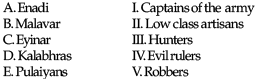
- a)[A-I], [B-V], [C-III], [D-IV],[E-II]
- b)[A-I], [B-II], [C-III], [D-IV],[E-V]
- c)[A-II], [B-I], [C-III], [D-V],[E-IV]
- d)[A-I], [B-V], [C-IV], [D-III],[E-II]
Correct answer is option 'A'. Can you explain this answer?
Match the Tamil words with their meaning:
a)
[A-I], [B-V], [C-III], [D-IV],[E-II]
b)
[A-I], [B-II], [C-III], [D-IV],[E-V]
c)
[A-II], [B-I], [C-III], [D-V],[E-IV]
d)
[A-I], [B-V], [C-IV], [D-III],[E-II]

|
T.S Academy answered |
A. Enadi → I. Captains of the army
Enadis were considered captains or leaders in warfare.
Enadis were considered captains or leaders in warfare.
B. Malavar → V. Robbers
Malavars were known for their association with robbery.
Malavars were known for their association with robbery.
C. Eyinar → III. Hunters
Eyinar were primarily hunters.
Eyinar were primarily hunters.
D. Kalabhras → IV. Evil rulers
Kalabhras were often depicted as oppressive rulers in Tamil traditions.
Kalabhras were often depicted as oppressive rulers in Tamil traditions.
E. Pulaiyans → II. Low class artisans
Pulaiyans were associated with low caste occupations, including artisanship.
Pulaiyans were associated with low caste occupations, including artisanship.
Thus, Option A is the correct match.
Consider the following statements regarding the economy of the Sangam Age:1. The port city of Puhar was a significant center for internal trade, primarily dealing with the exchange of goods within the Tamil region.2. Roman coins found in Tamil Nadu indicate that Sangam Age trade included exchanges with the Roman Empire.3. Major imports during the Sangam Age included horses and sweet wine.Which of the statements given above is/are correct?- a)1 Only
- b)1 and 2 Only
- c)1 and 3 Only
- d)2 and 3 Only
Correct answer is option 'D'. Can you explain this answer?
Consider the following statements regarding the economy of the Sangam Age:
1. The port city of Puhar was a significant center for internal trade, primarily dealing with the exchange of goods within the Tamil region.
2. Roman coins found in Tamil Nadu indicate that Sangam Age trade included exchanges with the Roman Empire.
3. Major imports during the Sangam Age included horses and sweet wine.
Which of the statements given above is/are correct?
a)
1 Only
b)
1 and 2 Only
c)
1 and 3 Only
d)
2 and 3 Only

|
EduRev UPSC answered |
1. Statement 1: "The port city of Puhar was a significant center for internal trade, primarily dealing with the exchange of goods within the Tamil region."
- This statement is incorrect. While Puhar was indeed a significant port city during the Sangam Age, it was known for being an important place for foreign trade, not just internal trade. Large ships entered this port carrying precious goods from different regions, indicating its role in international commerce, not merely internal trade.
2. Statement 2: "Roman coins found in Tamil Nadu indicate that Sangam Age trade included exchanges with the Roman Empire."
- This statement is correct. The discovery of Roman coins, issued by emperors such as Augustus, Tiberius, and Nero, across Tamil Nadu strongly indicates that there was trade between the Sangam period Tamil regions and the Roman Empire. This highlights the extensive reach and foreign interactions of the Sangam economy.
3. Statement 3: "Major imports during the Sangam Age included horses and sweet wine."
- This statement is correct. Horses and sweet wine are explicitly mentioned as significant imports during the Sangam Age, indicating selective trade practices that fulfilled specific regional demands for these items.
Based on the analysis, Statement 2 is correct, and Statement 3 is also correct. However, Statement 1 is not correct as it misrepresents the nature of trade at Puhar. Therefore, the correct answer is Option D: 2 and 3 Only.
Assertion A : In the Sangam age,Variyilar was in charge of revenue collections.Reason R: Ayakkarar was the revenue accountant who moved place to place for the collection of trade and transit duties.- a)If both A and R are true and R is the correct explanation of A.
- b)If both A and R are true but R is not the correct explanation of A.
- c)If A is true and R is false.
- d)If A is false and R is true.
- e)If both A and R are false.
Correct answer is option 'B'. Can you explain this answer?
Assertion A : In the Sangam age,Variyilar was in charge of revenue collections.
Reason R: Ayakkarar was the revenue accountant who moved place to place for the collection of trade and transit duties.
a)
If both A and R are true and R is the correct explanation of A.
b)
If both A and R are true but R is not the correct explanation of A.
c)
If A is true and R is false.
d)
If A is false and R is true.
e)
If both A and R are false.
|
|
Aravind Yadav answered |
The assertion A states that in the Sangam age, Variyilar was in charge of revenue collections. The reason R given for this assertion is that Ayakkarar was the revenue accountant who moved from place to place for the collection of trade and transit duties.
Explanation:
The Sangam age refers to the period between 300 BCE and 300 CE in South India, during which the Tamil literature known as Sangam literature was produced. The society during this period was organized into different occupational groups, and revenue collection was an important aspect of the administration.
The assertion A is true in the sense that Variyilar was one of the officers responsible for revenue collection in the Sangam age. Variyilar was the head of the administration in charge of revenue collection, and he was assisted by a team of officials who were responsible for different aspects of revenue collection, such as surveying lands, assessing taxes, and collecting revenue.
The reason R is also true in the sense that Ayakkarar was one of the officials responsible for revenue collection in the Sangam age. Ayakkarar was the revenue accountant who maintained the accounts of revenue collection and supervised the collection of trade and transit duties. Ayakkarar was not a stationary official but moved from place to place to oversee the collection of revenue.
However, the reason R is not the correct explanation of the assertion A. The fact that Ayakkarar was responsible for revenue collection does not necessarily mean that Variyilar was not in charge of revenue collections. In fact, Variyilar and Ayakkarar both played important roles in revenue collection, but their responsibilities were different. Variyilar was in charge of the overall administration of revenue collection, while Ayakkarar was responsible for maintaining the accounts and supervising the collection of trade and transit duties.
Therefore, the correct answer is option 'B' - Both A and R are true but R is not the correct explanation of A.
Explanation:
The Sangam age refers to the period between 300 BCE and 300 CE in South India, during which the Tamil literature known as Sangam literature was produced. The society during this period was organized into different occupational groups, and revenue collection was an important aspect of the administration.
The assertion A is true in the sense that Variyilar was one of the officers responsible for revenue collection in the Sangam age. Variyilar was the head of the administration in charge of revenue collection, and he was assisted by a team of officials who were responsible for different aspects of revenue collection, such as surveying lands, assessing taxes, and collecting revenue.
The reason R is also true in the sense that Ayakkarar was one of the officials responsible for revenue collection in the Sangam age. Ayakkarar was the revenue accountant who maintained the accounts of revenue collection and supervised the collection of trade and transit duties. Ayakkarar was not a stationary official but moved from place to place to oversee the collection of revenue.
However, the reason R is not the correct explanation of the assertion A. The fact that Ayakkarar was responsible for revenue collection does not necessarily mean that Variyilar was not in charge of revenue collections. In fact, Variyilar and Ayakkarar both played important roles in revenue collection, but their responsibilities were different. Variyilar was in charge of the overall administration of revenue collection, while Ayakkarar was responsible for maintaining the accounts and supervising the collection of trade and transit duties.
Therefore, the correct answer is option 'B' - Both A and R are true but R is not the correct explanation of A.
Chapter doubts & questions for The Sangam Age - 6 Months Preparation Course for OPSC 2026 is part of OPSC OCS (Odisha) exam preparation. The chapters have been prepared according to the OPSC OCS (Odisha) exam syllabus. The Chapter doubts & questions, notes, tests & MCQs are made for OPSC OCS (Odisha) 2026 Exam. Find important definitions, questions, notes, meanings, examples, exercises, MCQs and online tests here.
Chapter doubts & questions of The Sangam Age - 6 Months Preparation Course for OPSC in English & Hindi are available as part of OPSC OCS (Odisha) exam.
Download more important topics, notes, lectures and mock test series for OPSC OCS (Odisha) Exam by signing up for free.
6 Months Preparation Course for OPSC
636 videos|2472 docs|801 tests
|
